Moma Intelligence Raises Tens of Millions of RMB in Pre-A Round | Led by Oasis Capital

Dedicated to Intelligent, Flexible Industrial Robot Production

Shanghai Moma Intelligent Technology Co., Ltd. (hereinafter referred to as "Moma Intelligent") recently completed a Pre-A round of financing worth tens of millions of RMB, with Oasis Capital as the sole investor. The proceeds will be primarily used for R&D of cognitive intelligence algorithms for industrial robots and related areas.
Gao Rui, founder and CEO of Moma Intelligent, said: "Human development follows patterns, and so does technological development. Oasis Capital cuts through the noise to find true signals, and has built powerful first principles — clear, pragmatic, and energizing. Oasis helps me look at problems from a different angle and at a higher level. What Oasis empowers me and Moma with goes far beyond capital."
An investment lead at Oasis Capital said: "Intelligent and flexible robotics is an inevitable requirement for supply chain upgrades. Moma is dedicated to using AI to lower the barrier to using robots and solving intelligence problems in robotic operations — an important direction in exploring manufacturing upgrades. Mr. Gao worked for many years at Bosch Group's German headquarters and in multiple countries, evaluating and managing hundreds of factories globally. He has a clear understanding of manufacturing pain points and has continuously tried to upgrade manufacturing through new technologies, so it can better meet the challenges of the personalization era — this was the original intention behind founding Moma."
Moma Intelligent mainly targets the pain points of industrial robot deployment, providing enterprises with intelligent industrial robot solutions to help manufacturing companies achieve flexible production.
For manufacturing enterprises, industrial robot deployment has long been a persistent headache, with trajectory planning at its core. Trajectory planning typically requires experienced robot process engineers to first debug in virtual simulation software, such as ABB's RobotStudio and Siemens' Process Simulate.
Since simulation software cannot perfectly match the on-site environment, engineers need to repeatedly adjust the robot's working trajectory based on actual conditions. This debugging process usually consumes hundreds to even thousands of hours; for a large production line, deployment can stretch to half a year.
Clearly, robot deployment is time-consuming and difficult.
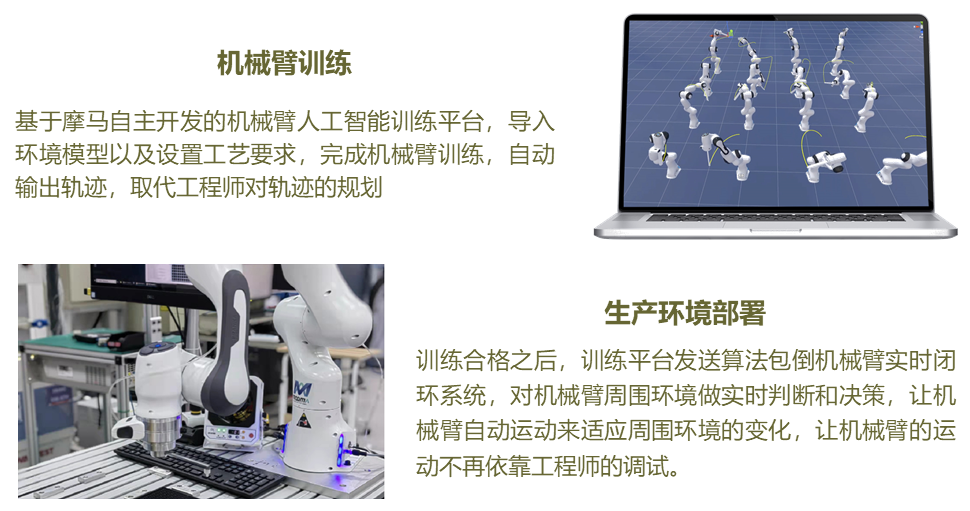
To address this, Moma Intelligent developed its own proprietary cognitive intelligence algorithm training platform, which embeds AI-based adaptive trajectory planning algorithms. The platform can adjust robot working trajectories in real time based on production conditions, iteratively training optimal trajectories with reduced human involvement. In this way, Moma Intelligent can shorten industrial robotic arm deployment from hundreds or thousands of hours to just over ten hours or even a few hours, helping enterprises achieve intelligent flexible production under personalized market demands.
To achieve automatic adaptive trajectory generation in actual deployment, a real-time closed-loop system is needed. The AI package is deployed from the training platform to a lightweight "robot brain" TCU. On-site sensors upload data to the TCU in real time, which makes millisecond-level autonomous path judgments and decisions, then sends instructions to the robot controller, giving the robotic arm autonomous adaptability.
From the demand side, industrial robot deployment and debugging is a high-frequency, rigid need. On the supply side, robot debugging and deployment mainly relies on experienced engineers, who are relatively scarce. Combined with lengthy on-site debugging, labor costs are also high.
For trajectory planning in high-precision process scenarios, planning algorithms embedded in current debugging software typically have high computing power requirements, further increasing the cost burden on enterprises.
Facing the emergence of personalized market demands, enterprises need to achieve multi-variety, small-batch flexible production at lower cost and faster speed. Take the automotive industry as an example: in the past, one production line mainly mass-produced a single model, but now needs to produce multiple models. Companies frequently need to add robot motions to meet line change requirements, and the time and labor costs of line changes are comparable to deploying an entirely new production line.
Through its AI platform, Moma Intelligent enables robotic arms to "learn first, deploy later," generating optimal obstacle-avoidance trajectories in real time. This reduces deployment time by approximately 90%, shortens the production ramp-up cycle, and improves stability — allowing enterprises to deploy robots faster and at lower cost, effectively solving the industry pain point of time-consuming and labor-intensive robotic arm deployment.
On another front, Moma Intelligent can also help enterprises digitally preserve production-related process data and experience online, continuously optimizing algorithms to improve production efficiency and further reducing dependence on robot debugging engineers.
In terms of application scenarios, Moma Intelligent's flexible loading and unloading technology has already been applied in the semiconductor and 3C industries. The company notes that this technology is applicable not only to industries with multi-variety, small-batch characteristics such as IC chips and aerospace, but can also rapidly extend to machining, logistics, assembly, and other industries with increasingly high flexibility requirements. Moma Intelligent is currently expanding its customer base.
Additionally, Moma Intelligent will provide flexible and intelligent robot solutions for automotive welding, flexible assembly, and other process scenarios.
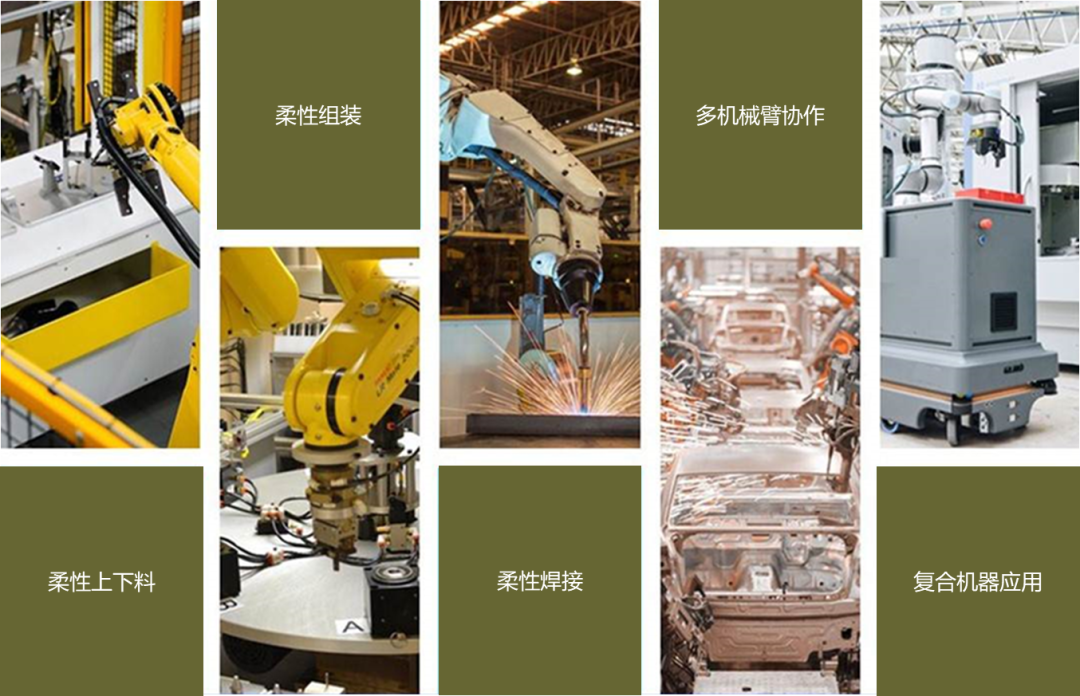
Moma Intelligent Application Scenarios
Facing the massive installed base of industrial robots, Moma Intelligent Technology can also help traditional robotic arms upgrade into flexible production systems.
Moma Intelligent's current customers fall into three categories: first, end users of industrial robots; second, robot system integrators; and third, ecosystem partners including robot OEMs. Moma Intelligent's algorithm training platform will be compatible with robotic arms from several OEMs, helping them enhance their intelligence capabilities.
Currently, the company's customers include Fortune 500 companies, listed companies, and other leading industrial clients, spanning industries such as integrated circuits, automotive manufacturing, aerospace, defense, and consumer goods.
The Moma Intelligent team currently numbers over 40 people, with more than 60% holding master's degrees or higher. The team includes a national "Thousand Talents" expert, with members mainly coming from Tsinghua University, State University of New York, Free University of Berlin, Kyushu University, Shanghai Jiao Tong University, Northwestern Polytechnical University, Harbin Institute of Technology, and other renowned domestic and international universities. The company has AI and robotic arm technology R&D centers in Shanghai and Berlin, and an engineering application center in Ningbo.
Source: 36Kr
Nourishing Vitality
What do you think vitality is?
In nature, organisms that persist over long periods all adapt to their environment — survival of the fittest. The force that allows organisms to survive in any environment is vitality.
Enterprises are a type of organization within human society, with clear interests and behavioral objectives. An enterprise's vitality is the capacity of a specific organization to selectively exchange resources with its surroundings in order to continuously and effectively adapt to environmental changes. Likewise, survival of the fittest.
— Gao Rui, founder and CEO of Moma Intelligent

Oasis Capital is a new-generation Chinese venture capital firm, dedicated to discovering the most vital entrepreneurs of the next decade in China and growing alongside them to create long-term value. "Nourishing vitality" is Oasis's vision and mission. This vitality is both the direction of structural transformation in our era and the resilience and evolutionary power of entrepreneurs. Oasis Capital focuses on early and growth-stage investments, with individual investments ranging from $3 million to $30 million, concentrating on technology-enabled services including healthcare and enterprise services, supporting China's technology-driven new service upgrade.