Akasuo Biotech Closes Tens of Millions of RMB in Pre-A Round, Led by Delian Capital with Follow-on from Oasis Capital

Counselor Vitality

Akaso Biotech recently closed a Pre-A round of tens of millions of RMB, led by Delian Capital, with existing investor Oasis Capital continuing to increase its stake. The proceeds will primarily go toward its technology platform and related product R&D, production line construction, and commercial projects and market expansion. Ben, investment lead at Oasis Capital, said: "Microfluidics sits at the intersection of microscale reactions and continuous-flow processes, with enormous potential to fundamentally transform large-scale production across multiple fields in the future. Akaso Biotech has been dedicated to high-throughput microfluidic chips for years, continuously refining its core technology. Technological evolution is full of challenges and requires long-term commitment and sustained investment. Oasis believes in the vitality of innovative technologies, and we are honored to grow alongside the team."

Founded in 2021, Akaso Biotech mainly uses microfluidics technology to develop and manufacture microsphere products. Compared with classic batch-stirring emulsification and membrane emulsification methods, microfluidics technology could once achieve micro-emulsification that conventional methods struggled with, thanks to its unique flow characteristics—meeting higher demands for microsphere performance and preparation processes. But it faced industry pain points like production capacity constraints, which Akaso Biotech aims to solve.
What qualifies as a "monodisperse microsphere"? Based on the Coulter Principle established in the 1940s, the coefficient of variation (CV) of microsphere particle size distribution reflects uniformity. "This method has been cited in over 8,000 academic papers to date, and industry consensus is basically consistent: only CV<5% qualifies as uniform particle size, or monodisperse microspheres," said Bao Xiaofan. Monodisperse microspheres and related products offer significant performance advantages in chromatography, sustained-release drug formulations, and medical aesthetic injectable fillers. However, in previous microsphere preparation processes, monodispersity and large-scale production capacity were essentially "mutually exclusive"—because under the physical characteristics of shear emulsification, as microsphere uniformity improved, production capacity would "drop by orders of magnitude." Academia and industry have not been without attempts. As early as 2007, Tokyo Institute of Technology professor Takashi Nisisako published an article in the top microfluidics journal Lab on Chip proposing a circular chip model concept (DOI: 10.1039/b713141k). In 2014, a research team from Saudi Arabia released the butterfly microfluidic chip (DOI: 10.1039/c4lc00379a). However, the physical limits of circular chip models resulted in relatively low integration ceilings and susceptibility to clogging, failing to meet requirements for large-scale stable production.
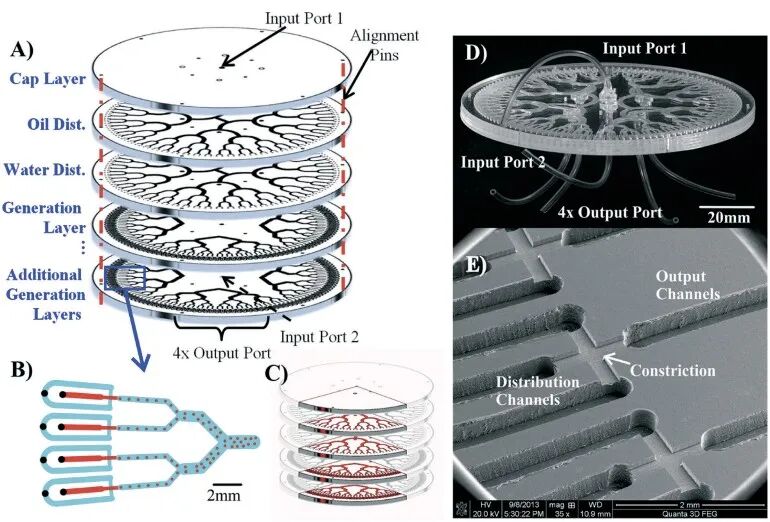
Butterfly microfluidic chip released by the Saudi team in 2014
To increase production capacity while ensuring stability, Akaso Biotech broke free from the "disc" paradigm, developing higher-throughput matrix microfluidic chips that achieve production capacity comparable to large-scale reactors while maintaining uniform microsphere particle size.
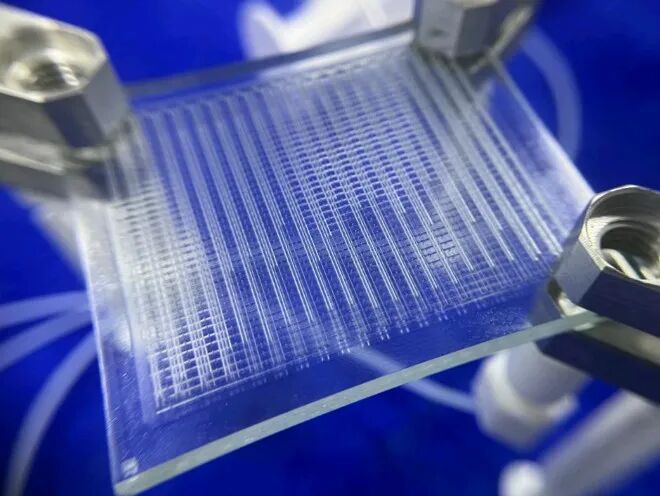
Akaso Biotech's innovative matrix microfluidic chip
The core of this technology is "increasing microfluidic chip integration to achieve greater single-chip microsphere production capacity." Akaso Biotech uses a self-developed rectangular asymmetric structure to break through the integration ceiling of circular chips, "raising integration by at least 1-2 orders of magnitude." Second, through 3D chip stacking technology, multiple layers of chips are bonded together to achieve higher integration in a smaller area. Additionally, fully parallel microchannel design—similar to independently parallel light bulbs—ensures that a failure in one branch does not affect other channels. This design approach upgrades the company's chip products across multiple dimensions, forming a technological moat. At the same time, the company has built its own yellow room and cleanroom, applying semiconductor processes to achieve full-chain autonomy from chip design and R&D to manufacturing. The fully self-developed approach improves efficiency while effectively controlling costs. In August 2023, Professor Nisisako visited Akaso Biotech to exchange in-depth with the company's R&D team and expressed admiration for the company's pioneering thousand-channel microfluidic chip. According to reports, over the past year-plus, the company's related technology has "evolved from laboratory benchtop equipment to relatively mature production equipment," including scaled-up raw material pre-treatment and microsphere post-treatment systems, "equivalent to a complete microsphere production line." The company can currently prepare microsphere products in multiple materials, including agarose, PS, PLLA, and PLGA, giving it a category advantage.
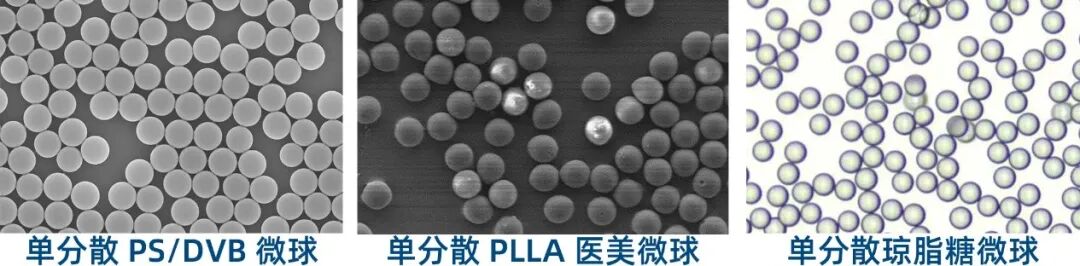
Some of Akaso Biotech's microsphere products
Additionally, Akaso Biotech has established a comprehensive microsphere matrix design and coupling modification technology platform. Currently, for the microsphere matrix itself, it can precisely control particle size and pore size, as well as indicators like different raw material ratios and viscosity; it has also conducted in-depth R&D on properties like hydrophilicity and pressure resistance. For backend coupling modification, the company can currently achieve multiple functional group modifications including affinity, ion exchange, hydrophobic, and mixed-mode types. Combined with monodisperse microsphere matrices, some products have reached industry-leading levels. At present, these products are mainly applied in two fields: purification fillers and medical aesthetics. Previously, in the purification filler field, domestic pharmaceutical demand for related core raw materials mainly relied on imports—but even imported products primarily used non-uniform agarose microspheres. In response, Akaso Biotech's soft gel and hard gel products based on monodisperse microsphere matrices feature "differentiation and high-end replacement," with a total potential market exceeding 3 billion RMB. In the medical aesthetics field, following the same differentiation approach, the company has launched distinctive monodisperse PLLA injectable microspheres that degrade to stimulate the body's own collagen synthesis, achieving anti-aging and firming effects, while more uniform particle size reduces inflammatory reactions and improves patient experience. Related data shows that since "youth injections" were officially approved for domestic sale in 2021, terminal market sales have exceeded 4 billion RMB, indicating substantial commercial potential. Akaso Biotech stated that the company is currently seeking downstream partners in this area. According to reports, through two models—product sales and R&D services—the company has initiated commercialization while also undertaking custom microsphere development and mass production projects. When asked how a startup enters customer supply chains in a microsphere field dominated by foreign brands, Bao Xiaofan explained that Akaso Biotech typically leverages its application advantages to "grow together with customers' R&D projects and replacement projects." Currently, the company has over ten enterprise customers, helping them reduce costs and improve efficiency. "Customers generally rate the company's products highly, and we believe that as customers progress in R&D and scale-up, their procurement of Akaso Biotech's products and services will correspondingly increase," Bao Xiaofan said.
Source: 36Kr, author: Hu Xiangyun