Rhythm and Structure in Investing

"For the Way, reduce daily; discard the false, keep the true."

Recently, at the WAVES New Wave 2023 conference hosted by 36Kr, Oasis Capital delivered a keynote speech titled "Rhythm and Structure in Investing." Below is the full transcript. Enjoy.
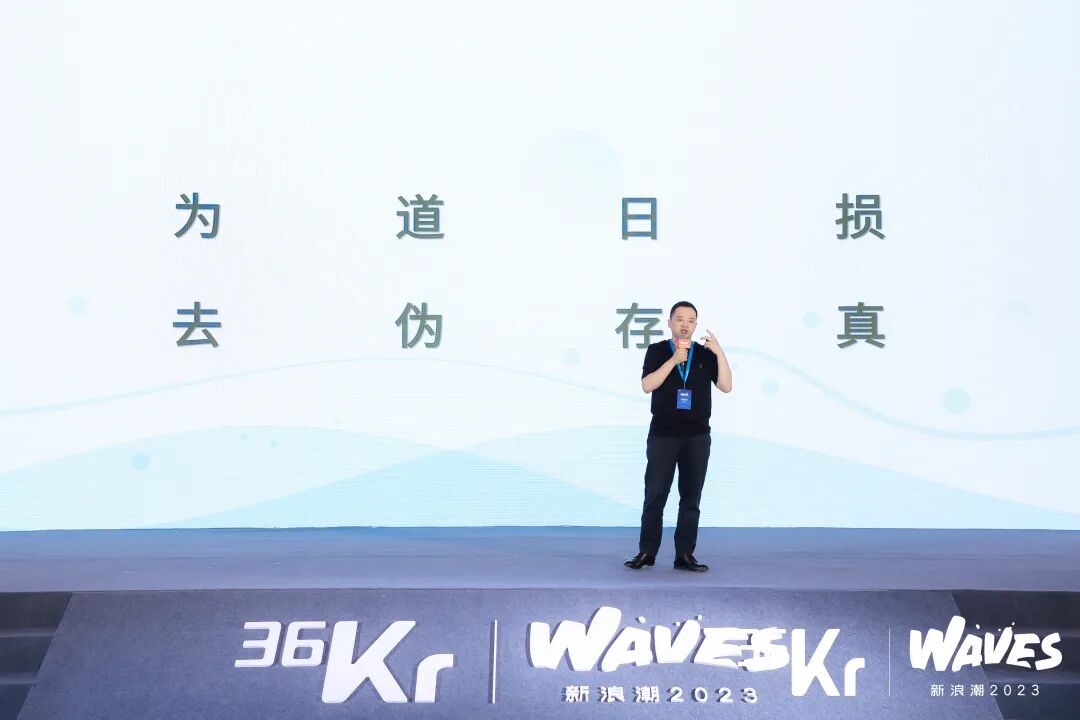
Those who know me are aware that before 2012, I spent seven years studying radar, focused on information engineering and the processing of signals versus noise. After 2012, I joined Trustbridge Partners to learn investing, and seven years later founded Oasis Capital. Altogether, that's 11 years. Over these 11 years of investing, I've encountered many problems. Looking back, they all fall into two categories: rhythm problems and structure problems. The difference between them lies in whether the driving force is random external factors or structural internal factors. Let me give an example: there was a founder who quarreled with his co-founder every few days. At first he came to me for advice on how to communicate with partners, but later he actually enrolled in a crash course on efficient communication. In his view, each argument had a different cause — sometimes over marketing strategy, sometimes over hiring — all seemingly random external factors. But from my perspective, the essence was a structural internal problem: he and his partner had different values and inconsistent goals. He didn't need to learn communication techniques; he needed to have an honest conversation with his partner about the reality of their value and goal differences.
Another example: a founder built a product with bright market prospects and clear demand, but the market was sluggish and regulatory policy was unclear. So he thought this was a structural internal problem of the industry and asked his investor: should we pivot? But this might not be a structural problem at all — it could be a rhythm problem caused by random external factors. So much of life's frustration stems from misjudging whether a problem is about rhythm or structure, leading to wrong actions: failing to confront when we should, failing to persist when we should.
Returning to the AI field that everyone cares about most. Over the past six months or so, Oasis has been one of the most active and frequently deploying funds in this space. We've invested in quite a few AI companies, and we've also felt plenty of anxiety: under compute constraints, can China's large language models succeed? With so many leading companies, and even OpenAI entering the fray directly, do startups still have opportunities? Questions like these. So are these rhythm problems or structural problems? Should we face the truth, or hold fast to our original aspiration?
This reminds me of something Drucker said, roughly that the core competence of entrepreneurs is converting external changes into internal opportunities. So the key is to ignore rhythm problems and grasp structural changes. How should we do this?
Let's look at this from a different angle. When we talk about the Industrial Revolution, textbooks have a phrase — "Watt improved the steam engine." Reading it, you'd think he spent an evening scrolling through Xiaohongshu and woke up the next morning with an improvement. Of course not. But as humans, we tend to focus our attention on where change is most dramatic — what we call the highlight moments: the prodigal son's return, the hero saving the beauty, sudden enlightenment. We expect some kind of "ultimate move" style of development.
But the world is never dramatic "ultimate moves" — it's structural "daily progress, bit by bit."
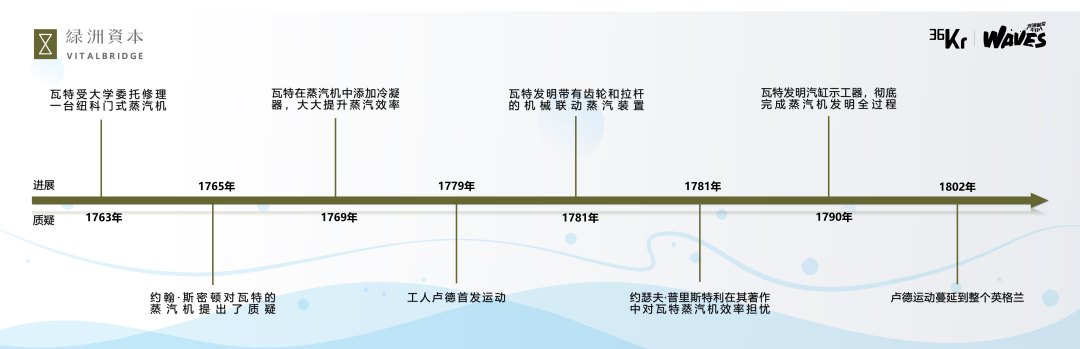
In fact, Watt's improvement of the steam engine was a nearly 30-year history, full of twists and turns. In 1763, Watt was commissioned to improve a steam engine. It took six years before he had any breakthroughs. You can imagine — back then, steam engines looked promising but performed terribly, much like today's large language models. There were two reasons: extremely low efficiency and extremely high energy consumption. But steam engines were fashionable at the time, and everyone was looking for ways to improve them. Watt was one of them. It wasn't until 1790 that he completed all improvements — a full 27 years.
There was a contemporary named Smeaton who later made many contributions to the Industrial Revolution. But even he, when he first saw Watt's steam engine, raised many doubts, believing its efficiency was too low and its feasibility questionable. By 1779, the effects of Watt's steam engine were gradually becoming apparent, and Britain saw the outbreak of the Luddite movement. What was the Luddite movement? Workers saying the Industrial Revolution was stealing their jobs, that society shouldn't embrace industrialization. Think about it — the Luddite movement happened before, and will it happen again? Workers desperately trying to protect their livelihoods, seeing machines as competitors — this seems laughable today, but what about back then?
Could the Industrial Revolution continue? It seems like a simple question in hindsight, but at the time it faced widespread social skepticism. Over 27 years, Watt steadily improved his steam engine, but societal questioning never stopped. In 1781, when steam engine efficiency improved dramatically, there were still renowned chemists questioning whether energy consumption was too high and efficiency too low. So if we look back at the history of technological development, revolutionary products were never the flashes of inspiration or moments of universal acclaim that we imagine. The history of technological development has always been about steady, year-by-year progress.
If we entrepreneurs and investors had lived in that era, spending all our time and energy chasing every daily improvement of the steam engine, we would have been destined for anxiety — just as we are today focusing on every development in large language models. Because in retrospect, these are all rhythm problems. What we should really spend our time on is thinking about the structural changes these technologies bring to society as a whole.
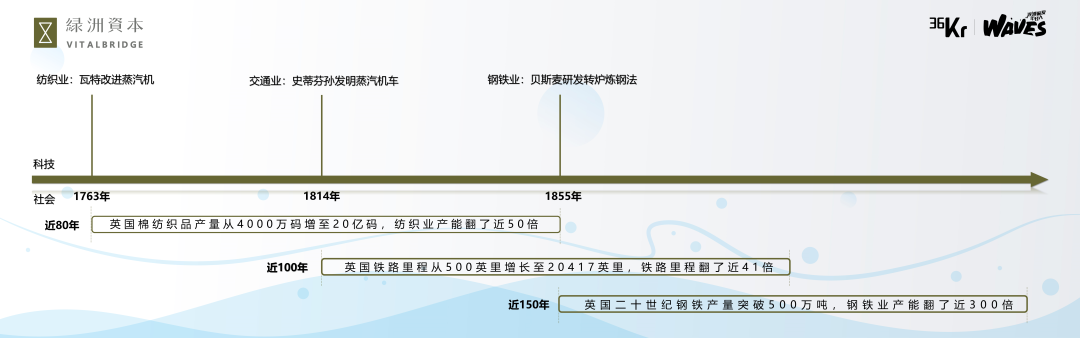
Expanding across the more than 100 years of Industrial Revolution history, in 1763 Watt himself probably didn't know what mission he was about to undertake. When he took on that steam engine, that sacred first step — how much structural change would it bring to society? In the 80 years that followed, British textile production increased 50-fold. Before the steam engine improvement, all textile producers were small families and workshops, with wives weaving clothes for their husbands and children. Before the Industrial Revolution, there was no surplus labor, and precisely because of this, there was no concept of goods. Without goods, there was no buying and selling. Without buying and selling, there was no retail industry.
Looking at transportation, or steel over the 150 years after the Industrial Revolution — all saw explosive growth. If we pull back historically, the Industrial Revolution had more than a dozen major industries slowly unfolding. And all of this began with Watt receiving that steam engine improvement order in 1763.
Going back to 1763, as an entrepreneur or investor, did you really need to pay attention to what progress the steam engine was making? Did you really need to care about efficiency and energy consumption issues? Were these questions really important? What everyone here today should really spend time thinking about is: am I in textiles, or am I in retail? In this massive wave, what are society's structural opportunities?
So too many people emphasize the rhythm problems of technology, while ignoring society's structural changes.

Here I must mention that even a genius like Watt failed and went bankrupt in his first venture because he chose the wrong partners. Only after finding new investors and partners did he sell 1,165 steam engines in the textile industry and make money. If even Watt had to start twice, then both investors and society need to have more patience with entrepreneurs riding these massive waves.
The Industrial Revolution may feel too distant, so let's talk about the mobile internet era. The keyword for mobile internet: "iPhone moment." We have today's mobile internet because of the iPhone. But were the great companies born in this era created by technology? Actually no — just like the Industrial Revolution, they were all companies that benefited from the structural changes technology brought to society as a whole.
Like the steam engine, if we only focus on smartphones, all we see are rhythm problems: the iPhone 4 launched in 2010, and many people said this was a phone that couldn't make calls, because it was mired in "Antennagate." If we look further back to how bloggers judged the iPhone 3G in 2008, the top complaint was that you couldn't replace the battery! In that era of Nokia and Motorola, replaceable batteries were standard for phones. In 2009 there was even an award-winning accessory — a massive solar panel attached to the back of the iPhone, meant to give it long battery life.
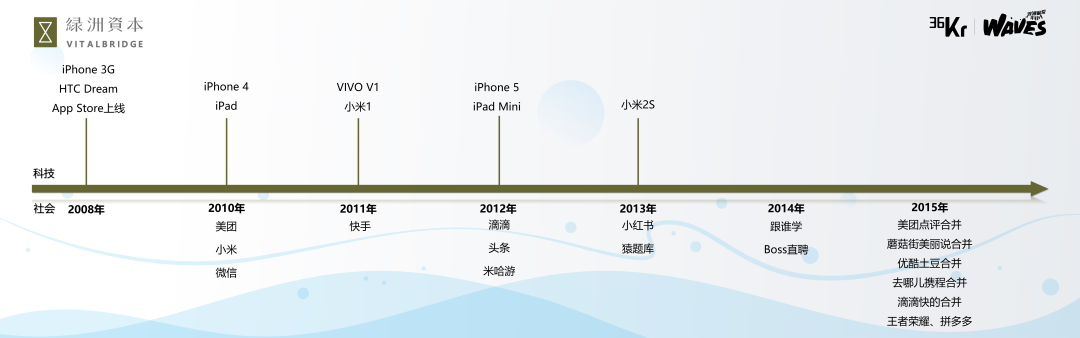
The battery life, computing power, and data issues that seemed so serious at the time — do you think they matter today? In the long river of history, many problems we obsess over are merely rhythm problems. Yet in the very year the iPhone 4 launched, the year when everyone was questioning whether this was a phone or a brick, WeChat was founded, Xiaomi was founded, Meituan was founded. In the five years that followed, every year you could start a great company, every year you could invest in a great company. After 2010 came Kuaishou, DiDi, Toutiao, and miHoYo. Even Xiaohongshu, which we might think appeared quite late, was actually founded in 2013.
In 2015, a capital winter, with giant mergers: DiDi and Kuaidi merged, Meituan and Dianping merged, Trip.com Group and Qunar merged. People might have thought there were no more opportunities after the giants consolidated. What actually happened? That year, Honor of Kings emerged, and Pinduoduo was founded. Even if you only identified the leader at that point, investing in the merged Meituan in 2015 still yielded over 20x returns by 2021, more than 60% annualized. So often rhythm problems are trivial in the long river of history. What matters is whether we pay attention to the social opportunities technology brings.
I often think, if AI is an Industrial Revolution-level transformation, what social opportunities will this technology bring? Which industry is the textile industry of the Industrial Revolution? Which industries are the food service, taxi industry of the mobile internet era?
Throughout my investing career, whenever I've encountered problems, I've tried to find answers from my background in information engineering. I love the signal and noise processing approach because it has a certain charm: complex problems can often be represented by simple formulas, and within these simple formulas lie simplicity, common sense, and beauty. This is what I've always believed: the simplest principles often solve the most complex problems.
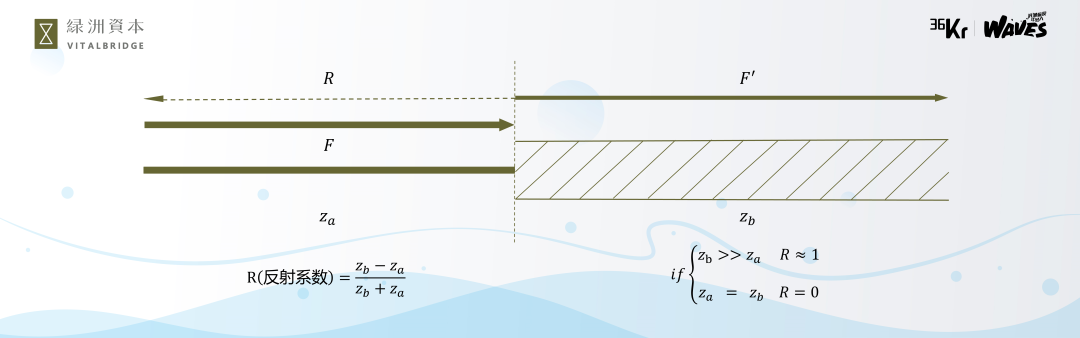
To think about this, we can borrow a concept from communications called "impedance." Every medium has its corresponding "impedance," so when signals propagate through media of different impedances, they follow a very simple principle: when impedances match between media, signals propagate efficiently. Whether the medium is air, water, or marble, as long as the impedance is the same, signals can propagate without loss.
Conversely, when impedances differ, signals reflect to varying degrees — the greater the impedance mismatch, the greater the reflection. So the process of adjusting signal propagation efficiency is a process of impedance matching.
This is actually quite similar to communication. Everyone has different cognitive structures, so their "impedance" for receiving and transmitting information differs, and the process of communication is a process of "impedance" matching — what we call "empathy." Conversely, communicating with someone without empathy is like talking past each other, complete reflection.
Industries also have impedance. The tech industry changes rapidly, information flows efficiently — this is the manifestation of low impedance, so naturally industries with low impedance in society receive signals first. For media of the same material, the more uniform the distribution, the lower the impedance. Similarly, I believe the same applies to industries: the more evenly distributed the participants, and the smaller the impact of any single point on the whole, the lower the impedance. Take textiles, for example — before the Industrial Revolution, it was an industry composed of small family workshops spread across every inch of Britain. This is similar to the taxi, food service, and small goods sellers during the mobile internet era — they were all scattered points. Conversely, this also explains why internet development started with consumer internet before moving to industrial internet — because industrial internet has higher impedance.
An industry, a company, a person — all follow this pattern. Low impedance states are "open," "transparent," "soft"; high impedance states are "protective," "constrained," "rigid." When we believe something "must" develop and organize in a certain way, impedance inadvertently rises. And behind this, we've given ourselves too many preconceptions and constraints. These conditions become "attachments" that subtly influence our choices and judgments.
We often say investing is a process of noise reduction, because the signal has always been there. It's not that you can't see the signal — there's just too much noise obscuring your receiver. This noise is preconceptions, it's "attachments." In entrepreneurship and investing, we have so much noise: assuming computing power is the bottleneck for large models, that Chinese people may not be able to break through; assuming computational costs are too high, that large-scale普及 is still far off. These are all noise. Even assuming "large models," assuming "applications" — these are noise too. If we remove this noise, what signal does Oasis see?
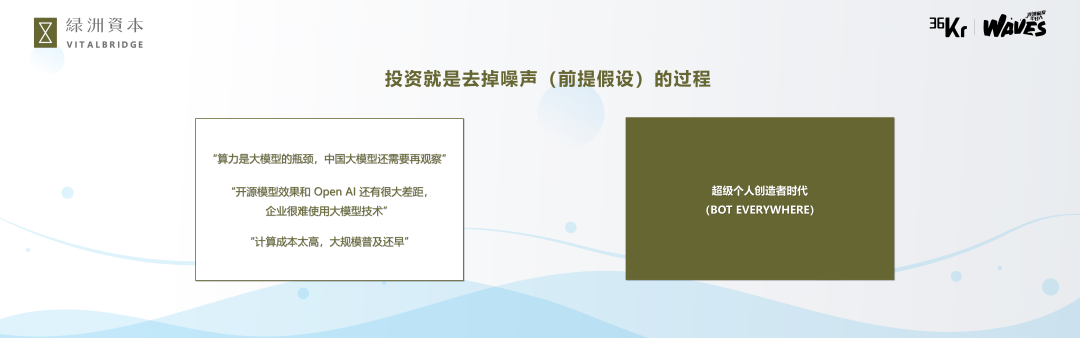
Oasis sees an AI-driven era of the "super individual creator." Why doesn't China have Hollywood? It's not because China lacks good directors or actors — it's because China lacks Hollywood's industrialized production process. Good directors have to build their own teams and construct the entire film and television supply chain. In Hollywood, as long as you have a good idea, there's a mature system to support you.
Why doesn't China have the endless stream of anime works that Japan has? It's not for lack of good IP — it's the lack of Japan's decades-cultivated完善的 anime supply chain system, so there's no way to turn good IP and ideas into excellent works. But with the arrival of the AI era, everyone will become a "super individual creator." As long as you have ideas, you can have: Makoto Shinkai-level background art; Hayao Miyazaki-level characters and storytelling; Yoshiyuki Tomino-level scriptwriting; Kunio Okawara-level mecha design. The experience of these masters from around the world will serve you in the form of bots. As long as you want to, you can create. This is the signal we see.
So we're not investing in applications or models — we're investing in the infrastructure that serves this future era of individual creation. This infrastructure will certainly have some characteristics, for example:
1. Infrastructure is global
After the AI era transcends language limitations, there will only be local experience, not local experts. Expert systems will serve you as bots不受空间和时间的限制. Your past teachers were the best locally; your future teachers will be the best globally; your future teachers may be the best in history, even if they've passed away — we can reconstruct them through their works.
2. Infrastructure serves both humans and bots
Future infrastructure won't serve only humans, but also bots. In the past, a "clothing" app would recommend outfits based on your preferences — the app was the platform, the human was the served. In the future, you'll train a bot that understands your lifestyle preferences to discover outfit combinations for you 24/7 globally, then recommend purchases. At that stage, those "browsing" Xiaohongshu may not be individuals — they may be bots. So infrastructure at that stage must have the capability to serve bots, because compared to humans, bots have unlimited "attention."
There are many more characteristics to our understanding of infrastructure, which I'll share another time if there's opportunity. Actually, these answers are in everyone's heart too — it's just that "attachments" have obscured them.
This process of removing "attachments," of removing noise, reminds me of something Laozi said: "In pursuit of the Way, one reduces daily." It means the Way has always been there — it's the "self" in your heart that prevents you from seeing the Way. As long as you continuously "reduce" and let go of the "self," you naturally enter the Way. Combining with today's sharing, I'd like to add: "Remove the false to preserve the true." Because truth has always been within us — instead, we've absorbed too much noise, from those around us, from society. They're methods of "how to conduct oneself and handle affairs," they're "principles" you should know at 20, 30, 40. But these are essentially preconceptions, constraints, noise. Remove them, and the "true" will naturally appear. We will naturally be called by the era, and harmonize with the great Way.

Having said so much, I hope that in this era of information explosion, you become a person of low impedance and empathy. Don't let rhythm problems obscure society's structural opportunities. Let go of attachments and preconceptions, remove noise, and preserve your original mind.
Finally, finally — I hope you can return to simple living, stay kind, stay joyful, stay vital. This was also Oasis's founding初心: to participate in and celebrate vitality.
Thank you, everyone.





Oasis Capital is a new-generation Chinese venture capital firm, dedicated to discovering the most vital entrepreneurs of China's next decade, growing with them, and creating long-term value. "Participating in and celebrating vitality" is Oasis's vision and mission. This vitality is both the direction of era-defining structural transformation and the power of entrepreneurs' resilience and evolution.
Oasis Capital focuses on early and growth-stage investments, with individual ticket sizes of $3 million to $30 million USD, concentrating on robotics, artificial intelligence, and technology services, supporting China's technology-driven new service upgrade.