The Russia-Ukraine War Through the Lens of Demographics | Oasis Signals

Rhythm and Structure

Preface
Most problems we encounter in this world fall into two categories: cyclical problems and structural problems. The distinction lies in whether the root cause is short-term random external factors or long-term structural internal factors. In daily life, for instance, if your wife has been anxious lately and snaps at you for forgetting to buy eggs during a group purchase, that's cyclical. But if you constantly argue over minor deviations — bickering every few days — that's structural. In investing, overlooking a founder's obvious flaws because you love the direction might pose a cyclical risk; but chronically underestimating people as the primary driver of enterprise growth while overestimating trend-driven upside makes it structural.
Much of the pain and confusion in our lives and investments stems from misjudging which type we're dealing with. When two co-founders clash repeatedly, the real issue is often fundamental incompatibility of character, yet we dismiss each disagreement as a cyclical externality until both sides are exhausted and part ways — the error of mistaking the structural for the cyclical.
Conversely, over-reflecting on random events to extract supposedly profound insights beyond common sense exaggerates the cyclical into the structural. We must understand that people, relationships, and enterprises are all organic systems with their own cycles, containing both structural patterns and cyclical rhythms. In discerning these patterns, we must avoid the trap of randomness; overreacting to random events can cause cyclical problems to evolve into structural ones.
Yet when "random" changes occur, we must carefully analyze potential structural implications rather than hastily categorizing them as cyclical. Winter always passes, but not all life regenerates.
This holds true for individuals, for life, and for nations alike. Major macro events have unfolded at home and abroad recently. Much of the current discourse on the Russia-Ukraine war centers on civilians, casualties, and military campaigns — the profound but largely cyclical external impacts on both nations. Equally deserving attention are the structural shifts in Ukraine's demographic composition and the European refugee crisis, issues that may reshape Ukraine, Europe, and the wider world for generations.
Lessons from Syria
When refugees come to mind, Syria is often the first reference point. Before discussing the Russia-Ukraine war, let's revisit Syria's experience.
Twelve years have passed since the anti-government demonstrations of 2011. The war has directly caused over 350,000 deaths and displaced 6.7 million people, destroying demographic cohesion and plunging the nation's economic development into structural crisis.
Before 2011, Syria was a "healthy" nation of over 21 million: fewer than 740,000 elderly, just 3.51% of the population, with growing births suggesting vitality. Seven years later, newborns plummeted, total population fell below 17 million, the elderly continued growing, and vast numbers of working-age people fled as refugees.
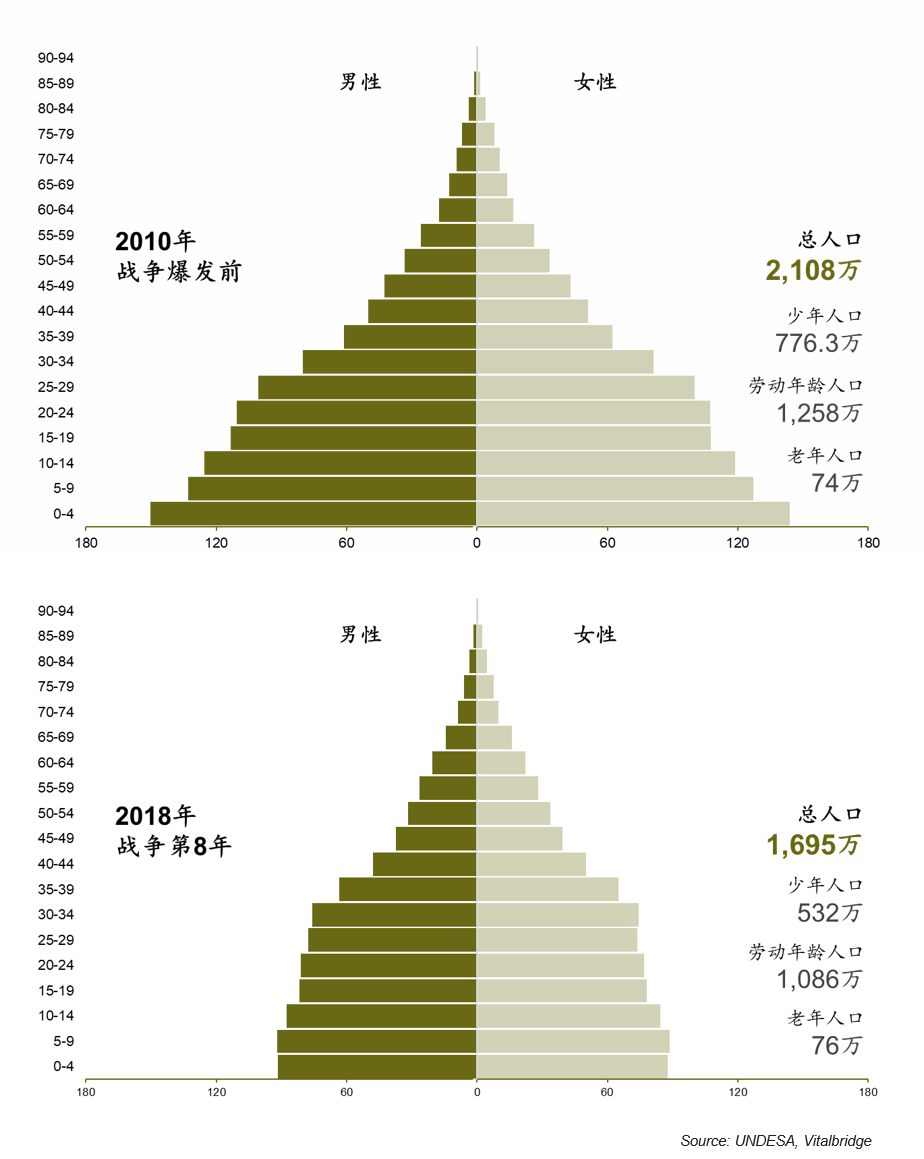
Syria's Demographic Shift Pre- and Post-War (10,000s)
The two charts reveal a stark contrast: youth under 30 have collapsed in number. War acted like a blade, slicing away the young who should have extended the population pyramid — and with them, the nation's future and hope.
Major cities, as hubs of talent, economy, and innovation, sank into demographic decline. Aleppo, Syria's largest city, held 2.12 million in the 2004 census but only 1.6 million by 2021, far below pre-war levels. Damascus had only just recovered to its 2004 figure of 1.5 million.
Such outcomes reflect a nation in structural crisis, having lost its long-term vitality — not something foreign aid can resolve.
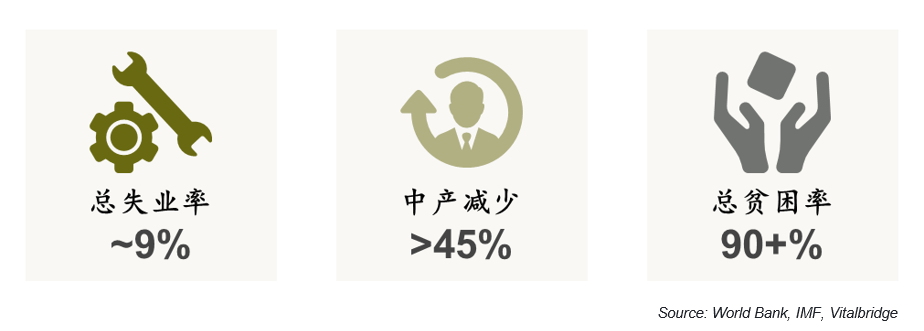
By 2021, national unemployment reached 9% (25.3% for youth 25 and under). The war obliterated Syria's middle class, which comprised 60% of the population pre-war but now accounts for merely 10-15%, while poverty has surged to an unprecedented 90%.
The demographic and economic impacts of refugees extend beyond national borders — even developed nations aren't spared. Germany, 2,800 kilometers away, is Europe's largest refugee host. By end-2020, it had accepted 1.21 million refugees (with 200,000 more seeking asylum), nearly 2% of total population. Syrians constituted the largest group at 740,000, or 0.89% of population, now Germany's third-largest overseas population.
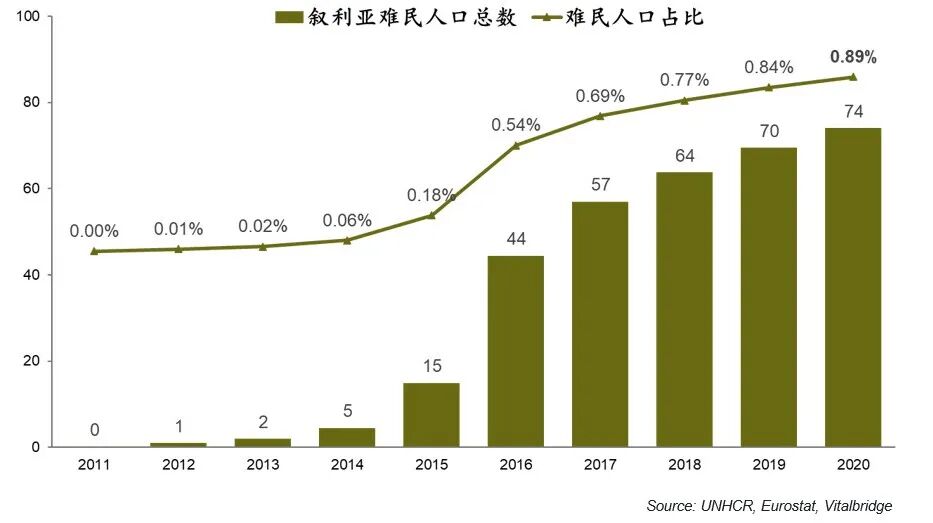
Syrian Refugee Population in Germany — Total and Share (10,000s)
Racial tensions and refugee issues have further strained Germany's already fragile economy, most directly through heavier social welfare burdens. Post-2015 refugee welfare spending remained elevated, peaking at €9.4 billion in 2016. Federal disclosures show 2020 comprehensive budget for refugees and asylum-seekers at approximately €22.9 billion, or 0.45% of that year's total budget.
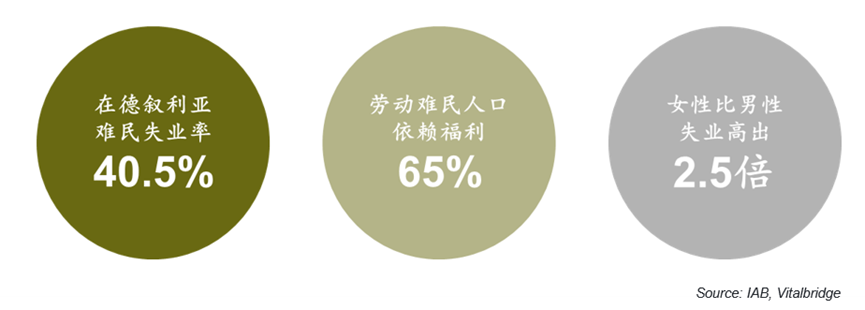
Oasis Capital also notes that language barriers and insufficient education leave most refugees struggling to find employment, while the surge has intensified social tensions — evidenced by the concurrent rise of Germany's right-wing xenophobic forces. During the 2014-2016 refugee wave, criminal offenses against refugee shelters spiked from 199 in 2014 to 1,031 in 2015 and 995 in 2016.
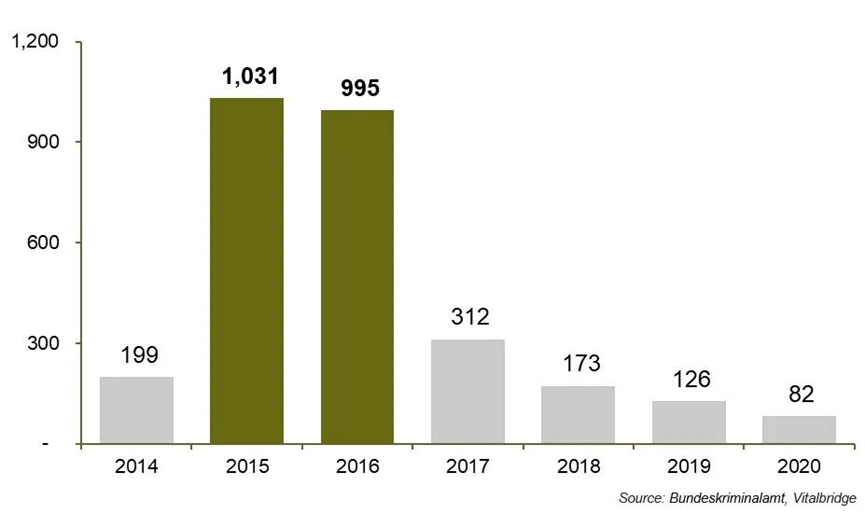
Criminal Offenses Against Refugee Shelters in Germany
A single conflict plunged Europe's demographic structure into crisis. This explains Germany and France's active mediation in the Ukraine war — Kyiv is merely 1,200 kilometers from Berlin. And Ukraine's population is roughly double Syria's.
The Ukraine Crisis
If Syria's domestic and international demographic catastrophes give us pause, we should recognize that Ukraine's disaster is only beginning.
Throughout history, Ukraine has endured repeated trauma — World War II, the Soviet collapse, and now war with Russia. Each major event's aftermath has deeply damaged the long-term demographic structure on which the nation's survival depends. Oasis Capital has studied population pyramids across many countries. You might assume they differ only in scale, not shape. They do not.
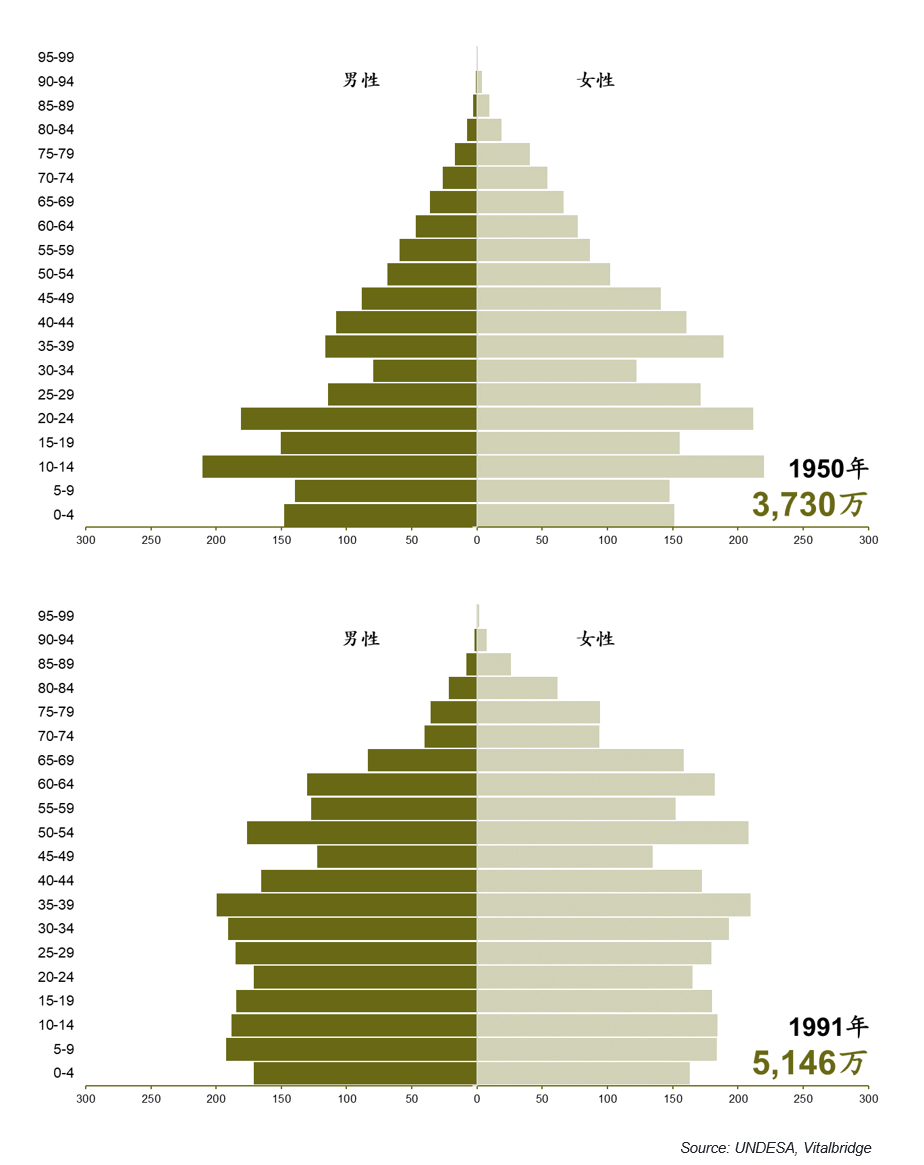
Ukraine's Demographic Shift Post-WWII and Post-Soviet Collapse (10,000s)
Some countries dynamically adjust their population structure through immigration policies, remaining youthful for decades — Singapore, for example. Others bring tears to your eyes, as you mourn a nation's suffering and fading vitality. Ukraine is such a case.
Even comparing Syria and Ukraine side by side, Ukraine's problems stand out. First, gender imbalance favors women: in 2021, of 43.47 million total population, 23.32 million were female, 53.7%. Second, age structure is skewed elderly: 7.53 million seniors, 17.31%. Such demographics typically correlate with labor shortages and anemic growth. Since 1994, Ukraine's per capita GDP has consistently trailed the middle-income country average, with the gap widening.
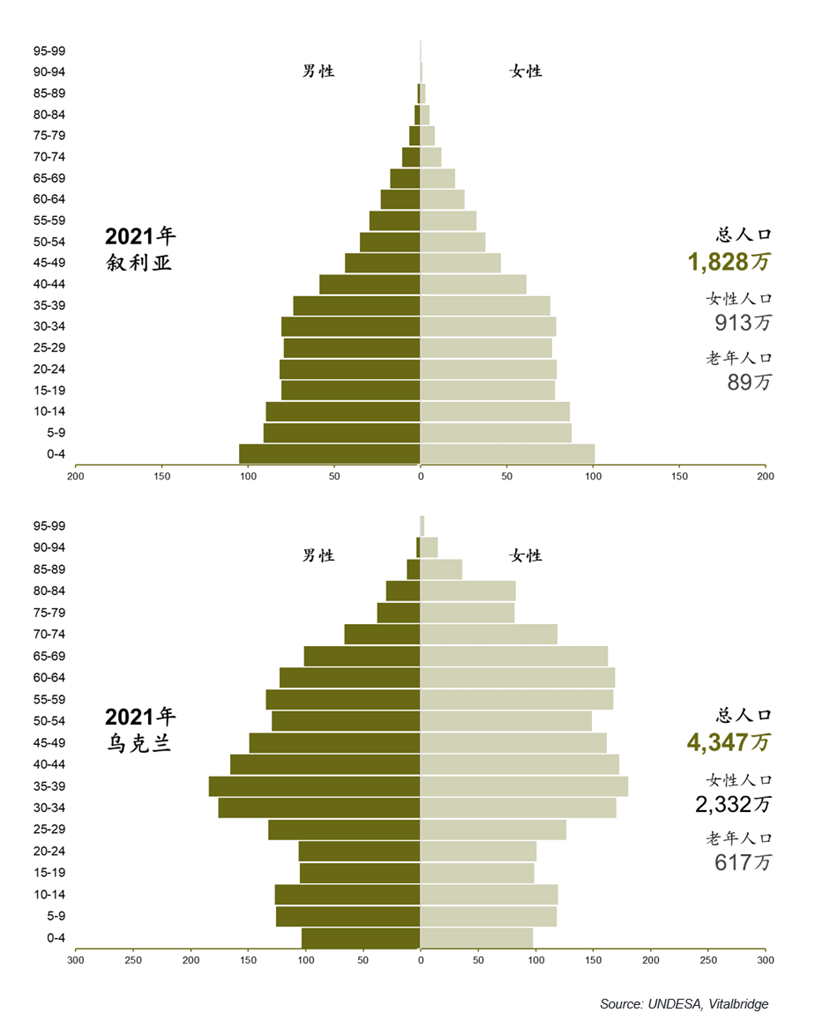
2021 Population Structure Comparison: Syria and Ukraine (10,000s)
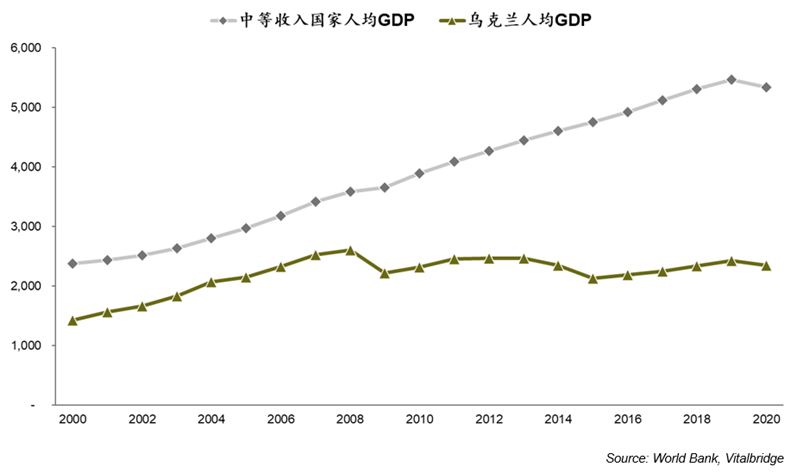
Ukraine vs. Middle-Income Countries: Per Capita GDP (2010 constant USD)
Ukraine's poverty manifests not only in aggregate structure but among its elite. Net worth under $100 million places you on the country's Forbes top 100; $200 million gets you into the top 50. The richest Ukrainian is worth roughly $4 billion, ranking below 700th globally.
By regional distribution, population concentrates in capital Kyiv (2.96 million), Russia-bordering Kharkiv (1.43 million), and the currently contested Donetsk and Luhansk regions (approximately 1.3 million combined). These cities have become the most severe sources of population and talent loss due to the war.
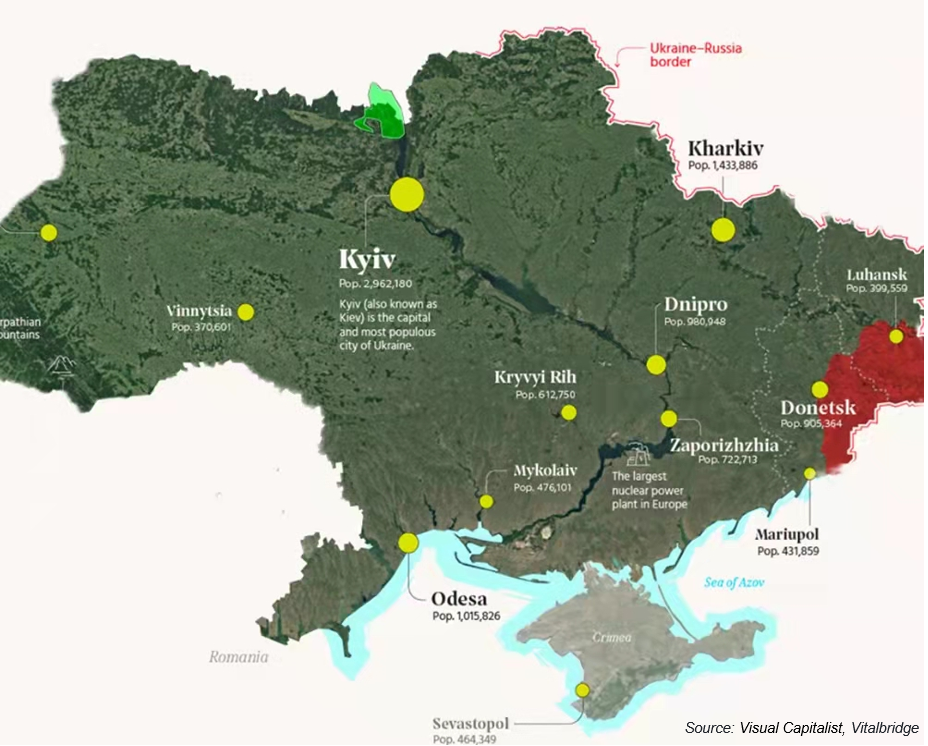
Urban Population Distribution in Ukraine
Since the outbreak on February 24, 2022, approximately 4.21 million Ukrainians have fled — compared to under 7 million over more than a decade of Syrian war. UNHCR calls this Europe's fastest-growing refugee crisis since WWII. UNICEF data indicates that in just one month, 4.3 million children — over half of the country's 7.5 million child population — were displaced, among the fastest mass child displacements since WWII.
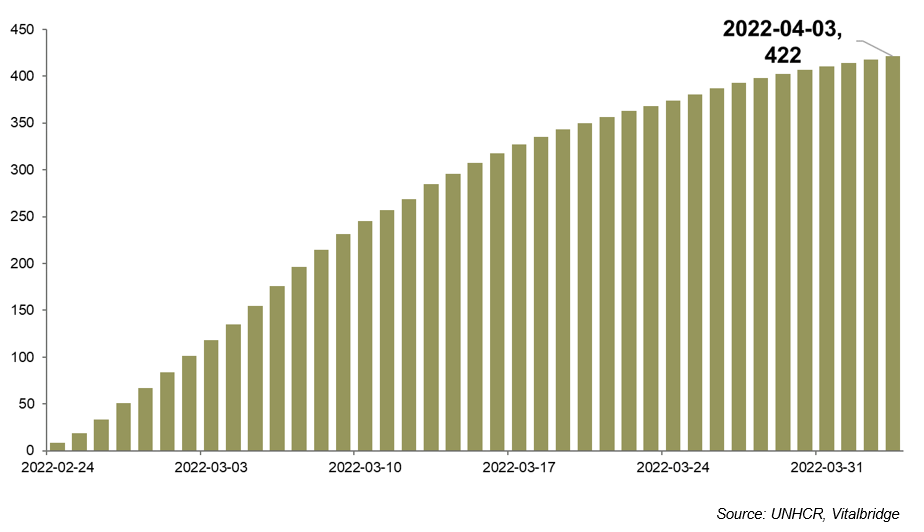
Cumulative Ukrainian Refugee Population (10,000s)
This time, Europe's absorption of Ukrainian refugees will far exceed Syria's impact.
Take Germany: less than two months into the war, it has already received 240,000 Ukrainian refugees — nearly one-third of its Syrian total — yet it ranks only eighth in refugee inflows. Poland, directly bordering Ukraine, has received the most; refugees may transit through Poland into other countries. With over 40 million people, Ukraine could produce more than 10 million refugees, with more profound effects on major European nations' demographic structures.
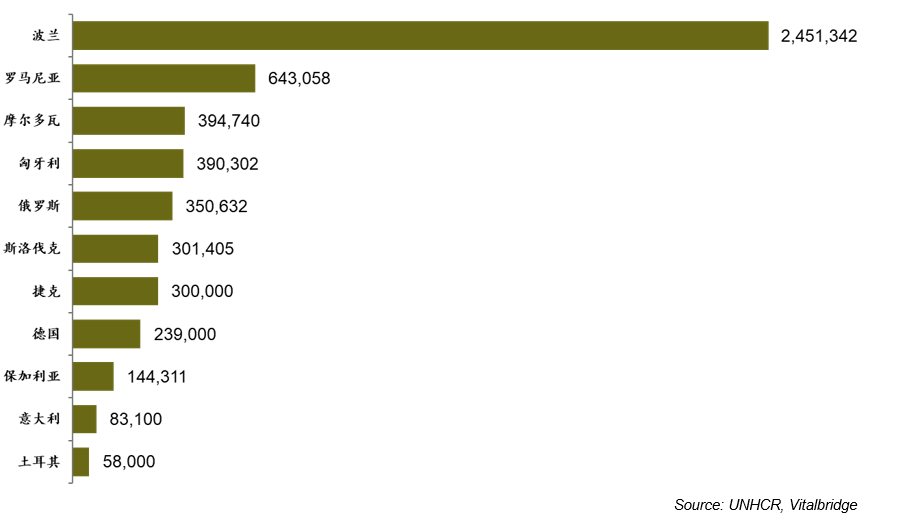 Cumulative Ukrainian Refugees Received by European Countries (50,000+)
Oasis Capital reviewed Ukraine's population pyramids across multiple historical periods, searching for its finest moment. History did offer opportunities — the year 2000, for instance, when external trade prosperity drove rising GDP. Like a 30-year-old stepping onto the world stage: enthusiastic, cosmopolitan, opportunity-rich, vibrant.
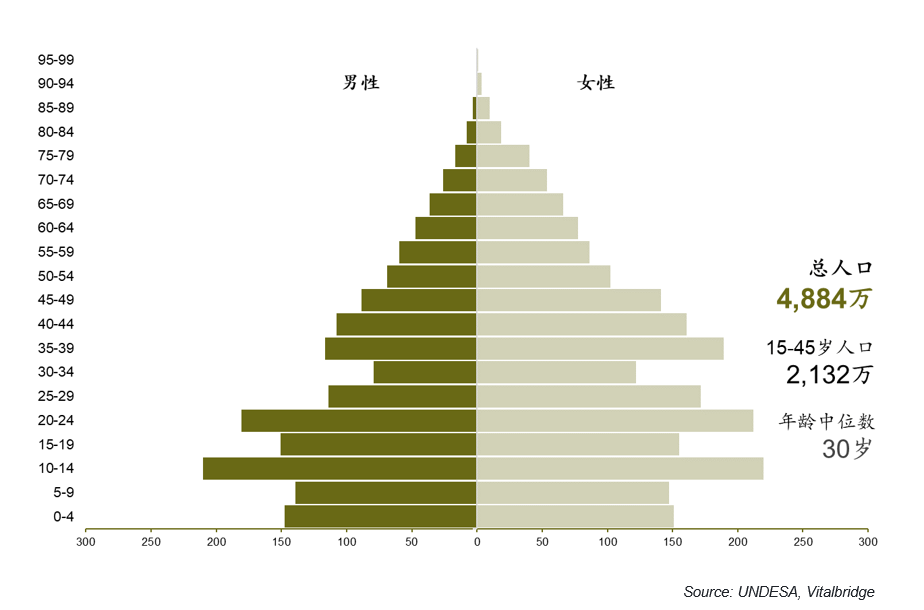 The "Young" Ukraine Population Pyramid, 2000 (10,000s)
Yet twenty years later, the 15-year cohort aged 30-45 that should now form society's core will be lost to this war. And these refugees' movements will further impact neighboring European countries, ultimately reshaping European economic, political, and social development.
Conclusion
If this war cannot be contained, Ukraine's crisis has only begun. More terrifying than direct casualties is the accompanying structural deterioration in Ukraine, Poland, Germany, and beyond — trauma that history shows often takes generations to heal.
Cyclical problems and crises aren't inherently frightening, for change breeds opportunity. Whether market panic or national conflict, transformation and possibility lie within. What truly terrifies is when cyclical problems trigger structural ones, when time ceases to be an ally and vitality drains away.
Long-termism, as we discuss it, presupposes the continuous extension and optimization of structural advantage. Fools sacrifice structural foundations to address cyclical concerns. The wise leverage cyclical problems to build structural advantage, using external factors to transform internal ones — what Taoism might call "cultivating truth through the false."
So it is for nations, for investing, and for society.

Oasis Capital is a new-generation venture capital firm in China, dedicated to discovering the most vital entrepreneurs of the coming decade and growing alongside them to create long-term value. "Advancing Vitality" is Oasis's vision and mission. This Vitality represents both the direction of epochal structural transformation and the resilience and evolutionary power of entrepreneurs. Oasis Capital focuses on early and growth-stage investments, deploying $3 million to $30 million per deal, with emphasis on healthcare, enterprise services, and other technology-enabled service sectors, supporting China's technology-driven new service upgrade.