Signals and Noise in Enterprise Services

Witnessing the Next Decade of Enterprise Services

At 36Kr's "2021 China Investor Future Summit" held in late September, Jinjian Zhang of Oasis Capital delivered a speech titled Signal and Noise in Enterprise Services. The following is an edited transcript:
Hello everyone! I'm Jinjian Zhang from Oasis Capital. I was a dyed-in-the-wool engineering student — spent seven years studying radar, mainly doing signal analysis and processing. In 2012, through a twist of fate, I started investing. Over the past decade, I've witnessed the growth and development of many Chinese companies. Today I have the opportunity to share some thoughts on enterprise services with you.
I had originally planned to start with changes and evolution in enterprise service business models, but on second thought, that's all noise. So instead, I'll share some perspectives on how we observe enterprise services in this era. Enterprise services have been a hot topic this year, a major theme. If you look at financing events in this market, you'll find that over the past decade, enterprise services' share of total financing in China has basically been a flat line — nothing has changed. If we look at other industries, there are obvious peaks and valleys, clear fluctuations.
Often when we say enterprise services is a theme, a key reason is simply that other themes aren't themes this year. When the market is relatively cold, enterprise services is always the theme, because it's like a flat line that occupies a significant portion of the market every year, yet few people pay attention to it. They're more focused on consumer, to-C. We see themes like O2O in 2014-2015, education in 2017-2018, consumer in 2019-2020 — many thematic moments. But enterprise services just stays flat. What's the underlying reason?
It's that in the enterprise services market, capital as a factor of production has very low leverage. It's not a business model where you can pour in massive capital to capture market share, then raise even more capital. For enterprise service companies, you ask how much money they need, they say 50 million. If you give them 100 million, how many times bigger can they get next year compared to 50 million? With 50 million they can triple; with 100 million they can only double. Because with more money, they can just spend more on product. In the enterprise services market, capital's productivity leverage has always been relatively low. Therefore, the market has always developed quite steadily.
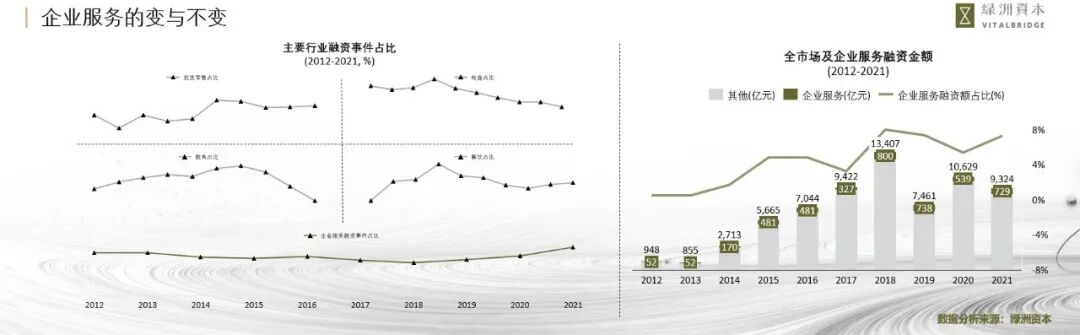
Over these years, if we look at this chart, we find that beneath the unremarkable surface of the enterprise services market, fundamental shifts have quietly taken place. Although the overall financing proportion has barely changed over the past decade, enterprise services funding has grown from a negligible 1% to 8% of total market financing. If the number of financing events hasn't changed but the funding amount proportion keeps rising, what does this imply? It means enterprise service companies are getting bigger, valuations are getting bigger, and single-round funding amounts are getting bigger.
Though valuations and funding are growing fast, on a global scale they're still trivial. Look at the top ten US enterprise service companies — together they're worth $4 trillion. What about China's top ten? Together they're worth $87 billion. Between these two superpowers, the top ten enterprise service companies show such a massive market cap gap.
What's behind this gap? We tried to find some underlying analytical frameworks and logic.
Enterprise Structure
We often talk about something called population structure, because a country's population structure determines its demand. A person is born with one nose, two eyes, one mouth, eats three meals a day. A village of ten people needs thirty meals a day; a hundred people need a hundred meals. Ultimately, a country's demand is determined by its population structure. The same applies to enterprise services — a country's total enterprise expenditure demand is ultimately determined by its enterprise structure.
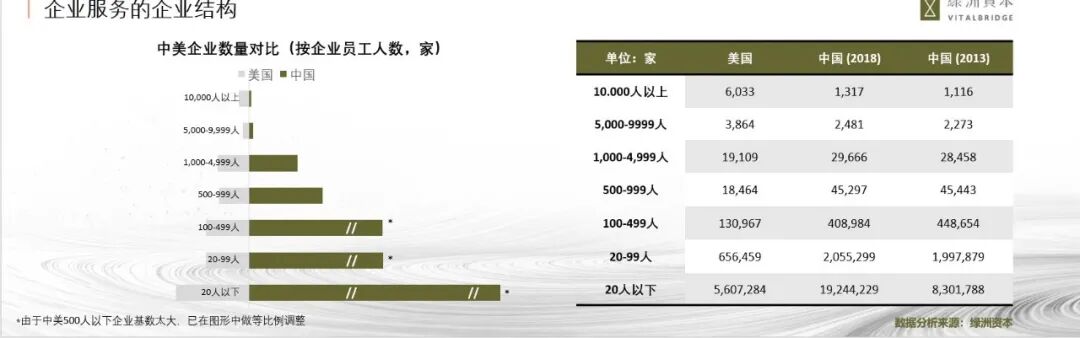
From this enterprise structure chart, the bottom three categories are marked with asterisks, meaning we've done significant data processing. You can't imagine — without processing, you basically couldn't see the companies above, because China has so, so many micro and small enterprises under 20 people. Comparing this chart with the US, you'll find that below 100 people, especially under 20 people, we have three times as many enterprises as the US. But for core enterprises above 10,000 people, our number today may be only one-fifth of theirs. Yet an excellent enterprise service company today isn't sustained by teams under 20 people — it's likely sustained by clients of 500 people or more. So today's enterprise structure determines our deficiencies in expenditure and in the enterprise services market.
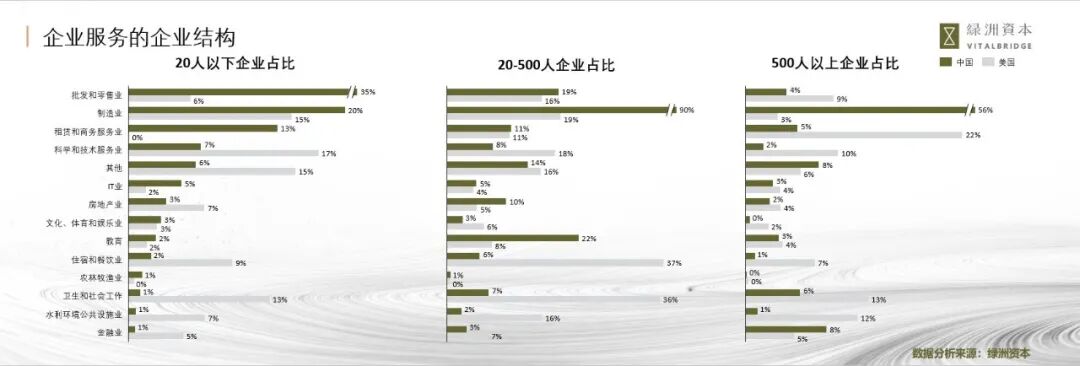
If we break down enterprises under 20 people further, we see this chart. We find that the vast majority of China's under-20-person enterprises are in wholesale and retail — the so-called mom-and-pop shops. Thirty-five percent of under-20-person enterprises are mom-and-pop retail and wholesale businesses; another 20% are small workshops, traditional small workshops and manufacturing plants. These enterprises occupy 55% of China's under-20-person enterprise market.
We used to talk about lifetime value of a customer, but we find that when renewal time comes, these enterprises no longer exist — so there's no way to maintain a long-term binding relationship with them. On the other hand, looking at enterprises above 500 people, if we compare China and the US in the leasing and business services category, we still have a large gap today. We only have 5%, while the corresponding US market has 22%, and this category is precisely the core segment for large enterprise services.
Looking at specific listed companies — not all US stocks disclose customer structure — if you look at Workday, with $4 billion in annual revenue, a 25 billion RMB enterprise service company, how many customers does it have? You might guess 100,000 to 200,000. Actually no. Workday, a company with 25 billion RMB annual revenue, has a total of 8,000 organizations. These 8,000 organizations sustain a $60 billion market cap company with $4.5 billion annual revenue — but it only has 8,000 customers. Large and medium-sized clients are a crucial foundation and cornerstone for enterprise service companies. It's the same in China — Weaver Network's top five clients are all large and medium-sized traditional enterprises. The current shortage of large and medium-sized enterprises in our country's enterprise structure has also affected our current development. But this situation is gradually shifting and optimizing over time.
Cultural Structure Issues in Enterprise Services
As just mentioned, since large clients are crucial for enterprise service companies, and China's large clients still have significant gaps and room for optimization compared to US market supply in terms of demand. From a cultural structure perspective, Chinese and US enterprise services also differ greatly — this is the difference between agricultural civilization and maritime civilization.
Maritime civilization started with trade, based more on external compatibility than internal compatibility, more on consensus through systems to conduct trade. You'll find Salesforce going to a small European enterprise, maybe 50 to 100 people — they buy Salesforce's product, start using it, and find it doesn't work because their retention doesn't match Salesforce's retention. At this point, the small enterprise's first reaction is: my company is too lousy, I can't even use Salesforce, I need to change, I need to align my processes with theirs, because their process is best practice.
Similarly, when Salesforce enters China's large and medium-sized enterprises, same logic — the enterprise tries it, finds Salesforce doesn't work. What does the Chinese chairman do? "Xiao Zhang, come over here, you change it, make it match my organization." Because agricultural civilization's characteristic of "looking inward" demands more organizational management differences, and these differences make it difficult for SaaS companies to achieve global growth through a single product without customization — this is the enterprise service difference caused by cultural structure.
Cultural structure and enterprise structure are changing along with new large and medium-sized startups and their chairmen's evolution, along with their increasingly globalized perspectives, along with their growing openness through the internet economy — they're providing more space for future and third-party services. For example, among top A-share companies in China, the current average age is 57, youngest 45. Today, the actual average age of China's top 50 US-listed Chinese companies has dropped from 57 to 50, youngest from 45 to 36. Across China, younger entrepreneurs are pushing the country's large and medium-sized enterprises to become more open, more able to accommodate different products and third-party services.
Changes in Technology Structure Within Enterprise Services
I was quite inspired by Mr. Li's earlier talk on digital real estate. What's the huge opportunity we see in today's enterprise services market? In the past, enterprise services — because of software's iteration capabilities and underlying source code 20 years ago, not cloud-native — were more based on traditional architectures, traditional languages, traditional development paths. It was like concrete walls, concrete houses one by one. Every new feature required modification, every new feature required addition, finally becoming concrete houses built higher and bigger. Now the client wants windows, now they want a rooftop garden — you modify, and find many enterprise service companies can't modify anymore, because if they keep modifying, the house will collapse.
But today in digital production, prefabricated construction has emerged — through steel frame structures, rebuilding the entire concrete structure from scratch. This is the revolution happening in real estate, and this revolution is simultaneously happening in enterprise services. Completely cloud-native architecture, based on new-generation languages and new-generation structures, rebuilding the entire enterprise services market from scratch — this is the huge opportunity we see in enterprise services, not merely adding layers on top of existing products.
We see that in the enterprise services market over the past decade, although on the surface the financing proportion hasn't changed, whether in funding amounts, enterprise structure, or technology structure — from these three underlying dimensions — massive changes have already taken place. We believe that in the coming decade, through structural changes in enterprise structure itself, along with younger founders and chairmen in China, and changes in technology structure within Chinese enterprise services, China will see more and more super enterprise service companies emerge. So we look forward to China's next decade of enterprise services. We're honored to have the opportunity to witness this next decade together with these entrepreneurs. Thank you everyone!
Source: 36Kr

Oasis Capital is a new-generation venture capital firm in China, dedicated to discovering the most vital entrepreneurs of the next decade and growing alongside them to create long-term value. "Nurturing Vitality" is Oasis's vision and mission. This vitality is both the direction of structural transformation in the era and the resilient, evolving force of entrepreneurs. Oasis Capital focuses on early and growth-stage investments, with $3 million to $30 million per deal, targeting technology-enabled services in education, healthcare, enterprise services, and other sectors, supporting China's technology-driven new service upgrade.