Signals and Noise in Investing

*The Signal and the Noise* Series 2
The following article is from 42Chapters.

Investors have different styles. Some are highly theoretical, studying business models. Others are deeply intuitive, studying products. Jinjian Zhang seems to move between the two — a rare feat — and has carved out a distinctive investment style of his own. He brings deep research into areas like society and demography, yet also has his own methodology for reading people. I'd say he's one of the most memorable investors I've met in recent years.
This year, two of his portfolio companies went public on U.S. markets. Seizing that occasion, I finally convinced him to come share his thinking. The content was excellent — among the most memorable talks I've heard this year. I'm confident you'll feel the same after reading.

Speaker: Jinjian Zhang Investor, Trustbridge Partners
Today's society is flooded with ever-growing information and ever-increasing noise. If we look at life in five-year cycles, we can see the growth, decay, and various changes within them.
Human beings can do great work today not because we've chosen to consume more information, but because we've chosen to focus. Focus helps us filter out what we don't need to see and concentrate on the present.
From undergraduate through graduate school — seven years — I worked on one research question: What is signal, and what is noise? More specifically, how do you use a "filter" to remove noise, and how do you receive that signal? Later, I successfully applied this framework to investing.
I. What Are "Signal" and "Noise"?
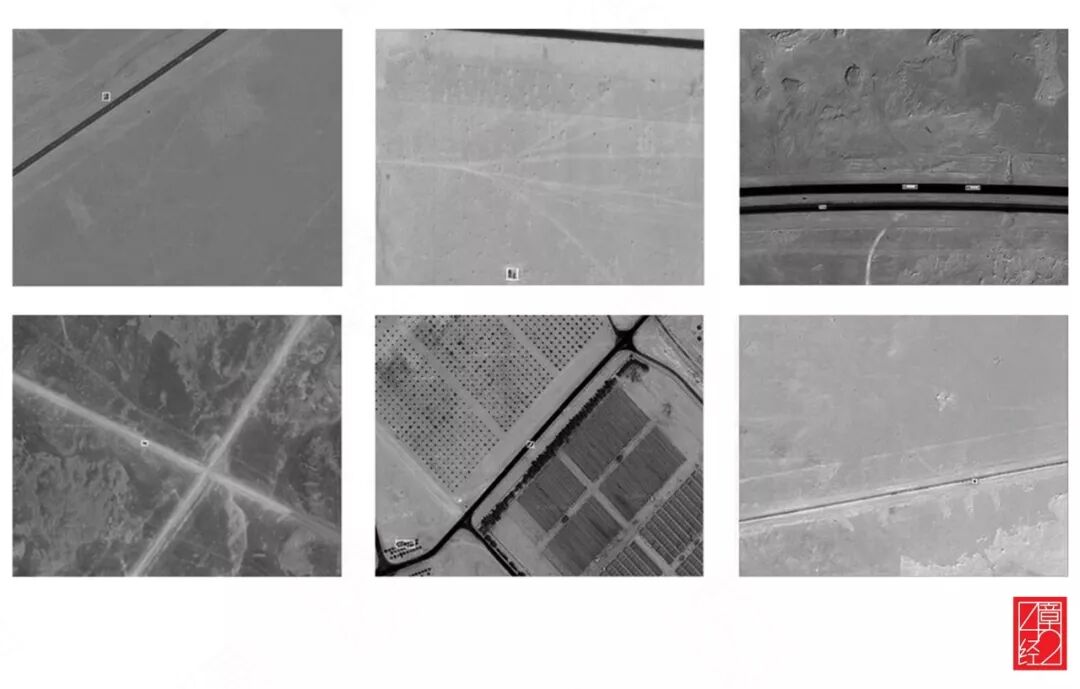
The image above is from a paper I published in a journal under the Chinese Academy of Sciences during graduate school. I was researching desert-based vehicle identification — analyzing low-earth orbit satellite imagery to find broken-down cars in the desert, so we could rescue stranded people.
You can see yellow boxes in every photo from that paper. Those boxes mark cars identified by the computer. In the first image, for example, the box captures a small car by the desert road. These cars were all single-digit pixel images; slightly larger ones might reach 20 pixels at most.
What does this mean? It means we were trying to find signals of just a dozen or so pixels, sometimes only a few pixels, within a high-resolution image.
Look back at life — isn't it the same? Finding that tiny bit of crucial signal within a mass of redundant information. That's what we studied, and what we kept experiencing in investing.
When I entered the industry in 2012, I didn't know what investing was or how to do it. Like most new investors, my first instinct was to read sell-side reports from firms like CICC, Morgan Stanley, Goldman Sachs. I'd break down industry information into supply chain, demand side, distribution channels, and so on. At first there might be five parameters; gradually that became a dozen, then twenty, then fifty-plus.
I discovered that the more I understood an industry, the more parameters I had. At that point, I felt I needed to pause. Something was wrong with this process, because seven years of scientific research had taught me one thing: signal is about finding sameness; only noise is about finding difference.
When you're learning something new and it keeps getting harder, more细分 — congratulations, nine times out of ten you've found noise. When the more you learn, the simpler it gets, and the more commonalities you see — that's when you've returned to what Laozi called the "One" ("The Tao gives birth to One, One gives birth to Two, Two gives birth to Three, Three gives birth to all things"). That's when you've found the true signal.
My advisor used to repeat one sentence: Noise differs everywhere; signal extracts sameness. The most typical noise, like white noise, is random at every single point, but when you aggregate those points, it forms a Gaussian distribution.
So we can never study something from a single point — that kind of study only makes your head spin and your parameters multiply.
Let me give another example, about my roommate.
My roommate had a crush on a girl, and she actually liked him back too. One day after playing ball, she ran over and asked him, "Are you hungry? I bought you some chips." Any normal person would recognize this as a signal being sent.
But at that moment, a guy from the bunk below — very loyal, very helpful — said, "Those chips have been on sale lately, I've been wanting to buy some, sure enough you bought them too." My roommate heard this and thought it made total sense. So he completely missed the girl's real signal.
At that moment, signal and noise had mixed together. He received a meaningless waveform.
So sometimes in life we complain about not receiving certain signals, not noticing how the world is changing — how did I miss that company about to take off? Fundamentally, it's not that we didn't see those signals. It's that you have this kind of "bad friend" around you, a noise source in your environment, continuously supplying you with all kinds of Gaussian noise.
So how do you identify them? You can only maintain observation and awareness over a long time. Eventually, when that noise source is gone, you'll have the chance to receive a true signal. Like in that example — when the "noise source" (that bad friend) is removed, my roommate might have ended up with that girl.
II. Signal and Noise in Investing
Looking back at investing: what is signal here? What is noise?
People say five years often makes a cycle. Breaking that down: what changes and what stays constant over long periods? What can we think about in five-year cycles? What has relatively less noise?
I found my first signal in investing: population structure.
From 2012 to 2014, I spent two years studying population structures across different countries, different periods, and different inflection points worldwide. By late 2014, I suddenly realized my previous research had all been noise.
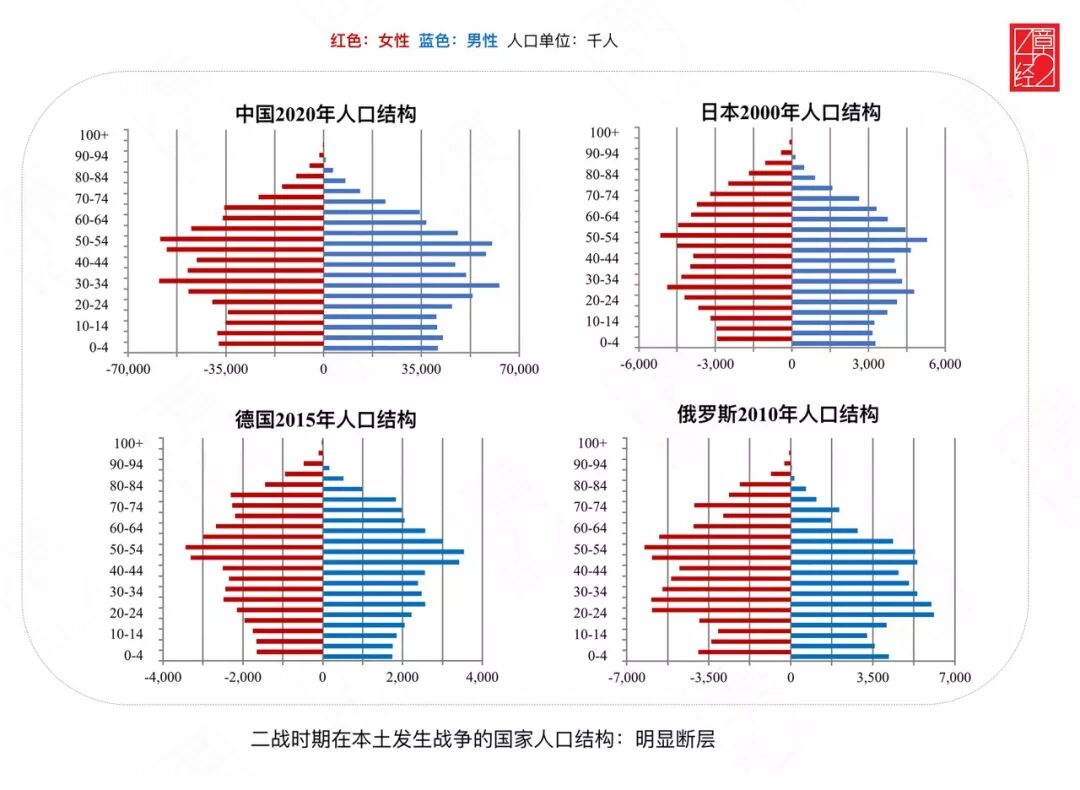
To elaborate: look at the population structures of these four countries in the image above, and you'll notice they all share one characteristic — a fertility gap.
China had two population surges; Japan showed almost identical surges. And this phenomenon appears not just in Japan and China, but also in Germany, Russia. Look further and you'll find Poland, South Korea too.
Why?
Because they were all major participants in WWII. Perhaps a generation was lost to war; perhaps they began furiously producing children in preparation for war; or perhaps after defeat, there wasn't much to do at home besides have children.
Take Japan: this country's population structure in 2000 was remarkably similar to China's in 2020. How could one country's 2000 structure resemble another's 2020 structure? If they were both major WWII participants, shouldn't they face similar problems in the same time period?
This is because Japan, at the outset, believed itself too powerful. After occupying Northeast China at maximum speed, they proposed the 100-million population plan in 1939. They felt that to fully occupy China, they wouldn't have enough Japanese people, so the emperor encouraged everyone to have more children, as many as possible. In other words, before WWII even ended, Japan was in the midst of an intense "baby-making movement." For China, it was in the decade after WWII ended that the culture of honoring "hero mothers" emerged, eventually forming our first population surge.
So the same war had massive, vastly different impacts on different countries, in different ways and phases. Often we think these things don't concern us, but in fact they are intimately connected to us.
In 1978, China wrote family planning into the constitution; in 1982, it became a basic national policy. Do you know what this means? It means almost every child born after 1983 was an only child. And being an only child means growing up without siblings to fight and argue with — it means not needing to develop much of the accommodation, compromise, and social glue that comes from interpersonal friction.
What does this further imply?
It means when our post-83 generation first entered the workplace, we found our egos were quite large. When an entire generation has large egos, what happens?
When the post-83 cohort reached age 22 — around 2005 onwards — China saw a wave of small merchants and vendors. Taobao also gained a huge wave of active small sellers at this time, because these people felt they couldn't adapt to working alongside others in offices; they had to work independently, and stay in the places most familiar to them from childhood.
Meanwhile, another interesting data point emerged in this period: from 2005 to 2017, China's divorce rate nearly tripled.
Before 2005, the divorce rate had basically grown slowly and steadily; there was even a dip between 2000 and 2005. But starting in 2005, as the post-83 generation gradually reached legal marriage age, many found they couldn't accept living with someone of a different personality, and couldn't compromise.
So this process may seem unrelated to us on the surface, but in fact everyone is a droplet in this wave. And as an investor, what you invest in is the pulse of the era. What we see isn't just individual points and minor changes, but the entire era, and the full process of its orderly advance.
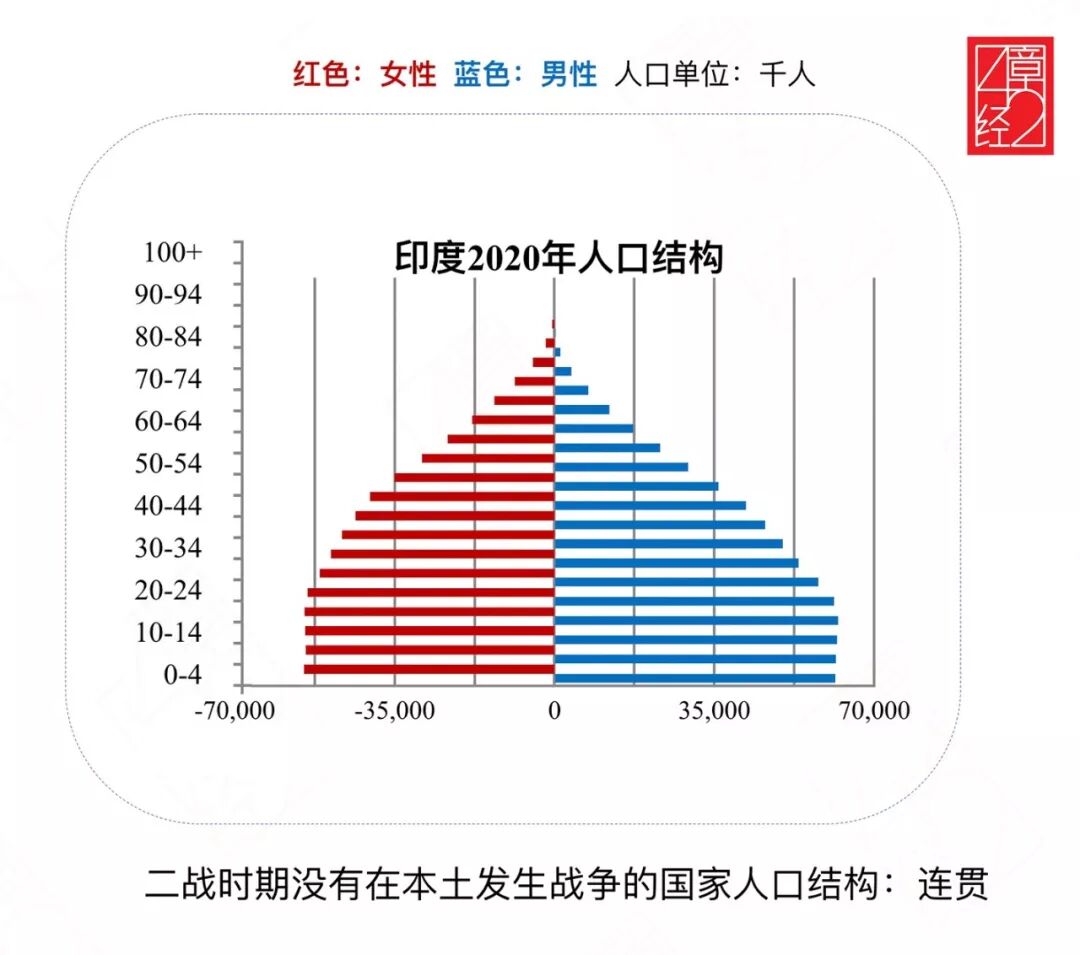
Now look at another country: India.
If you examine India's population structure closely, you'll find it's actually quite ridiculous. From this chart, you can sense that India had little participation in the globalization process. Because whether WWI or WWII, whether globalization or WTO, its population just kept growing steadily — no gaps, no changes.
So often when we invest in Indian companies, we face a question: what exactly are you investing in? This is what we often mean when we ask — who are our users? Do you really understand your users? What year were they born, and what happened that year? What era-defining threads ran through their upbringing? What kind of personality did they form? What characteristics do these personalities have?
On the surface, everyone is different. But from the era's perspective, everyone shares many commonalities. Investing, again, comes back to that point: find sameness, not difference.
Many might ask: how much does population structure relate to economics? Do these similarities and differences in signals really have scientific relevance? Can they guide your investment methodology?
After posing this question, I did extensive demographic research and read many books. There's one book I'd recommend: The Demographic Cliff. Its author, Harry Dent, is an important American demographer who extensively surveyed the entire U.S. population structure. He discovered that although every American family is different, they actually share many similarities. So he aggregated these similarities into a trend chart.
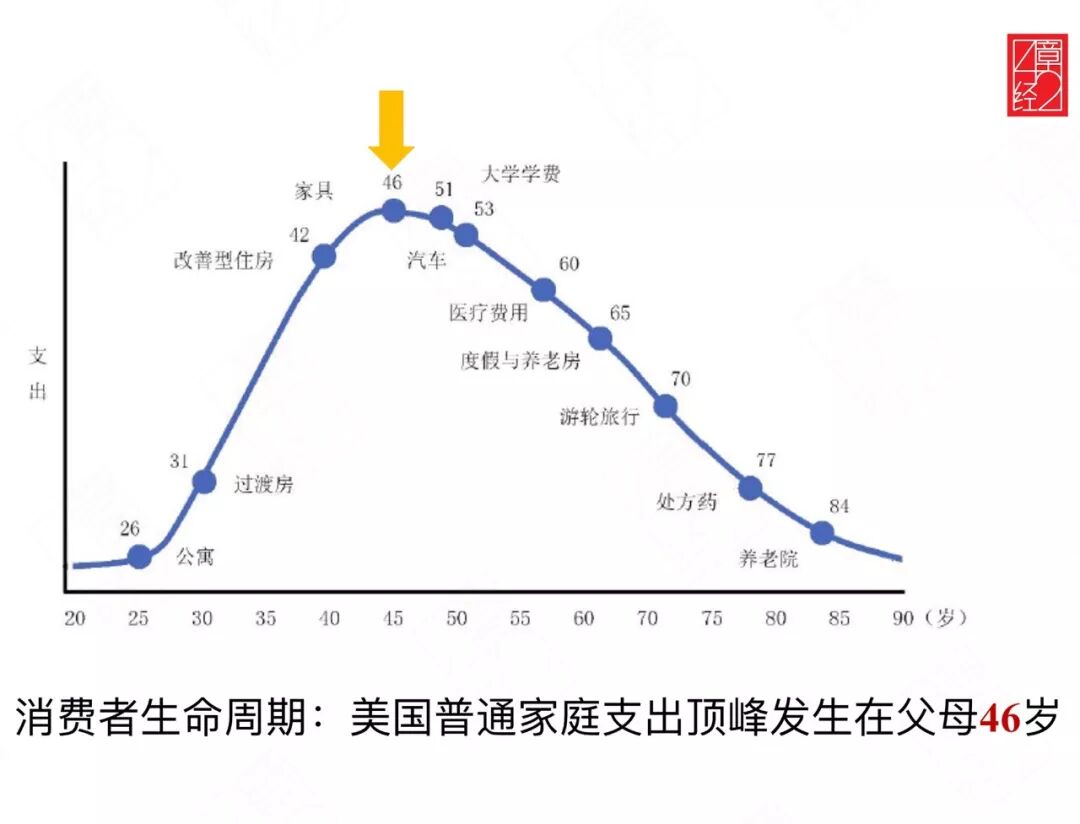
This chart shows that children in any American family hope to buy their first apartment at age 26; a transitional home at 31; an upgrade home at 42; and at 46, better furniture plus the ability to afford their children's college tuition.
Through extensive statistics, he found that 46 is the peak of average household spending in the U.S. population structure. This might mean we only need to take the birth index (immigration included), project it forward 46 years, and we can see the predictable spending peak of an average American family.
Before that, let's review the baby boom birth trend: starting in 1934, accelerating in 1937, peaking in 1961. Using 46 as the household spending peak, the spending peak should lag the birth peak by 46 years, so from 1983 to 2007 there should be strong economic prosperity.
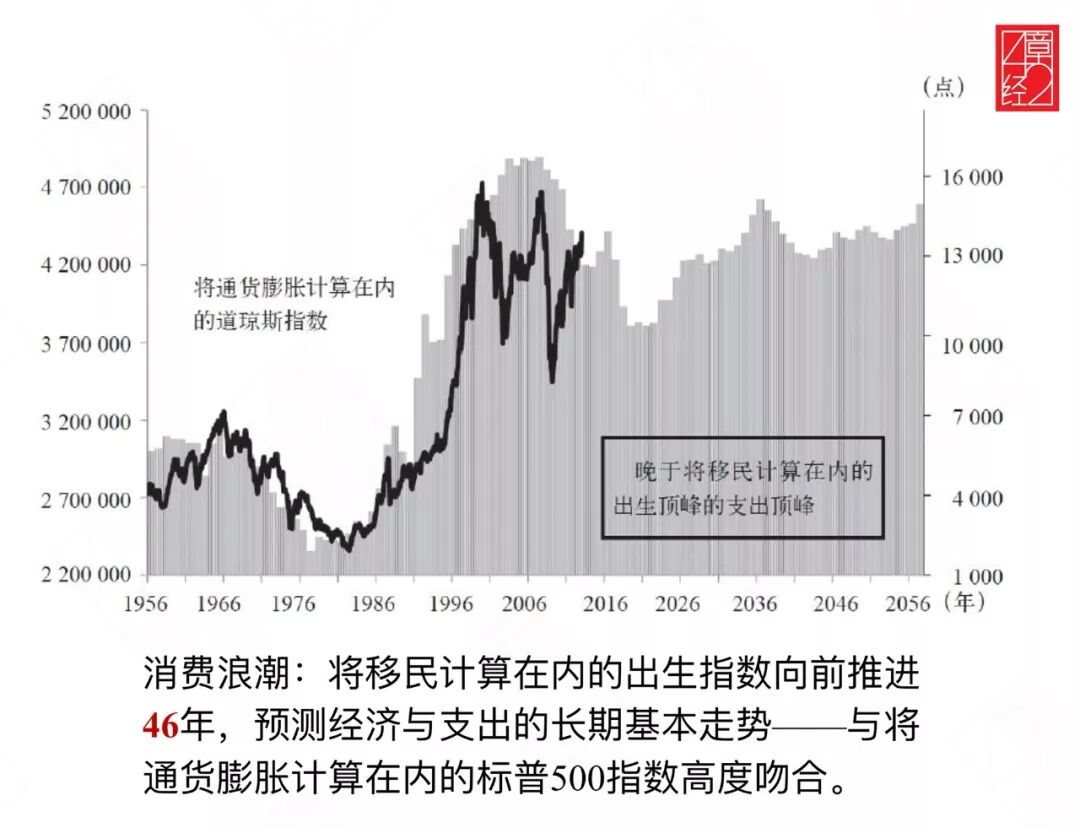
After forming this hypothesis, Harry Dent checked the Dow Jones index and found the data remarkably similar to his predictions. So something that appears unrelated to us may, in aggregate, have unexpectedly strong correlations.
There are actually many more细分领域 here. If you further examine economic data from various countries worldwide, studying their population structures, fertility rates, marriage rates, and divorce rates, you'll find they're connected to many things in your life.
It's like the "Fourier Transform" in Oppenheim's Signals and Systems. The Fourier Transform means any wave can be decomposed into the superposition of different periodic functions. So in life there must be small cycles influencing you, but what are the big cycles? We need to find those big signals.
Today Meituan Waimai and Ele.me have grown massive, so people explain "why food delivery took off in China." There are many reasons — the rise of micropayments, increased mobile penetration, WeChat red envelopes further pushing adoption — but ultimately they all discuss technology's impact on humanity.
But have you considered: what about the impact of population and social structure? We can reduce this to one question: if there were no technological development today, no smartphones, red envelopes, micropayments — would food delivery still exist? Let's project this question to more developed countries and see if they experienced similar trajectories.
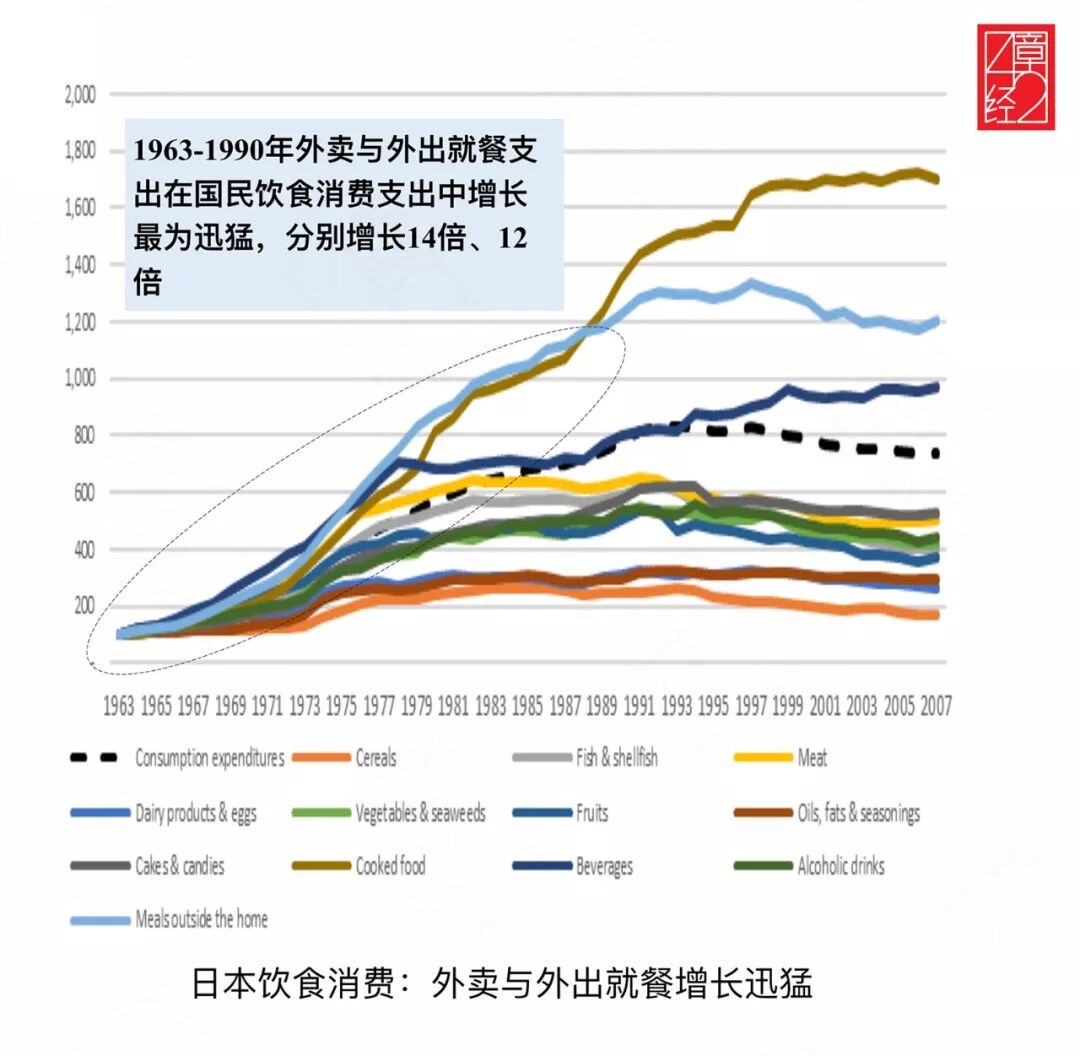
Take Japan as an example (because Japanese data is very complete and covers a long enough timespan).
The chart above shows growth across all dining-related subcategories in Japan from 1963 to 2007. Two lines grew extremely rapidly, increasing 14x and 12x respectively between 1963 and 1990. These two lines are "cooked food" — what Japan today calls bento culture — and "meals outside the home," meaning restaurant dining.
So in an era without smartphones, the two fastest-growing dining categories in Japan were actually food delivery and eating out. What caused this? Technology? Delivery drivers? Let's look at what changed in Japan's social structure from 1963 to 1990.
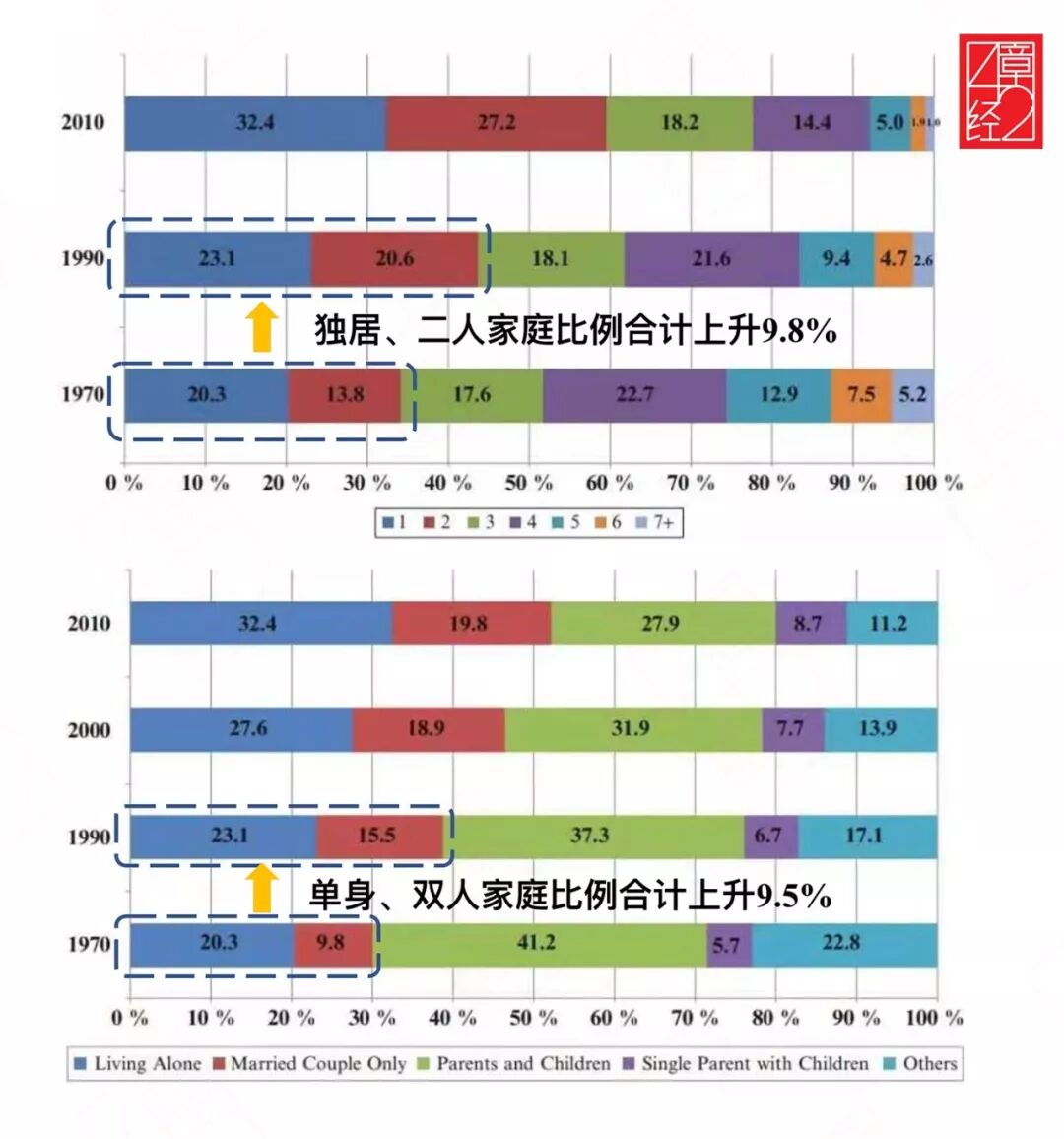
According to the data in this chart, from 1970 to 1990 — over 20 years — the proportion of single-person and two-person households in Japan rose by a cumulative 9.8%.
So you suddenly realize: why do you order food delivery today? Because you're alone, or just with your girlfriend or wife. Anyone with a family knows, when you have children or elderly at home, you're less inclined to order delivery.
Much of what appears to be technological revolution is actually the subtle influence of social structural change — growing alongside the singles wave and rising divorce rates. Because the rapid expansion of single-person and childless-couple households squeezed out a demand for food delivery and dining out. This demand grew 14x and 12x in Japan over 20 years, while Japan's overall consumer index grew just over 7x in the same period.
So often in investing, we think about what revolution technology has brought, but we should return to the signal side and think: what changes are happening in population structure? What changes is social structure bringing? More and more single people — what does this mean? What is the true signal? The answers are all in the signal.
III. How to Respond to a World of High-Liquidity Noise
Here's another question: in this society driven by population structure and social structure, how do we utilize them? What exactly is signal and noise theory?
I figured I couldn't be the first person looking for these things. There must be people in this world using signal and noise theory to think — including many excellent product managers and entrepreneurs using this method to build products and business models.
So I tried to find some anchor points and fusion points in economics, and eventually found one person: Fischer. Fischer was a Wall Street legend, co-creator of the famous Black-Scholes option pricing model. He passed away one year before the Nobel Prize in Economics was awarded to his two model collaborators.
Fischer wrote extensively about pricing and quantitative methods throughout his life — methods that form the foundation of modern finance. Through this foundation, in 1986 he published a paper: "Noise." He used a full 8 pages to describe what noise is in financial markets.
He wrote in the paper that value investors cannot prove their ability in short timeframes because there is so much noise in the world. This noise spawns so-called noise traders, and because these traders operate around noise, their trading behavior itself becomes noise, which further influences more noise traders. Thus society becomes a confrontation between value traders and noise traders.
Most of the time, noise traders far outnumber value traders, so stock prices fluctuate rapidly in short periods, and the direction of fluctuation often runs completely opposite to value traders. At the end of this paper, Fischer asked: are these noise traders without value? His answer: no.
It is precisely because these noise traders provide liquidity to the entire market that the market can develop over the long term. Think about it: if everyone were a value trader, who would sell? And when everyone is selling, who would buy?
So in life, don't worry about this noise, and don't worry about hearing things like: "Your competitor raised funding again in just three months; or before you've figured things out, they've raised three more rounds in a year."
There is so, so much noise in this world — in your life, your career, your daily relationships — but I hope you ultimately aren't changed by it, because it's just noise.
If you follow Fischer's theory, you'll find that the stronger liquidity becomes in a system, the more noise that system generates. Looking back at every technological revolution, each one has pushed the world's liquidity further. We once thought the Industrial Revolution had massively increased liquidity; later we discovered that compared to the Information Revolution, it was nothing.
And just when we thought information and asset flow efficiency was already extremely high, blockchain technology suddenly appeared — and you realize past liquidity was nothing. Going forward, you can even turn things you never dared imagine into liquid assets.
So in this era of ever-increasing noise, how do we invest and build companies? Based on years of understanding and research into signal and noise, I'd like to share three points:
First, stay open.
In this era, you must remain sensitive to changes in the world. Because as noise increases, you may need more sensitive radar to capture those signals. So you'll notice satellite dishes (receivers) getting flatter and wider in diameter — so they can capture more minute changes.
So first, regardless of where you stand today, everyone needs to stay open.
Second, long-term awareness.
Signal never suddenly arrives at your doorstep one day. Like my roommate example at the beginning — that girl was the most important signal of his life, but there were problems in the signal transmission early on. He didn't realize from the start what a true signal was; instead you might think that bad friend beside you was an important friend in life, until one day graduation came, the bad friend was gone, and the interfering noise was finally processed.
So in life, you must maintain long-term awareness, because only through long-term observation and understanding of signals can you possibly capture that truly belonging-to-you signal one day.
Third, discover change.
Because at any single point, noise is random and different, but when expanded to a sufficiently long timeline, noise is uniform and zeroes out. So only by discovering change can you find the most important signals in life.
Over these years, I've greatly benefited from this research methodology. I hope this methodology can similarly help you become an excellent filter in this high-liquidity, noise-filled world — screening out life's noise and finding your life's signal.
Finally, finally, as 42Chapters says: think about the essence of things, return to simple, honest living.
This article covers roughly half of the complete sharing content. In the video, Jinjian Zhang also shares his most fundamental thinking on education-sector investing — the investment signals within education, and more.


Oasis Capital is a new-generation venture capital firm in China, dedicated to discovering the most vital entrepreneurs of the next decade and growing alongside them to create long-term value. "Celebrating Vitality" is Oasis's vision and mission. This vitality is both the direction of era-defining structural transformation and the resilience and evolutionary power of entrepreneurs. Oasis Capital focuses on early and growth-stage investments, with individual checks of $3 million to $30 million USD, concentrating on technology-enabled services in education, healthcare, enterprise services, and other sectors, supporting China's new service upgrade driven by technology.