Special Edition: North Slope Project

*The Signal and the Noise* Podcast Special Season

Ten months ago, the podcast Signal and Noise released its first episode.
Since then, we've spoken with eight scholars and entrepreneurs — including Shanyou Li, Lan Xiaohuan, Wei Zhang, and Boyan Wang — documenting their worldviews, values, and their judgments of "signal versus noise" in the AI era, their understanding of vitality.
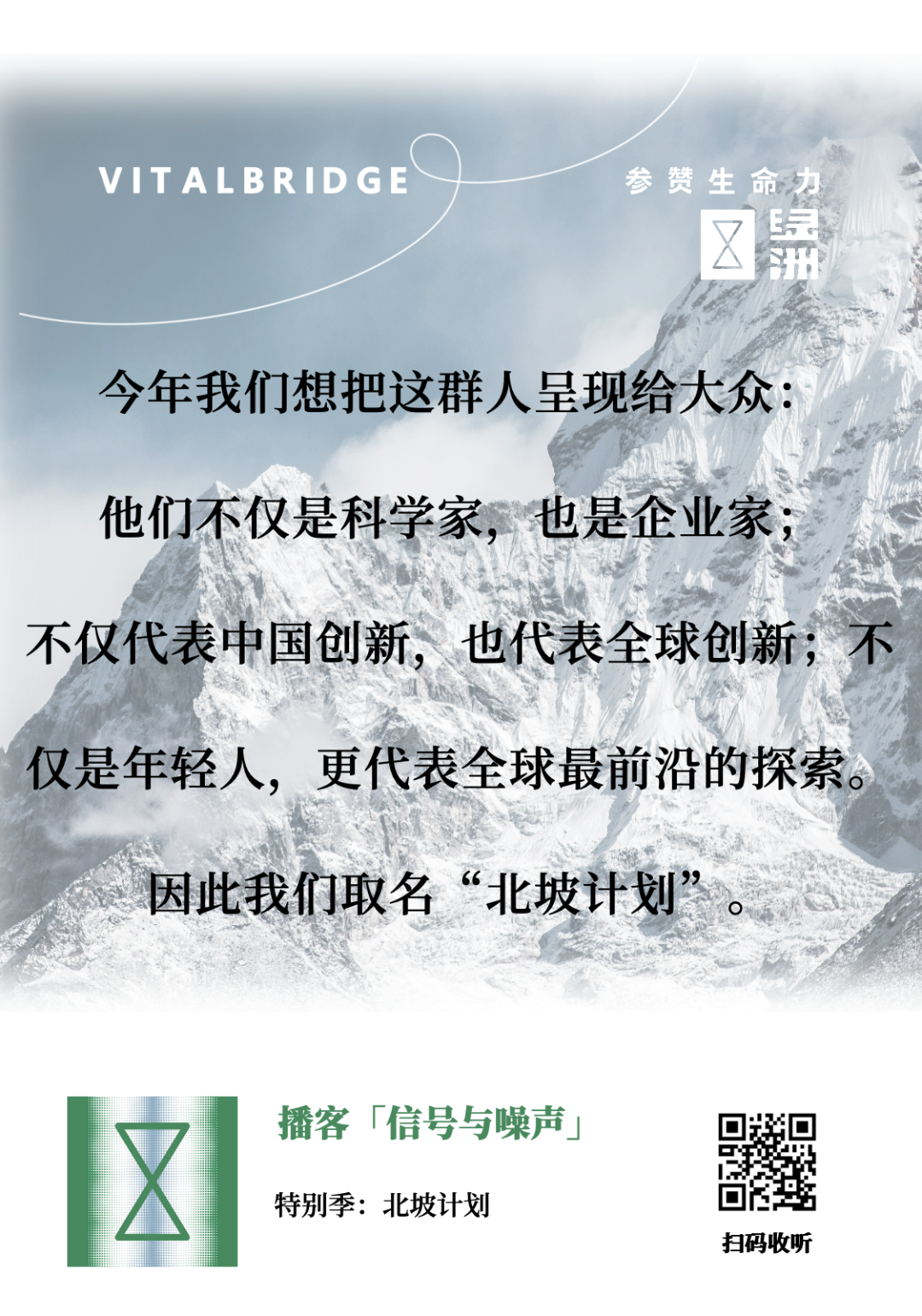
Today, the show enters a special season: The North Face. The term "North Face" isn't mere rhetoric — it points to a steeper, more variable path to the summit of AGI. We'll focus on a group of researchers and scientists pushing the global frontier of embodied intelligence, the technical paths they face, the unsolved problems, their philosophy of life, and the future they're actively creating.
In this episode, through a conversation with Pu Fan, an editor at ChinaVenture, we share the original intention, starting point, and boundaries of this initiative. Whatever changes in content and form, what remains constant is our commitment in this AI era to connect heart-to-heart, to participate in and celebrate the vitality of life.
Below is an excerpt from the ChinaVenture article. Enjoy.
If you want to climb Mount Everest, there are theoretically two routes.
One starts from Lukla in Nepal, passing through the Khumbu Icefall, the Western Cwm, and the Hillary Step to reach the summit — known as the "South Col route." The other begins at the famous Everest Base Camp in Tingri County, Tibet, requiring passage through the Great Couloir, the ice wall of the couloir, and then over three major steps — the "North Face route."
But if you were actually planning this extreme challenge, whether you asked the local guides who make their living off "guaranteed summits" or professional mountaineering teams, nearly everyone would recommend the "South Col." The South Face has been developed longer, with complete commercial services, and has long become a mature tourist route. More importantly, the Himalayas are a north-south oriented mountain range in the Northern Hemisphere — a planetary-scale wall high enough to block warm, moist air currents on the South Asian subcontinent, leaving extreme plateau polar climate on the northern side.
High winds, ice cliffs, blizzards, precipices, extreme cold and oxygen deprivation far beyond human physiological limits, plus vast unknown factors that cannot be accurately predicted, cannot be precisely detected with tools, and are constantly changing — this is everything you face when you choose the "North Face." When the first team in human history to complete a North Face summit descended in 1960, nearly every member suffered frostbite and blindness, teetering on the edge of amputation.
The venture capital industry has a classic phrase: "long slope, thick snow," used to describe a startup track with long cycles and high barriers, where one misstep can sink you deeper. But if you find the right approach, you might also get a "snowball" opportunity — accelerating, sprinting, compounding geometrically. Consumer businesses, for example.
So, what startup track today is best defined by the "North Face"?
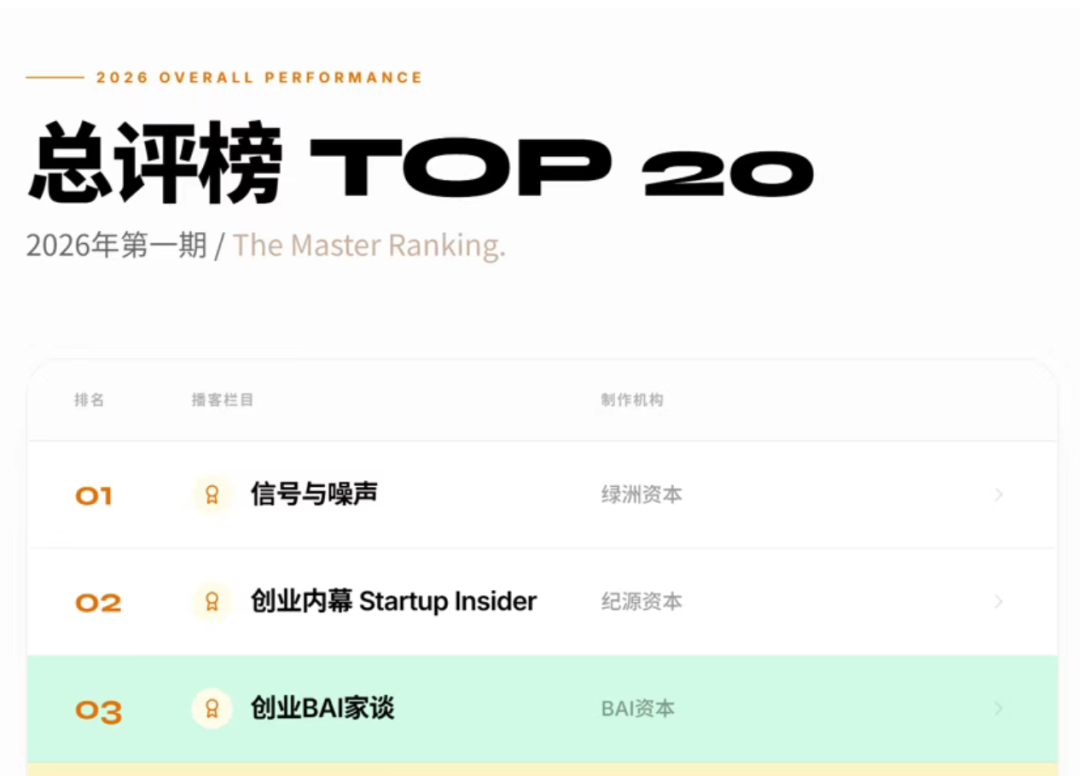

Earlier this year, we conducted a horizontal review of Chinese venture capital industry podcasts, ranking them based on depth of thinking, breadth of sharing, and other factors.
Oasis Capital's Signal and Noise ranked first.
Across ten episodes last year, Oasis devoted more attention to "worldview" — discussing how to maintain curiosity, how to return to vitality. Recently they're about to launch a special season, with定向 invitations to scientists and entrepreneurs in embodied intelligence, and an intriguing name: "The North Face." The idea is that there are two paths to AGI, the ultimate dream: one is large language models, the other is embodied intelligence. Jinjian Zhang feels that the "embodied intelligence" path resembles the "North Face" that climbers face — every step forward is a "challenge of the unknown," "difficulty" will always exceed your expectations, and the closer pioneers get to the summit, the more elusive the view becomes.
Signal and Noise's significance lies in transcending the fund perspective. Interview subjects include both portfolio companies like Wei Zhang of LimX Dynamics and university professors like Shanyou Li and Lan Xiaohuan. Content ranges from AI development to Taoist internal alchemy views on life, with an authentic, flowing "sense of being alive" and Oasis's "aesthetic" of vitality running throughout. Different individuals sketch different solutions under the grand era of AI, "warm and healing."
Speaking of "The North Face" special season, Oasis Capital is indeed well-suited to discuss it. Oasis began investing in embodied intelligence in 2023. Its portfolio includes Spirit AI, Hillbot, LimX Dynamics, Hypershell Tech, and Inx — all pioneers in their respective fields. For instance, when investing in Hypershell, many were questioning "what even is an exoskeleton?"; when Spirit AI faced its toughest angel round, everyone's attention was on "can robots dance, can they walk," with almost no one discussing how to replicate human "animal neural control consciousness."
To date, there are at least nine domestic embodied intelligence companies valued at over 10 billion RMB: Unitree, AgiBot, Galaxy Universal, Hillbot, Xinghai Tu, AI2Robotics, Spirit AI, Independent Variable Robotics, and LimX Dynamics. Especially after the Spring Festival Gala, market frenzy for embodied intelligence reached a peak, with over 90 related financing events domestically, including more than 40 at the 100-million-yuan level and above. No one is asking anymore whether "robots will fall down" or "robots won't understand commands."
You see, Oasis Capital actually had the opportunity to see future leaders ahead of time. They should be the most optimistic pioneers, yet they consider embodied intelligence a difficult "North Face" — why is that?
The moment the rankings were published, we reached out to Oasis Capital, hoping to hear them discuss Signal and Noise and "The North Face."


Why is embodied intelligence considered a difficult "North Face"?
Pu Fan: Let's talk about "The North Face." What made you decide to do a second season?
Jinjian Zhang: There are two core reasons.
First, from the podcast itself. In season one, we discussed a lot about worldview and philosophy of life. Listeners said they were deeply inspired, and also raised a new request: they wanted to see these ideas put into practice. So if season one was about "knowing," then season two wants to show the integration of "knowing and doing" — seeing the future visions of frontier explorers, how they act, the cognitive logic behind their actions, allowing listeners to translate their understanding of life into concrete behavior. In our listener group, many people listen repeatedly, write long reflections, gain energy and want to put it into action, hoping to know how frontier practitioners combine power with practice. So at the podcast level, we want to explore more in the realm of "doing" and the "world" of worldview.
Second, regarding AGI. Returning to our previous conversation ("Dialogue with Jinjian Zhang: Four Years Ago No One Believed in AGI, MiniMax Is Now Worth 300 Billion"), the market is gradually forming consensus: multimodal large language models are one path; embodied intelligence is another. Because all learning essentially falls into two types: one through thinking and reading, the other through practice. Just as one cannot learn to swim on shore — throw someone in water, and they'll iterate through breaststroke, backstroke, and other forms in practice, finding the optimal path. By interacting with the real physical world, learning "through experience" with more modalities rather than pure research and study, we believe this is another path to ultimate intelligence. Some now call it Physical AI (PAI), but the essence is different paths to AGI.
Currently, large models are further ahead and more mature — the South Col. And I believe that in triggering this "North Face" of embodied intelligence, China has tremendous advantages: North Face exploration requires synchronized iteration of hardware and software, and massive data collection. Current training data in embodied intelligence is about 200,000–300,000 hours; GPT-3's data volume was 100x that of GPT-2, meaning if embodied intelligence has just passed the GPT-2 stage and is moving toward GPT-3, it will need 10–20 million hours of data. This data involves talent organization, equipment collection, data cleaning — areas where China has natural advantages: equipment costs, experience in large-scale data operations, all far ahead. Based on this data iteration, we hope to approach GPT-3 level faster, and many Chinese teams are already entering this track.
The real difficulty is whether you believe in this path, whether you believe the summit of this path is AGI — whether you believe is more important than doing it itself. The success of the South Col today has shown North Face explorers possibility, inspiring more people to dare set out from the North Face — this itself is tremendous energy.
Another characteristic of this track: scientists have become the core force. The core of top American AI companies are AI researchers and scientists; China is the same. These scientists are mostly born around 1995, very young, a new generation of Chinese youth scientists with global vision, from major universities, leading the global development of embodied intelligence. This is very meaningful.
And even within the North Face track, scientists' views are completely different: some believe VLA (Vision-Language-Action) is the future, some believe VLA is worthless and insist on world models; some take other technical paths, and even definitions of data, distinctions between quality data and dirty data — each has different understanding, truly a hundred schools contending, competing for the Central Plains — this itself is beautiful.
More interestingly, the core leaders of global PAI, general robotics, and Tesla's Optimus project are mostly ethnic Chinese; Chinese founders and Chinese scientists also come from top global labs like UC Berkeley, MIT, and Stanford, going from top labs to the world, joining the AI era at their prime, jointly driving innovation, branching out like "one flower opening five leaves."
So this year we want to present these people to the public: they are not only scientists, but also entrepreneurs; they represent not only Chinese innovation, but global innovation; they are not only young people, but represent the frontier exploration globally. Hence we named it "The North Face." This year we plan to interview ten top global young scientists in embodied intelligence, showing their courage, innovation, and their future cognition, vitality, and philosophy of life, sharing their unverified, uncongealed "knowing" and "doing" with everyone, leaving it to time to test, believing it will bring inspiration to everyone's life.
Pu Fan: I have a concern. In my view, what makes someone a "scientist" is that the endpoint of their work is science, pushing research toward fundamental origins. Their worldview and accustomed thinking altitude must necessarily be distant from ordinary people. If the dialogue locks onto scientists, won't it be too far from ordinary people's lives?
Jinjian Zhang: This is the huge change brought by the AI era: AI is a super tool, a social transformation, and a super lever, turning everyone into a super individual. Whether strengths or weaknesses, one must live authentically, using AI to amplify their own value.
The essence of scientists is people who explore frontiers and boundaries. In the future, AI will certainly do better than humans on everything within boundaries; human value lies in exploring boundaries — from small personal boundaries to large civilizational boundaries. This is a cruel yet beautiful era: no value without boundary exploration, but everyone can maximally exercise imagination and creativity, exploring boundaries.
Scientists represent exploration of boundaries; the future is the era of big science, and everyone is essentially a scientist in some sense, exploring the boundaries of the world. After GPT's launch, the Deep Research function allows ordinary people to access frontier research, broadening cognition. Future stars will be science stars. We document these young scientists' thinking, life views, values, worldviews — this has tremendous value for every individual and entrepreneur in the AI era. Whether what they do is correct isn't important; what's important is what they're exploring and why.

Embodied Intelligence Is Still at the "Foot of the Mountain"
Still Unaware of Many Difficulties
Pu Fan: "The North Face" makes me think of Everest's North Face, and Wu Jing's The Climbers. That film tells of China's first North Face summit of Everest in 1960 — but due to limited equipment, no complete record was left, and it wasn't recognized by the world, so the team launched a second summit to find traces proving the feat. Now when I hear "North Face," I instinctively think of difficulty, hardship, of team members falling into ice crevasses in that film.
I'm wondering, is naming it "North Face" Oasis's way of cooling down embodied intelligence? Especially after the Spring Festival Gala, embodied intelligence completely exploded — almost daily billion-level financings, no one asking anymore whether robots will fall, whether they can understand commands, whether their walking is clumsy. The gala robots' drunken fist performance was too stunning, everyone is full of confidence. By naming it "North Face," are you reminding people: embodied intelligence's development isn't that smooth, many difficulties are underestimated?
Jinjian Zhang: You're absolutely right. First, we're far from the summit — we haven't even encountered the real frozen zones yet. Objectively speaking, we only passed the GPT-2 stage in the second half of last year. If everything goes smoothly, we'll still need 10–20 million hours of data (including pre-training and post-training data), and only by mid-next year at the earliest might we enter the GPT-3 stage. What form the eventual ChatGPT moment of embodied intelligence will take, no one knows. GPT has already iterated to 5.4, and we still believe it's far from AGI — let alone embodied intelligence?
During the Everest climbing craze, people at the foot of the mountain were also enthusiastic, buying equipment was easy, but none of that matters. What matters is the goal is the summit, is firmly walking this path. And this path has just begun, with extreme difficulty: hardware and software architecture, manipulation capabilities, locomotion, integration with large language models, from large model reasoning to VLA to locomotion — different modules with different frequencies and logic, how to integrate them into true embodied intelligence, there are massive problems yet to solve.
We're still at the foot of the mountain, not even at the mid-slope. The so-called frozen zone is data — we only have concepts, but don't know their true forms, core issues, what risks we'll encounter when integrating, whether they can be remedied — we haven't encountered these problems yet.
The industry is very lively now, but we must soberly recognize the long road ahead. This is also its charm: these top young scientists remain calm in the face of a hot market; outsiders think they raise money smoothly, are in the spotlight, but in reality they're also anxious, solving specific problems no one has ever cracked; they're both scientists and have to handle the practical problems of enterprise organization and management, completing the integration of "knowing" and "doing" amid multiple role conflicts.
This is what we want to do this year: focus on Chinese scientists in global embodied intelligence, explore their vitality, and the signal and noise in their growth processes.
Pu Fan: This answer is excellent, and important. You responded to my initial question: why Oasis Capital still considers embodied intelligence a "North Face" when the industry is hot; where embodied intelligence's difficulties are overestimated and misread; what signal Oasis wants to send. These answers are crucial for many people — you're not thinking about a single institution, industry, or portfolio company, but core issues with universal relevance.
Jinjian Zhang: Yes, we also haven't thought about what the final form will be. Over these years, Wei Zhang of LimX Dynamics, Yang Gao of Spirit AI, suho of Hillbot — all top scientists in their fields who've also become founders, jointly exploring the world. What outsiders see is IPOs, financing, smooth development; only up close do you discover they're solving countless specific, never-before-cracked problems. Some problems they had no opportunity to solve in the United States; returning to China, with complete industrial chain support, they were able to break through — this itself is very meaningful.
There are also scientists we've engaged with but haven't invested in, like Xu Jiang and Huazhe Xu — all top researchers taking different technical paths, all pouring their heart and cognition into the field. This matters for the industry, for investment, for Signal and Noise listeners.
What we can do is authentically present their state, without judgment — we don't know the answers either, we only know there's a group of people advancing on this path. But "advancing" itself is full of value and meaning.

Hoping That in the Future, a Young Person Will Dream of Becoming a Scientist Because of This Show
Pu Fan: In season two, will your personal style change? Will you focus more on technology and business, or like season one, focus on personal stories?
Jinjian Zhang: The final landing point is still personal stories, but we'll increase discussion of frontier technical innovation and China-US innovation strategies. If season one focused on worldview and values, season two will first discuss "the world," then "worldview."
Pu Fan: If you set a goal for season two "The North Face," what counts as passing? What counts as full marks?
Jinjian Zhang: After recording season two, if a student says, my original aspiration was finance, but now I want to switch to automation, to science and engineering, to become a scientist and drive global innovation in embodied intelligence — that's full marks.
Pu Fan: The passing line is season two still ranking first on the list, right?
Jinjian Zhang: No, we can't have that expectation — expectations become baggage. Many things have two sides; we won't deliberately focus on rankings. Return to original intention: see how many people are genuinely inspired. Our internal core metrics for evaluating Signal and Noise aren't follower count or play count, but completion rate and share rate — how many people listen to the end, how many share it with others after listening. These two metrics represent the inspirational value of the content; other data doesn't matter.
Pu Fan: This is equivalent to providing an operations manual for institutional friends who want to do podcasts, answering how to set KPIs.
Jinjian Zhang: Yes. If everyone iterates around these two metrics, industry content will keep improving, and more people will be inspired.
Pu Fan: More importantly, by doing this well, venture capital is no longer alternative investment full of financial sensibility, but becomes part of entrepreneurship, job-seeking, and life, eliminating public distance.
My biggest feeling last year was that when hard tech investment first emerged, the public demonized venture capital, seeing it as speculation, hype, equating VCs with profit-seeking speculators — this disappointed me greatly.
Doing podcasts well is an excellent breakthrough. Venture capital should be a tool to help everyone realize beautiful expectations for the world, a springboard connecting future imagination. We haven't achieved this yet, but at least someone needs to act first. I especially applaud Jinjian's efforts, hoping more friends in the VC and PE industries, after hearing this episode, will boldly try, together letting venture capital return to its ideal state.
Jinjian Zhang: Yes. Doing podcasts must have an ordinary mind — it's not that lofty. Doing what you like in the way you like is already very valuable.