Spirit AI Closes Angel+ Round, Accelerating Commercial Rollout | Oasis Capital Vitality

Counselor on Vitality

Spirit AI recently closed an angel+ round with exclusive funding from Bairui Capital. Not long before that, Oasis Capital led Spirit AI's seed round. Since its founding, Spirit AI has completed three funding rounds in just over six months. With this new capital, the company will focus on talent acquisition, product iteration for commercial scenarios, and business expansion. Bairui Capital, the investor in this round, is an investment firm founded by Li Ping, CATL's angel investor, co-founder, and vice chairman.
Capital Accelerates Resource Integration
Fengtao Han, founder and CEO of Spirit AI, emphasized: "We're grateful for our investors' support. Spirit AI's vision is to build a general-purpose embodied intelligence model applicable to all kinds of robots. Drawing on top-tier AI technology from UC Berkeley, industry-leading hardware, and extensive commercialization experience, Spirit AI has a solid foundation — one we use as a springboard to push the boundaries of embodied intelligence. With strategic industry resources, we'll rapidly move toward market deployment to validate generalized embodied intelligence operations. We expect to deliver hundreds of embodied intelligence products next year, potentially becoming the world's first company to achieve mass delivery in high-value real-world scenarios. We believe model quality depends on data quality. High-quality delivery generates high-quality real-world data, which will help Spirit AI quickly establish a closed physical data flywheel, continuously driving rapid model and algorithm iteration, and ultimately giving robots unprecedented dexterity."
First to Achieve Multi-Scenario Generalization
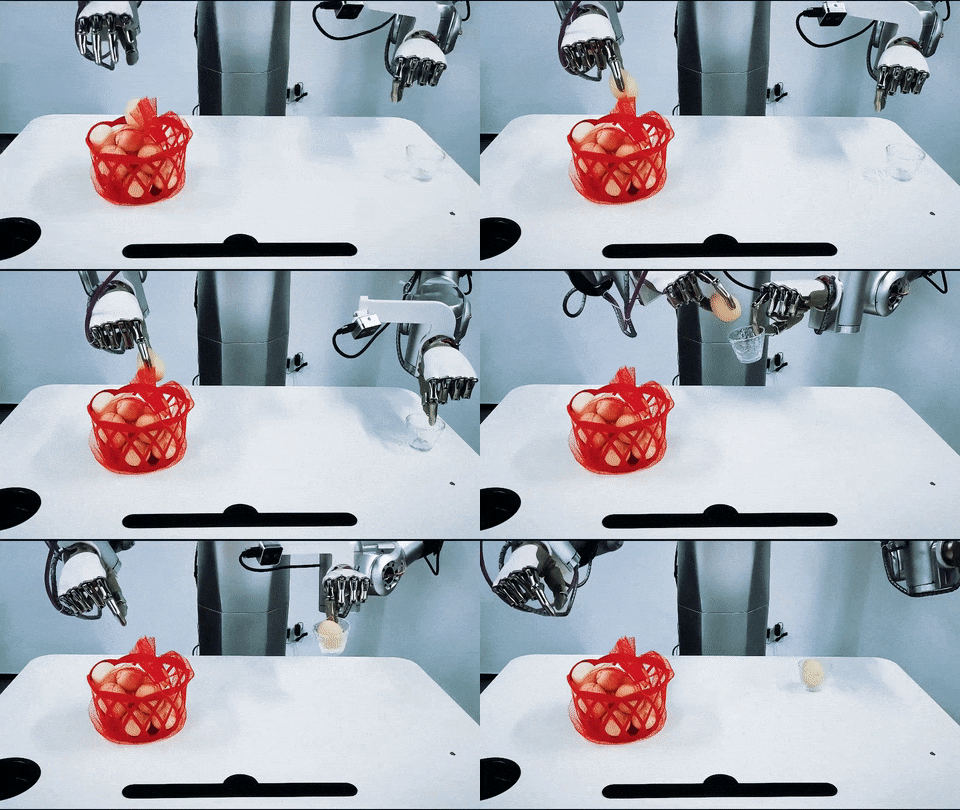
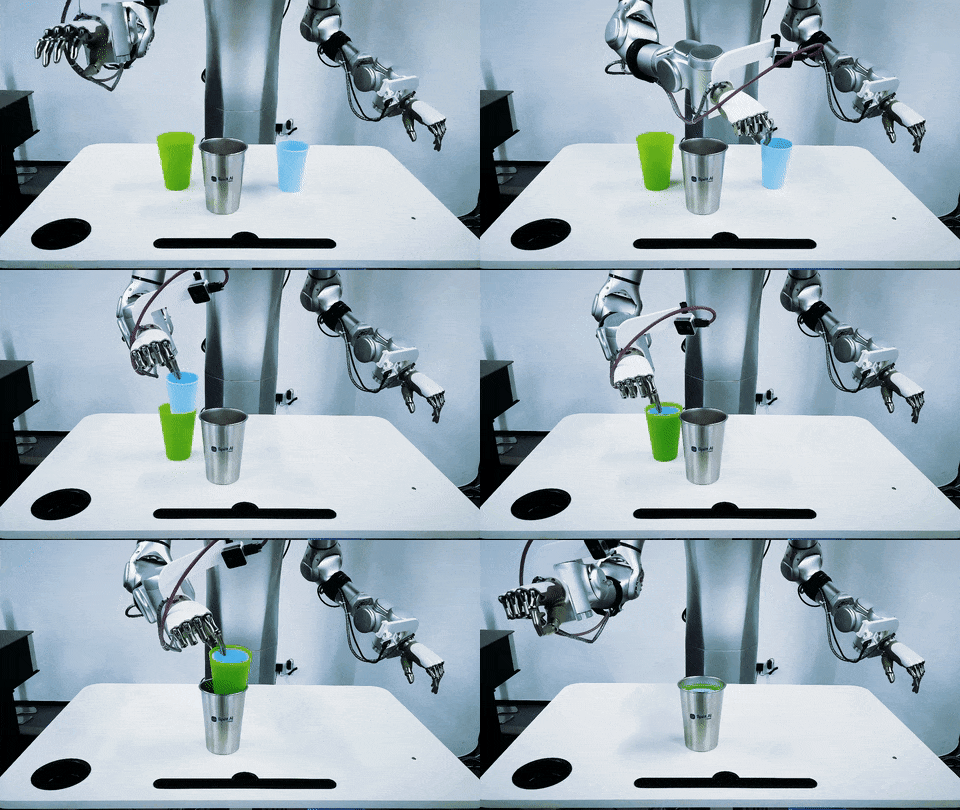
Beyond technology, the biggest challenge for embodied intelligence companies is exploring application scenarios. In early September this year, Spirit AI became the first to publish its latest research results on general robot generalization technology. Based on neural network architecture, robots successfully completed complex actions such as brewing coffee and weighing apples by hand in unstructured environments, achieving continuous multi-task generalization capabilities.
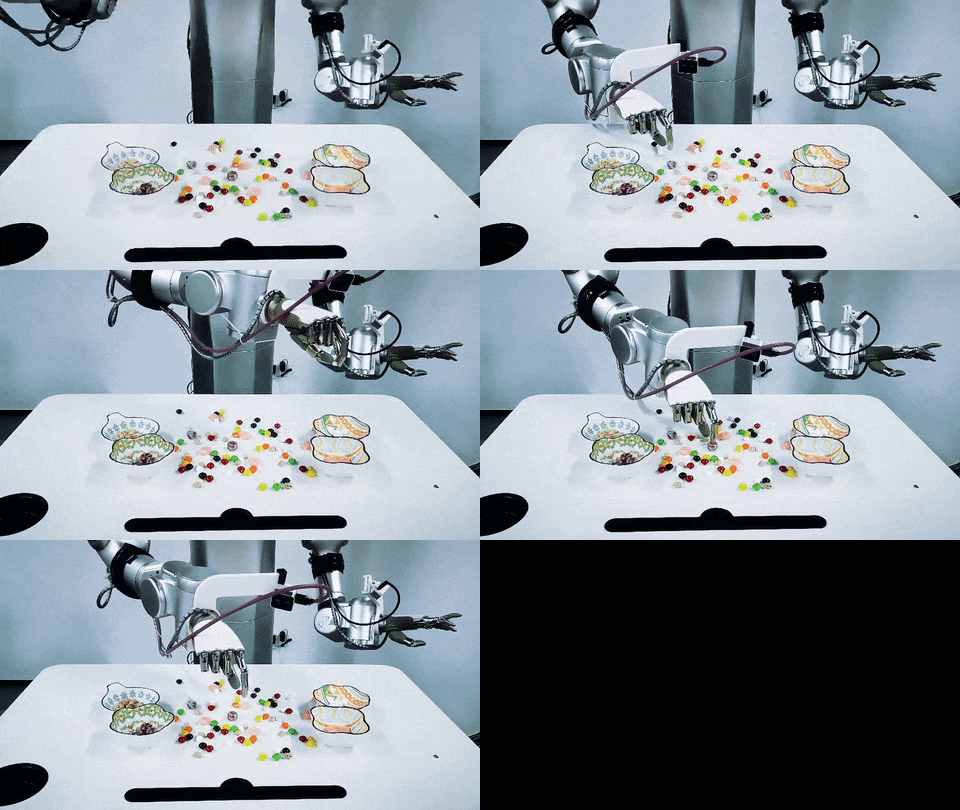
For embodied intelligence to achieve large-scale deployment, it must first solve generalization capabilities to meet operational requirements across different scenarios. The prerequisite for solving generalization is acquiring high-quality data samples, which directly impacts the precision of robot task execution.
Spirit AI possesses industry-leading embodied large model technology and exceptional robot R&D capabilities, with particular strengths in pre-trained models, imitation learning, and reinforcement learning.
World-Class Embodied Intelligence Technical Strength
Spirit AI co-founder Yang Gao graduated from Tsinghua University with a bachelor's degree. Driven by his passion for machine learning, he pursued further studies at UC Berkeley, where he earned his PhD in Trevor Darrell's group, focusing on cross-modal robot interaction research. Gao not only delved deep into computer vision but also boldly explored embodied AI and decision science. In his second year of PhD studies, he ventured into autonomous driving and deepened his practical experience through an internship at Waymo. He keenly recognized the commonalities between autonomous driving and robot control, actively promoting the integration of imitation learning and reinforcement learning. In the Deep Drive project led by Trevor, Gao was responsible for core algorithm development and real-vehicle validation, personally experiencing the leap from simulation to reality. His released autonomous driving dataset BDDV emphasized the critical role of data quality for models. During his postdoc at Berkeley, Gao conducted research with Pieter Abbeel, a top professor in reinforcement learning, and collaborated deeply with Sergey Levine, a leading scholar in robot learning. Pieter Abbeel is one of the originators of diffusion models — the core technology behind Sora and Stable Diffusion — while Sergey Levine is a co-founder of Physical Intelligence (Pi) in the United States, focusing on algorithms for autonomous agents to learn complex behaviors, providing key technical support and strategic guidance to Physical Intelligence. Just recently, Physical Intelligence announced a $400 million funding round (approximately RMB 2.8 billion), bringing its total valuation to $2.4 billion (approximately RMB 17 billion). Crucially, both Sergey Levine's and Gao's research focuses on improving robot generalization capabilities — training a single model to control multiple robots. Both also emphasize the importance of data in robot learning, exploring how to leverage diverse datasets to train robot models. Because their technical approaches align so closely, the two have become close friends, and Physical Intelligence's impressive funding round has further strengthened Gao's conviction that Spirit AI will become a world-leading embodied intelligence company.
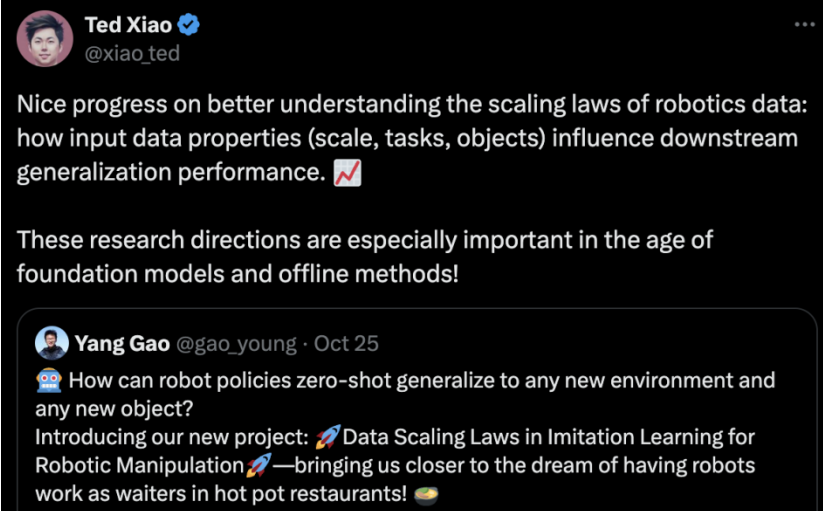
Globally, the most accomplished embodied intelligence scientists and companies are overwhelmingly concentrated in North America, with Berkeley widely regarded as the epicenter of embodied intelligence. After completing his PhD, Gao chose to return to China and join the Institute for Interdisciplinary Information Sciences at Tsinghua University as a PhD advisor, focusing on research at the intersection of computer vision and robotics. He firmly believes that when generalized robot technology achieves large-scale deployment, China will be the first to enter the fourth industrial revolution — and he is determined to become the key that unlocks that door. Gao has numerous technical innovations in robotics. At the recently concluded CoRL 2024 conference in Germany, his team had four high-level papers accepted. Beyond that, they discovered the "Holy Grail" of embodied intelligence — Data Scaling Laws — enabling true zero-shot generalization in robots, allowing them to generalize to entirely new scenes and objects without any fine-tuning. This discovery reveals a power-law relationship between a robot's ability to generalize to new objects, new environments, and environment-object combinations, and the volume of training data.
 Scaling Laws: The Winning Formula from ChatGPT to Robots
The image shows a comment from Google DeepMind technical expert Ted Xiao, calling this research a milestone for the era of robot large models.
Multi-Dimensional Efficient Collaboration, Rapid Development
Beyond this, model evolution depends on high-quality commercial deployment. From its inception, Spirit AI assembled a dedicated product team responsible for scenario implementation and business expansion. Product definition is market-driven from the start — truly customer and market-centric, maintaining acute market sensitivity. The company's other co-founder, Lingyin Zheng, was a pioneer in industrial robot international expansion, having built and led overseas teams to deeply cultivate global markets and rapidly achieve commercialization results. Spirit AI is not only steadily building its domestic market presence but also expanding its vision globally, completing 80+ scenario investigations across new energy batteries, logistics, food service, and healthcare — forming a unique and proven commercialization logic.