Spirit AI Closes Nearly 2 Billion Yuan Funding Round! Valuation Exceeds 10 Billion Yuan | Oasis Capital Vitality

Accelerating Machines' Understanding of the Physical World

Recently, Spirit AI — a leading domestic embodied intelligence company and Oasis Capital seed-round portfolio company — announced it has closed two consecutive funding rounds totaling nearly RMB 2 billion.
This round's investors include: Yunfeng Capital, a leading state-owned institution, Hundun Investment (Ge Weidong), HSG, and other top-tier firms; Synstellation Capital, TCL Capital, Minghui Investment (the family office of Inovance chairman Zhu Xingming), and other strategic industrial capital; Chongqing Industrial Investment Fund of Funds and Hangzhou Capital, among state capital entities; and strategic investors including 360 Fund and HouXue Capital — forming a comprehensive empowerment network spanning elite financial capital, industrial giants, state capital, and strategic investors.
Notably, existing shareholders including Shunwei Capital, Prosperity7, Fortune Venture Capital, Bairui Capital, HLC, Huatai Zijin, Orient Capital, Qiancheng Capital, and GF Xinde Investment Management all chose to make substantial follow-on investments, demonstrating through their continued commitment their firm confidence in the company's technical roadmap and growth prospects.
With this round successfully closed, Spirit AI's valuation has surpassed the RMB 10 billion threshold, officially joining the "10-billion club" of the embodied intelligence track — a landmark event in the sector's history that signals the industry's commercialization has entered a new phase.

Capital Barometer: The Industrial Synergy Logic Behind the RMB 2 Billion Raise
After large language models reshaped the digital world, the "embodied" wave of AI penetrating the physical realm has become the central narrative of the global tech industry. Data from the China Academy of Information and Communications Technology shows that in 2025, total funding in China's embodied intelligence sector reached RMB 73.543 billion across over 740 investment events, with the track's momentum continuing to accelerate. Yet amid this capital influx, the market is rapidly bifurcating. From concept hype to value realization, companies with genuine technical moats and the ability to penetrate industrial scenarios are becoming scarce targets that capital scrambles to secure.

Spirit AI's latest funding round is a concentrated reflection of this trend. It represents far more than a capital injection — it is a "full-ecosystem mobilization" spanning top-tier financial capital, industrial capital, state capital, and financial institutions: elite funds betting on technical foresight, industrial capital injecting scenario and supply chain resources, and state capital providing long-term stable support. The collective alignment of such diverse capital constitutes, at its core, a powerful endorsement of Spirit AI's comprehensive capabilities.
In terms of industrial capital deployment, Spirit AI is the only embodied intelligence startup to attract simultaneous bets from multiple industrial capital sources, constructing a unique "full-scenario ecosystem" within the track. From industrial manufacturing leaders like CATL, Inovance, and TCL, to logistics, retail, and financial infrastructure represented by JD.com and China Merchants Capital, to consumer electronics giants Huawei and Xiaomi — industrial shareholders now span cross-sector coverage of the real economy's core verticals.
This means Spirit AI is not merely a leader in technical approach, but has become a scarce target that top industrial capital collectively favors. As embodied intelligence competition moves from laboratories to industrial depth, Spirit AI has already secured strategic advantages in scenario access, data sources, and collaborative deployment through the most extensive industrial shareholder network in the sector, building hard-to-replicate core competitiveness for scaled commercialization.

Model and Data Dual Moats: The Core Foundation for Moving from "Task Execution" to "World Understanding"
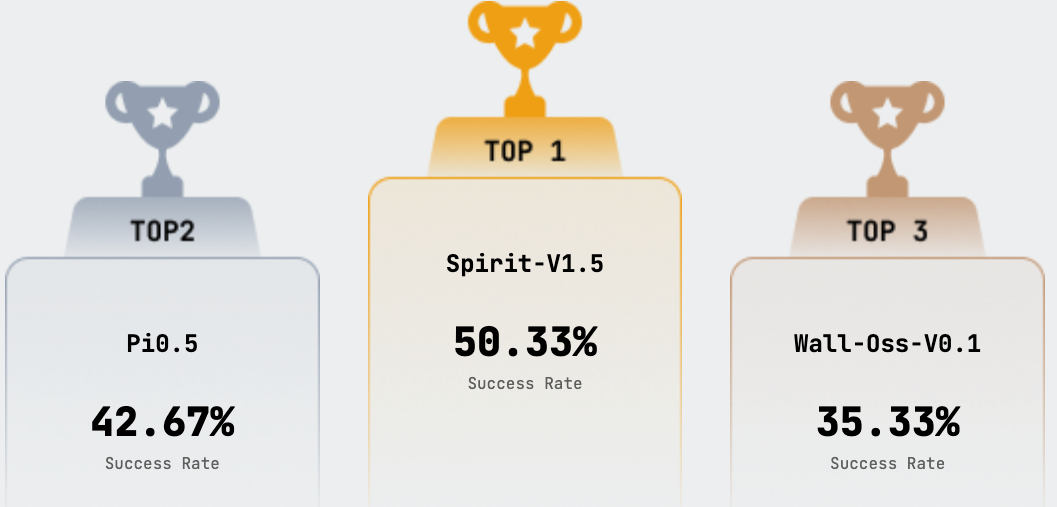
In January 2026, Spirit AI's open-source Spirit v1.5 model became the first Chinese open-source model to surpass Pi0.5 in performance. The model demonstrates powerful zero-shot generalization capabilities, completing complex tasks like wiping objects, manipulating hinges, and handling flexible materials without new sample training — showing efficient cross-scenario execution ability.
Behind this breakthrough lies Spirit AI's long-term commitment to its technical path. Cofounder Gao Yang explained: "We adhere to a 'data pyramid' training philosophy. During pre-training, we didn't follow the traditional 'world model' approach of predicting every frame — that path consumes enormous compute with poor efficiency. Instead, we chose pre-training on massive amounts of human internet video, achieving better results with fewer parameters and significantly reducing compute costs."
On data collection, Gao added: "We've reduced data acquisition costs by 90% through self-developed equipment, enabling scaled deployment of massive real-world data. It's the stacking of these technical capabilities that made Spirit v1.5 the world's first open-source foundational embodied model to surpass Pi0.5 in performance."
Spirit AI firmly advances its Scaling roadmap with "diversity" as the core. To date, it has accumulated over 200,000 hours of multi-type real interaction data, spanning internet video, teleoperation, and wearable-based collection, with total volume projected to exceed 1 million hours by 2026. Its self-developed wearable data collection devices have reached their fifth generation, reducing data costs to one-tenth of traditional methods and clearing obstacles for scaled acquisition.

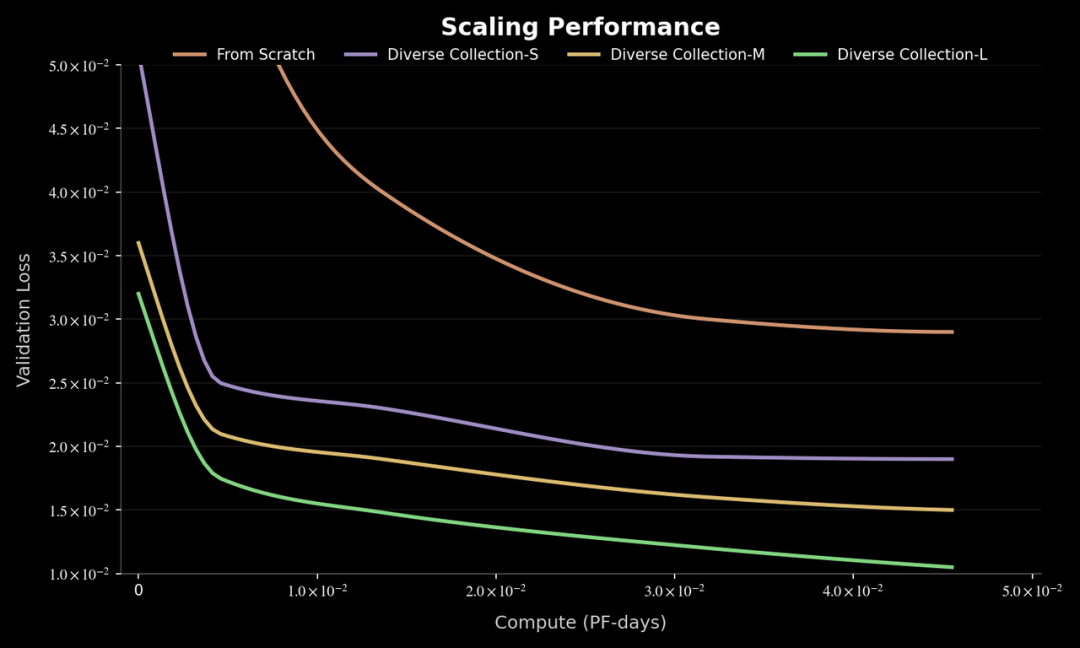
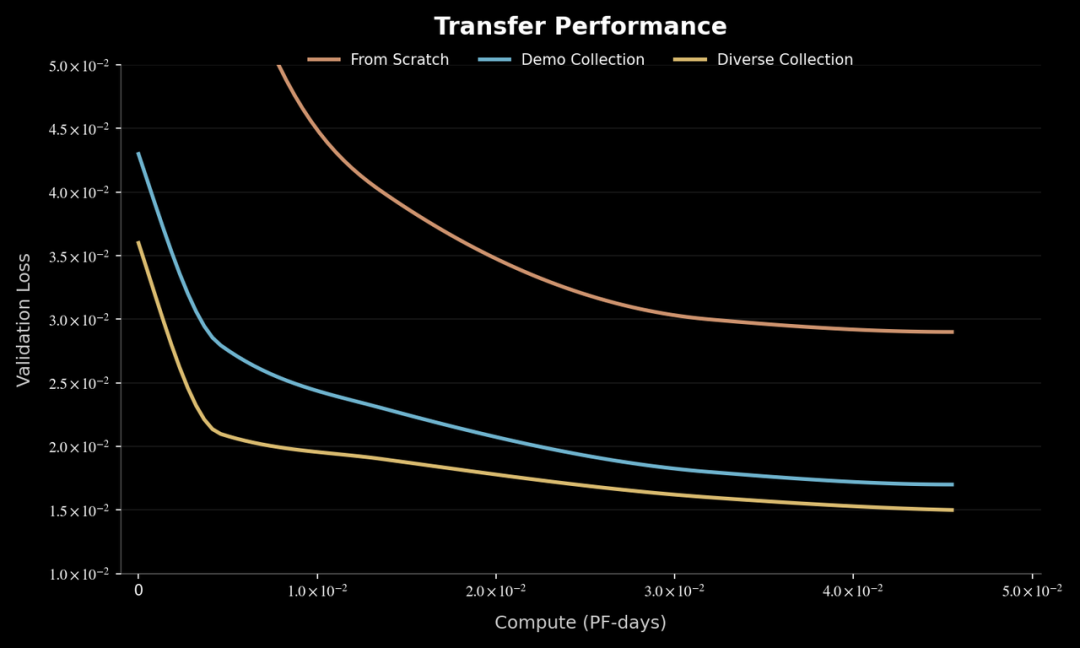
More critically, Spirit AI has put forward a counterintuitive thesis: Dirty data is the key to scaling VLA models. Through training on diverse "imperfect data," the team discovered a steeper Scaling curve — data diversity matters far more than "cleanliness" itself. It is this data logic that places Spirit AI's focused VLA technical approach in high resonance with global leaders like Google DeepMind and Pi, confirming the foresight of its technical positioning.

Team and Commercialization: Scarce Assets and the "Capability Export" Model
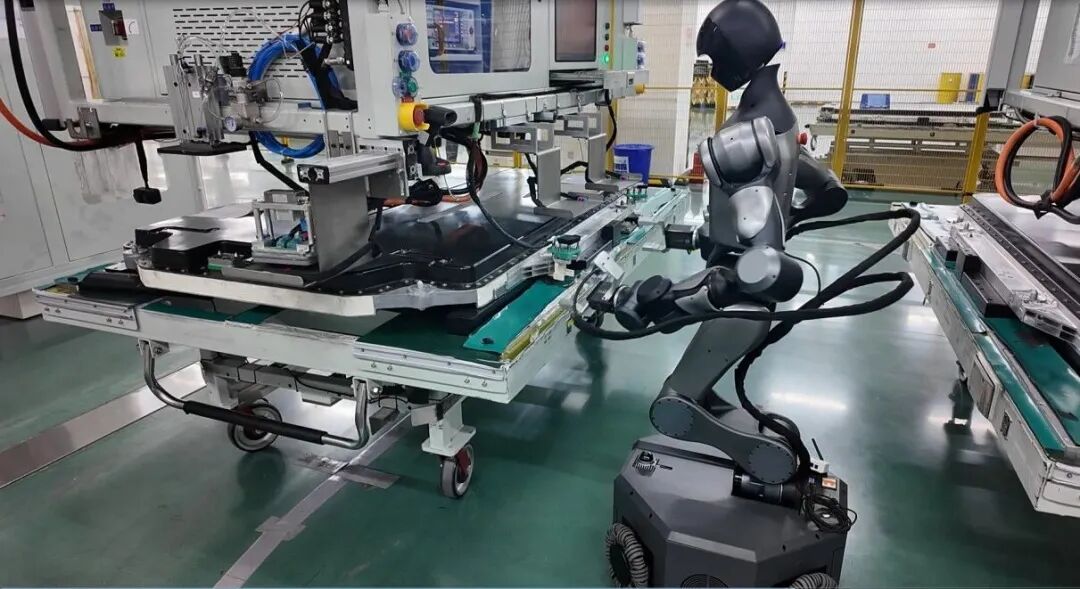
Spirit AI has achieved strong breakthroughs in commercial deployment: the world's first humanoid embodied intelligence production line is now operational at CATL's Zhongzhou base, with the Xiaomo robot serving as core equipment. Nearly a thousand battery units have been produced with zero failures, with operation cycle times matching or exceeding skilled human workers — demonstrating millisecond-level rapid adaptation to production uncertainty and flexible manipulation capabilities surpassing humans. Built on 100% self-developed full-stack technical moats and massive process data accumulation, Spirit AI has not only established industry barriers but also pushed "capability export" to the extreme: moving from pure hardware sales to exporting full-stack perception, decision-making, and execution capabilities, rapidly customizing for different production lines and enabling global scalable replication. Future coverage will extend to multiple battery types and process segments, fundamentally reshaping the commercial boundaries of new energy manufacturing.
In commercial applications, the partnership with JD.com further extends these boundaries. The Mozi robot replaces humans for interactive demonstrations and product operation showcases in JD retail scenarios, with both parties jointly exploring the deployment potential of JD Cloud and the Joyinside large model across JD's extensive retail network — achieving bidirectional empowerment between technology R&D and application scenarios.
Behind these commercial results lies Spirit AI's deep accumulation in core capabilities. Industry consensus holds that embodied intelligence competition is, at its essence, competition among top model teams. Spirit AI fields what has been called an "unreplicable AI dream team" — members largely from UC Berkeley, Tsinghua University, Peking University, and other top institutions, with an average age under 30, yet already possessing deep academic and engineering DNA in multimodal large models, robotics, reinforcement learning, imitation learning, and other core embodied model domains. The team not only continuously delivers core contributions to international open-source communities but also possesses full-chain capabilities spanning "model-algorithms-hardware." It is this young, scarce team that underpins the technical confidence behind Spirit v1.5 surpassing Pi0.5. One investor assessed: "Spirit AI's team is configured to compete in the same tier as Pi and Google DeepMind."
Following this funding round, Spirit AI will continue increasing investment in foundational embodied models and real-world data systems, while deepening industrial ecosystem partnerships. From task-level intelligence to general embodied models, from simulation to real-world-driven development, embodied intelligence is entering a critical phase of technical industrialization. Industry observers note that when machines truly gain the capacity to understand the physical world, human-machine collaboration, production processes, and even the efficiency of social operations will undergo profound transformation — and companies like Spirit AI are becoming important starting points for this change.