Tell me a story, the kind that breathes.

Oasis Capital's Anniversary: Our New Translation of *The Man Who Planted Trees*

Oasis Capital was founded on October 9th, its name evoking the idea of "ten out of nine perfect." In this world, the crooked becomes whole, the bent becomes straight — leave the remaining one to the short-sellers, for nine out of ten is more than enough. The past year has brought me much, and among these gifts, the story Jamie shared with Oasis has been profoundly influential. As this anniversary arrives, I have nothing grand to offer in celebration, only gratitude. And so we share this story with you.
Preface
It began with the fundraising for a USD fund. Jamie and I first met at the Oasis office in Shanghai. Two hours passed like the blink of an eye. He asked only one question: "At the final moment of an investment decision, what pulls the trigger?" "Vitality — the innate resilience and capacity for evolution that entrepreneurs carry within themselves." Entrepreneurship is a form of spiritual practice. How far one ultimately goes depends not on background, experience, or resources, but on self-awareness, self-endurance, and continuous evolution. This is what distinguishes life from matter. This is "vitality."
Investing is like planting trees. Every entrepreneur is a seed in the soil of their era. Amid structural shifts in the times, some places become fertile ground, and seeds rich with vitality break through, sprout, and grow. This is heaven's grace, and also vitality's own expression. Capital is like water — used well, all things flourish; used carelessly, haste makes waste. And all of this must follow the objective laws of how things develop. So Oasis likes to set closing dates on the solar terms: Miaoyou closed on Rain Water, Shouhoubao on Grain Full. Diligent labor, praying for the year to come.
After Jamie returned to England, he sent a book — The Man Who Plants Trees — about an old countryman who persistently planted acorns, decade after decade, until woods became forest, stretching on without end. This is a story about vitality, long-termism, and time. This is a story about Oasis.
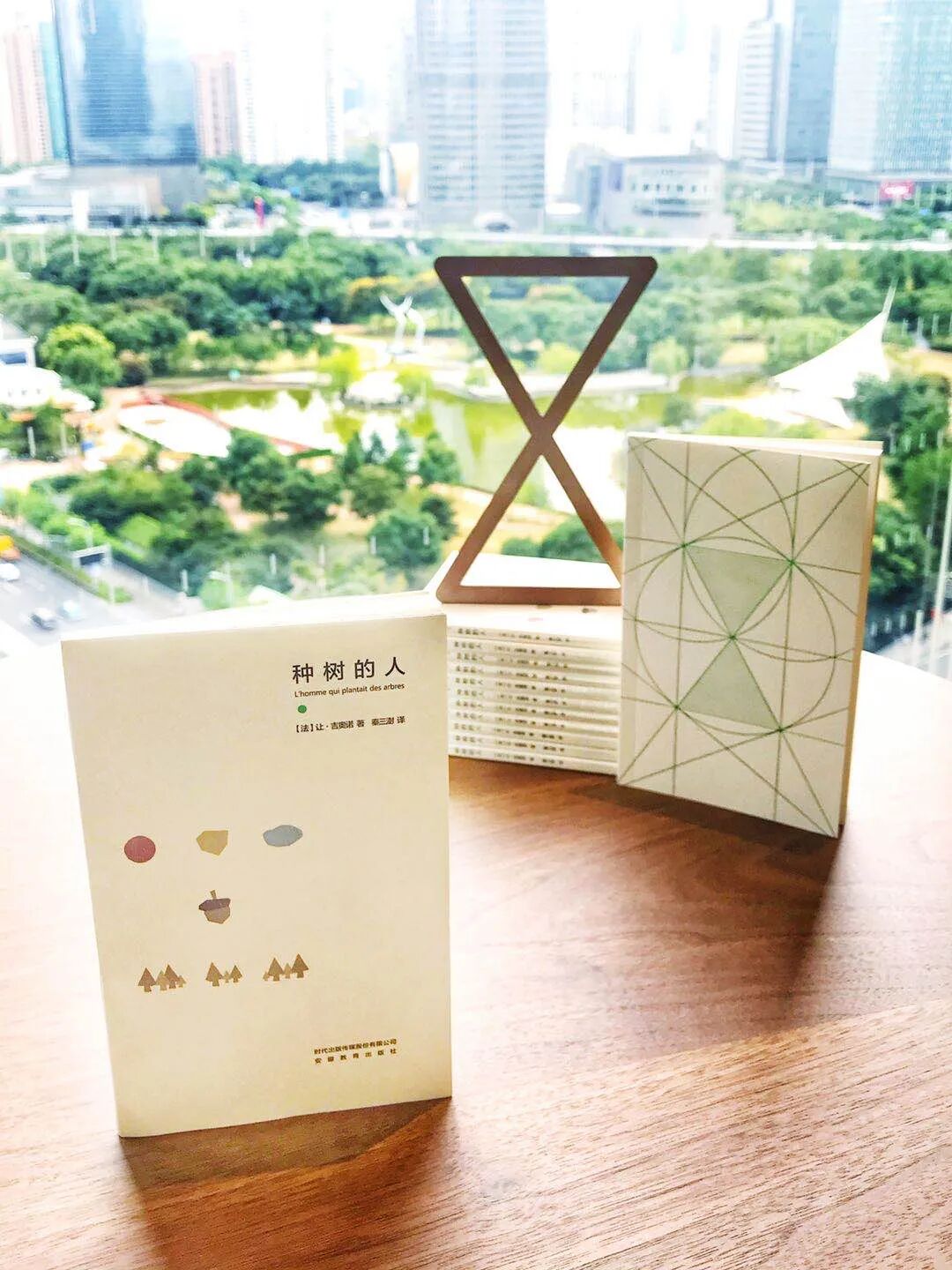
Yet I found that Chinese editions on the mainland were mostly categorized as children's books. So I turned to my friend Mr. Eniao, founder of Federal Gallop and designer of Villain Motorcycles. He is an odd man, for his meditation practice is reading — he finishes a book every morning. Over the past decade or so, he has read roughly 4,000 books. He said, "When I reached 1,000 books, I realized all things are connected." Yet this odd man was also moved by simplicity. So he took it upon himself to find a translator, using the original French as the base, to produce a new Chinese edition: The Man Who Plants Trees (Zhong Shu De Ren). I hope you will enjoy it.
Below are the prefaces by Jamie and Mr. Eniao. Enjoy:

Jamie Cayzer-Colvin
Who doesn't love a story? For thousands of years, storytelling has been the common thread running through the world's rich and varied cultures. Every region, every religion, every culture — none can resist the allure of a good story. Stories know no geographic boundaries; they travel from country to country, wearing only the lightest veil of regional difference.
I have always loved simple stories, especially those that contain profound truths within their simplicity. The Man Who Plants Trees is such a story. Now that humanity has finally awakened to recognize the damage we have done to our planet over so many centuries, this story feels more significant than ever. I believe Elzéard Bouffier can be a guide and mentor to us all. For only through the efforts of each individual can we heal this wounded, ailing world.
A solitary man scatters seeds. Seeds become towering trees. Trees expand into a wood. The wood evolves into an ecosystem. Eventually, he creates a climate zone. Such is nature. One determined man proved that the astonishing power of compounding applies not only to finance or numbers — compound interest. Albert Einstein called compounding the eighth wonder of the world, but in the hands of men like Elzéard, compounding can become our salvation.
This story has been published many times under several different titles, but I feel the one that best captures its essence is The Man Who Plants Hope and Harvests Happiness. Sadly, in today's globally connected world of instant gratification, happiness is ever harder to find. Only a life of fulfillment brings happiness. Elzéard also reminds us of the immense power of silence and contemplative meditation. "Is there one word that can serve as a guide for the whole of life?" Confucius replied: "Is it not 'reciprocity'?"
This story lingers on the palate like fine champagne or a delicious hot pot, so whether it is literally true matters less and less.
My acquaintance with Jinjian was somewhat like Elzéard's encounter with the story's narrator — half intentional, half accidental. Like all travelers and those with curious minds, our two hours of conversation passed in what seemed an instant. We discussed shared interests, exchanged views and understanding. I felt something like a modern Marco Polo, seeking investment opportunities in China while thoroughly enjoying listening to a traveler's tale.
The Man Who Plants Trees is the story I shared with Jinjian. He saw in it what I saw. So I invite you, dear reader, to appreciate, learn from, and share this simple yet deeply moving story — and to share your own stories in turn.

Eniao
To call it a thought-provoking allegory is to say less than it is. It is better described as a crystal bearing a hidden image. The former generally refers to a narrative method, a plot with rises and falls; the latter, we might say, is a structure capable of cleansing and reviving the soul.
In the unprecedented pandemic of 2020, we all know there was a crucial device called an ECMO machine, using machinery to replace human effort in providing basic life support like respiration and chest compressions. A good story is an equally rare revival machine for the soul. Especially in this fragmented world of clamor and restlessness, where our minds, interacting with things, wear against and grind upon each other; interacting with people, engage in daily mental strife — toiling all our lives without seeing success, exhausted in servitude without knowing where we are bound.
When we enter this story, this crystal, we place our minds in a cascade of language, allowing them to be reshaped by an external narrative. Language, carrying ignorance and unenlightenment, flows away, and slowly an "image" takes form in the heart — that dim, indistinct image, not a concrete "worldly appearance." Zhuangzi also said: once formed, we do not perish but wait for exhaustion. When the mind settles in the body, that "qi" becomes bound by form, unable to flow freely, until death. So first there is form, then transformation of form, then form becomes image. This is the twofold meaning of "manifestation" and "concealment" in story.
I want to point out this hidden image — how the shepherd in Jean Giono's pen, through planting trees, arrived at the true meaning of happiness, and cultivated a forest of time.
Ordinary yet great. Many people read with too strong a utilitarian impulse — hoping one book will yield the ultimate answer to life's meaning, free will, what fate is. Yet great people or sages have always avoided such grand questions, instead starting from the details of daily life, from the minute, repetitive labor you face every day. For they know that daily life is where great change will occur.
Simple yet open. Because it is simple, without intention, without strategy, honestly and simply applying one's craft, it becomes open. Every strategy or calculation, every plan, locks down a territory. When there is no plan, you break through those artful tricks. For the mining of a kind of energy is both temporal and pervasive; strategies and tricks choose only one. Even the optimal choice can mine only a small fraction of the energy. As the book says: these are oaks planted in 1910, birches in 1915, beeches in 1920, oaks in 1930 — they merge into one, becoming a forest. Time becomes visible before simplicity. The past can be glimpsed in the present; the future unfolds from the present. At the book's end, the forest unfolds, springs and rivers grow clear, air and environment become pleasant, people begin to rebuild, the village shines again — this is ecological pervasiveness. All this, only because of simplicity, only because of planting that seed.
Entering the flow, without dwelling. "Entering the flow" is consciously, without self, entering the present moment. These moments follow one another, forming a flow, a way — like each instant of a bird's flight, allowing us to glimpse the way of flight, the trace. And the shepherd's flow is the cascade of seeds. One seed grows into a tree; one tree bears more seeds; more seeds grow into more trees — this is the cascade, endless life. Enter this seed-flow, this lively vitality, and it arises in the present moment. "Without dwelling" means facing all circumstances in the world, yet remaining unaffected. The shepherd in the book, day after day, single-mindedly planting trees, was not affected by World War I or World War II; nor did he dwell on the fact that his trees would be cut down for a highway. He simply followed this seed-flow onward, flowing along, and so could move with time.
This is the hidden "image" behind the story. Like Jinjian, who seemingly lightly entrusted this book to me — yet this green "image" has already flowed from one person's heart to another's, and will soon flow into more hearts, endlessly. And this book is also the first seed we have planted for that oasis. They will follow one after another, forming a flow, and the "Oasis Reborn Classics" series will in turn unfold into a forest of time, its green shade spreading everywhere.
Welcome to share your most vital story or moment in the comments below this article, or leave comments on other articles on our WeChat account. For the first 50 selected commenters, please leave your information in our backend, and we will send you a copy of The Man Who Plants Trees. May the spirit in this book, through your hearts, spread green shade everywhere.
In praise of vitality.
Oasis Capital is a new-generation Chinese venture capital firm, dedicated to discovering the most vital entrepreneurs of China's next decade, growing alongside them to create long-term value. "In praise of vitality" is Oasis's vision and mission. This vitality is both the direction of structural transformation in the times, and the force of entrepreneurs' resilience and evolution.
Oasis Capital focuses on early and growth-stage investments, with check sizes ranging from $3 million to $30 million USD, concentrating on education, healthcare, enterprise services, and other technology-enabled service sectors, supporting China's technology-driven new service upgrade.