Signal-to-Noise Ratio in Investment Decisions

*The Signal and the Noise* Series 3
This article originally appeared on 42章经 (42Chapters).

This article is adapted from a 42Chapters offline event titled "Signal-to-Noise Ratio in Decision-Making."
The market was cold in 2019–2020. Some chose to leave, some to lie low, some to change. Growing from Trustbridge Partners, where he wrote Signals and Noise in Investing, to Oasis Capital as discussed in this article — this was not an easy decision. Here, Jinjian Zhang shares his methodology for core decision-making in the venture capital market.
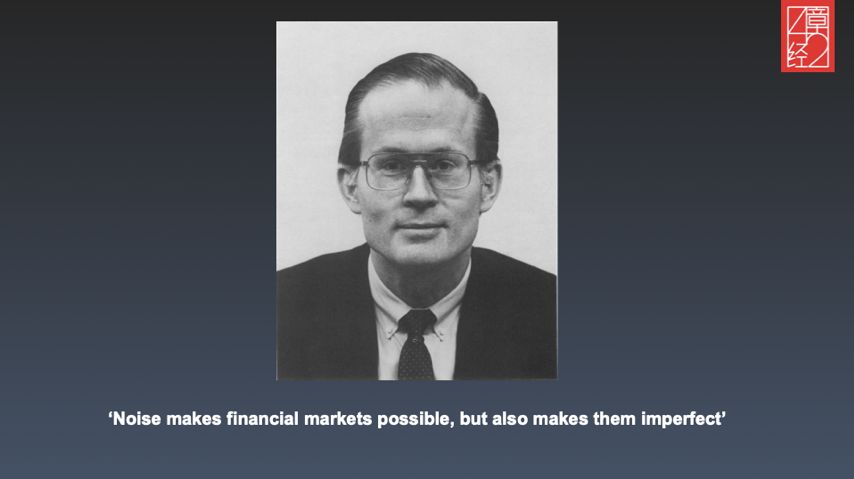
Noise creates the possibility for financial markets and makes them imperfect. — Fischer Black, quantitative economist
Markets are saturated with signals and noise.
We all know to chase signals and discard noise. Yet without noise, there would be no trading. Imagine if everyone had the same signal — when you wanted to buy, no one would sell, and no transaction could occur.
So noise actually drives the ecosystem of our entire venture capital industry. But last year, noise suddenly diminished, and noise traders dwindled too. Market liquidity weakened, and everyone grew anxious and confused.
When overall market liquidity declines, "doing something" always gives us a sense of security. But striving to find exclusive information and trade on it inevitably turns you into a noise trader.
Actually, we should more fundamentally reconsider what signals are when noise decreases.
So the best approach right now is to stay quiet — and in that quiet, continuously improve the signal-to-noise ratio in our decision-making.
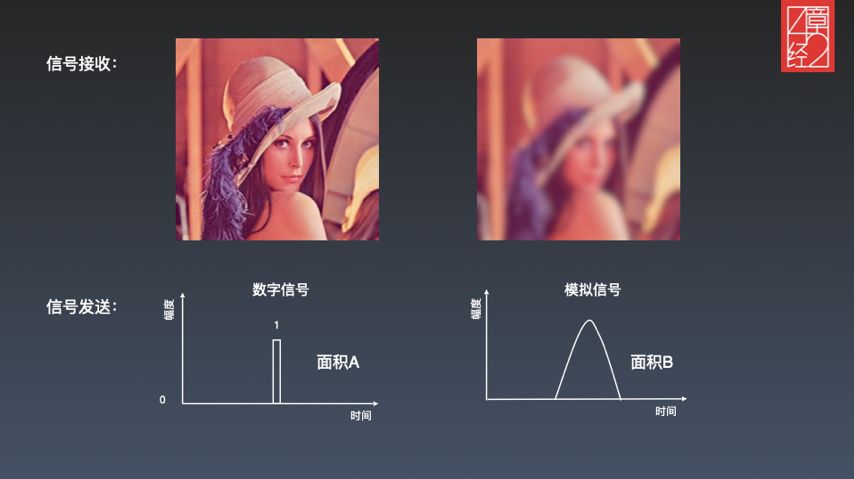
What is signal-to-noise ratio? Let's look at the image above.
On the left is the information we ideally want to receive; on the right is what we actually receive. The gray area A on the left represents ideally consumed power; the right side shows actual consumption. You can see that noise-generated "redundant" information not only affects quality but also consumes energy.
Unfortunately, human thinking more closely resembles the analog circuit on the right rather than a digital circuit — our expression tends toward "redundancy" rather than "concision."
More unfortunately, since it's an analog circuit, it's constrained by different circuit board designs and component choices. For us, that means being limited by our upbringing, experiences, and personality traits, which further increase system noise in communication.
As mentioned in the previous article Signals and Noise in Investing, a college roommate once mustered the courage to write a love letter to a girl he secretly admired (who also secretly admired him). Six pages, detailing his life story and unwavering patriotic aspirations, ending with: "You matter too." He mailed it, stayed up all night excited, while the girl cried all night thinking she'd been gently rejected.
Another example: when discussing an investment, if you ask someone whether they'll invest, what you need is a 0 or 1. But usually they'll tell you, "There's huge opportunity here — points 1, 2, 3 — but also risks, points 1, 2, 3, 4, 5."
You ask again: invest or not? The final answer might be: "Shall we talk about price?"
In this example, much of the information is noise, while the signal remains unexcavated, so the conclusion ends up ambiguous.
So signal-to-noise ratio is the proportion of signal to noise in information — mathematically, signal power divided by noise power. The larger this number, the higher the signal proportion and the better the information quality.
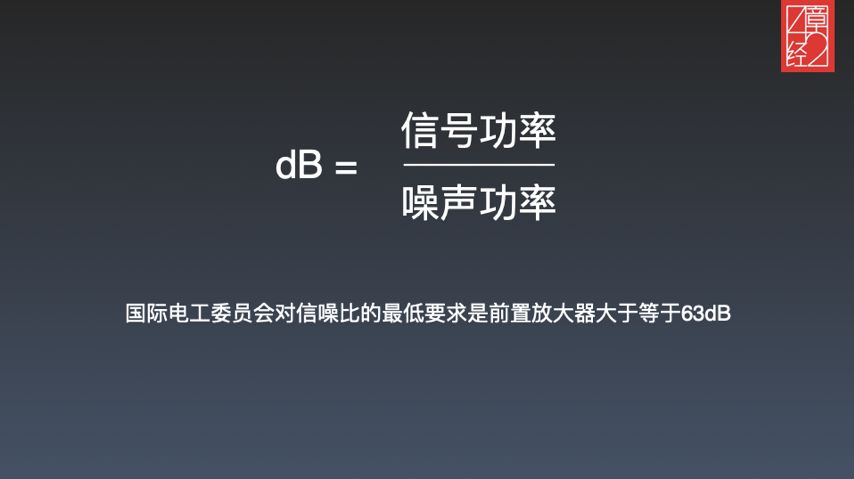
However, all components generate noise when emitting a signal — it's just a matter of proportion.
So in investing, where we make decisions daily, how do we effectively filter signals and improve signal-to-noise ratio?
The "brain" faces similar problems every day.
Limited by human processing capacity, we cannot handle all information collected by the retina. So humans solve this through two methods:
- Ignoring information at the edges of the retina;
- "Focusing" on processing information in specific regions.
So even though we can see an entire book, we can only "read" one line of text. The latter is the "attention" mechanism evolved by humans. This mechanism greatly improves the "signal-to-noise ratio" in visual information processing.
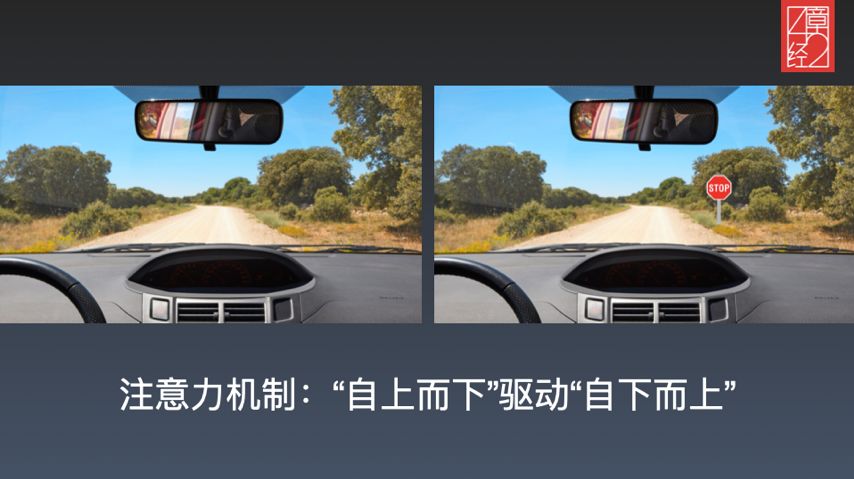
In the image above, for instance, a driver quickly "focuses" on the red "STOP" signal while directly ignoring other information. Computers differ — with unlimited computing power, they perform global analysis rather than rapid focusing.
Simply put, the attention mechanism is a "top-down" strategy driving "bottom-up" processing.
In investing, "top-down" is inductive reasoning: finding internal connections and common characteristics between things, inducing universal features. For example, what traits do excellent entrepreneurs share, what business models do high-quality projects follow;
"Bottom-up" is deductive reasoning: finding external differences and distinct characteristics between things, deducing individual conclusions. For example, what resources would this entrepreneur seek in this environment, what transformations would they make;
The former requires large-sample abstract summarization ability; the latter requires insight and imagination in specific events. Each has strengths and weaknesses — let's elaborate.
Facing small samples in life, "bottom-up" is more flexible, so deductive reasoning is our primary daily strategy:
For example, in daily life, if you need to choose one from three renovation suppliers, what's the best strategy? Meet all three, and you'll naturally reach a conclusion. The core of this strategy is comparison — finding the "globally optimal" solution through "comparison."
Of course, some merchants exploit this. The classic Economist subscription three-option example:
- Digital edition, $59/year
- Print edition, $125/year
- Digital + print, $125/year
Who would you choose? Without option 2, who would you choose? Option 2's appearance makes option 3 the globally optimal choice.
But everyone should know that this comparison is actually the largest source of noise in life and decision-making. Because in this process, we constantly confirm our choice is the best through comparison, and as comparison options multiply and system complexity increases, we fall into an overloaded system.
Just like between people — before graduation, maybe you just compared grades. After graduation, grades can no longer sustain comparison, so it becomes compensation, social status, reputation, your wife, your son — from one point to a hundred points. This is the source of ever-increasing peer pressure.
So the bottom-up comparison method fails when facing large-sample environments.
For example, if today you're told there are one hundred top doctors in China, you can only choose once, and this choice may determine the length of your remaining life — how do you make this choice? Would you spend two years meeting all one hundred? Even after meeting them all, you might not be able to choose through comparison.
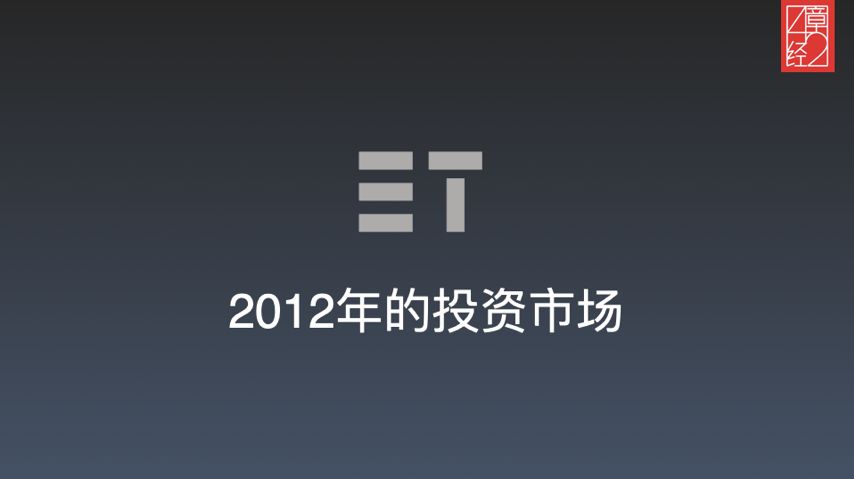
The venture capital market in 2012 was precisely a small-sample environment. Simplified, like the image above, China's entire market in 2012 might have been just these five companies — vertical bars represent valuable companies, horizontal bars represent worthless ones.
The ecosystem was also immature then. Take FA (financial advisory) institutions — there were only a few in all of China. You only needed to know one to understand all market changes. At year-end, all investors sat together, everyone knowing which projects raised money that year, how this project was doing — everyone had seen all the projects.
At this time, the "bottom-up" comparison strategy was the best method. The entire market was small enough that you could see all projects in a short time. You just needed to meet all five projects to naturally know which was best, making decisions through comparison. So "sourcing" was the core of this stage.
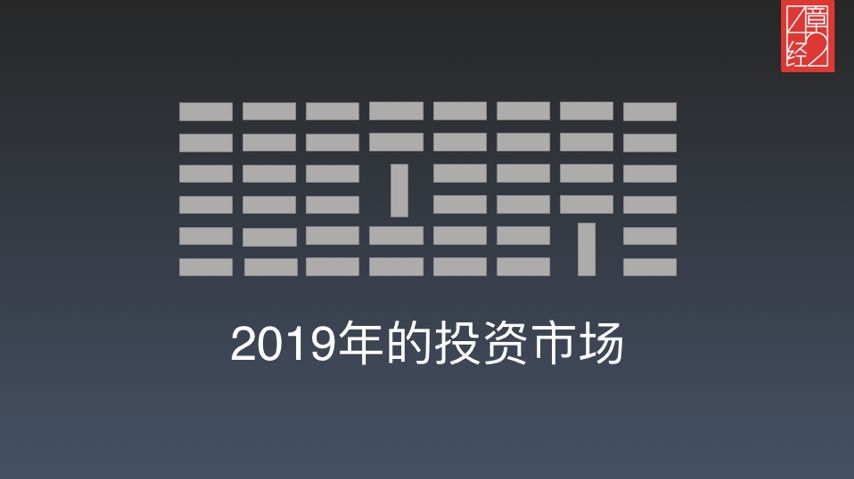
But today the market has changed. Today's market has become like the image above — a large-sample environment.
Some people happen to meet all companies in one column (all poor targets) and say, "Oh no, there's no more innovation in this market," because not one company is worth investing in. Others happen to meet three companies and find good targets, saying "This market is fantastic, it's absolutely springtime."
For our past bottom-up comparison strategy, if we still want to find these two most valuable investment companies in this market, what do we do?
Since the strategy is comparison, we cannot "miss" anything, so investment organizations began expanding around "sourcing." Some organizations divided by horizontal units (sectors), others by vertical units (industries). Attempting through grouping to divide one image into groups one, two, ... seven, eight, with each group having a leader, and leaders discussing with each other to reach conclusions about what to invest in this year.
But at this point, what problems emerge?
First, no one can see the global information — meaning no one can compare based on global information. If what you're comparing differs from what I'm comparing, how do we cross-validate?
Second, when information dimensions multiply, single comparison methods no longer suffice. We must continuously add "comparison points." As "comparison points" increase, noise follows, and the market begins to fragment.
There are two more points here.
The first is the structural differences of individual components mentioned earlier.
When one person can no longer cover the entire market, they can only hire more people to do it. So you'll find that hierarchies in China's VC industry have grown increasingly layered — unlike America's Benchmark, which to this day only has partners and analysts.
But many people forget something: any component generates noise when emitting a signal.
The second is that too many comparison objects cause entire system overload.
Like last year — suddenly one day, you feel how cold this market is. You find many people around you suddenly exhausted, lost. It's because under high-liquidity stimulus, the system could no longer support such massive information gathering.
As we mentioned before, "noise differs in every case, signals seek sameness." When samples grow large and comparison becomes impossible, we need to find sameness to find signals.
And "top-down" inductive reasoning precisely explores commonalities between large-sample things, not differences.
We call these commonalities features, and these features constitute the essence of things. We often mention retrospection — retrospection is the process of continuously summarizing success and failure features through inductive reasoning, thereby understanding essence.
For individuals, it's about what kind of life you want to live, what features can define it, which in turn guides decisions. For investment organizations, it's about what kind of entrepreneurs we seek, what kind of companies. Fast-growing or high-quality — ultimately, these essential features become the consistent behavioral principles of individuals and organizations, what we often call "vision, mission, values."
When we understand and are firm about essence, we unfold decisions around essence. When you decide to build a high-quality company while competitors choose high-growth, the organization knows their fundraising news is all noise. When you choose a simple yet joyful life while the era chooses noise and spotlight, you understand that their anxiety has nothing to do with you.
So with this winter and long holiday, what we should truly focus on is: as individuals and organizations, what is our foundation, what are our features, what is our essence.
This method can filter out massive noise, but its shortcoming is that this generality lacks application in specific events, becoming hollow and unimplementable.
The attention mechanism combines these two strategies — using pre-induced features of things to optimize the comparison process in specific cases. Driving deduction through induction, driving comparison through essence. Ultimately improving the signal-to-noise ratio in information.
Take the driving example from the beginning. Driving school teaches us features of danger signs, and in actual scenarios, when these features appear, the brain prioritizes processing this information while ignoring other information.
We often say "stay true to the original aspiration." This aspiration is the consistent feature throughout personal life, and this feature in turn guides daily specific decisions, reducing comparison-induced noise.
Now the market is cold, many feel there are no opportunities — this conclusion comes from "comparison." But when we return to "essence," is there really no opportunity in China's technology-driven consumer market?
Here, we return to two features: technology features and population features — have these two features disappeared?
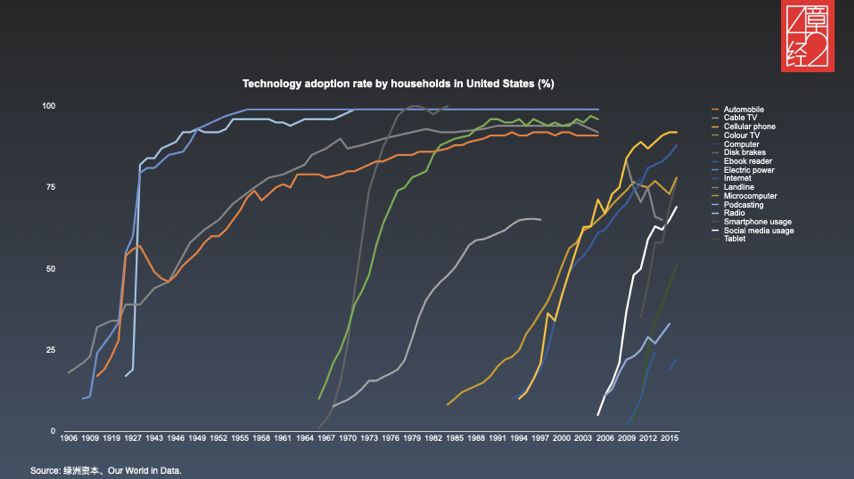
Let's first look at technology.
This chart shows penetration rates of major technology products in American households over the past 100 years.
"Electricity" took about 40 years to achieve widespread adoption, "mobile phones" about 20 years, "tablets" haven't completed adoption yet and appear to be on track for even faster penetration. We can see in this chart that technology penetration is becoming increasingly dense and steep.
Our exploration and innovation in technology will only become more frequent and rapid — from 0 to 90% will only happen faster and more unexpectedly. Especially in the coming decade, with the explosion of 5G, AI, blockchain, and many other technologies, we may usher in an entirely new era.
So for the technology feature, it hasn't diminished at all.
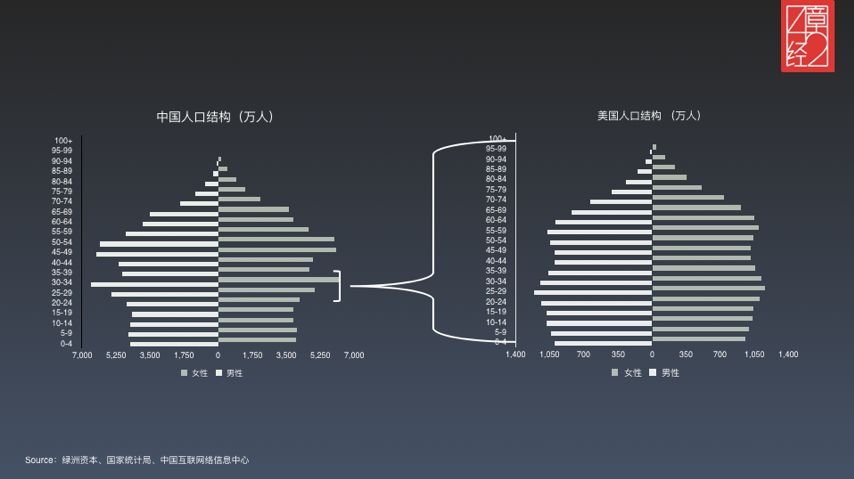
Now let's look at population.
The number of births in China between 1980 and 1995 over these 15 years roughly equals the total US population. Moreover, this special only-child generation is generating unique consumption demands due to their distinctive upbringing and social experiences.
On the other hand, China's population and industrial structure is also shifting.
For example, in the chart below, the United States as an agricultural powerhouse has approximately 3.2% of its population in the primary sector. After 1970, most tertiary sector population came from the secondary sector — mostly transitioning from factories, so today's US service industry is dominated by mid-to-high-end services.
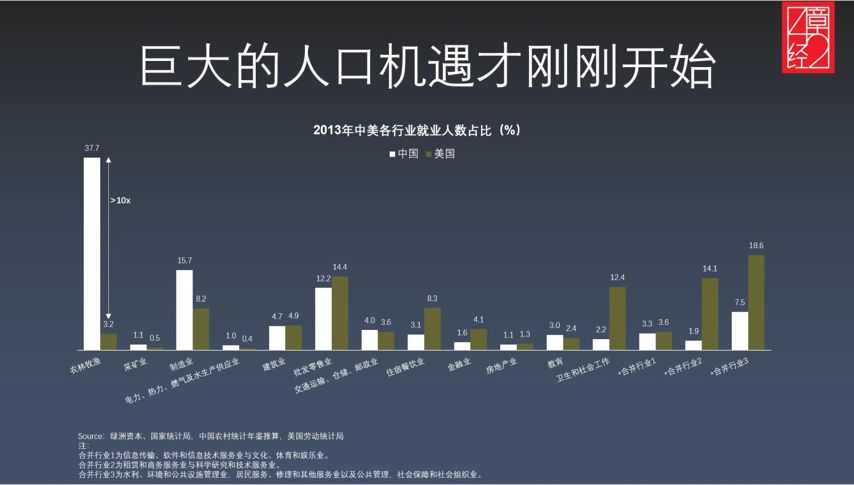
But China's tertiary sector population currently mainly comes from the primary sector — mostly low-end services. How many people remain in agriculture, forestry, and animal husbandry in China? 33.7%, compared to 3.2% in the US and 3.7% in Japan.
This nearly 10x structural difference will migrate over the next 20 years in China, creating massive transformation.
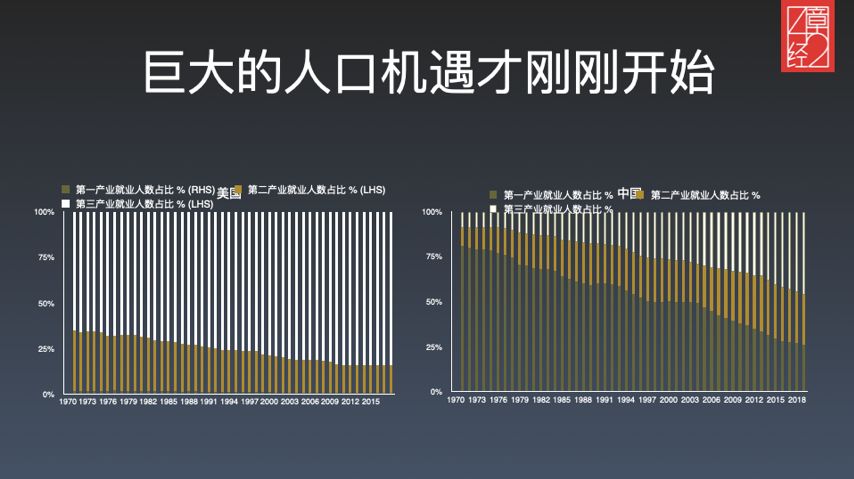
In this massive transformation, where do these people go, how do they stably adapt to new industries, how do we help them, what technology companies will benefit? There are many questions worth considering here.
So whether for technology or population features, noise may be increasing, but signals have not diminished. We hope the attention mechanism we mentioned can help everyone continuously improve the signal-to-noise ratio in investment and decision-making.
So in daily life and investment decisions, how do we continuously improve application of the attention mechanism? Based on what's been discussed, two points to summarize here:
First, know yourself.
Understand your upbringing, life experiences, and family relationships — better还原 yourself as original parameters and personality traits. These traits determine what we care about, what we like to compare. This is homework for yourself, and for organizational leaders regarding team and organizational development.
Only this way can we better utilize our own traits to improve decision quality.
Second, return to essence.
Lao Tzu said, "In pursuit of learning, one increases daily; in pursuit of the Way, one decreases daily." Continuously removing noise, returning to the most basic features of things — this is essence, this is the Way. Business has its Way, entrepreneurs have their Way. This Way involves a process of continuous simplification and belief.
For example, we strongly emphasize entrepreneurs' "vitality." Experience can be accumulated, skills can be purchased — only this power of life itself is innate. This is also the main difference between life and matter. But many people don't cherish this power, letting it be gradually eroded by noise.
There's an English word, "Vitality," which speaks to this "life force." Webster's Dictionary further explains it as life's ability to endure and evolve itself. Beautifully said — this is also what we consider the most essential ability of entrepreneurs. How far an entrepreneur can go certainly doesn't depend on their background, experience, or resources, but on whether they continuously self-cognize, self-endure, and evolve. We hope to discover these vital entrepreneurs and build bridges of vitality — this is the origin of our fund name Vitalbridge (Oasis Capital).
May every life protect this vigorous vitality above all else.
I'm glad to share feelings from the past year, and hope that in this era of noisy disturbances, we can all know ourselves, return to essence, and improve the signal-to-noise ratio in our decisions.
Finally, as 42Chapters says: return to simple living, think about the essence of things. Thank you all!

Oasis Capital is a new-generation venture capital firm in China, dedicated to discovering the most vital entrepreneurs of the next decade and growing alongside them to create long-term value. "Participating in and enhancing vitality" is Oasis's vision and mission. This vitality (Vitality) represents both the direction of era-defining structural transformation and the resilience and evolutionary power of entrepreneurs. Oasis Capital focuses on early and growth-stage investments, with individual investments ranging from $3 million to $30 million, concentrating on technology-enabled services in education, healthcare, enterprise services, and other sectors, supporting China's technology-driven new service upgrade.