The Universe Wants You to Be Ordinary | Oasis Signals

Jeff Bezos's Final Shareholder Letter

This is Bezos's final shareholder letter. All additional summaries are noise — this is the original text. Enjoy.
To Amazon Shareholders:
In Amazon's first shareholder letter in 1997, I wrote about our hope to build a "lasting franchise" — redefining what it means to serve customers by unleashing the power of the internet. I noted that Amazon had grown from 158 employees to 614, and that we had surpassed 1.5 million customer accounts. We had just gone public, with a split-adjusted stock price of $1.50 per share. I wrote: It's Day 1.
Since then, we've come a long way, and we've worked harder than ever to serve and delight customers. Last year, we hired 500,000 employees, bringing our global workforce to 1.3 million. We have over 200 million Prime members worldwide. More than 1.9 million small and medium-sized businesses sell on Amazon, accounting for nearly 60% of our gross merchandise sales. Customers have connected more than 100 million smart home devices to Alexa. Amazon Web Services (AWS) serves millions of customers, with an annual revenue run rate of $50 billion as of 2020. In 1997, we hadn't yet invented Prime, Marketplace, Alexa, or AWS. No one had even thought of these things. Their creation was anything but inevitable. For each one, we took enormous risks, and invested great ingenuity and sweat.
Along the way, we've created $1.6 trillion of wealth for shareholders. Who are they? Of course, my Amazon shares have made me wealthy. But more than seven-eighths of those shares, representing $1.4 trillion of wealth, belong to others. Who are they? Pension funds, universities, 401(k) plans — and Mary and Larry, who happened to send me this letter just as I sat down to write:
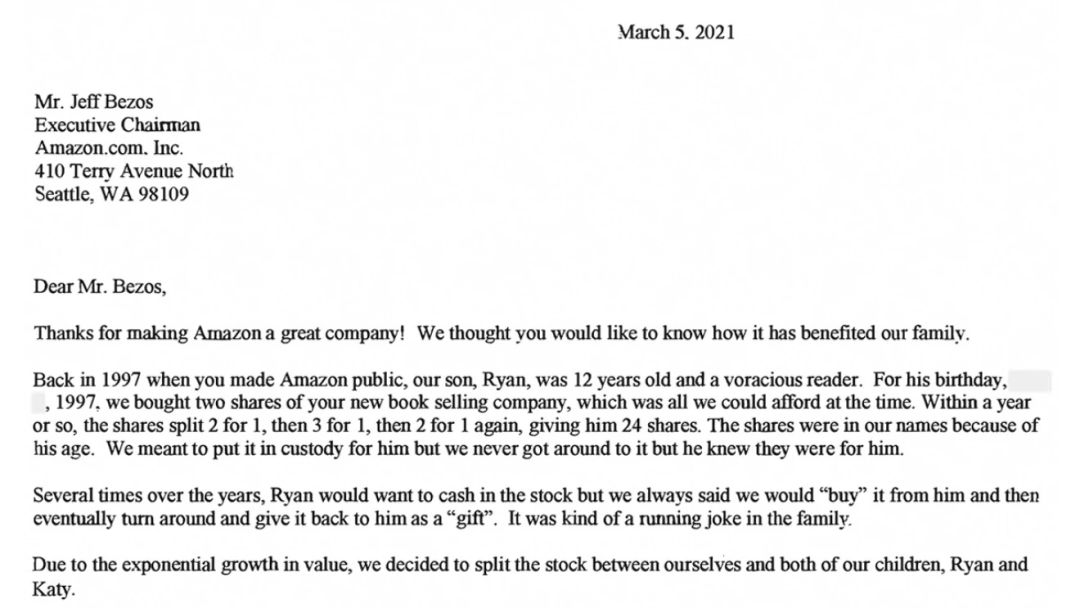
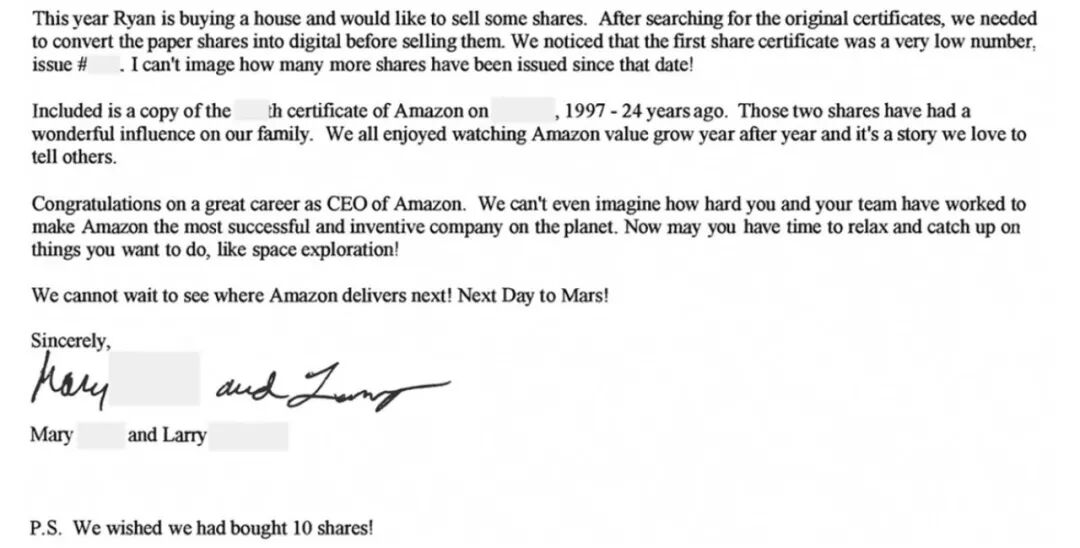
I hear stories like these constantly. I know shareholders who have used their Amazon investment to pay for college, to handle emergencies, to cover rent, to take vacations, to start businesses, to give to charity — the list goes on. I'm proud of the wealth we've created for shareholders. It matters. It improves their lives. But I also know something else: this isn't the largest part of the value we've created.
Create More Than You Consume
If you want to be successful in business (in fact, in life), you have to create more than you consume. Your goal should be to create value for everyone you interact with. Any business that doesn't create value for those it touches, even if it appears successful on the surface, isn't long for this world. It's on the way out.
Remember, stock prices are not about the past. They are a prediction of future cash flows discounted back to the present. The stock market has expectations. Let me pivot for a moment and talk about the past. How much value did we create for shareholders in 2020? This is an easy question to answer, because accounting systems are built for exactly this purpose. In 2020, Amazon's net income was $21.3 billion. If Amazon were a sole proprietorship owned by one person, rather than a publicly traded company with thousands of shareholders, this is what that single owner would have earned in 2020.
What about employees? This is also a relatively easy value creation question to answer because we can look at compensation expense. A company's expense is an employee's income. In 2020, Amazon employees earned $80 billion, plus another $11 billion in benefits and various payroll taxes, for a total of $91 billion.
What about third-party sellers? We have an internal team (the Selling Partner Services team) that exists to answer this question. They estimate that in 2020, third-party seller profits from selling on Amazon were between $25 billion and $39 billion. To be conservative, I'll use $25 billion.
On the customer side, we need to split this into consumer customers and AWS customers.
First, consumer customers. We offer low prices, vast selection, and fast delivery. But let's set all that aside for this exercise and focus on just one thing: we save customers time. On Amazon, 28% of purchases are completed in three minutes or less, and half of all purchases finish in under fifteen minutes. Compare that to the typical shopping trip to a physical store — driving, parking, searching store aisles, waiting in checkout lines, finding your car, driving home. Research suggests the typical physical store trip takes about an hour. If we assume a typical Amazon purchase takes fifteen minutes and that saves you a couple of trips to a physical store per week, that's more than 75 hours saved per year. That's significant. It's early in the twenty-first century, and everyone is busy.
So we can get a number. Let's value conservatively and say each hour is worth $10 (which is of course far below what most people value their time). Seventy-five hours times $10 per hour, minus the cost of Prime, equals $630 in value created per Prime member. With 200 million Prime members, that's $126 billion in value created in 2020.
Evaluating AWS customers is harder because each customer's workload is so different. But let's try anyway, with the caveat that the error bars are large. The direct cost improvements from operating in the cloud versus on-premises vary, but a reasonable estimate is 30%. Against AWS's 2020 revenue of $45 billion, that 30% implies customer value creation of $19 billion. What's tricky about this assessment is that direct cost reduction is the smallest benefit of moving to the cloud. The much larger benefit is the increased speed of software development, which can dramatically improve customer competitiveness and revenue growth. We have no reasonable way to estimate this portion of customer value, only to say it's almost certainly larger than the direct cost savings. Conservatively, I'll say it's the same, and value AWS customer value creation at $38 billion for 2020.
Adding AWS and consumer together, total customer value creation in 2020 was $164 billion.
To summarize:
- Shareholders: $21 billion
- Employees: $91 billion
- Third-party sellers: $25 billion
- Customers: $164 billion
- Total: $301 billion
If each group had an income statement representing their interactions with Amazon, the numbers above would be the "bottom line" for each. These numbers explain why employees work for us, why sellers sell through us, and why customers buy from us. We create value for them. And this value creation is not a zero-sum game. It's not simply moving money from one pocket to another. Invention and creation are the root of all real value creation, and the value created is the measure of innovation.
Of course, our relationships with these stakeholders and the value we create extends beyond dollars and cents. Money doesn't tell the whole story. For example, our relationship with shareholders is relatively simple. They invest and hold stock over a time horizon of their choosing. We provide guidance on annual meetings and proper voting procedures. Even then, they can ignore that guidance and abstain from voting entirely.
Our relationship with employees is a very different example. We have processes they must follow and standards they must meet. We require training and certifications. Employees must show up at scheduled times. We have extensive interactions with employees. It's not just about wages and benefits, but about all the other details of the relationship.
Regarding the recent union election, I think we need to do better for employees. While the vote was in our favor and our direct relationship with employees is strong, it's clear to me that we need a better vision for how we create value for employees — a vision for creating value for their success.
If you read some of the news reports, you might think we don't care about employees. In those reports, our employees are sometimes accused of being desperate souls, treated as robots. That's not accurate. They're sophisticated and thoughtful people who can choose where they work. When we surveyed fulfillment center employees, 94% said they would recommend Amazon as a place to work to a friend.
Our employees can take informal breaks during their shifts to stretch, get water, use the restroom, or talk to a manager, all without impacting their performance. These informal breaks complement their normal break time of 30 minutes for lunch and 30 minutes for rest.
We don't set unreasonable performance targets. Rather, we set achievable targets that account for tenure and actual employee performance data. Performance is evaluated over a long period of time, because we know that various factors can affect performance in any given week, day, or hour. If employees fail to meet performance goals over time, their managers work with them and provide coaching.
Coaching also extends to employees who are doing well and capable of taking on more responsibility. In fact, 82% of coaching is positive, provided to employees meeting or exceeding expectations. We terminated less than 2.6% of employees for inability to perform their duties (and that number was even lower in 2020 due to the extraordinary circumstances of the COVID-19 pandemic).
Earth's Best Employer and Earth's Safest Workplace
The fact is, the large team leading Amazon operations has always cared deeply about our hourly employees, and we're proud of the work environment we've created. We're also proud that Amazon creates jobs not just for computer scientists and those with advanced degrees, but for people who have never had that kind of advantage.
Despite what we've accomplished, it's clear to me that we need a better vision for our employees to succeed. We've always wanted to be "Earth's Most Customer-Centric Company." We won't change that. It's what got us here. But I am committing that we will also be "Earth's Best Employer and Earth's Safest Workplace."
In my upcoming role as Executive Chair, I will focus on new initiatives. I'm an inventor. It's what I enjoy most and what I do best. It's where I create the most value. I'm excited to work alongside the large team of passionate people we have in operations and help invent in this arena of "Earth's Best Employer and Earth's Safest Workplace." We have always been flexible on details, but stubborn and relentless on vision. When we've set our minds to something, we've never failed, and we won't fail here either.
Let's dive deep on safety. For example, about 40% of Amazon's work-related injuries are musculoskeletal disorders (MSDs) — sprains and strains, often caused by repetitive motion. MSDs are common in the kind of work we do and are more likely to occur during an employee's first six months. We need to invent solutions to reduce MSDs for new employees, many of whom might be working in a physical role for the first time.
Working Well is one such program, which we rolled out to 859,000 employees at 350 sites across North America and Europe in 2020. There, we train small groups of employees on body mechanics, proactive wellness, and safety. Beyond reducing injuries, these concepts have positive effects on everyday activities outside of work.
We're also developing new automated staffing schedules that use sophisticated algorithms to rotate employees among jobs using different muscle-tendon groups, reducing repetitive motion and helping protect employees from MSD risk. This new technology is central to a job rotation program we'll launch in 2021.
Our increased focus on early MSD prevention is already paying off. From 2019 to 2020, overall MSDs decreased by 32%, and MSDs resulting in time away from work were cut by more than half.
We've hired 6,200 safety professionals at Amazon. They use safety science to solve complex problems and establish new industry best practices. In 2021, we'll invest more than $300 million in safety projects, including an initial $66 million to create technology to help prevent collisions between forklifts and other types of industrial vehicles.
When we lead, others follow. Two and a half years ago, when we set a $15 minimum wage for hourly employees, we did so because we wanted to lead on wages — not follow the crowd — and because we believed it was the right thing to do. A recent paper by economists at UC Berkeley and Brandeis University analyzed the impact of our decision to raise starting pay to $15 per hour. Their assessment aligns with what we've heard from employees, their families, and their communities.
By raising our starting wage, we not only benefited our own employees but other workers in the same communities, boosting local economies across the country. The research shows that our wage increase led to an average hourly wage increase of 4.7% for other employers in the same labor market.
Our leadership work doesn't stop there. If we want to be Earth's Best Employer, we shouldn't be satisfied that 94% of employees say they would recommend Amazon as a place to work to a friend. We must aim for 100%. We'll do this over time by continuing to lead on wages, benefits, upskilling opportunities, and more.
If any shareholders are concerned that being Earth's Best Employer and Earth's Safest Workplace might dilute our focus on being "Earth's Most Customer-Centric Company," let me set your minds at ease. Think of it this way: if we can run two different businesses — consumer e-commerce and AWS — and do both at the highest standards, we can certainly do both of these as well. In fact, I'm confident they will reinforce each other.
The Climate Pledge
In early drafts of this letter, I laid out the case and offered examples to demonstrate that human-caused climate change is real. The arguments and examples were meant to be persuasive. But frankly, I think we can do without that now. You don't need to say that photosynthesis is real, or that gravity is real, or that water boils at 100 degrees Celsius at sea level. These things are simply true. So is climate change.
Not long ago, most people thought that fighting climate change would be expensive and would threaten jobs, competitiveness, and economic growth. We now know better. Smart action on climate change will not only prevent bad things from happening, it will also make our economy more efficient, help drive technological change, and reduce risk. In total, these can lead to more and better jobs, healthier and happier children, more productive workers, and a more prosperous future. Of course, this won't be easy — it certainly won't be. The coming decade will be decisive. The economy in 2030 will need to be vastly different from today's, and Amazon plans to be at the heart of that change.
In September 2019, we co-founded The Climate Pledge with Global Optimism because we wanted to help drive this positive revolution. We need to be part of a growing team of companies that understand the urgency and opportunity of the 21st century. Now, less than two years later, 53 companies representing nearly every economic sector have signed The Climate Pledge. Best Buy, IBM, Infosys, Mercedes-Benz, Microsoft, Siemens, and Verizon have all committed to achieving net-zero carbon across their global businesses by 2040 — ten years ahead of the Paris Agreement.
The Pledge also requires them to measure and report greenhouse gas emissions on a regular basis; implement decarbonization strategies through real business changes and innovations; and neutralize any remaining emissions with additional, quantifiable, real, permanent, and socially beneficial offsets. Credible, high-quality offsets are valuable, and we should reserve them to compensate for economic activities where low-carbon alternatives don't yet exist.
The Climate Pledge signatories are making meaningful, real, and ambitious commitments. Uber aims to be a zero-emission platform in Canada, Europe, and the United States by 2030. Henkel plans to produce 100% of its electricity using renewable energy. Amazon is making progress on our own goal to power our operations with 100% renewable energy by 2025 — five years ahead of our original 2030 target. Amazon is the largest corporate buyer of renewable energy in the world. We have 62 utility-scale wind and solar projects and 125 solar rooftops on fulfillment and sort centers globally. These projects have the capacity to generate over 6.9 gigawatts and deliver more than 20 million megawatt-hours of energy per year.
Transportation is a major component of Amazon's business operations and the hardest part of our plan to reach net-zero carbon by 2040. To help rapidly accelerate the market for electric vehicle technology and help all companies transition to greener technology, we've invested more than $1 billion in Rivian and ordered 100,000 electric delivery vans. We've also partnered with Mahindra in India and Mercedes-Benz in Europe.
These custom electric delivery vehicles from Rivian are already operating and first hit the road in Los Angeles this February. Ten thousand new vehicles will be on the road as early as next year, and all 100,000 will be deployed by 2030, saving millions of metric tons of carbon. One of the important reasons we want companies to join The Climate Pledge is to send a signal to the market that businesses should start inventing and developing new technologies that help improve the climate. Our purchase of 100,000 Rivian electric vans is a good example.
To further accelerate investment in the new technologies needed to build a zero-carbon economy, we launched the Climate Pledge Fund in June of last year. The investment program started with $2 billion to invest in visionary companies whose products and services will facilitate the transition to a low-carbon economy. We've already invested in CarbonCure Technologies, Pachama, Redwood Materials, Rivian, Turntide Technologies, ZeroAvia, and Infinium.
Separately, I've personally allocated $10 billion to help drive the systemic change we will need over the next decade. We'll support leading scientists, activists, NGOs, environmental justice organizations, and others working to fight climate change and protect the natural world. Late last year, I made my first grants from this fund to 16 organizations working on innovative solutions and mobility. It will take collective action from big companies, small companies, global organizations, and individuals, and I'm thrilled to be part of this journey and optimistic that humanity can come together to solve this challenge.
Differentiation Is Survival, and the Universe Wants You to Be Typical
This is my last annual shareholder letter as CEO of Amazon, and I have one last thing of utmost importance I feel compelled to share. I hope all Amazonians take it to heart.
Here is a passage from Richard Dawkins's book The Blind Watchmaker. It's about a basic fact of biology.
Staving off death is a thing that you have to work at. Left to itself — and that is what it is when it dies — the body tends to return to equilibrium with its environment. If you measure some quantity such as the temperature, the acidity, the water content or the electrical potential in a living body, you will typically find that it is strikingly different from the corresponding measure in the surroundings. Our bodies, for instance, are usually hotter than our surroundings, and in cold climates they have to work hard to maintain the differential. When we die the work stops, the temperature differential starts to disappear, and we end up the same temperature as our surroundings.
Not all animals work as hard as this to avoid equilibrium with their surrounding temperature, but all animals do some comparable work. For instance, in dry country, animals and plants work to maintain the water content of their cells, work against the natural tendency of water to flow from them into the dry outside world. If they fail they die. More generally, if living things didn't work actively to prevent it, they would eventually merge into their surroundings, and cease to exist as autonomous beings. That is what happens when they die.
While this passage is not intended as a metaphor, it's nevertheless a fantastic one, and very relevant to Amazon. I would argue that it's relevant to all companies, all institutions, and to each of our lives individually. In what ways does the universe pull at you to be typical? How much work does it take to maintain your distinctiveness?
I know a happily married couple who have a running joke in their relationship. Not infrequently, the husband looks at the wife with faux distress and says to her, "Can't you just be normal?" They both smile and laugh, and of course the deep truth is that her distinctiveness is something he loves about her. But at the same time, it's also true that things would often be easier — take less energy — if we were a little more normal.
This phenomenon happens at all levels. We all know that distinctiveness (originality, uniqueness) is incredibly valuable. We're all taught to "be yourself." What I'm really asking you to do is to embrace and be realistic about how much energy it takes to maintain that distinctiveness. The universe wants you to be typical, in a thousand ways, pulls at you. Don't let it happen.
You have to pay a price for your distinctiveness, and it's worth it. The fairy tale version of "be yourself" is that all the pain stops as soon as you allow your distinctiveness to shine. That is not real. The truth is that it's worth it, but don't expect it to be easy or free. You'll have to put energy into it continuously.
The universe is always trying to make Amazon more typical — to bring us into equilibrium with our environment. It will take continuous effort, but we can and must be better at maintaining our distinctiveness. I can't and won't promise this will be easy. I can and do promise it will be worth it.
As always, I attach our 1997 shareholder letter. It concludes with this: "We at Amazon.com are grateful to our customers for their business and trust, to each other for our hard work, and to our shareholders for their encouragement and support." That hasn't changed one bit. I especially want to thank Andy Jassy for agreeing to take on the CEO role. It's a hard job with a great deal of responsibility. Andy is brilliant and has the highest of standards. I assure you, Andy will not let the universe make us typical. He will muster the energy needed to keep alive in us what makes us distinctive. It won't be easy, but it is critical. I also predict it will be satisfying and frequently fun. Thank you, Andy.
To all of you: be kind, be original, create more than you consume, and never, never, never let the universe smooth you into your surroundings. It remains Day 1.
Jeff Bezos Founder and CEO, Amazon

Oasis Capital is a new-generation venture capital firm in China, dedicated to discovering the most vital entrepreneurs of the next decade and growing alongside them to create long-term value. "Vitality" is Oasis's vision and mission. This vitality is both the direction of structural transformation in the era and the resilient, evolving force within entrepreneurs themselves. Oasis Capital focuses on early and growth-stage investments, with individual ticket sizes ranging from $3 million to $30 million. The firm concentrates on technology-enabled services in education, healthcare, enterprise services, and other sectors, supporting China's new service upgrade driven by technology.