Tripo AI Open-Sources Foundation Model, Kicks Off "Open Source Month" | Oasis Vitality

Counselor on Vitality

In March 2024, VAST and Stability AI jointly open-sourced the 3D large model TripoSR. With its breakthrough capability of generating 3D models from a single image in just 0.5 seconds, it quickly became the go-to model for 3D creators worldwide.
Over the past year, open-source projects have continuously pushed the boundaries of the AI industry, vigorously driving academic research and the flourishing development of commercial ecosystems.
VAST has also kept iterating and upgrading the Tripo series: Tripo 2.0 launched in September 2024, followed by Tripo 2.5 in January 2025. These versions, trained on a ten-million-scale high-quality 3D-native database, have achieved continuous breakthroughs across generation speed, model precision, and success rates. Their exceptional geometric detail accuracy has redefined the technical ceiling of 3D model generation.
In our global technology exploration, we deeply understand that disruptive innovation in underlying architecture and breakthroughs in model capabilities are the critical development paths for foundation model teams. While continuously making Tripo a "more perfect solution" in closed environments, we should also transform ourselves into "fundamental particles" within the open-source ecosystem. An open technology ecosystem holds greater long-term value than a closed system.
Therefore, in March 2025, we launched the "Technology Open Source Month" initiative.
We will consecutively open-source eight major projects, covering the full technology chain from foundation generation models and core functional components to exploratory innovative ideas. We hope to build the world's first end-to-end open-source 3D generation system, and sincerely wish that researchers and ecosystem developers working in 3D generation can find inspiration and benefit from our work.

Today, VAST is open-sourcing two foundation 3D generation models: TripoSG and TripoSF.
TripoSG: A Major Upgrade, First to Implement MoE Transformer Architecture in 3D Generation
TripoSG is an RF-based MoE Transformer foundation model for 3D generation.
This open-source release includes the TripoSG 1.5B model weights and inference code, with an interactive demo available on HuggingFace.
Tests show that TripoSG's generation quality is roughly equivalent to Tripo 2.0, surpassing existing open-source 3D generation projects on the market. Its standout advantages are strong generalization in generation results and high stability when generating complex composite objects.
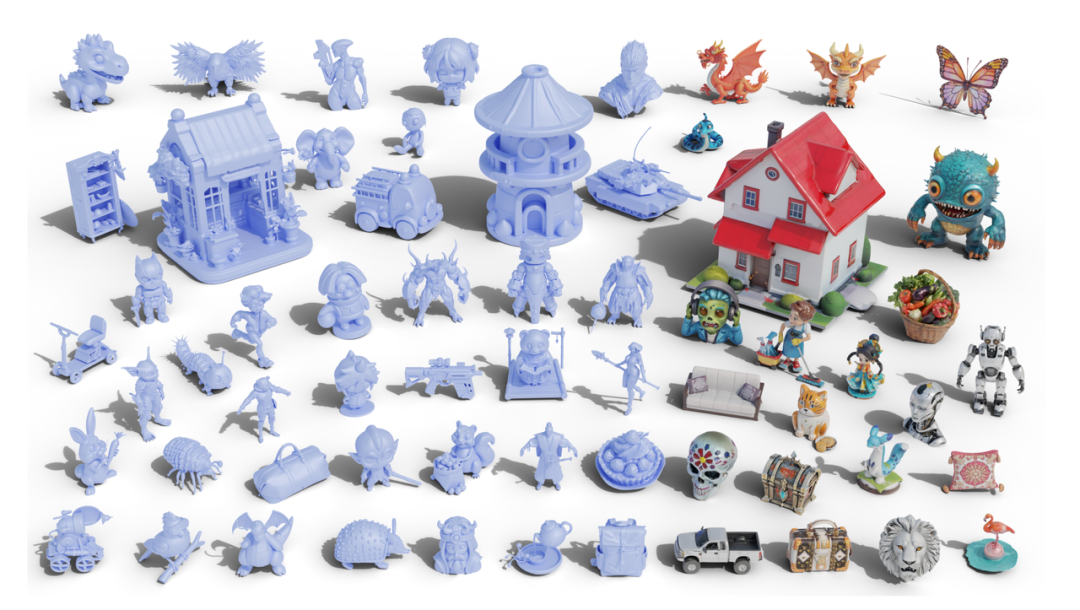
Adhering to the Scaling Law, higher-quality data, and larger models remain the key winning factors for TripoSG. We are sharing four approaches in TripoSG's efficient training path, architecture design, and data governance.
First, the pioneering application of Rectified Flow (RF)-based Transformer architecture to 3D shape generation.
Since developing Tripo 2.0, we found that compared to traditional diffusion models, rectified flow provides a simpler linear path modeling between noise and data, enabling more stable and efficient training. Combined with DiT, it offers better model stability.
Second, to more efficiently achieve scaling, TripoSG is the first MoE Transformer model released in the 3D domain.
This approach has been practiced in language, image, and video models before, but it proves equally effective in the 3D domain. This way, model parameter capacity can be significantly increased with virtually no added inference computational cost, with particular emphasis on deeper, more critical layers in the network.
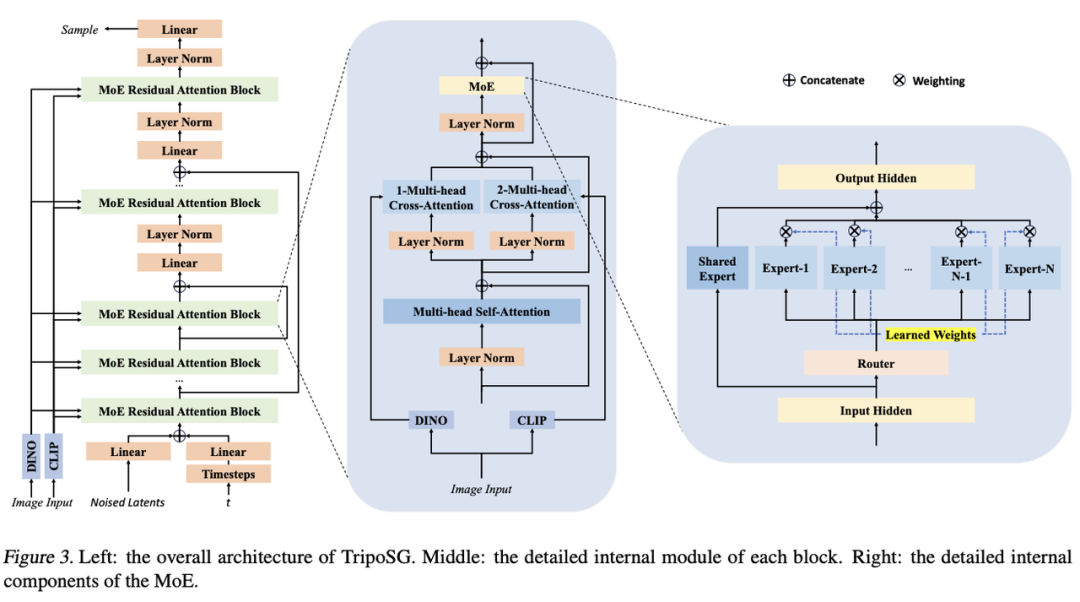
Meanwhile, with Transformer as the foundation, TripoSG incorporates key enhancement designs including skip-connections to improve cross-layer feature fusion. Additionally, an independent cross-attention mechanism can efficiently inject global (CLIP) and local (DINOv2) image features, enabling precise alignment between input 2D images and output 3D shapes.
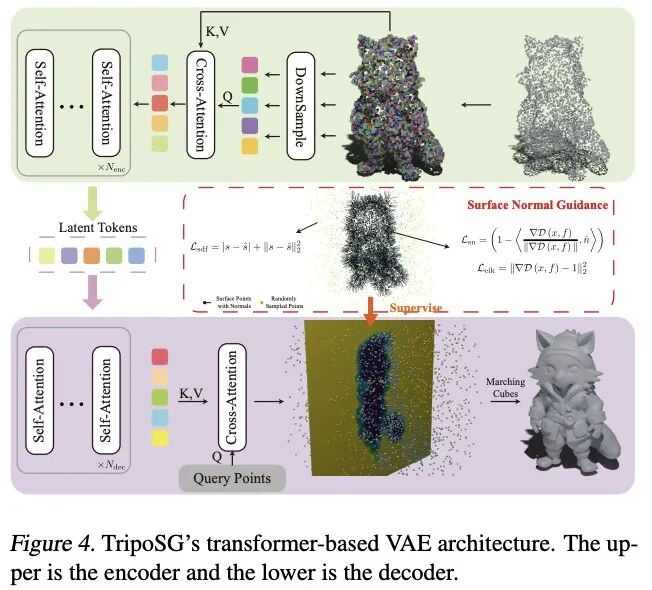
Third, seeking better geometric representations by developing a high-quality VAE with innovative geometric supervision.
We have been exploring better geometric representations. In TripoSG, we chose a VAE using Signed Distance Functions (SDFs) for geometric representation — offering higher precision compared to the previously common occupancy grids.
At the same time, the Transformer-based VAE architecture demonstrates strong generalization in resolution, capable of handling higher-resolution inputs without retraining.
Fourth, emphasizing data governance by developing a comprehensive, refined data construction and governance pipeline.
Data quality matters as much as quantity. VAST possesses the world's largest high-quality 3D-native dataset, and has simultaneously developed a complete data governance pipeline for the open-source community's reference.
The pipeline stages are as follows: Scoring — Filtering — Fixing & Augmentation — SDF Production
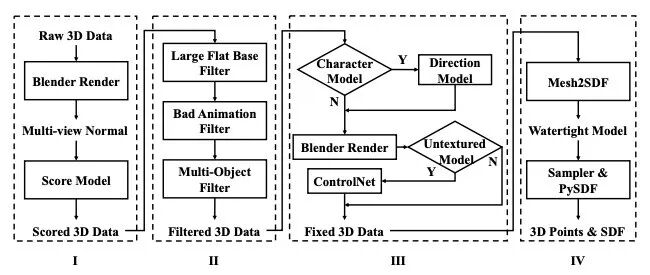
Through this process, we built a dataset of 2 million high-quality "image-SDF" training sample pairs for TripoSG.
Ablation experiments clearly demonstrate that models trained on this high-quality dataset significantly outperform those trained on larger-scale but unfiltered raw datasets.
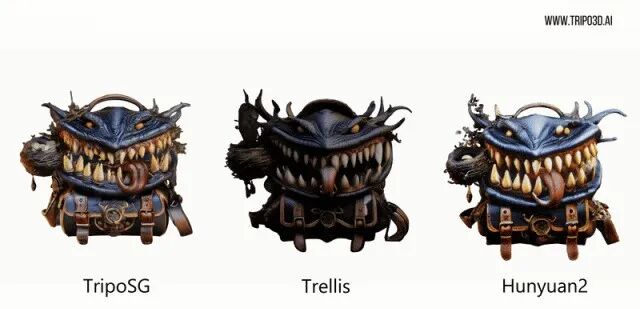
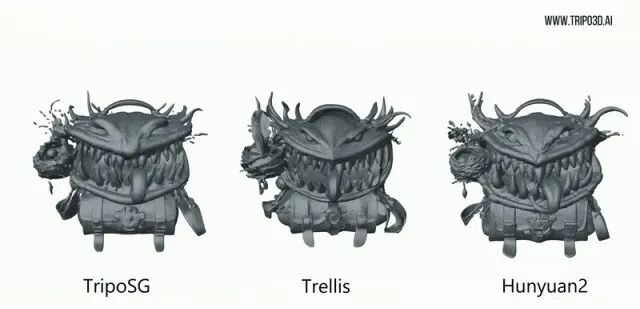
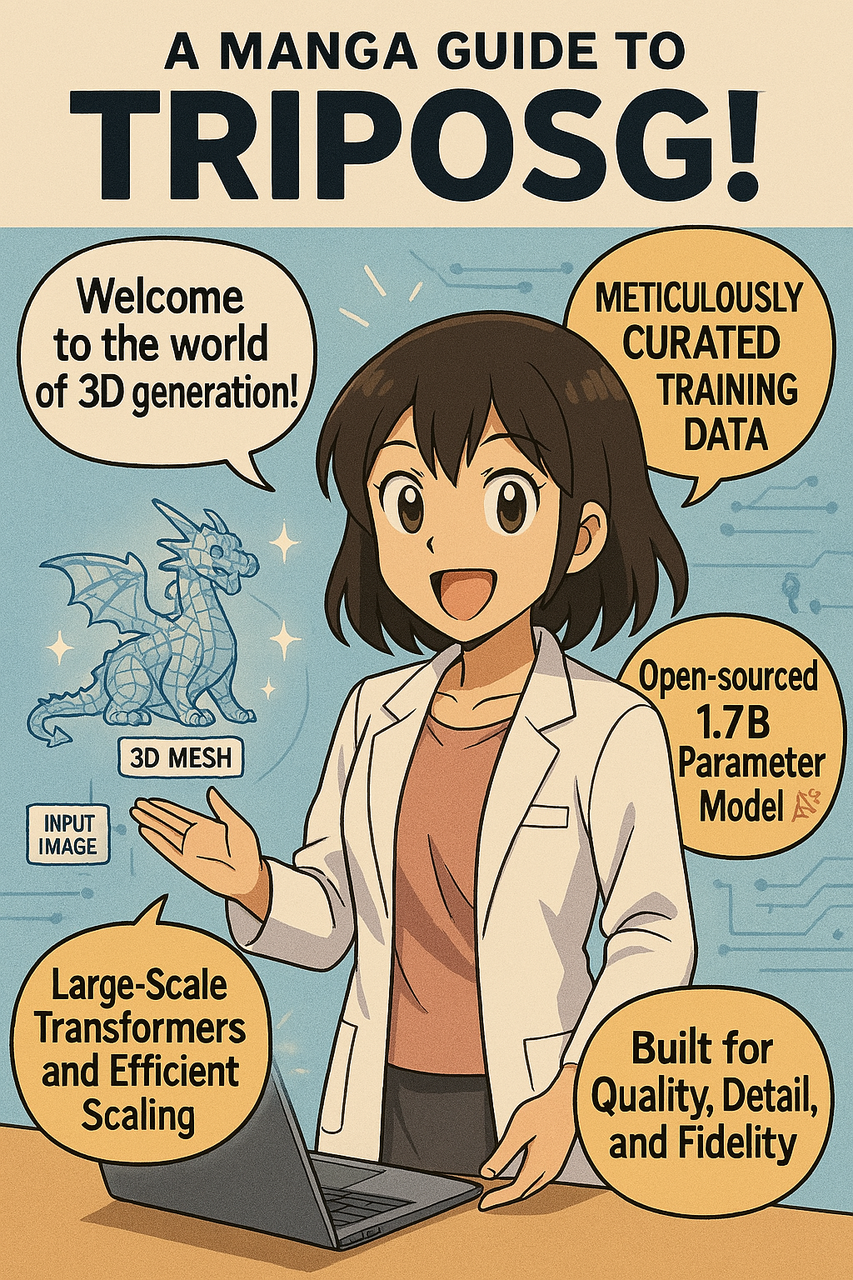
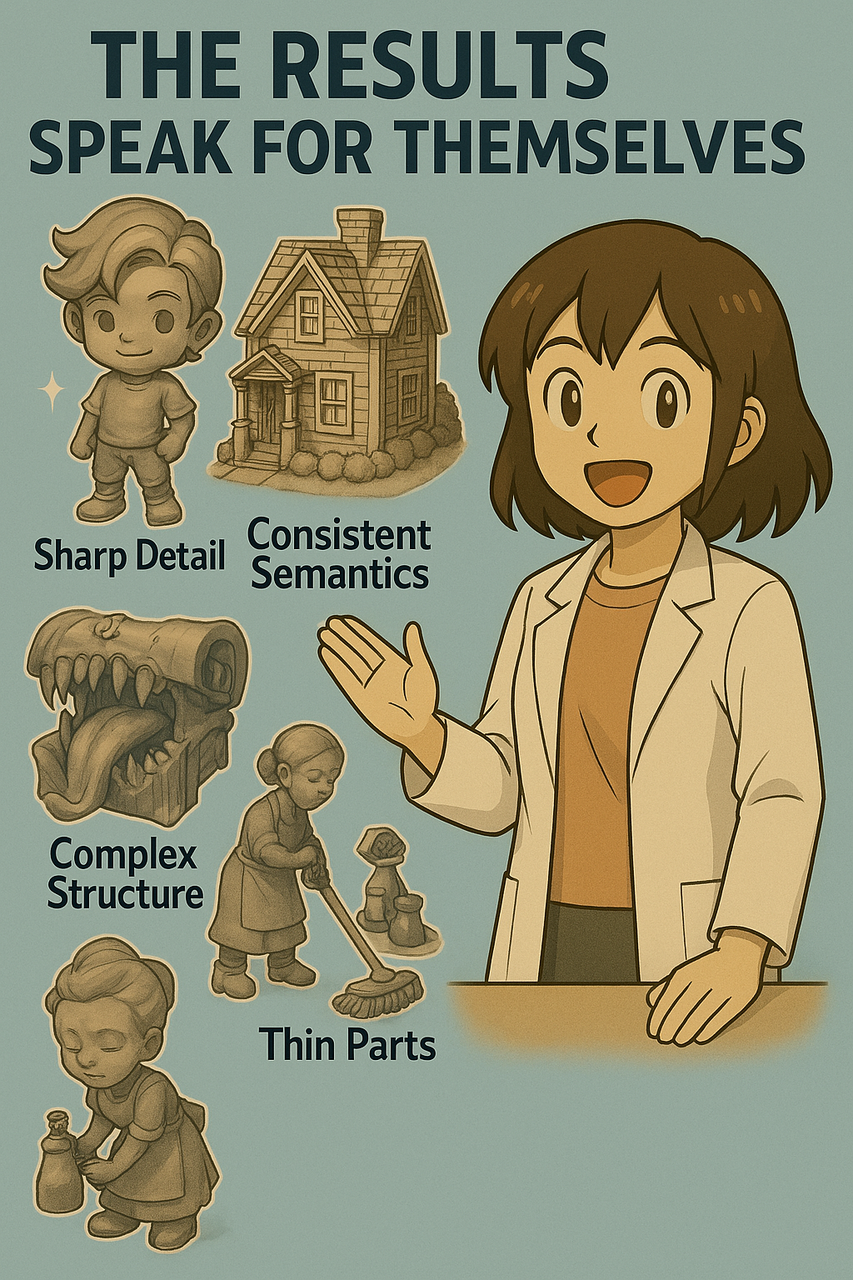
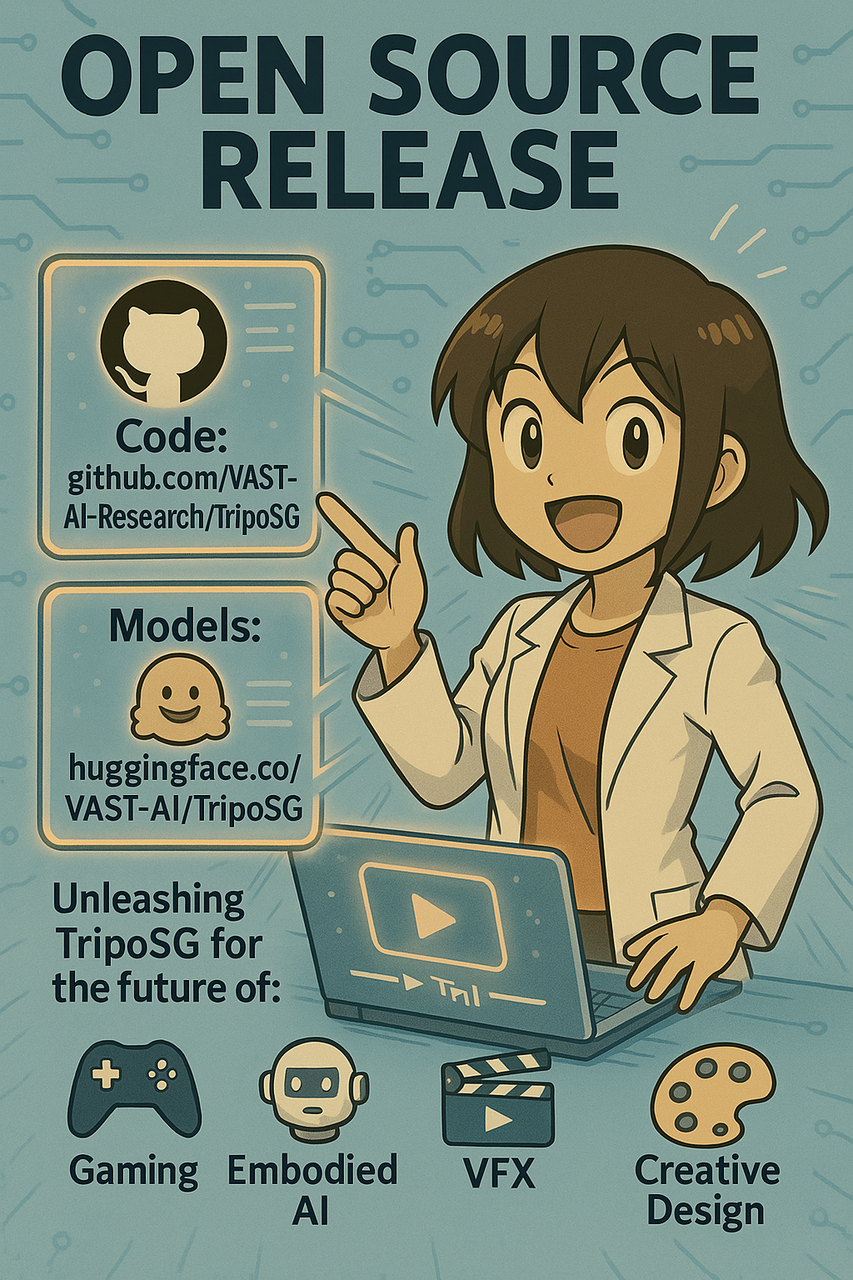
(Thanks to ChatGPT-4o for the dedicated illustrations for the TripoSG open-source release)
TripoSF Unlocks Internal Structure Generation in 3D Models, Better Tokenizer Breaks 3D Generation SOTA
TripoSF is a 3D foundation model developed by VAST based on a new 3D representation called SparseFlex.
Tests show that its results surpass all open-source and closed-source work currently on the market. This release open-sources the TripoSF VAE pretrained model and related inference code; the full-powered version of TripoSF will be experienced in Tripo 3.0.
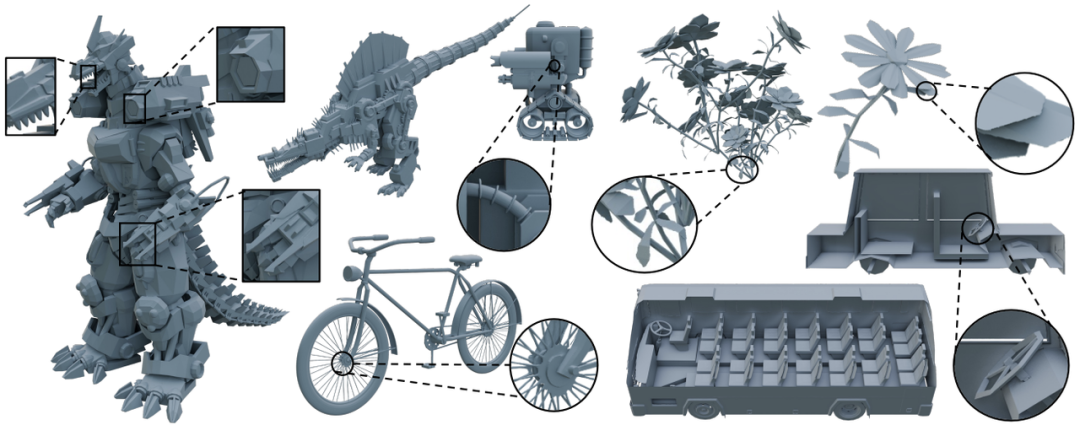
In terms of results, TripoSF redefines "the upper limit of model quality."
For the first time, models can not only obtain the "back side" but even the "internal structure" (see the bus seats and driver's seat in the image above);
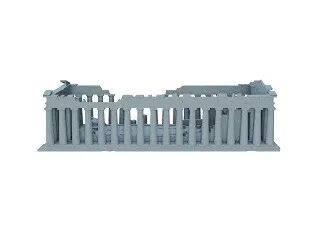
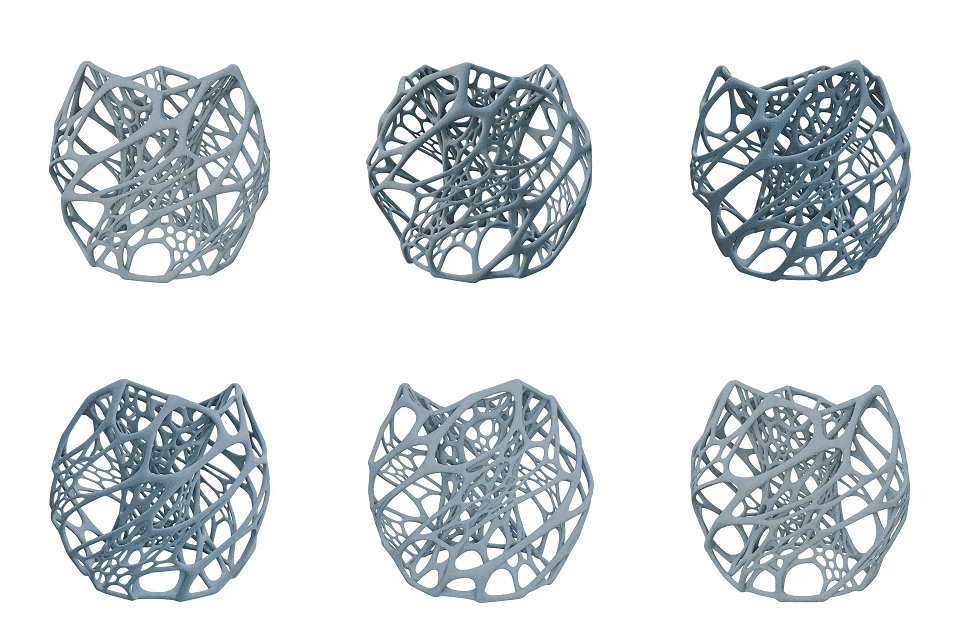
Meanwhile, previous work generated clothing or petals as thick geometric structures, but as shown, TripoSF handles "single-sided assets" with much greater finesse.
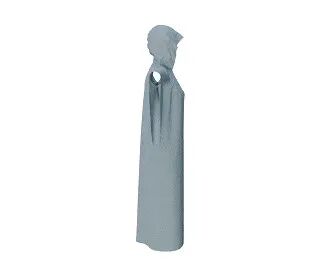
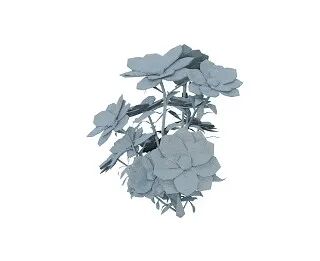
The richness of detail in other categories also reaches unprecedented levels.
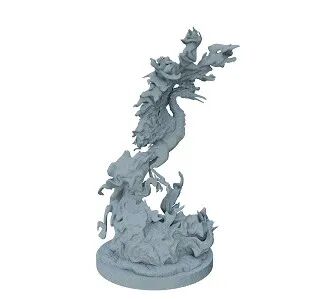
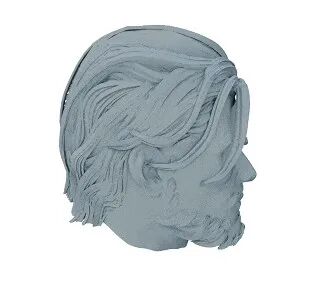
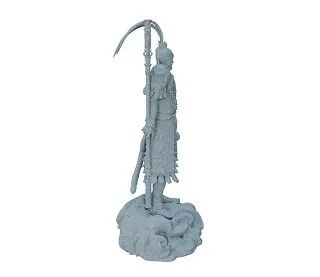
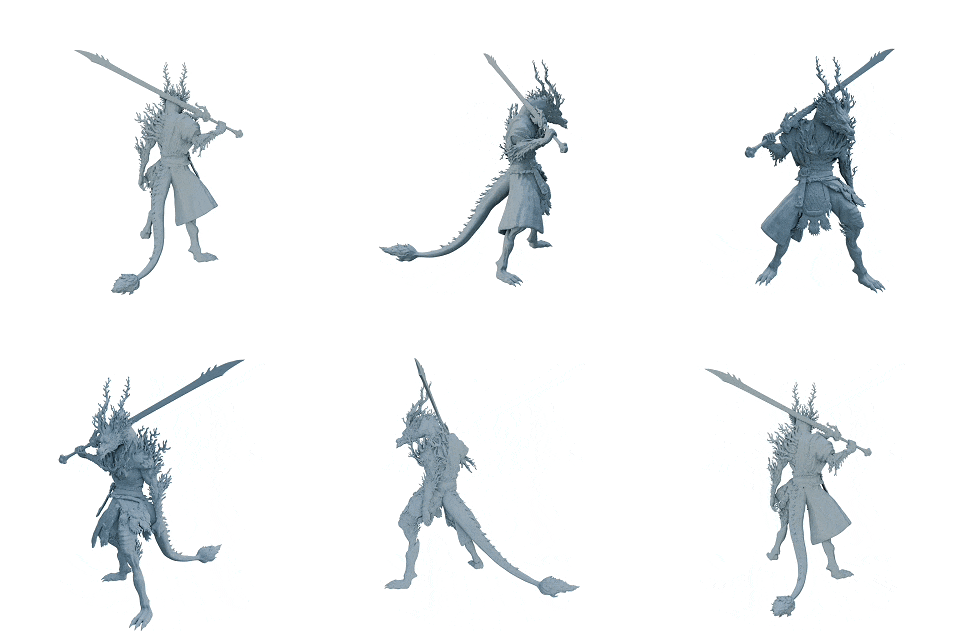
The targeted goal in developing TripoSF is to break through the bottlenecks of traditional 3D modeling in detail, complex structure, and scalability.
Past approaches still had many shortcomings in addressing this problem, such as detail loss from preprocessing, insufficient expressiveness for complex geometric shapes, or prohibitive memory and computational costs at high resolutions. We have been searching in our research for a Tokenizer that can raise the ceiling of 3D generation tasks, and the core representation method of this TripoSF release, SparseFlex, represents important progress in this direction.
SparseFlex draws on the advantages of Flexicubes (differentiably extracting meshes with sharp features), and creatively introduces a sparse voxel structure that only stores and computes voxel information in regions near the object surface.
The effects are significant:
- Dramatically reduced memory footprint, enabling TripoSF to train and infer at high resolution of 1024³.
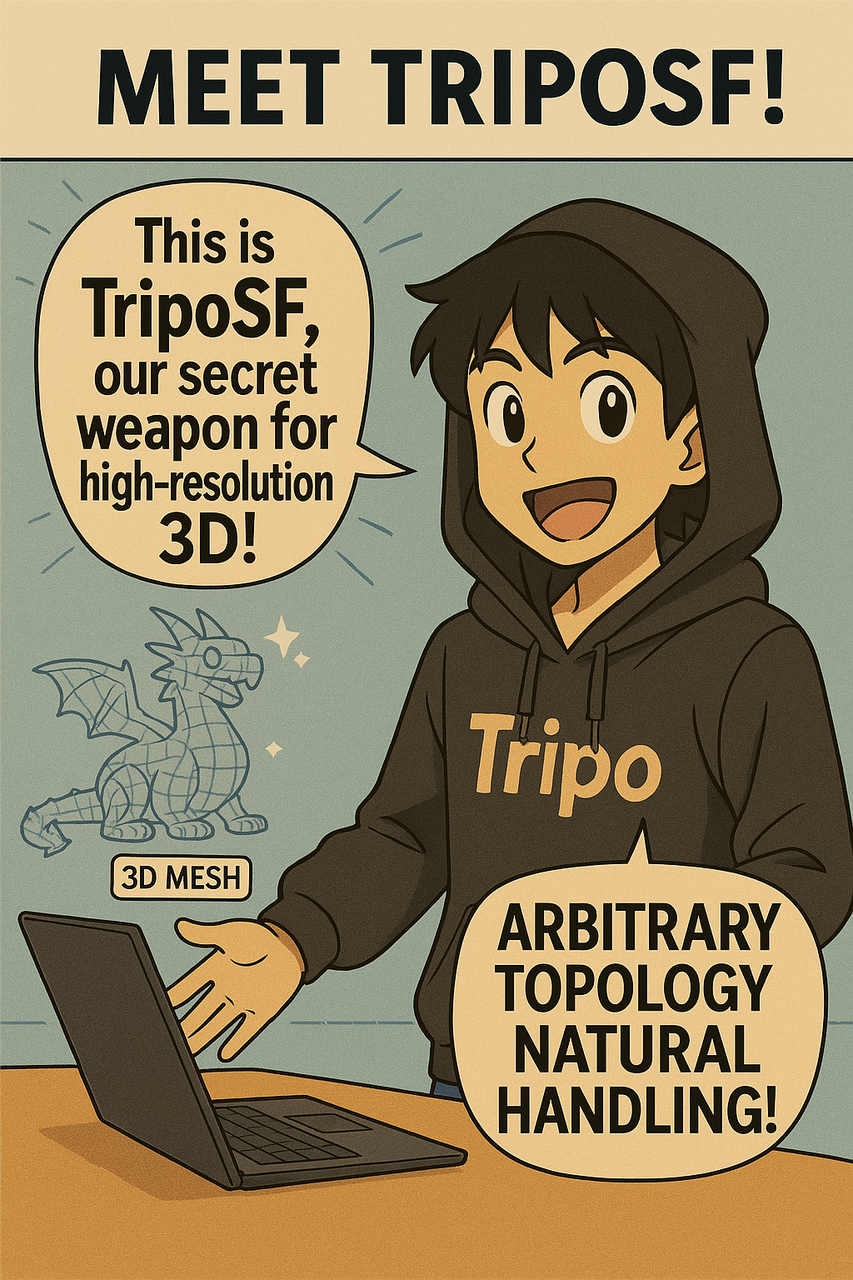
- Native support for arbitrary topology handling: not only naturally representing open surfaces (such as cloth, leaves) by omitting voxels in empty regions, but also effectively capturing internal structures.
- Support for direct optimization based on rendering loss: SparseFlex is differentiable, allowing TripoSF to use rendering loss for end-to-end training, avoiding detail degradation caused by data conversion (such as watertight meshing).
Experimental results show that TripoSF achieves new SOTA in quality. Across multiple standard benchmarks, TripoSF achieves approximately 82% reduction in Chamfer Distance and approximately 88% improvement in F-score compared to previous methods.
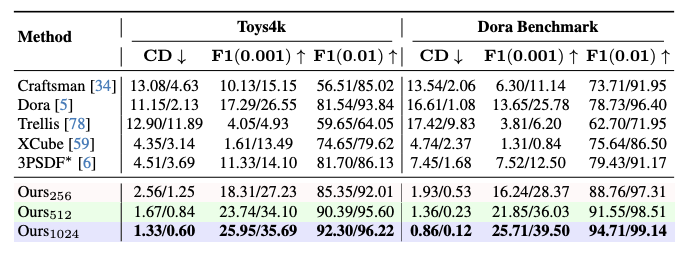
【 TripoSG 】
Homepage: https://yg256li.github.io/TripoSG-Page/
Paper arXiv: https://arxiv.org/abs/2502.06608
GitHub Code: https://github.com/VAST-AI-Research/TripoSG
HuggingFace Weights: https://huggingface.co/VAST-AI/TripoSG
HuggingFace Demo: https://huggingface.co/spaces/VAST-AI/TripoSG
【 TripoSF 】
Homepage: https://xianglonghe.github.io/TripoSF/
Paper arXiv: https://arxiv.org/abs/2503.21732
GitHub Code: https://github.com/VAST-AI-Research/TripoSF
HuggingFace Model Weights: https://huggingface.co/VAST-AI/TripoSF
Further updates and enhancements to more open-source projects will be posted first on VAST AI Research's official GitHub, HuggingFace, and X.
GitHub: https://github.com/VAST-AI-Research
HuggingFace: https://huggingface.co/VAST-AI
X: https://x.com/VastAIResearch
Beyond the series of open-source projects, the creator tools available on the official Tripo website (https://www.tripo3d.ai) and the highly cost-effective API (https://www.tripo3d.ai/api) both provide access to VAST's latest model services.
For technical and academic suggestions or collaborations, welcome to reach out to us at research@vastai3d.com.
Scanners cannot fully capture the ravines on the far side of the moon, but there are always people in the wilderness, heads down, mining.
The clanging sounds rise and fall, until one day they merge into one — open source is the sound of iron picks striking soil; there are no maps for the far side of the moon.