Professor Haohan Wang of UIUC: A New Era for Biological Gene Agents | Agent Insights

Counselor Vitality

Traditional bioinformatics data processing is cumbersome and expensive. Bioinformatics analysts typically spend their time on repetitive, low-efficiency data processing and verification tasks. To address this, Haohan Wang, an assistant professor at the School of Information Sciences at the University of Illinois Urbana-Champaign (UIUC), led his team in designing the GenoTEX dataset and GenoAgent, a data processing agent that can replace this repetitive work. In this article, we explore this new era of bioinformatics agents with Professor Wang. Enjoy.

GenoTEX: A Benchmark for Evaluating LLM-Based Exploration of Gene Expression Data in Alignment with Bioinformaticians
Paper link: https://arxiv.org/pdf/2406.15341
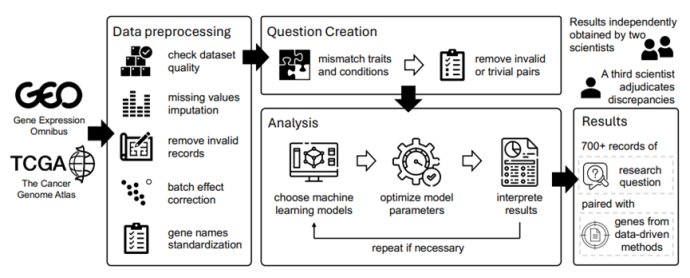
GenoTEX framework
Problem addressed: Traditional bioinformatics data processing is costly and complex. Bioinformatics analysts typically perform repetitive, low-efficiency data processing and verification work. The team designed the GenoTEX dataset and GenoAgent, a data processing analyst, to replace this repetitive work.
Model architecture: GenoAgent comprises a project manager agent responsible for coordinating and resolving the analysis workflow for each gene identification problem; a data engineer agent and a statistician agent — two programming agents handling data preprocessing and statistical analysis tasks respectively; a code reviewer agent that helps programming agents debug code and verify whether it complies with instructions; and finally, a domain expert agent that provides specialized knowledge consultation.
Application scenarios: Biology and other knowledge-intensive analysis scenarios. Currently applied primarily to understanding disease mechanisms at the genetic level, such as early cancer screening and target discovery.
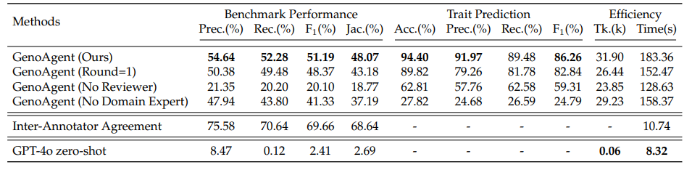
End-to-end gene identification performance of GenoAgent on benchmark tests
Test results: The performance of GenoAgent and baseline methods in identifying genes from raw input data was evaluated for end-to-end data analysis capability. GenoAgent achieved the highest accuracy score of 51.19% among all baseline methods.
Earlier version paper: Toward a Team of AI-made Scientists for Scientific Discovery from Gene Expression Data Link: https://arxiv.org/abs/2402.12391
Oasis Capital: Could you walk us through your educational background and research focus?
Professor Wang: After graduating with a bachelor's degree in computer science in 2012, I happened to come across Andrew Ng's machine learning course and decided to continue studying machine learning and AI. I went to Carnegie Mellon University to pursue a PhD in machine learning under Eric Xing, and I've now been an assistant professor at UIUC for about two years. My research mainly falls into two areas. One is computational biology — using AI to understand how the biological world works. The other is trustworthy machine learning, aimed at making AI actually deployable in the real world, rather than just benchmarking agent performance on certain datasets. These two topics may seem unrelated, but they're actually closely connected. The insights computational biology gains through AI only matter if we can ensure these AI systems actually work in practice. Otherwise, it's just superficial knowledge collected from some dataset.
Now that large language models have matured so much, we wondered whether we could have LLMs play human roles to replace the gene expression work I was familiar with. So we built this agent to take over gene data processing tasks. We started with this particular task because it's relatively straightforward, and we're well-versed in both AI and gene expression — the intersection of these two fields. That was how this research began.
Oasis Capital: Could you explain the GenoTEX and GenoAgent architectures?
Professor Wang: We wanted GenoTEX to simulate a very complete data analysis process. Back in the 1990s, people first started using statistical methods to analyze gene expression data, applying them to breast cancer. They later designed a product based on this approach that generated millions of dollars in annual revenue. We thought — if it worked for breast cancer, could it work well on other datasets too? And could we automate the entire data processing pipeline with an agent? So we started discovering data from gene datasets uploaded by various labs. We performed quality screening on noisy datasets and addressed batch effects caused by merging data from different batches. We processed over 700 datasets in total, and finally used GenoTEX as a benchmark to verify whether our agent was reliable.
For GenoAgent, we designed several roles. One is the project manager agent, responsible for task identification and distribution. Then there's the code agent, which mainly writes code to preprocess data, remove noise, and normalize it, before passing the data to the analysis agent. The analysis agent uses different statistical methods to try to find which data is disease-related. Additionally, we have a specialized domain knowledge expert agent dedicated to answering biological questions from the two code agents. Finally, we set up a checker agent to verify results and provide feedback to the code agents for revisions.
Oasis Capital: After the GenoAgent research, what new understanding do you have about applying agents across different disciplines?
Professor Wang: First, GenoAgent provides us with a framework for processing complex information and data. We've gained deeper appreciation for how large models can empower data engineers to process unstructured data. This goes far beyond the simple data processing and labeling that the deep learning era could offer. It's a more accurate methodology capable of real-time interaction with the physical world. This is revolutionary, and it's what drives us to tackle problems beyond gene expression.
Going forward, we hope to continuously integrate and upgrade deep learning and large model capabilities, using broader domain data to compute loss functions and train agents with better performance. Right now, we can see drug discovery agents emerging that are similarly text-based. Even in chemistry and materials science, many teams around me are actively pushing forward, continuously using cleaner data to unlock models' predictive capabilities in these areas.
If I had to name a major milestone that would prove the arrival of the AI for Science moment, I think it would be when an established large pharmaceutical company uses large model capabilities to significantly accelerate drug R&D, or when humans discover treatments for familiar diseases like cancer or AIDS through agents. That stage of actual deployment would be the "AlphaGo moment" for AI for Science in the large model era. We still have quite a long way to go.
Oasis Capital: What are your next steps?
Professor Wang: There are two directions we need to iterate on. From the agent research angle, we want to introduce more powerful tools and methods to help agents solve tasks better and advance the overall agent framework. On the biology side, we hope to integrate more statistical methods to accomplish more complex tasks and replace more aspects of gene data analysts' work.
I believe biology and medicine should be treated differently. Often, the end product of biological research is new knowledge — for instance, which gene is more relevant to which disease — ultimately serving other biologists. Medicine, on the other hand, produces treatment plans that directly serve patients. So we think end-to-end solutions or analyses are more likely in biology and genetics, while in medicine, Copilot is more probable at a certain stage.
Oasis Capital: How do you think the emergence of large models has changed AI for Science from the deep learning era?
Professor Wang: I believe large models have the potential to create a discontinuous, transformative effect in AI for Science, though many practitioners haven't realized this yet. Technically, large models make end-to-end scientists possible. Such end-to-end scientists need to handle very unfriendly, unclean data, ultimately enabling technicians to discover interesting hypotheses and complete the full cycle of biological verification — something deep learning could never offer. Of course, we're not only exploring how large models empower bioinformatics. We're also in exploratory stages for finance, chemistry, and materials science.
Oasis Capital: Once agents replace a large portion of repetitive bioinformatics data processing work, what other research domains will we break through?
Professor Wang: First, basic bioinformatics processing represents a significant expense for labs. Every lab needs to hire researchers who spend their time doing repetitive data processing year after year. Their salaries run around $50,000–70,000 per year. Every university has numerous labs requiring this much data processing, and with so many universities across the United States, the overall replacement incentive is substantial.
The domains we want to break into next actually depend on how ambitious we want to be, and how much foundational capability large models can give us. Large models' true creativity is still quite limited. So-called model innovation ability is still fundamentally very pattern-based. Perhaps we need to reach a point like in the deep learning field, where enough architectures have been tried and sufficient compute resources are available, before we can attempt deeper AI for Science or even more direct agent products that replace human analysts to serve humanity. At that point, it could mean major transformations across chemistry, medicine, materials, biology, and many other fields.