When Intelligence Starts Devouring Labor | Vital Views

Counselor Vitality

AI is not merely a technological paradigm shift, but a profound social transformation. This has been Oasis Capital's core thesis all along, and it has been repeatedly validated over the past three years.
In a recent speech, a16z partner Alex Rampell argued that as artificial intelligence achieves end-to-end execution, SaaS software is evolving from "recording work" to "completing work" — and is now truly beginning to consume the labor market. The entire software industry is undergoing a deep structural transformation.
We believe this is not merely an inflection point for business models, but a critical moment in the reconfiguration of production relations: capital is being converted into compute to generate intelligence, which is then evolving into new forms of labor.
When software ceases to be merely a tool and becomes the outcome, even the labor itself, the curtain has risen on the era of the intelligent economy. We have compiled this speech to share with you. Full read: approximately 8 minutes.
Enjoy.
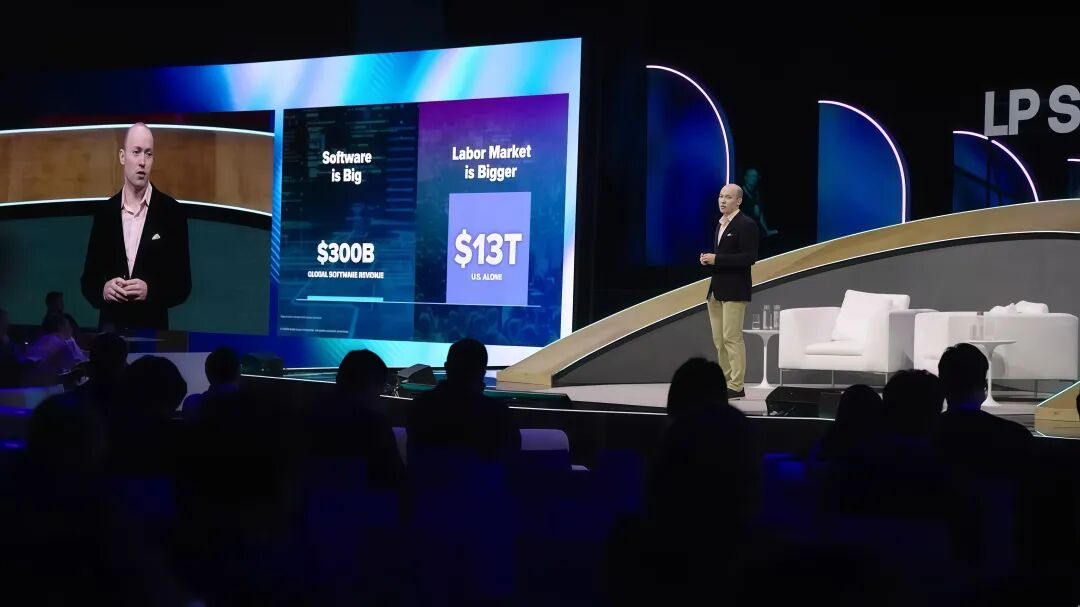
The global SaaS market is already roughly $300 billion in annual revenue, while the U.S. labor market stands at $13 trillion. What software is now targeting is a massive slice of that labor market pie.
In the past, nearly every software company was essentially turning a filing cabinet into a database. But what's changed now is this: virtually entire workflows can be completed in an end-to-end manner.

What I'm going to share is how software "eats" labor.
About a decade ago, Marc Andreessen published an article in The Wall Street Journal titled "Software Eats the World." The labor market, of course, is part of that "world."
If there's only one takeaway you remember from this talk, it's this: the labor market is vastly larger than the software market — almost self-evidently so. The global SaaS market generates roughly $300 billion in annual revenue, and the total market cap of all global software companies is about $2.2 trillion. By comparison, the U.S. labor market alone reaches $13 trillion — orders of magnitude larger.
Of course, this doesn't mean the software market will quickly become a $13 trillion annual market. But the crucial point is that what software is really aiming at right now is this labor market.
There's nothing more fitting at a venture capital conference than opening with the world's most famous communist — yes, Karl Marx. If you've read Das Kapital (I read it in college), you may recall its central argument: the world consists of two elements, capital and labor; capital exploits labor; the two are in opposition.
What's truly exciting is that today's logic can almost be described as a "chemical reaction": investors provide capital, we give that capital to companies, companies use it to buy GPUs, rent compute, hire engineers, purchase coffee, then provide the GPUs and coffee to those engineers, who ultimately write software that replaces labor.
This has practically become the new "E = MC²": capital is converted into code, and code replaces human labor.
We're already seeing this phenomenon occur at numerous companies that are expanding extremely rapidly, because the real promise they make to customers — to end users — is: "We don't sell you software; we simply get the work done for you." This has become their new sales logic.
The concept itself, of course, is not new. Automation has long existed. Take The Seamstress, a painting from roughly the 16th or 17th century depicting the loom replacing hand-sewing — though someone still needed to operate the loom. Or steamships, or Gutenberg's printing press.
Finally, the assembly line — a massive innovation that replaced the previous method of workers hand-assembling every component piece by piece. Plenty of workers were still involved in the assembly line, but labor efficiency multiplied several times over.
So this model is not new: capital can be used to build machines that enhance the efficiency of individual laborers. But the real transformation today is that the entire process from task input to outcome output can now be completed end-to-end automatically.

I believe understanding the past is the best entry point for understanding the future and what's possible.
Looking back at the evolution of the software market, my core argument is this: nearly every software company has been doing the same thing — turning filing cabinets into databases. This is the source of the $2.2 trillion market cap we see today, and the source of $300 billion in annual software revenue.
The first example I want to mention is Sabre Systems, headquartered in Texas, which began as a joint initiative between American Airlines and IBM.
Can you imagine booking a flight in 1959, and how American Airlines operated? They probably had massive filing cabinets filled with forms like this one. Say Betty Owens calls in: "I'd like to book seat 4A." She speaks to some operator, then says: "Oh wait, actually I want to cancel." The operator has to erase the record. Finally she says: "Actually, I want seat 2C." Erase and rewrite again.
Filing cabinets handled all information recording tasks with terrible efficiency, requiring many people to operate, and offices couldn't share information with each other — everything was sealed in their respective filing cabinets. Sabre changed this. It centralized all information onto IBM mainframes, accessible remotely via thin clients. This became the starting point of fundamental change in the travel industry. Galileo did something similar for hotels, Amadeus served the European market — many large companies were born from such systems.
The same thing happened in sales. I recall someone mentioning the film Glengarry Glen Ross yesterday. You may remember all those business cards in it — so-called quality leads, all on paper. For viewers of my generation, you might remember Axe Systems from the 1980s, one of the leading CRM companies at the time. GoldMine emerged in 1990, Tom Siebel founded Siebel Systems in 1993 — what these companies did was move the filing cabinet systems that salespeople used onto mainframes. Then Salesforce appeared in 1999, putting the filing cabinet in the cloud. You can see how in a film set in the 1950s, a salesman consults physical files, while in 2010 he might be looking at Salesforce records.
The essential workflow hasn't changed; only the medium has.
Manufacturing and inventory management is another classic domain. Imagine you're a manufacturer. You ask yourself: how many widgets do I have on hand? What's my inventory? How are sales? IBM was also a pioneer in this area, and later many still-existing companies like SAP, Baan, JD Edwards all did the same thing: digitizing traditional paper-based record systems.
My favorite illustration of how universal this pattern is: the library card catalog system. Libraries have existed for a very, very long time. After the Dewey Decimal Classification was introduced, when I was a kid I'd go to the library and look up cards alphabetically to find books. Then someone founded a company called OCLC, which grew into a substantial enterprise, later the more innovative SirsiDynix. They digitized these catalog cards — now you simply check a computer terminal at the library to know if a book is on the shelf.
The legal field is no different. When I visited law firms in the 1980s, nearly the entire office was filled with filing cabinets. PC Law, LexisNexis, Reuters — much of these companies' revenue came from selling services to law firms, transforming materials that once occupied prime Fifth Avenue office space into digital files.
My parents were accountants. I remember visiting their office as a child — there was almost no room for a five-year-old to run around, the whole place was filled with filing cabinets. Later Intuit launched QuickBooks, digitizing financial statements. PeachTree was a 1970s company, MYOB as well. At the core, it was still filing cabinets, filing cabinets, and more filing cabinets.
Finally, HR and payroll systems. In fact, even before Sabre, ADP (Automatic Data Processing) was founded in 1949. How did they track employee attendance back then? Time strips and punch cards. How did they calculate withholding tax? These companies were solving precisely these problems — putting paper documents into mainframes, and then companies like Workday moved them to the cloud. Workday was essentially a new product built by the original PeopleSoft team.
The process itself hasn't changed; only the technological medium has shifted.

The person checking your time card in 1940 and in 2015 is fundamentally the same person — only the medium is no longer paper, no longer a mainframe, but the cloud. I emphasize this because the process hasn't actually become more efficient. Before, humans read materials from filing cabinets; now humans read digital records. Whether a woman is processing a customer support request, previously she might have been looking at paper documents, now she's looking at a computer screen.
Understanding this is critical, because the entire software business model must change.
I call the current model an homage to Starbucks — the "tall, grande, venti" model of SaaS. If you visit the homepage of virtually any SaaS company, you'll likely see a similar interface. Zendesk, which was taken private by Permira and Hellman & Friedman a few years ago, is a company with $2 billion in ARR, and its business model is selling by "seat." Their most popular service, the "venti" package, is the "Suite Professional" at $115 per month.
But as we've discussed these past few days, AI can now answer customer support questions very effectively. So here's the question: if every one of your customer service representatives becomes 9,000x more productive, how many seats do you still need?
Assume I have 1,000 employees in a customer support call center, each with a fully loaded cost of $75,000 per year, for total labor cost of $75 million annually. What's the software cost? 1,000 times $115 times 12 — approximately $1.4 million per year.
Labor cost vastly exceeds software cost.
And for a company like Zendesk, two radically different scenarios may unfold next. If AI can answer all questions, how many seats do you still need?
Zero.
You no longer need a single seat; AI can handle everything. And Zendesk charges by the seat — so its revenue would drop from $1.4 million to zero. Obviously a very bad outcome.
But the opposite could also happen. Let's look at the data: if each human agent answers 2,000 questions per year, then for a company using Zendesk as its customer support system, your per-response cost is roughly $37 in labor plus $0.69 in software — so about $38 per response.
This is a rough example. Perhaps Zendesk could instead charge $5 million per year, essentially saying: "You no longer need to spend $75 million on customer service; just pay us $5 million annually. Don't give us $1.4 million, give us $5 million, and you'll still save $70 million." So Zendesk is now at an inflection point: its revenue could drop to zero, or it could triple.
Which will it be? I don't know, they don't know. I was recently speaking with their CEO; they're piloting an outcome-based billing model in New Zealand. So we'll see.

Here's another example of just how large the labor or quasi-labor market is.
The $13 trillion wage market we mentioned earlier vastly exceeds the software market by comparison, with software revenue representing only a small fraction. If we look at just one category, one specific occupation — nurses (I chose this example because we have a portfolio company in this space).
In the United States, nurses earn approximately $650 billion in total annual income, with roughly 4.5 million registered nurses nationwide. This single occupation alone exceeds the entire global software market. Of course, this doesn't mean software will "eat" the entire nursing-related software market. But it does mean: this is the real pool you're competing against.

I started with filing cabinets because the future direction of development will shift from "recording" to "outcomes." Software will no longer merely play the role of a filing cabinet; it will begin to "execute operations" on the contents of that filing cabinet.
What does this mean? Take travel: if I have a travel filing cabinet, software won't just store flight information — it will rebook tickets for me. Suppose I want to arrange a trip for 75 students at my son's high school. Previously I'd need to contact a travel agent; now I no longer need to speak with an agent at all — I interact directly with United Airlines' AI system, and it completes the entire booking process. The same applies to sales, to manufacturing.
Library card catalogs — this example may sound somewhat far-fetched, but if I have an overdue book, it shouldn't be the librarian calling to remind me; it should be the library systems company calling to say: "Time to return your book, or perhaps order a few more copies, because this one is extremely popular." Say Ben's book is selling very well — the system should proactively alert: "Better stock up quickly."
An AI nurse cannot perform CPR, nor handle gunshot wound patients. But it can absolutely call a patient in their forties like me and say: "How are you feeling? Is there anything we can help with?" "Do you have a fever? You should go to the hospital immediately." And so on. This is outcome-oriented service. If you have my medical records, you can proactively deliver services based on them, then charge — say, $20 per outbound call.
HR and payroll management is the same. How do you conduct background checks? How do you verify whether someone really worked at the three companies listed on their resume? Workday could absolutely take the initiative to call those three companies and ask: "Did Alex really work at your company?" It could also explain benefits policies, assist employees with enrollment. If it starts doing these things, Workday's revenue could triple, because it's already the system of record for HR.

If you know the Airbnb story, you know Airbnb started by scraping Craigslist. Craigslist is a site from the mid-1990s that has barely changed since, with many apartment rental listings. But when you click through, half are scams, and the other half are either already booked or reposted daily. What Airbnb did was put this information into a better interface and call it Airbnb. That was their starting point.
This is also a very exciting trend we're seeing now. Because of my Achilles injury, I've had plenty of free time to browse Craigslist — certainly not to look for jobs myself — and I found a real job posting there. This is Plaza Lane Optometry, an eye clinic hiring a front desk receptionist. This position has been vacant for six months, just sitting there.
Now California law requires salary ranges to be posted; they listed $45,000 per year. From a supply-demand perspective, if they offered $100,000, they probably would have filled the position long ago. But they need to keep it around $45,000, likely due to cost structure considerations.
If you look at the job responsibilities, the first item is opening and closing, locking up — of course AI can't do that. But many of the other responsibilities, AI can absolutely handle: communicating with insurance companies, calling patients the day before appointments to prevent no-shows.
If you look at the eye care market now, you'd think it's not a "good" software market at all. This company probably spends only $500 per year on software — maybe a Microsoft Office license, plus a Squarespace or Wix website, and that's it. So their software expenditure is around $500.
But in this new world, we're seeing more and more companies doing something like this. They browse Craigslist for job postings, then proactively reach out to say: "Plaza Lane Optometry, I'd like to apply for this position." The eye clinic might respond: "Okay, tell me your qualifications, where have you worked before?" Then the "applicant" says: "I know this sounds crazy, but I'm actually a software company. I can't help you lock the doors, but I can do the other eight tasks. Can I give you a demo?"
Initially the eye clinic might refuse, but then says: "Alright, let me try it out." And this service costs only $20,000 per year — far below the $45,000 annual salary they had budgeted for a human employee, whom they can't even hire right now.
This is what's actually happening. And these are industries where software spending was originally extremely low, but labor spending was extremely high. This imbalance is being broken, giving birth to a massive and rapidly growing new market — especially in "obscure" vertical industries that might seem unglamorous.

This time, rather than speaking conceptually, I'll give you a concrete example.
This is one of our portfolio companies, Happy Robot, serving the freight and trucking industry. What you're about to hear is a clip from a phone negotiation between AI and a potential customer:
"Joliet, Illinois, shipping between 6 a.m. and 2 p.m., delivery Monday between 6 a.m. and 4 p.m. I've got this load at $700, do you want to book it?"
"Um, I need $800 on my end."
"I can check on that."
"We can't accept $800 right now, is there any way to get closer to the current platform rate?"
"I can do $775, that's my lowest."
"I understand. Is there any chance of going lower?"
"How about $750?"
"Let me see."
"Alright, I got you $735."
"$735? Done."
That's a complete transaction. But now the question is: which one is the robot, and which is the human? This has practically become the new Turing test.
Here's another example — Salient, another company specializing in collections services. If you're a lender, say an auto loan company, you need to regularly collect payments, and Salient serves many such lenders. Here's a clip from one of their calls:
"Your account is 51 days past due, with an outstanding balance of $825.35. Can you make a payment today?"
What's interesting is that Salient supports dozens of languages, including Tagalog, Vietnamese, Mandarin, and others — this is critically important. Many people misunderstand, thinking AI replaces humans simply because humans are expensive and AI is cheaper. But it's not just cost — there are many things AI can do, such as handling intermittent demand, which is a crucial scenario.
Imagine you're a retailer; Black Friday sales surge, and you need to hire large numbers of cashiers. If you're an online retailer, you need to hire many customer service agents to handle issues. So here's the question: what do you do on January 1st? Fire everyone? Rehire in November? But you'd actually need to start hiring in September, because you still need to train people — it's a huge hassle.
Many industries face similar intermittent demand challenges. Take United Airlines: if Chicago gets hit with severe weather, they can't hire and train 10,000 people overnight.
AI performs extremely well in these types of scenarios.

Another example: there are many deeply frustrating jobs in reality.
What counts as a frustrating job? Collections is one of them — you're calling customers to say: "You're past due." In some recordings I've listened to, about half the calls involve the other person cursing you out. This is absolutely not pleasant work; humans naturally become demoralized doing it over time.
But AI isn't affected by these things. For this kind of frustrating work, it's perfectly suited.
Another advantage is stronger regulatory controllability. Take our firm — we receive UDAP ("Unfair, Deceptive, or Abusive Acts or Practices") training every quarter. There are many regulations governing what you can and cannot say when communicating with customers. Suppose you call a customer and say: "You owe me money." They respond: "Go to hell." And your employee is having a bad day, so they easily fire back: "Go to hell, customer." Now you've got a major problem.
If you can hand over the entire call flow to a robot and program it effectively, you can achieve far greater compliance and control than with humans.
My favorite example is language capability. I myself speak Russian, Japanese, and a bit of Spanish — and I've spent far too much time learning languages. Here's a factual question: if I only speak Persian, can anyone at Stanford Hospital call me and ask my pain level in Persian? If I only speak Mongolian, do they have Mongolian-speaking nurses? Now they do — AI nurses, AI collections agents, AI negotiators; all of these roles can now immediately perform tasks in dozens of languages. You can't temporarily find a part-time worker in Iowa who speaks Serbian and is willing to do a frustrating job. But AI absolutely can. And AI can also respond instantly, be used on-demand, without interruption, without emotionality.

This is why I started with the filing cabinet story, because there was no such thing as "compliance" software companies in the past. This is real data from the U.S. Bureau of Labor Statistics: the fastest-growing occupation in America is nail technicians — certainly not something AI can do. The second fastest-growing occupation is compliance officers.
For compliance roles, you didn't need specialized software in the past. If you were Citibank, your only option was to hire more people. No company had truly built effective compliance software, because the market was too small while the labor market was enormous. But now you can go directly to Citibank and say: "I can provide end-to-end compliance services as a software solution — pay me $10 million per year, and I'll be your compliance system, handling full-process tracking." Previously, all they might have done was buy a few more Microsoft Office licenses.
In collections, there were no software companies either — only collection agents hired by companies. But now, you can enter this market through the "voice" entry point. We know this part will be commoditized quickly, but you can gradually build a real software company with real software revenue, software gross margins, software renewal rates.
There's another category: businesses that we're now starting to pay attention to because they've become viable due to AI, even though they weren't AI companies originally. For example, because of this injury I can't cycle anymore. I was an avid cyclist; I have many bikes sitting in my garage that I can't use for now, though I hope to ride them again in the future. So here's the question: why hasn't anyone built an "Airbnb for bicycles"?
The answer: because it's a terrible business idea, so nobody's done it.
Why is it terrible? Because the fundamental principle doesn't hold. Whether it's AI or not, whether it's 2000 AD or 2000 BC, the same rule applies: if your customer acquisition cost plus sales cost exceeds lifetime value, it's not a business.
But now with AI, the situation has changed. Suppose I really want to build a "shared bicycle Airbnb." How do I find people with idle bikes in their garages? Do I hire a bunch of expensive Stanford students? Do they need to work in Palo Alto with twenty flavors of coconut water and every millennial workplace perk to be willing to do sales? Of course not.
I'd have AI contact everyone. Each AI sales representative costs a few hundred dollars per year, not $100,000. No coconut water required. What if there's an emergency? Now you can set up a 1-800 customer service number, with an AI representative behind it that can handle all tasks, including calling emergency services, handling incidents.
Another issue: how do I screen this person, do background checks, assess the bike's condition, determine if it's stolen... whatever processes you need to support this seemingly absurd business model, AI can handle them all. So this is giving rise to an entirely new category of businesses: ventures that previously failed due to "annoying customer acquisition costs" or "annoying sales costs" can now be viable.
Of course, in this era you can also quickly enter such businesses through "AI prompt engineering."
The result of AI infrastructure is that the total addressable market of non-AI markets is being massively expanded. Now you can drive down customer acquisition costs, drive down sales costs. While all companies will soon adopt these tools, potentially leading to a paradox of "too many people, so no one comes," what we're seeing right now is many companies revisiting ideas that were completely unworkable five years ago, and they're now making steady progress.