Architectural Planning and Compliance Challenges for Tech Startups | Vital Views

Counselor Vitality

For early-stage teams, incorporating a company isn't just about legal registration — it signals a set of strategic decisions around fundraising trajectory, equity arrangements, business operations, and even long-term direction.
Recently, Oasis Capital hosted its second closed-door salon in Shanghai, bringing together three seasoned lawyers with years of experience and hundreds of deals across fundraising, M&A, and private equity transactions, along with over 20 founders from hard tech, AI, and other fields for three hours of in-depth discussion on "Structural Planning and Compliance Challenges for Startups."
Below are selected, anonymized highlights from the session. Enjoy.

Where to Incorporate: A Question of Efficiency and Path Dependency
When choosing where to incorporate, startups typically face a decision between domestic and offshore jurisdictions.
As businesses globalize, how to build a structure that is flexible, efficient, and scalable becomes a question that needs to be addressed early on.
Experts noted: "While 'begin with the end in mind' thinking has its place, in practice it's more important to start from your current stage — weighing fundraising rhythm, target markets for product delivery, and where the management team is based." The choice of jurisdiction directly connects to multiple variables: financing methods, investor composition, customer distribution, and future exit pathways. Especially when funding prospects remain unclear, the flexibility of registration location and structural design affects how much room you have to maneuver later.
Currently, many companies opt for offshore incorporation in places like the Cayman Islands, Hong Kong, or Singapore. But if operations, revenue sources, and teams remain largely concentrated in China, the practical benefits of offshore registration are often limited. Take the United States market as an example: regulators there assess company classification based on factors including primary place of business, management composition, and asset origins. If the core business重心 remains domestic, disclosure requirements and review processes may still be handled under domestic frameworks.
From a public perception standpoint, even with a parent company overseas, if core operations and resources are concentrated in China, it's difficult to shift how the company's "native identity" is perceived. This in turn can affect business development, fundraising market selection, and how investors assess long-term value.
Therefore, at the startup stage, the choice of registration location tends to be more of a technical arrangement — tied to capital pathways, transaction convenience, tax treatment, and signing logistics — usually bound to operational and financing trajectories rather than treated as an independent decision.
Structural Design Anchored to Business Development Pathways
Drawing on case studies, lawyers mapped out several common incorporation structures and their applicable scenarios:
If the investors are RMB funds and customers are in the domestic market, a straightforward domestic structure is more efficient. If the entity is established in the United States, it's typically because the product or team is oriented toward the North American market, factoring in local operating costs and business synergies. If bringing in USD funds or planning for an overseas listing, a red-chip structure is more common — usually a Cayman holding company controlling a Hong Kong entity, which in turn controls the onshore operating company. In recent years, some companies have also adopted domestic JV (joint venture) structures to achieve equity alignment between Chinese and foreign investors.
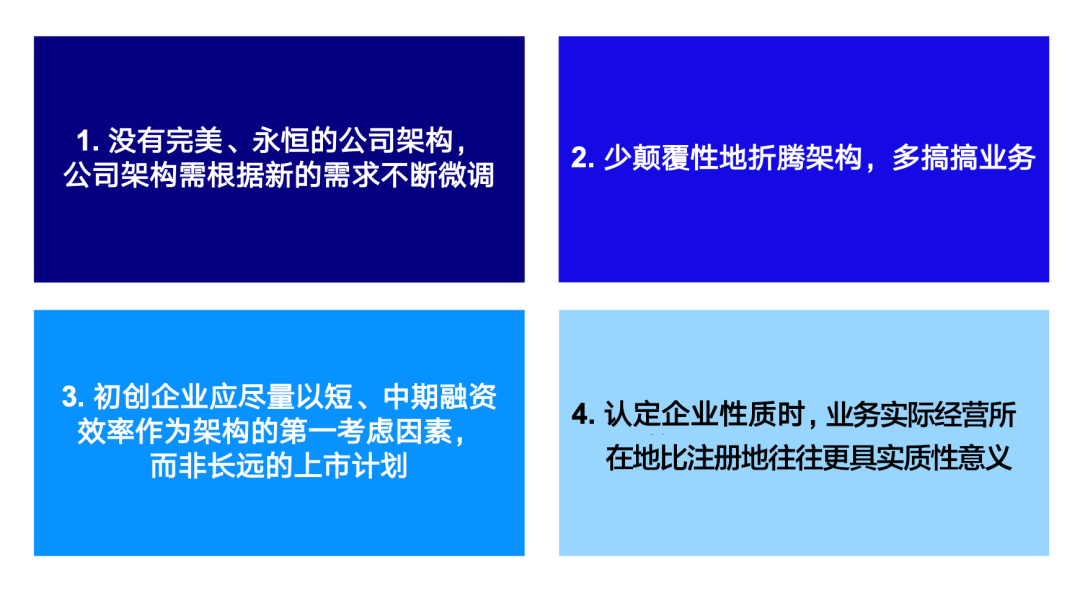
A corporate structure is fundamentally a stage-specific tool; different stages call for different pathways. Early-stage structures don't need to be perfect from day one — they should serve the immediate needs of fundraising and business execution.
As operations expand and capital pathways evolve, some companies proactively restructure later on — for example, shifting from red-chip or VIE structures to domestic-controlled structures, or forming intermediate "hybrid architectures." Over the past two years, cases of "VIE unwinding" and "hybrid architectures" have noticeably increased. Behind this trend lies not only a shift in funding sources, but also a broader move in structural design from "standardization" toward "pragmatic adaptation."
In a "hybrid architecture," for instance, offshore investors invest through the Cayman parent while domestic investors hold shares in the WFOE; despite different pathways, both sides can align on valuation and equity ratios. Such structures offer greater operational flexibility when a company's direction isn't fully settled.
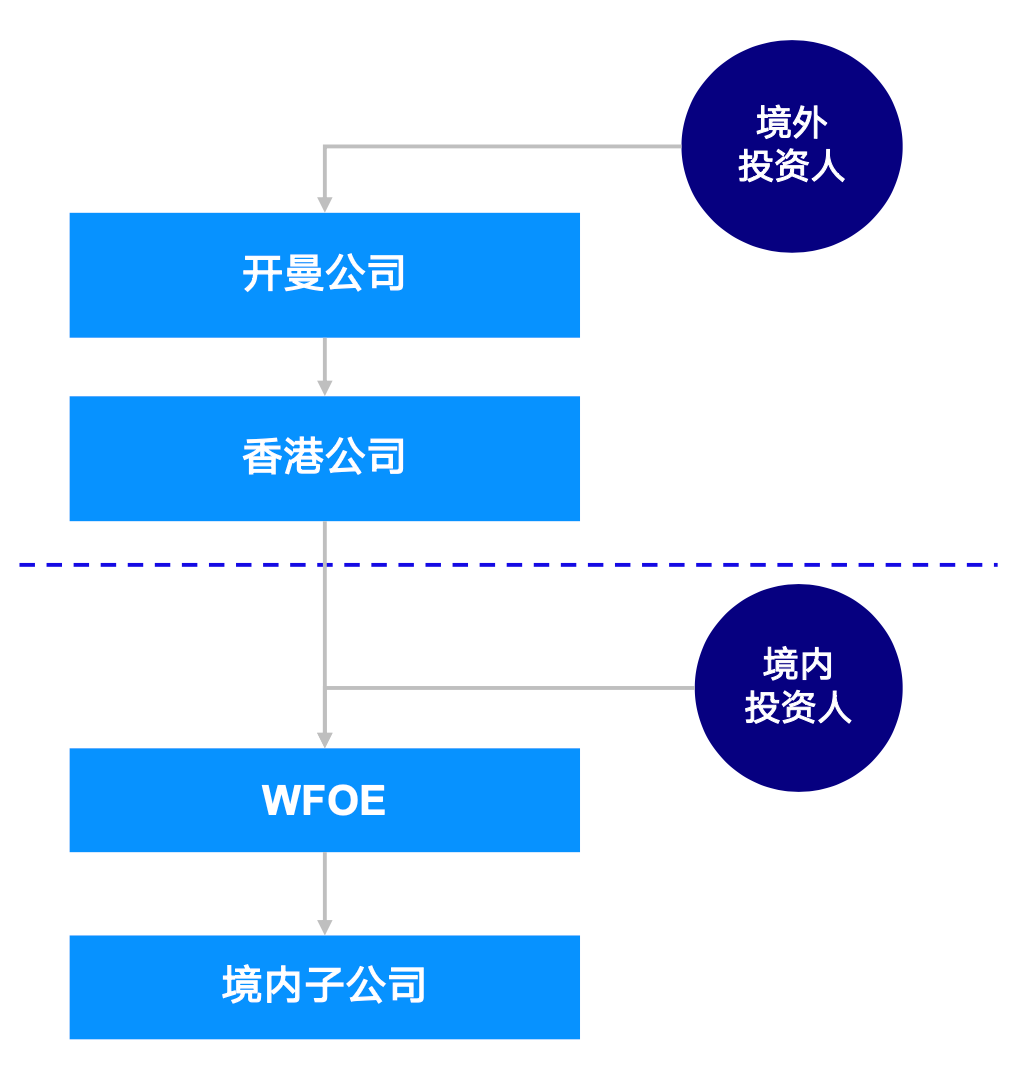
When founding teams first establish structure, they typically start simple and upgrade incrementally as needs change. For example, incorporating a domestic company to complete an angel round, then building out a Cayman holding structure for red-chip conversion at the Pre-A or Series A stage when USD investors come in. This "two-step" approach effectively lowers initial setup costs, improves decision-making efficiency, and preserves ample room for subsequent adjustments.
Experts emphasized: "There's no inherently superior or inferior structure. As long as transactions are clear, governance is transparent, and fundraising is viable, the structure is practical. Structure should serve the business, not constrain its development."
Restructuring itself is unremarkable — this kind of "rolling upgrade" has become routine in practice. Most companies undergo one to two architectural iterations as they grow. The key is to reserve adjustment windows early on, avoiding path lock-in.

Offshore Is Not Automatically Better
Some founding teams incorporate in the United States due to business needs, expecting easier access to local capital markets, resource networks, and business ecosystems.
At the operational level, U.S. incorporation offers certain advantages but also entails higher compliance requirements. The United States operates with parallel federal and state laws, plus regulatory rules, case law conventions, and multiple coexisting standards — an overall complex environment.
Moreover, financing and partnership thresholds vary significantly by industry in the U.S. market. Companies in AI, semiconductors, telecommunications, and related fields have faced heightened disclosure requirements in cross-border investment reviews in recent years. Beyond traditional CFIUS (Committee on Foreign Investment in the United States) review, the U.S. Treasury introduced "reverse CFIUS" rules in early 2025, further restricting outward investment flows.
When facing specific issues, beyond consulting professional legal counsel, it's strongly recommended to research successful case studies from peer companies.
Build buffer space between business operations, policy, and capital pathways.
Singapore, Japan, and other jurisdictions have also become popular incorporation destinations in recent years. But from a practical business standpoint, whether a company is well-suited depends on the specific circumstances — for example, if the business targets Southeast Asian markets, or if certain industries face policy constraints in the domestic market environment.
Specific considerations include: Singapore requires at least one local director; the absence of tax treaties between China and certain external markets can raise capital remittance costs; and Europe, Japan, and other regions have relatively strict corporate governance and information disclosure standards — all of which create operational and cost thresholds for company management.
Notably, an increasing number of companies in mid-to-late stages are choosing to simplify structures and relocate back onshore, driven by factors including clarified listing pathways, growing recognition in domestic capital markets, and shareholder structure adjustments. "Choosing the optimal solution dynamically is the more effective approach."
Additionally, the expert team identified several easily overlooked but critical operational touchpoints:
- Whether structure matches fundraising rhythm. Prioritize financing convenience in structural setup; avoid sacrificing current transactions for a "perfect architecture."
- Investor requirements need early alignment. RMB funds, USD funds, and strategic investors have different structural demands — reach consensus as early as possible.
- Whether adjustment space is preserved. Some structures are costly to change after establishment; avoid path lock-in from the outset.
- Clear ownership of key assets. Including IP, data control rights, and major contract归属 — these affect future valuation and compliance.
- Signing and governance should be clean and transparent. Especially under multi-layer SPV structures, maintain clear signing authority and governance to avoid operational redundancy.
- Don't let structure impede business execution. Architecture is a tool; it shouldn't become an obstacle to operations, hiring, or capital flows.
Q&A Highlights
Q: How do you balance external compliance and regulatory requirements with actual business development needs?
A: The most effective approach currently is to reference successful operational precedents from comparable companies. At the same time, it's advisable to establish compliance-related roles or engage advisors early on, to avoid the high costs of remedial measures later.
Q: For AI startups currently facing overseas consumer markets, how can they better handle privacy-related issues?
A: Establish a privacy framework compliant with major regulations like GDPR/CCPA early on, for general user data processing. For emerging issues like AI copyright attribution, maintain flexibility in adjusting data usage norms in response to policy changes, and set clear bottom lines.
Q: How do you assess whether an early-stage structure is appropriately designed?
A: Evaluate holistically based on fundraising pathway, market layout, and shareholder background; assess periodically by stage, and preserve upgrade pathways.