LimX Dynamics: Humanoid Robotics Innovation Leads the World | Vital Views

Achieving side-by-side collaboration with humans within 5 to 10 years

According to CNBC, LimX Dynamics — a portfolio company of Oasis Capital's Pre-A round — is advancing commercial partnerships for humanoid robots in overseas markets including the Middle East and North America, and has already completed physical product deliveries. While US domestic companies remain in small-scale validation phases, Chinese companies have already taken the lead in bringing operational products to markets worldwide.
Humanoid robots are still in the early stages of market development. The speed of execution and engineering capability that LimX Dynamics has demonstrated is becoming a clear signal of Chinese innovative strength going global — and leading globally.
We've translated and are republishing this report for our readers.
Enjoy


An Evolving Narrative of the Era
While Elon Musk's Optimus is still being refined in the lab, Chinese humanoid robots have already entered the US market.
Over the past two years, we have made multiple visits to Shenzhen — China's "Silicon Valley" — witnessing firsthand LimX Dynamics' transformation from a scrappy startup team operating in modest conditions to a humanoid robotics company now housed in modern office towers, with expanding vision and ambition to match.
Founder Will Zhang revealed in an exclusive interview last week that LimX Dynamics is exploring commercial partnership opportunities in the US market. Days earlier, the company had showcased its latest humanoid robot product at CES. This appearance marked an important step in LimX Dynamics' globalization strategy, leveraging local partners and investors to push forward.
In the company's global roadmap, the Middle East market currently takes priority. Zhang said LimX Dynamics has welcomed its first overseas investor from the region, and plans to begin product deliveries to the Middle East this year. As a new funding round is still ongoing, he did not disclose specific investors or the funding size. The company stated that upon completion of this round, its overall valuation will see a significant increase from its previous Series A.
According to PitchBook data, as of July 2025, LimX Dynamics has raised approximately $69.31 million in total funding, with investors including Alibaba, JD.com, Lenovo Capital and Incubator Group, and Oasis Capital. Zhang did not comment on any IPO plans.
"What matters more to me than the capital itself is the local partnership relationships," Zhang said, adding that he will engage with more international investors in the coming months. Beyond the Middle East, despite Europe's large but highly fragmented market structure, he also sees strong long-term growth potential there.

A Head-to-Head with Musk, Coming Soon
LimX Dynamics is not fighting alone. At this year's CES, multiple Chinese humanoid robot companies including Unitree made concentrated appearances, showcasing their respective product capabilities. Together they form an emerging force: an increasing number of consumer electronics and robotics companies headquartered in China are now systematically exploring the US market.
This also means that in the humanoid robot space, Elon Musk will face challenges not only from US-based companies like Figure AI, but also from Chinese enterprises that are accelerating deliveries and gradually expanding overseas — a force that cannot be underestimated.
Research firm Omdia's data shows that approximately 13,000 humanoid robots were delivered globally last year, with Chinese companies led by AgiBot occupying leading positions in the top five of shipment rankings; Figure AI currently ranks seventh, while Tesla sits at ninth. Omdia noted that Tesla has gradually begun delivering Optimus to enterprise clients, but has not yet opened sales to the general public.
Last week, Morgan Stanley also revised its forecast for China's 2026 humanoid robot sales upward from 14,000 to 28,000 units — a figure covering only external sales. Morgan Stanley equity analyst Shawn Shen noted in his report that enterprise-side demand is expected to become the main growth driver this year, replacing the previous demand structure dominated by government, R&D, and entertainment uses. The firm further predicts that by 2050, annual sales of China's humanoid robot market could reach 54 million units.
As for Optimus, Musk said at Davos last week that the product will not be available for public sales until at least the end of 2027.

"Gunning for Global Number One"
Zhang revealed that LimX Dynamics began delivering its product, the humanoid robot Oli, several months ago. The base model is currently priced at 158,000 RMB (approximately $22,660), equipped with LimX's self-developed application system; a version allowing developers to integrate their own functions is priced at nearly double, at 290,000 RMB.
But in Zhang's view, LimX Dynamics' goal extends far beyond its current commercialization path. "We want to be a global leader in underlying technology. When it comes to technological innovation, we don't believe it has to be America leading and China following."
Before founding LimX Dynamics in 2022, Zhang was a tenured professor in the Department of Electrical and Computer Engineering at Ohio State University. This year, he is focused on improving voice command and autonomous decision-making capabilities, trying to move beyond the current state where many robot demonstrations still rely on human instructions and remote control operations.
To this end, LimX Dynamics is introducing an Agentic AI approach: an advanced form of AI capable of making continuous decisions autonomously and completing complex tasks. Earlier this month, the company released COSA, an Agentic AI "operating system" that enables robots to adjust their physical movements in real time during scenarios such as grasping and locomotion.
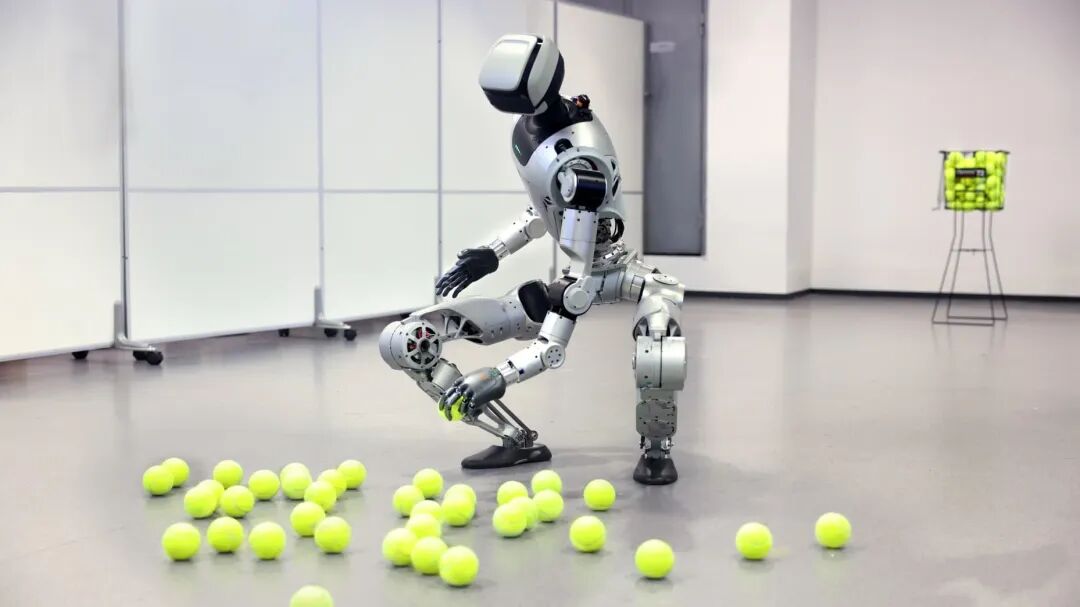
A LimX Dynamics robot grasping and storing a tennis ball in real time
2026 is only the starting point of LimX Dynamics' three-year plan. The company aims to deliver thousands of humanoid robots to the Middle East over the next three years, primarily for research and development purposes, while gradually building application scenarios where robots serve humans in the real world. The specific timeline for US market entry remains under exploration.
However, Zhang believes that the industry's overall acceleration means humanoid robots could be working alongside humans within 5 to 10 years. If everything proceeds according to plan, these robots will appear not only in China, but will gradually make their way across the globe.
Click "Read Original" to jump to the English source article