suho's WAIC Keynote: The Mission of Physical Intelligence Is to Give People Back to People | Oasis Vitality

On the afternoon of July 17, the main forum of the 2026 World Artificial Intelligence Conference and High-Level Meeting on Global AI Governance was held in Shanghai.

On the afternoon of July 17, the main forum of the 2026 World Artificial Intelligence Conference and High-Level Meeting on Global AI Governance was held in Shanghai.
suho, co-founder, chairman, and CTO of Sudu Tech — an Oasis Capital portfolio company — and inaugural dean of the Fudan University Institute of General Physical Intelligence, was invited to deliver a keynote speech titled Physical Intelligence: From Hallucination to Reality.
As a leading figure in global 3D vision and physical intelligence, suho was an early contributor to ImageNet, later co-founded ShapeNet, proposed PointNet, and led the development of systems including SAPIEN and ManiSkill.
His research has always revolved around answering one ultimate question: how to make genuine physical intelligence emerge.
Below is the full text of his speech. Enjoy.

Distinguished leaders and guests, hello. It is an honor to share some personal views at the World Artificial Intelligence Conference. This forum's theme is "Cornerstone," and what I want to talk about today is precisely the most foundational cornerstone of intelligence itself: physical intelligence.
Let me start with my conclusion: on physical intelligence, I am a committed optimist. Seeing through hallucination is what brings reality closer — that is the meaning of today's title, From Hallucination to Reality.

From Large Models to Physical Intelligence
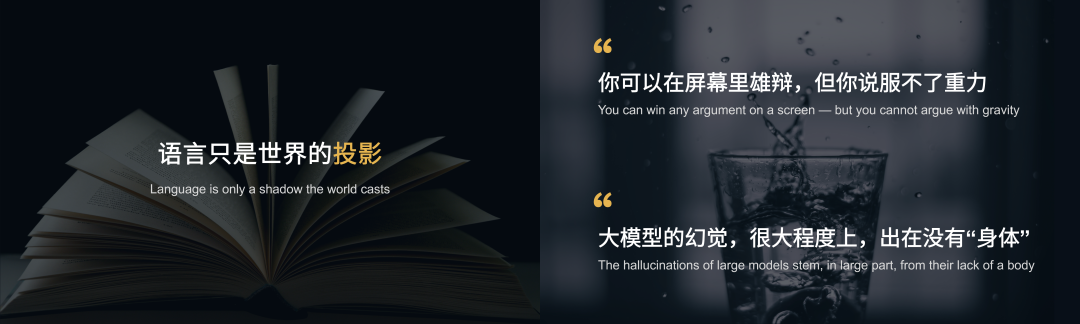
The progress of large models is plain to see. But why do even the smartest models still hallucinate? I believe the most fundamental reason is this: language is merely a projection of the world.
Humans first stumble through the physical world, then compress their experience into language; models have always been learning from this shadow, never seeing the entity that casts it. It can fluently describe "a cup falling to the ground will shatter," yet it has never had the chance to feel a cup's weight. Knowledge without an anchor in reality — when it errs, it has no way of knowing. You can be eloquent on a screen, but you cannot argue with gravity.
The hallucination of large models stems, to a large extent, from having no "body." To escape hallucination, one must step beyond the boundaries of the "digital world," to experience firsthand, to submit oneself to the judgment of the "physical world": make predictions, take actions, be corrected by reality.
This ancient process is called experiment — and it is also the key to physical intelligence.

What Physical Intelligence Truly Lacks: Aggregating Scattered Knowledge
So what does physical intelligence truly lack?
What we need is a model capable of aggregating all of humanity's physical-world knowledge. Tracing from the source of cognition, physical knowledge has at least six rungs of a ladder, each building upon the last.
The bottom three belong to the objective world — they exist whether or not "I" do.
- First, knowledge of objects: the world is composed of discrete, persistent objects — a ball rolls under the sofa, out of sight, yet it remains. Recognizing "what is there" must come before anything else.
- Second, knowledge of states: what are these things like right now? The ball under the sofa — how heavy is it, soft or hard — all of this belongs here.
- Third, knowledge of dynamics: how does the world change on its own? Balls roll, water flows, released objects fall. And "force" resides on this level — you cannot see it with your eyes.
The top three arise because of "I." Each is what the bottom three become once bound to a subject.
- Fourth, knowledge of function: what is this thing for, to me? Handles are for gripping, cups are for holding. The same chair is "sittable" for a human, not for an ant. A thing becomes a tool only through the subject.
- Fifth, knowledge of goals: what do I want the world to become? The ball is under the sofa; I want it back in my hand. Where the ball is — that's state. Where I want it to be — that's goal. Between "is" and "ought" lies the entire subject.
- Sixth, knowledge of action: knowing what to do, and the hand actually being able to do it, are two different things. Carrying a cup of water across a room without spilling — that's measure; tying shoelaces, using chopsticks — that's finesse. These skills aren't written in books; they grow in the hands.
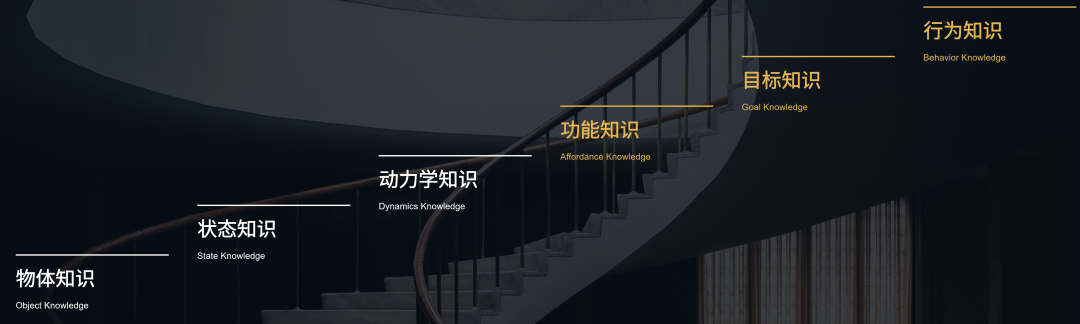
From objects to action, the higher you go, the less this is learned by "seeing," the more it must be learned by "doing" in the physical world. Every infant's first two years are spent climbing this ladder rung by rung — Piaget called this the "sensorimotor stage": the foundation of human intelligence is laid by the hands.
But models have no such childhood — they learn mainly from records left by humans. The trouble is, these six layers of knowledge are scattered across mutually incompatible carriers, and the higher you go, the less has been recorded. Internet video is the most abundant, yet it largely stops at the lower rungs — appearance and motion are visible, force and touch are not; textbook equations are the most precise, capturing dynamics exactly, but only for idealized worlds; real robot data has force sensing, has operational demonstration, reaching straight to the upper rungs, yet it is pitifully scarce.
Language models were lucky: the internet had already aggregated linguistic knowledge for them. Physical knowledge has had no such fortune. Polanyi said, we know more than we can tell. So the upper half of the ladder has never been systematically recorded — no amount of web scraping will yield complete physical intelligence. Aggregation is the scientific engineering project our generation must complete: melting the breadth of video, the precision of equations, the reality of real robots, and the subtlety of intuition into a single model, cross-calibrating and filling in each other's blind spots, completing the ladder.
For physical intelligence to go from hallucination to reality, this ladder is what stands in between.


The Era's Imperative Need, and How It Arrives
Why must this ladder be climbed?
The answer is not in the corpus, not in the server room, but in the real world.
Today's AI can write poetry, write code, make PowerPoints — yet it cannot help an elderly person turn over in bed. Most of intelligence's value still resides in the digital world of bits, yet humanity's heaviest needs are all in the physical world of atoms. Look around: aging is written on the calendar. Those needing care grow more numerous, while hands available to provide care dwindle. On the other side, dangerous and grueling work in high places, deep underground, and extreme heat also faces labor shortages.
The needs are all there. What is missing is the hands.
Physical intelligence is not a replacement for humans, but a collaborator — filling the gap in human hands, entrusting tasks like turning and lifting to machines, returning caregivers' time to companionship and care; sending machines into dangerous operations, pulling humans back behind the safety line to take on judgment and creation.
The mission of physical intelligence is to return humans to being human.
So how will it arrive? Speaking as a technologist, here is my personal judgment. It will not be "realized" overnight at some product launch. It will be more like electrification back in the day — first lighting up factories and warehouses, then entering shops and hospitals, and only finally reaching every household. The value of physical intelligence need not wait for the destination; it is released along the way.

The most treacherous stretch of this road is the reliability chasm between demo and product. Bridging it depends not on spectacle, but on foundational work, on accumulating data — especially the half that carries force and interaction. Bridging it depends on industry standards, supply chains, and the hardest thing to build: social trust. Trust can only be earned bit by bit through reliability; and this trust is also the most foundational cornerstone for physical intelligence to take root.

Three Predictions
Finally, I leave three predictions for the future to test.
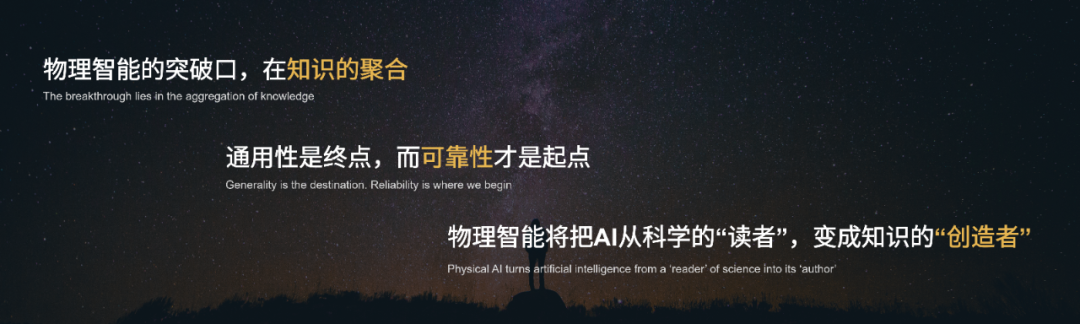
First, the breakthrough in physical intelligence will not come from model architecture, but from knowledge aggregation. Aggregation by its nature exceeds the boundary of any single institution — video is on the internet, equations are in textbooks, force-sensing data is in individual labs, operational intuition resides in hundreds of millions of workers. No one can assemble this ladder alone. It requires concerted collaboration across the entire industry and even society: jointly building data, jointly establishing standards, jointly sharing infrastructure for simulation and evaluation. When this knowledge is truly melted into a single model, the physical world will have its own "internet moment" — the so-called GPT moment will merely be its byproduct.
Second, the industry's center of gravity will shift from "how stunning the demo" to "how reliably it runs." In engineering there is a term called "how many nines": from 99% to 99.9%, each additional "nine" raises difficulty exponentially; the gap between demo and product is caught in those final nines. Generality is the destination, but reliability is the starting point — teams willing to do the unglamorous work on the "nines" will go the farthest.
Third, physical intelligence will transform AI from a "reader" of science into a "creator" of knowledge. Today's AI has read nearly all human papers, yet has almost never performed an experiment with its own hands; and new knowledge is born precisely in experiment. When it gains hands capable of perceiving, manipulating, and verifying the real world, it can propose hypotheses, run experiments, and correct itself around the clock. The discovery of new materials and new medicines may accelerate by several orders of magnitude.
From hallucination to reality, there is no shortcut. It depends not on louder narratives, but on reverence for the physical world, and on the unglamorous work of climbing that ladder rung by rung. The physical world is intelligence's oldest teacher, its most honest examiner, and its ultimate cornerstone. We choose to submit our answer sheet to it.
Thank you, all.