When Philosophy Meets Science: Oasis Dialogue with Yu Mingfeng of Tongji University | Oasis Vitality

Counselor Vitality

When artificial intelligence gets pulled into grand narratives, it ceases to be merely a technical topic and becomes instead a vehicle for reshaping relationships and society.
More specifically, if technology has philosophically given rise to a mainstream technicist worldview, then AI's development has also produced a philosophical position — computationalism: the mind is treated as a computational system, and all thinking can be achieved through computation.
In reality, throughout AI's development, philosophers have continually offered fresh reflections on the relationship between machines and humans from a philosophical perspective.
In 1980, the analytic philosopher J. R. Searle proposed a thought experiment called the "Chinese Room."
He imagined a machine capable of effective communication in Chinese with others — a machine that could exchange information without actually understanding Chinese. From this, he concluded that machines cannot truly think. To this day, many scholars continue to follow Searle's line of reasoning to criticize current AI, including ChatGPT.
From one angle, the relationship between machines and humans is precisely the philosophical question that demands our attention right now.
At this year's 40U40 Innovation Conference, an interview series hosted by Wealth, we sat down for a three-way conversation with Yu Mingfeng, associate professor and deputy director of the Philosophy Department at Tongji University, and Yang Anqi, executive deputy editor of Wealth China New Media. Our aim was to step outside technology itself and offer a way of thinking and a method for humans to coexist peacefully with technology. Enjoy.
Guests
Yu Mingfeng Associate Professor and Deputy Director, Philosophy Department, Tongji University
Yang Anqi Executive Deputy Editor, Wealth China New Media
Jinjian Zhang Founding Partner, Oasis Capital
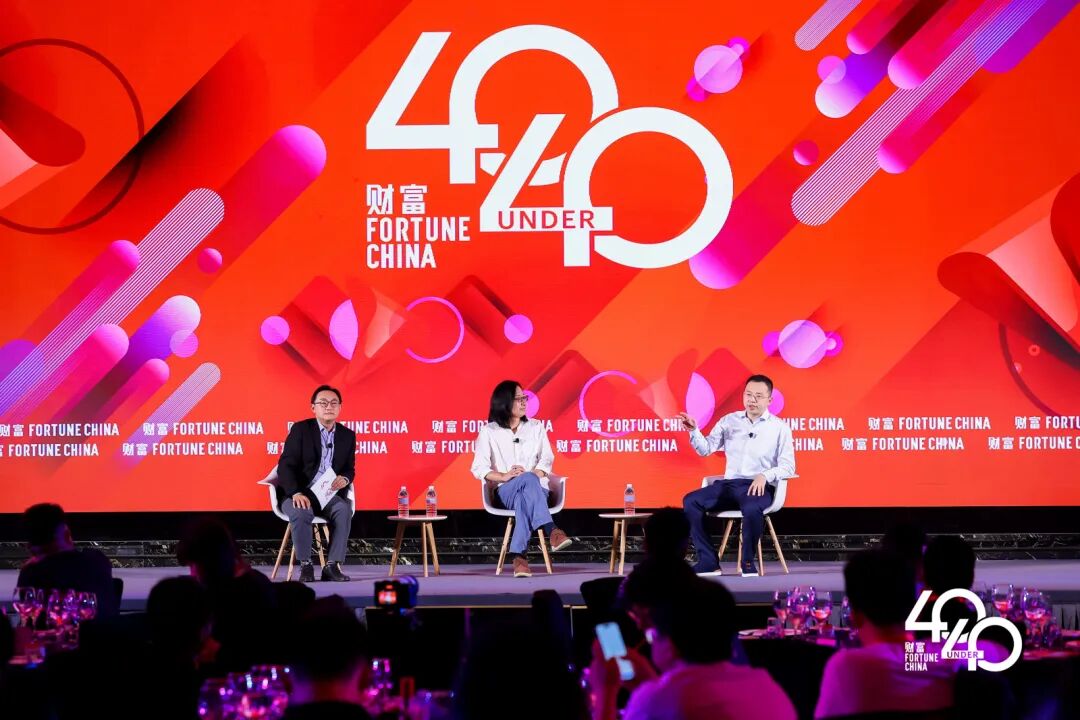 September 5, 2024, at the Wealth 40U40 Innovation Conference. From left to right: Yang Anqi, Yu Mingfeng, and Jinjian Zhang.
Yang Anqi: This is the part I've been looking forward to most today — the relationship and questions between technology and philosophy.
Let's start with AI and the reshaping of human society. We know that in the agricultural age, the appearance of iron tools changed how farmers worked. In the industrial age, the steam engine changed how workers worked. Many people now draw an analogy that AI, as a new productive technology, will revolutionize and transform society. This is a rather grand topic. How do you two view this perspective?
Yu Mingfeng: First, when something new emerges, it's crucial to establish the coordinates or frame of reference for understanding it. Different frames of reference for AI mean different positioning. In my academic lectures, I typically draw an analogy between AI and the steam engine. Because when you compare AI to the steam engine, you can see that on the surface it's merely technological progress, but in fact, the products of technological progress carry entirely new messages of civilization. That's how I personally position AI's development.
Zhang: Over the past two years, media and peers have said Oasis is the most aggressive fund investing in AI. From my perspective, we're not aggressive enough.
Before humans entered agricultural civilization, we survived by hunting and gathering. That was the matriarchal society, which lasted about 300,000 years. Then came agricultural civilization, which lasted roughly 10,000 years. Next came industrial civilization, about 300 years. Each of these three civilizations accelerated by a factor of 30. At this rate, if humanity is entering what we call artificial intelligence civilization, this period will last only 10 to 15 years. If we consider 2022's ChatGPT a milestone, then roughly between 2025 and 2037, we may have already entered a new stage of civilization.
A major shift in civilization produces enormous changes in social structure and in relationships between people.
I feel we're still not aggressive enough. For various reasons, society's discussion and support of current AI is far from sufficient.
Yang Anqi: Professor Yu, how do you view the changes in relationships between people brought by era-defining technology? Will relationships between people and things change as well?
Yu Mingfeng: I believe changes are already underway. For example, the smartphones everyone carries today — they are objects on our person, yet simultaneously treat us as their object, monitoring our data. Regarding AI, we've discussed data extensively. In the age of big data, each person is no longer the subject using data; we are the objects being harvested by it. Of course, changes in the relationship between people and things will unfold on other levels too. But perhaps more important is the relationship between people. In this process of change, as Mr. Zhang just mentioned, we'll need tremendous imagination to envision how relationships between people might transform. When we talk about AI, a frequent topic is future employment. In the Industrial Revolution, much discussion centered on the division of labor that industry brought, the necessity of specialized training that division of labor created, and the modern university education that specialized training necessitated.
Now when students enter university, their first consideration is choosing a major, and choosing a major means thinking about employment. This entire set of concepts may all change in the future. In the Industrial Revolution era, the most discussed topic was the relationship between capitalists and workers. In the future, this relationship too will undergo fundamental change.
Yang Anqi: Will it cease to exist?
Yu Mingfeng: In the foreseeable future, AI will replace large numbers of low-end laborers. This involves the reorganization and reconstruction of the entire society, including relationships between people and the world, and between people and each other.
Yang Anqi: Jinjian, you said our discussions about AI are still insufficient. If we had enough discussion, how would AI change us? How would it reconfigure relationships between people and the world, and between people and technology?
Zhang: I very much agree with what Professor Yu just said. "Things" are merely "appearances" — they are merely vehicles that bring different life experiences. Sometimes, in pursuit of these "appearances," people neglect the true life experience. Many people start businesses with original intention, then lose the happiness they had before succeeding — they've discarded their life experience for the sake of so-called "appearance." Returning to each person's present moment is about life experience. But what cannot change within life experience is the relationship between people. Relationships between people divide into two kinds: one is the relationship between people from the perspective of society as a whole; the other is the relationship between people from the perspective of individual life experience.
The new productive force transformation we're experiencing today is AI. In the past, seeking medical care meant finding a doctor. But in the future, all the books a doctor has read, all the cases they've handled, all the conditions they've seen — these can all be presented through an Agent. When you can't tell whether this is a doctor or an Agent, then which is the expert — the Agent or the expert? If all human professional services are ultimately沉淀ed through AI, then what remains of relationships between people? Perhaps what remains is what we call kindness and compassion, what we call empathy. From the perspective of overall social structure, relationships between people will undergo tremendous change.
Suppose today there's an Agent that understands you very well, knows what kind of clients you prefer today, and can search for clients for you everywhere in the world. The greatest limitation of humans is that attention is finite, time is limited, mental energy is limited. But if our time and mental energy were unlimited, we could browse every website in the world, flip through every book in the world, and find what we want. At that point, the value of advertising would be diminished, because all advertising's value lies in filtering based on your limited attention. Thus business models would change, with many Agents helping you accomplish many things.
Yang Anqi: Professor Yu researches Nietzsche. Nietzsche has a very famous line: "God is dead." Do you think God is dead? Or has God been resurrected in the form of AI?
Yu Mingfeng: The question now is whether humans will die. Later, another philosopher, Foucault, picked up where Nietzsche left off and said "man is dead" too. By "man is dead," he meant that humans are no longer the subject of the world; the human as subject is slowly disappearing. Mr. Zhang described relationships between people from the perspective of Agents — this part is very interesting. As a university teacher, I play this kind of role too: I'm a mediator that students need to enter specialized fields. A large part of this mediator function will be replaced by AI in the future. Whether it can be replaced, and whether this replacement should be welcomed — there's more room for reflection here. I can sense that Mr. Zhang is more of a radical technicist than I am — more radical on technology, and also maintaining a relatively optimistic attitude.
Zhang: I am very radical, while also having many fears.
Yang Anqi: In the AI era, what should our fears be? What positions should humans assert for ourselves regarding AI?
Yu Mingfeng: In Mr. Zhang, I see the tremendous excitement of a thinker encountering AI for the first time. I share this excitement too. From the perspective of thought, this means the opening of a world of ideas. It means that studying various relationships in human society holds tremendous imaginative space for us in the future. This is very interesting — it's as if history has started moving again. For a long time, we felt as if history had stagnated, but AI makes us feel that history is stepping forward.
Yang Anqi: Jinjian, you're constantly investing — does this method accelerate history? You mentioned "fear" just now. What should we fear? What are you afraid of?
Zhang: First, I fear the future of relationships between people. We looked at a social software where you could put your best friend into the software as an Agent, turning chat history with your friend and knowledge about yourself into information input into the Agent. The social software quickly discovered that when you have the choice between an Agent and a real friend, the Agent rapidly becomes one of your top three social contacts — one of your three most recent contacts is definitely an Agent. So what will relationships between people be in the future?
Second, I actually don't worry about employment. Looking back at employment rates after Britain's Industrial Revolution, there was one year when it dropped 5%, then quickly rebounded to 95%. Every one of us here today works far longer hours than peasants did back then — at least they started when the sun came out and ended when the sun went down.
As information becomes increasingly abundant and frequencies get higher, we may be enslaved by information, trapped in torrents of information, with someone caring about us every moment, someone watching us every moment.
Yang Anqi: What should we do next to prevent this from happening?
Zhang: I think first, find a personal hobby. Hobbies carry you through many cycles of life; hobbies quiet you down. Second, find your core capability, because the value of non-core capabilities will rapidly be flattened. Each person's core capability becomes increasingly valuable, so the world becomes one where everyone serves me and I serve everyone. And the core of that core capability is something you continually refine — that thing becomes the way all your value manifests.
Yang Anqi: Professor Yu, do you fear anything that AI might bring us in the future?
Yu Mingfeng: I'm more curious. Like Mr. Zhang, I'm excited — excited intellectually. I suddenly feel this world is interesting. There was a period when I found this world terribly boring. With this kind of change, I start wondering: what will relationships between people be like in the future? This is extremely interesting to think about. As an educator, I sense students have great employment anxiety, which stems from uncertainty about the future. New types of employment will emerge, but we don't know where.
We're still at a historical turning point. Our university teaching materials remain quite outdated, still teaching subjects related to the Second Industrial Revolution. These disciplinary classifications and major divisions are already obsolete. Yet students face an employment market five or ten years in the future. In this gap, employment issues, along with higher education issues, need to be re-examined — this is what I think about more.
If there's any other anxiety, or latent concern, it would be this: in an AI-constructed society, the individuality of a person's existence gets flattened. We experienced the flattening of individuals in the mobile internet era, and this will be further intensified in the future. Such flattening is not good news for society, because when people have independent thinking capacity, society is generally more civilized. When people in a society are swept along by torrents of information, they lose their own judgment, and this makes for a concerning society.
Zhang: In the society to come, each person's individuality will become increasingly important, because commonalities — so-called knowledge, experience, wealth — are worthless in the grand torrent, but your individuality, your aesthetic sense, that little bit of core capability makes each person distinctive.
Yang Anqi: But individuality and aesthetic sense are very difficult to educate.
Yu Mingfeng: This is also very interesting. AI can replace everything that can be datafied, but aesthetic sense is truly special. It can be cultivated, activated by certain experiences, developed — but it cannot be educated. So this is what humans cannot be replaced by AI.
Zhang: What we call "modern education" only emerged after 1850. Why did so-called "modern education" appear in 1850? Because the world needed to cultivate large numbers of industrial workers. "Modern education" was a training base for industrial workers. Thus for the first time, humans made literacy rates the core metric of education, using this method to raise their productivity levels. This will definitely be very different from future education systems and methods.
Yang Anqi: If you were a university professor, what new courses would you create?
Zhang: A course about quieting oneself down. Only by quieting down can one discover that beauty is not invented but discovered, not educated but self-emergent. Essentially, one must quiet down within an information-flow society, quiet down to discover oneself, to discover beauty. Becoming an entrepreneur is a process of self-discovery. Every time an entrepreneur rises to a new level, it's not that some specific problem was solved enabling breakthrough; rather, they themselves broke through, themselves transformed, and thus problems were solved. I think this is the meaning of future education.
Yang Anqi: In the final two minutes, I'd like each of you to ask the other one question, one minute each, and explain why you're asking it. You don't need to answer now — let everyone hearing this question think about it together.
Yu Mingfeng: I met Mr. Zhang for the first time today. It's very interesting — like us scholars, he overflows with curiosity and imagination. At the same time, I wonder: curiosity is good, but is excessive imagination also a risk for investors? Why do I ask this? I'm thinking that AI's development is certainly the basic direction of the future, but this process may have ups and downs. Why? All new things undergo a process of human societal reconstruction. In this reconstruction, regulation becomes an organic part of society — not necessarily a negative element — but this process itself has a certain tortuousness.
Zhang: Professor Yu, I'd like to ask: AI's development is visibly becoming stronger and stronger. What do you think is that final boundary between AI and humans? What determines that something is human rather than AI?
Welcome to leave your thoughts and perspectives in the comments. We'll select three commenters to receive gifts prepared by Oasis Capital. The deadline for submissions is 8:00 PM, September 15, 2024.