LightStandard, a Yunqi Capital Angel Round Portfolio Company, Raises Several Billion RMB at Nearly 20 Billion RMB Valuation

Achieving "All-Optical Computing" in 5–10 Years
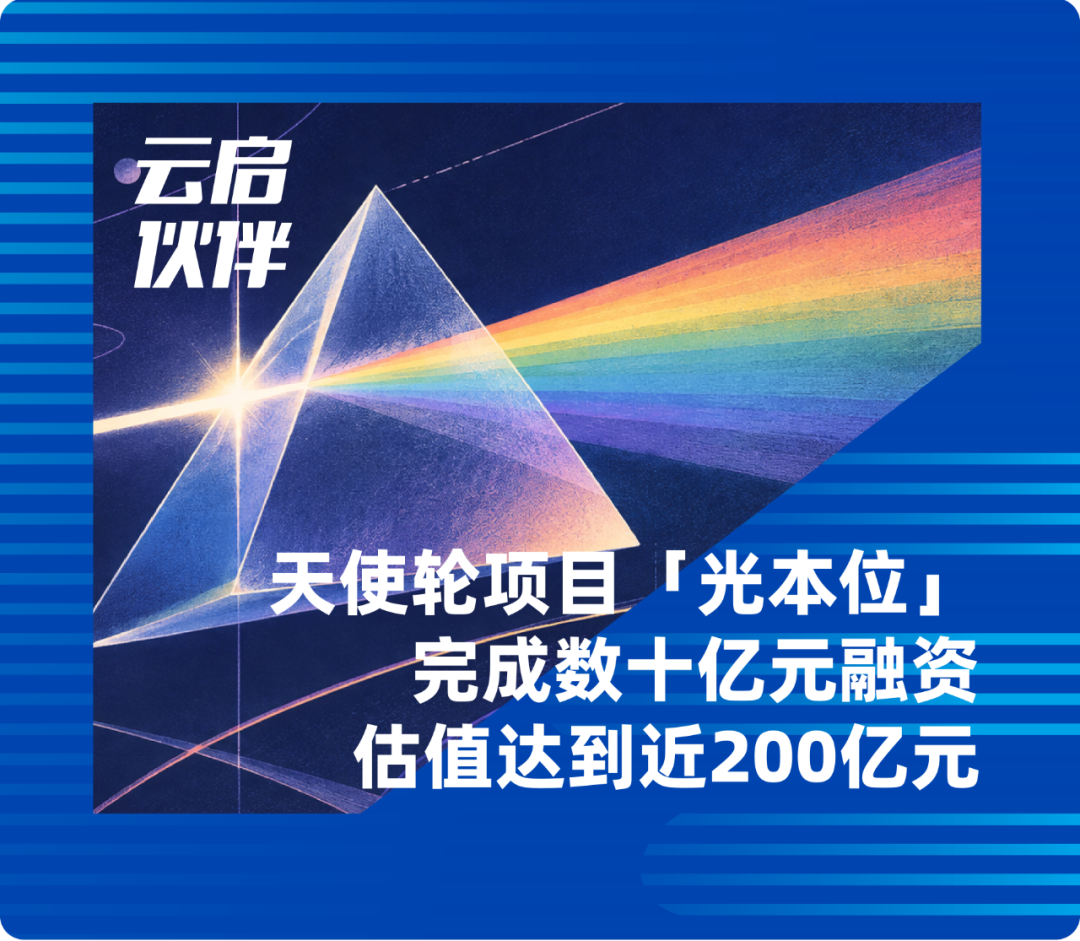
AI computing power is standing at a historic inflection point — the shift from "electrical" to "optical."
Recently, LightStandard, a photonic computing systems company that received angel-round investment from Yunqi Capital, announced that it has completed multiple funding rounds within the past year, with cumulative financing reaching several billion RMB and a post-money valuation approaching 20 billion RMB. Currently, LightStandard has become one of the world's most heavily funded photonic computing companies with the fastest product development and commercialization progress — its first-generation photonic computing product already matches the performance of mainstream domestic AI inference chips, it has completed scaled delivery of more than 10 photonic computing systems, and at this year's World Artificial Intelligence Conference, it unveiled two world-first technologies: a 256×256 photonic computing chip and a glass-substrate photonic computing chip.
Having accompanied the team from the angel round to today, we have witnessed LightStandard's continuous breakthroughs in architecture, materials, and packaging, and are glad to see photonic computing moving from ground-based compute clusters into space.
The following is adapted from TMTpost, by Zhang Xiaoxia
In 2026, the global AI computing power landscape is undergoing a quiet but profound transformation. Two seismic signals — "light succeeding electricity" and "compute power going to space" — are emerging. Across the ocean, Elon Musk and Jensen Huang are both making their moves. Meanwhile, in China, one AI photonic computing systems company holds the narrative authority on both fronts, with an overall layout that predates Musk and Huang and has already entered the commercialization phase. That company is Lightstandard.
Recently, Lightstandard announced that it has completed multiple funding rounds within the past year, with cumulative financing reaching several billion RMB — the company's first formal disclosure of funding progress this year. According to public information, the company's post-money valuation has reached nearly 20 billion RMB.
Currently, Lightstandard has become one of the world's most heavily funded photonic computing companies with the fastest product development and commercialization progress. It is understood that the proceeds from this funding round will primarily be used for large-scale mass production and delivery of photonic computing systems, as well as R&D investment in frontier directions such as glass-substrate photonic computing chips.
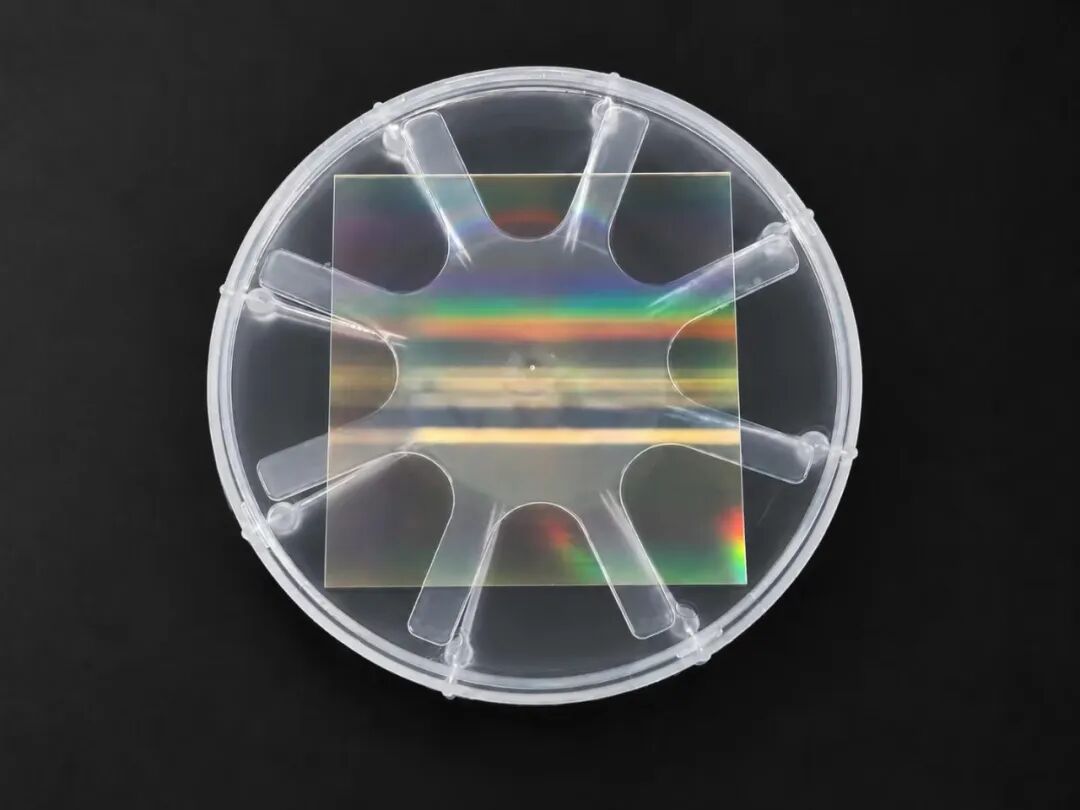
Glass-substrate photonic chip
Scaled Delivery of Photonic Computing Systems
A Clear Commercialization Path
Lightstandard currently has two business lines: photonic computing and photonic interconnects. Its photonic computing business directly competes with AI chip vendors, with core metrics centered on tokens per second and tokens per watt. Photonic computing's natural advantages are speed and low power consumption. Unlike traditional photonic computing approaches, Lightstandard's technical route solves an expensive and stubborn problem in large-model inference: the repeated movement of massive weights from memory to compute units just to generate the next token. Its photonic interconnect business is positioned to provide GPU vendors with package-level integrated photonic interconnect solutions. Unlike external photonic interconnect approaches, Lightstandard's solution enables GPUs with native optical I/O capabilities, addressing the bandwidth bottleneck in scaling domestic clusters from thousands to tens of thousands of cards.
According to public information, Lightstandard's first-generation photonic computing product already matches the performance of mainstream domestic AI inference chips, with several-fold advantages in energy efficiency. The planned second-generation product will target performance parity with international mainstream AI inference chips.
Yinjiang Xiong, Lightstandard's founder and chairman, stated that in Q2 this year, the company formally established a mature cross-functional commercialization team, with core leaders personally following up on front-line deployments. To date, it has secured dozens of customers across leading tech giants, vertical AI companies, and intelligent computing centers, obtaining orders and letters of intent worth several hundred million RMB, and has completed scaled delivery of more than 10 photonic computing systems.
Joint R&D is one way Lightstandard connects with leading tech giants. In March this year, Lightstandard reached a strategic partnership with a leading cloud service provider (CSP) to jointly develop a full-stack AI R&D solution for chip design. This solution aims to support chip design tasks including requirement extraction, simulation code design, and iterative device optimization, and supports private model deployment that meets customer requirements for data security and intellectual property protection. Lightstandard contributes its expertise in photonic and electronic chip design, which is incorporated into AI agents for the chip design workflow, while the CSP provides underlying AI coding and agent development capabilities.
In Xiong's view, beyond competing with traditional AI inference chips on performance and energy efficiency in the above domains, photonic computing also has areas where it is natively suited — with space-based computing being the most representative. In the extreme constraints of space, where energy is severely limited, temperature differentials are extreme, and radiation is intense, photonic computing's core advantages of natural radiation resistance, near-zero thermal dissipation, and ultra-high energy efficiency make millisecond-level onboard AI real-time processing possible for the first time. This transforms satellites from mere data "porters" into "space intelligent agents" capable of autonomously performing hyperspectral analysis, ad-hoc obstacle avoidance, and tactical decision-making — pushing the "compute infrastructure race" from the ground to low Earth orbit.
Lightstandard is the world's first photonic computing company to apply AI photonic computing systems to space-based computing scenarios. In May this year, Lightstandard and Dongfang Tiansuan formally announced the co-establishment of the Space-Based Photonic Computing Innovation Center, globally pioneering the development of space-based photonic computing satellites and photonic computing payloads to support on-orbit AI inference and large-model operation in space, extending photonic computing product applications from the ground to space.
Maintaining Reverence for Future Technologies
Achieving "All-Photonic Computing" in 5–10 Years
In July this year, at the World Artificial Intelligence Conference, Lightstandard formally released two milestone advances in world-first photonic computing technologies — a 256×256 photonic computing chip and a glass-substrate photonic computing chip. The former surpassed the world's first commercial-grade 128×128 photonic computing chip that the company successfully taped out in June 2024; the latter disrupted the global silicon-based photonic computing system that the company itself had been leading. In the same month, Lightstandard jointly with Fudan University published another major photonic computing research achievement, which was featured on the cover of the international journal Science Advances.
Xiong has mentioned on multiple occasions in media interviews that photonic computing companies must maintain reverence for future technologies. Many tech companies that were ultimately eliminated by the market were not defeated by competitors, but by future technologies beyond their own vision. Therefore, Lightstandard began laying out mainstream photonic computing technologies for 5–10 years out very early on.
In 2025, Lightstandard globally pioneered replacing silicon with low-cost, high-transmittance glass as the substrate for photonic computing chips. The underlying logic is to解除 the triple constraints on photonic computing chips of chip area, photon transmission loss, and manufacturing cost, while adapting to advanced packaging technologies centered on glass substrates. This enables photonic computing chip fabrication to break through for the first time the limitations that lithography processes impose on chip area, freeing compute power from the physical constraints of mask stitching, thereby achieving multiplicative gains in chip area and compute power. At the same time, glass substrates reduce material costs to a fraction of silicon-based costs, while their extremely low optical transmission loss eliminates signal attenuation in optical path interconnects, paving the way for ultra-low-cost mass production of wafer-scale photonic computing chips.
Xiong stated that the reason Lightstandard continuously pursues breakthroughs in architecture, materials, and packaging is the ultimate goal of launching an all-photonic computing system — enabling optical signals to achieve repeated computation and dynamic temporary storage within the optical domain itself, changing the current state where photonic computing can only serve as a "single compute core," and making photonic computing chips an AI computing platform capable of directly running complete models. In the future, when a user issues an AI inference request, the optical signal could run through the entire glass body and output results — meaning the landscape of AI inference would be fundamentally transformed.
This reverence for future technologies is also reflected in Lightstandard's ecosystem layout. In August this year, the company formally began investing in industrial chain supporting projects, with deal sources including university and research institute partners in industry-academia-research collaborations, as well as upstream and downstream industrial chain partners.
Standing at a valuation approaching 20 billion RMB, looking back on the company's nearly legendary four-year development journey, the entrepreneurial maxim Xiong trusts most is "with thunder in one's chest, yet a placid face." And standing ten years or even further in the future looking back at the present, what sustains him may still be these eight characters, along with Lightstandard's mission — "to build the necessary chip and system infrastructure for the sustainable prosperity of energy and intelligence."