Yunqi Capital and WRC Jointly Release 2026 Embodied Artificial Intelligence Data Industry Chain and New Infrastructure Report

The Data Flywheel: From Handicraft Workshop to Experience Factory
From factories and fields to every corner of daily life, a global "data collection army" is growing fast. But will more devices, more people, and more hours actually break through the data bottleneck?
A wave of world models is emerging rapidly. Is the "GPT moment" for embodied AI really near?
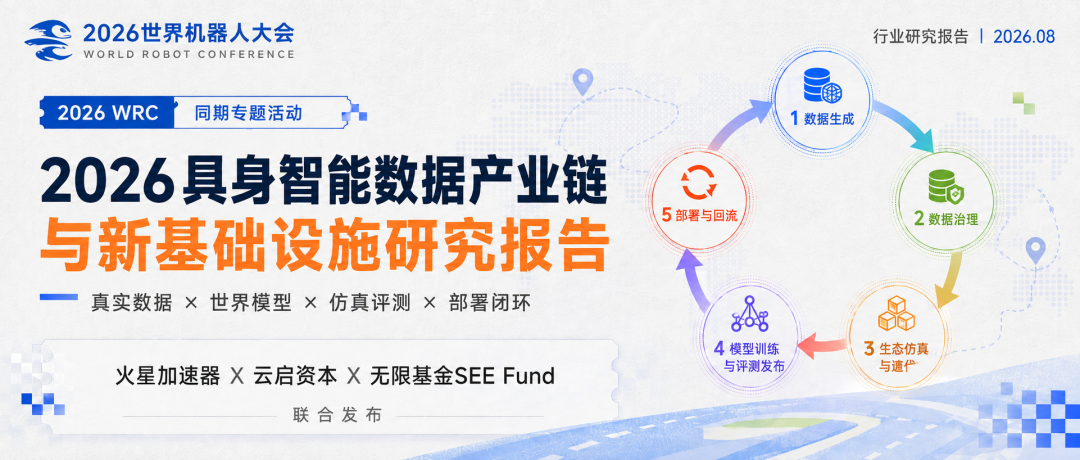
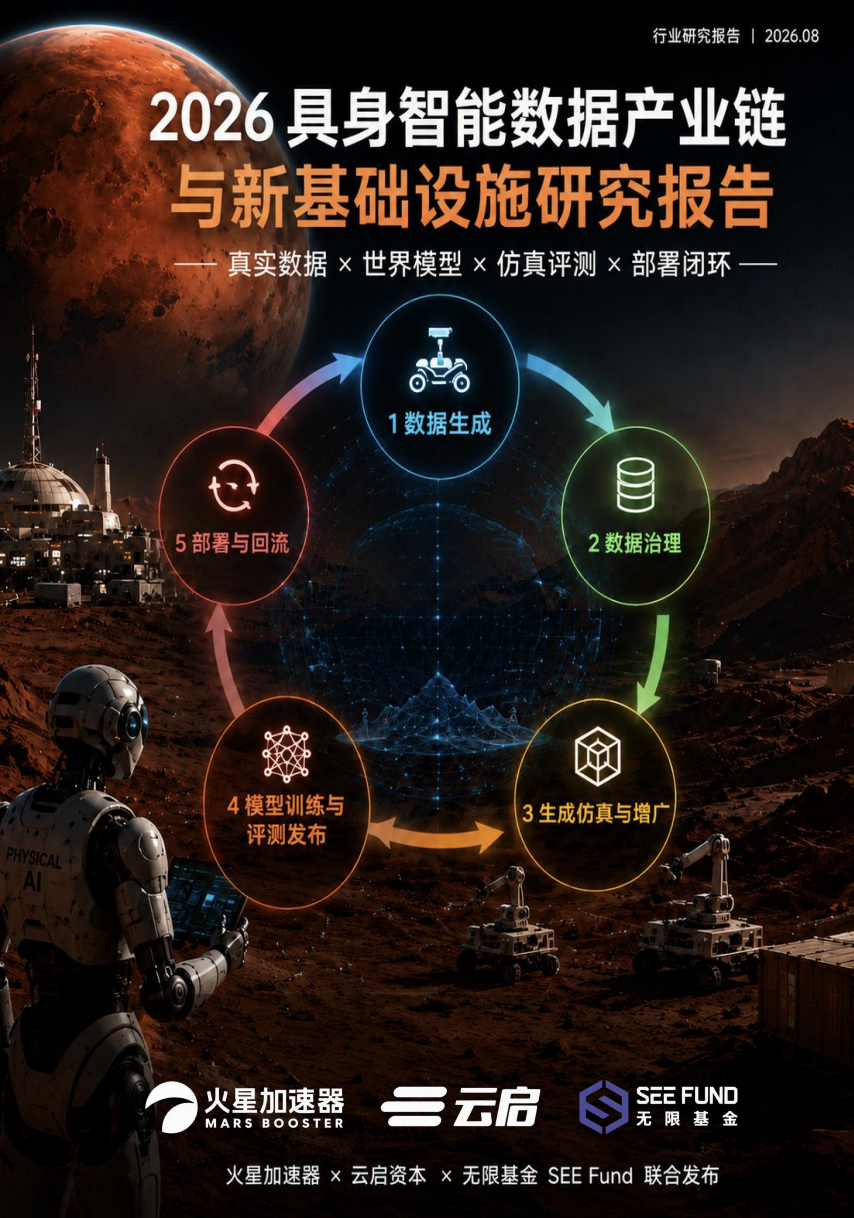
On August 21, 2026, at the World Robot Conference (WRC) forum, Mars Accelerator, Yunqi Capital, and SEE Fund jointly released the "2026 Embodied AI Data Industry Chain and New Infrastructure Research Report", sharing their core assessments on the next phase of evolution in the embodied data industry:
Competition in embodied data is shifting from "chasing quantity" to "chasing validity"; from single-point contests over hardware or models to full-stack, data-flywheel-driven systems engineering. New infrastructure — world models, data governance, evaluation, and deployment — is pushing the industry from artisanal workshops toward "experience factories."
Below is a summary of the report's core findings:
PART 1
Why does the industry need data infrastructure?

Yunqi Research: Embodied AI in Industrial Scenarios
Over the past decade-plus, mainstream AI development has relied primarily on "large-scale static data and offline pre-training," with outputs in discrete digital forms like text, images, and code. The emergence of embodied AI marks a paradigm shift for the industry: system outputs change from tokens to actions, and training targets shift from text to temporal closed loops of "perception—action—feedback."
The report identifies seven key differences between Digital AI and Physical AI:
| Dimension | LLMs / Digital AI | Embodied AI / Physical AI |
|---|---|---|
| Training Data | Offline corpora: internet text, code, images, etc. | Multimodal temporal data from real or simulated physical environments |
| Output Form | Discrete tokens | Continuous actions / trajectories / policy parameters |
| Learning Method | Primarily offline pre-training | Offline pre-training + real-device fine-tuning + continuous iteration with deployment feedback |
| Core Evaluation | Text comprehension, generation quality, reasoning accuracy | Task success rate, robustness, recovery capability, safety, human takeover rate |
| Value Loop | Model output is directly deliverable | Must pass robot system and real-scenario acceptance |
| Error Cost | Content quality, compliance, and decision risk | Contact failure, downtime, asset loss, and personal safety |
Embodied AI is not a simple extension of large language models, but a leap from Digital AI to Physical AI. Digital AI can be accountable only for tokens; Physical AI must be accountable for the consequences of actions. This means that approaching the field purely through a model-technology narrative risks underestimating the systemic challenges of real-world deployment.
System Competition Replaces Single-Point Model Competition
One of the report's core judgments: the true competitive center of embodied AI is shifting from "a model" to "a sustainably deliverable system." The gap between technology and commercialization manifests across four layers:
- Layer 1: Model capability — Can it understand tasks and generate effective strategies?
- Layer 2: Data supply capability — Is the data qualified, reproducible, and reusable?
- Layer 3: Predictive evaluation capability — Can it predict consequences and filter at high frequency?
- Layer 4: Deployment feedback engineering capability — Can it rapidly detect, attribute, and resolve issues?
Without Layer 4's closed-loop system capability, technology remains stuck at the demo stage of effect optimization. Only by filling in engineering integration and scenario feedback capabilities can an irreplaceable industry-grade moat be built.
PART 2
What counts as truly effective data?
More Data Is Not Always Better
The industry currently lacks consensus on a "minimum hour threshold for general embodied models." Different studies use hours, trajectories, clips, tasks, robot embodiments, or tokens as units; even the same hour of data can vary several-fold in information density, action coverage, failure ratio, and sensor modality.
The report notes that the data gap stems not just from quantity, but more painfully from quality:
Pain Point 1: Real data is expensive, slow, and fragmented. A single device generating 10,000 hours of training data costs over one million RMB, with overall collection costs more than 10x those of conventional data.
Pain Point 2: Structurally unusable. Missing task definitions, misaligned multimodal temporal sequences, inconsistent action spaces, missing failure causes, incomplete metadata — these collection breakpoints cause significant attrition in usable hours before training and evaluation even begin. Fixing these issues often improves training and delivery efficiency more than adding equivalent raw hours.
Seven Capabilities of "Usable Data"
The report proposes that what is truly scarce is "usable data" — data that is searchable, alignable, compressible/loadable, reproducible, evaluable, cross-embodiment reusable, and traceable in rights and provenance. Only such data can be converted into model capability. This means the industry is shifting from the "cumulative hours" evaluation dimension toward a more explanatory new framework:
| Metric | Definition |
|---|---|
| Data-to-Action Efficiency | Task gain per unit of newly added qualified data |
| Data Reuse Efficiency | Ability of the same data to be reused across tasks, scenarios, and embodiments |
| Simulation Amplification Ratio | Ability of simulation / world models to reduce real-device consumption |
| Deployment Feedback Loop Velocity | Speed from failure detection to updated deployment |
Future leaders won't necessarily own the most data, but will achieve the highest data value conversion efficiency.
PART 3
How does the data flywheel form?
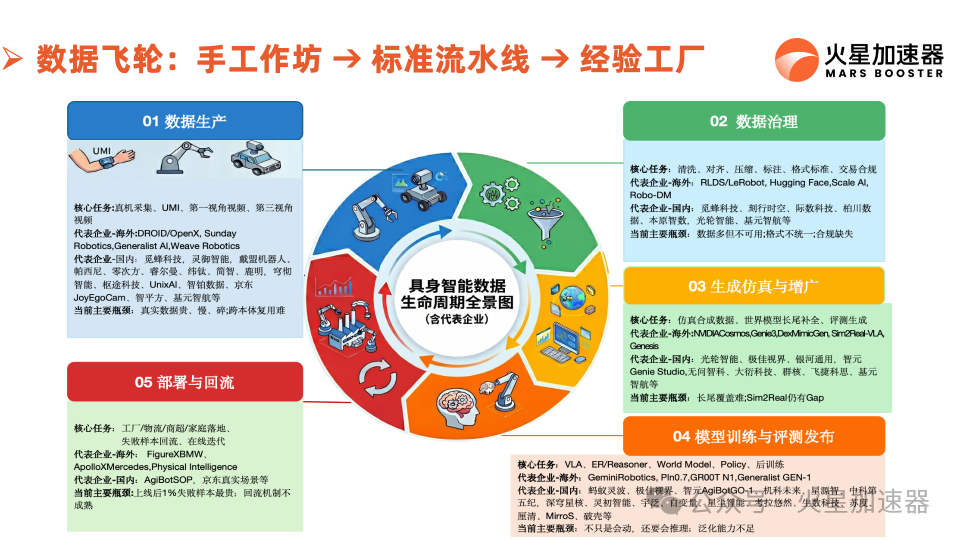
Five Stages of the Data Lifecycle
The report defines the embodied AI data lifecycle as a closed loop: data production → data governance → generation & simulation → data consumption → deployment feedback. Data is no longer a static deliverable for one-time transactions, but a dynamic production factor running through the entire industry chain and iterating continuously.
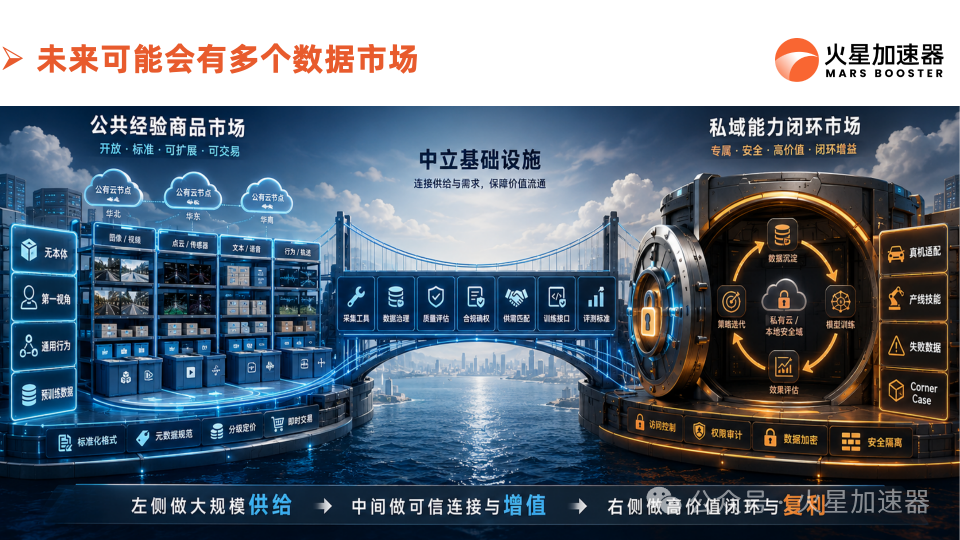
The industry is accelerating from loosely coupled, fragmented modes at each stage toward protocol-level vertical integration. Leading full-system and model companies generally value proprietary data and deployment feedback, but "building everything in-house" is not economical — the more likely pattern is: high-value private domain data, critical evaluation, and feedback loops stay inside enterprises, while general collection hardware, governance tools, simulation, and standardized testing are provided by specialized suppliers and public platforms.
Deployment Feedback: The Highest-Marginal-Value Data Source
Deployment feedback is the core mechanism for embodied AI's continuous evolution. Unlike traditional AI where "training completes and the model is fixed," embodied AI models require continuous iteration of "deploy → collect → optimize → redeploy."
Particularly noteworthy: when model execution success rates approach 99%, the remaining 1% of failure samples (edge cases, unadapted scenarios) become the core source of data feedback. These failure samples expose the capability boundaries of the current version and carry high marginal value.
PART 4
How do world models restructure the embodied data industry chain?
World Models Are Not a Single Model, but a Set of Foundational Capabilities
The report breaks down world models for embodied AI into three interconnected foundational capabilities:
| Capability Category | Core Question | Primary Value |
|---|---|---|
| World Representation Model | What is the world? | Unify multimodal states, support reuse and memory |
| World Prediction Model | How does the world change? | Generate candidate futures, support simulation, planning, and evaluation |
| World Action Model | How to change the world? | Integrate prediction—selection—action |
Most VLA pipelines are "see → act," not explicitly requiring the model to predict how candidate actions will affect the future world; world models enable robots to move from "reacting to the environment" to "predicting the environment," from imitating single-step actions to modeling action consequences. This doesn't mean VLA disappears, but rather provides strategy with forward simulation, backward verification, and auxiliary training signals.
A Concentrated Burst from Chinese Vendors
In July 2026, Chinese vendors hit a concentrated release window, with at least six projects open-sourced simultaneously: Ant Group's LingBot-World 2.0, Amap's ABot-World series, Tencent Robotics X and Hunyuan team's Hy-Embodied series, Independent Variable Robotics' WALL series, GigaWorld-1 from Best World View in collaboration with Tsinghua University, Astribot's Lumo-2, and others. The field is active with diverse approaches covering pixel/video representation, latent space prediction, world-action fusion, and more.
But the report also issues a clear warning: the value of world models must be validated against real task acceptance. They can generate experience, predict consequences, and filter strategies, but amplification only has industrial meaning when it reduces failures, takeovers, or testing costs on real test sets not seen during training.
Simulation and World Models Are Amplifiers, Not Replacements
The report explicitly states: simulation and world models amplify the training and validation value of real data, but cannot replace it. Real data remains the benchmark for calibrating physical laws, verifying generalization capability, and closing deployment feedback loops. Generated scale only has industrial meaning when it reduces failures, takeovers, or testing costs on independent real-world tests.
PART 5
What will future markets and industry structure look like?
2026: The "Scaled Exploration Inflection Year"
The report judges that 2026 is better defined as a "scaled exploration inflection year" — full-scale deployment has not yet arrived. Semi-structured, fault-tolerant scenarios like industrial, logistics, retail, and hotel settings will be the first to work through; home scenarios remain constrained by safety, cost, long-tail tasks, and compliance.
From a market size perspective, global embodied AI market size is projected at $6.5 billion in 2026, growing to $67.6 billion by 2033, a CAGR of 39.7%. Software and ecosystem will account for approximately 48.8%, with the embodied AI data industry chain capturing roughly 62% of that software ecosystem — a blue ocean market worth tens of billions of RMB.
China Is Forming a New Generation of Embodied Data Infrastructure Suppliers
The most notable change in the Chinese market is not how many hours any single company has collected, but rather that data capabilities are splitting from internal capabilities of model/full-system companies into a specialized supply network. The report identifies four types of suppliers:
- Data-native enterprises: Focused on hardware and data production lines (e.g., Jianzhi, Mifeng, Luming)
- Platform players: Providing full-chain infrastructure (e.g., AgiBot, JD.com)
- Model / full-system companies: Building proprietary data factories and exporting capabilities to the ecosystem (e.g., Poke, Qiongche)
- World model companies: Providing infrastructure and platform capabilities for the industry (e.g., Feijiekesi, Wuwenzhi)
Meanwhile, leveraging its unique institutional and industrial cluster advantages, China has forged a path of "government guidance + new infrastructure first," forming "data collection field" clusters. Dozens of embodied AI data collection or training centers have emerged nationwide, with the mainstream construction model following a pattern of "government-funded construction + government-enterprise joint venture operation + prioritized data buyback by enterprises."
From "Can We Build It?" to "Can We Deliver It Reliably?"
The report concludes that when models actually enter workstations, production lines, warehouse workflows, or home scenarios, the industry's value center will shift from "can we build it?" to "can we deliver it reliably?" The critical factor in embodied AI development is moving from single-point model capability to system delivery capability.
Whoever can continuously turn the real world into verifiable experience will master the new infrastructure.

How to Obtain the Full Report
Follow our WeChat official account and reply with "embodied AI report"
to receive the full PDF report.