Neolix Raises Nearly $400 Million, Expanding Autonomous Fleet to Over 30,000 Vehicles | Yunqi Capital

The largest single funding round in autonomous driving this year
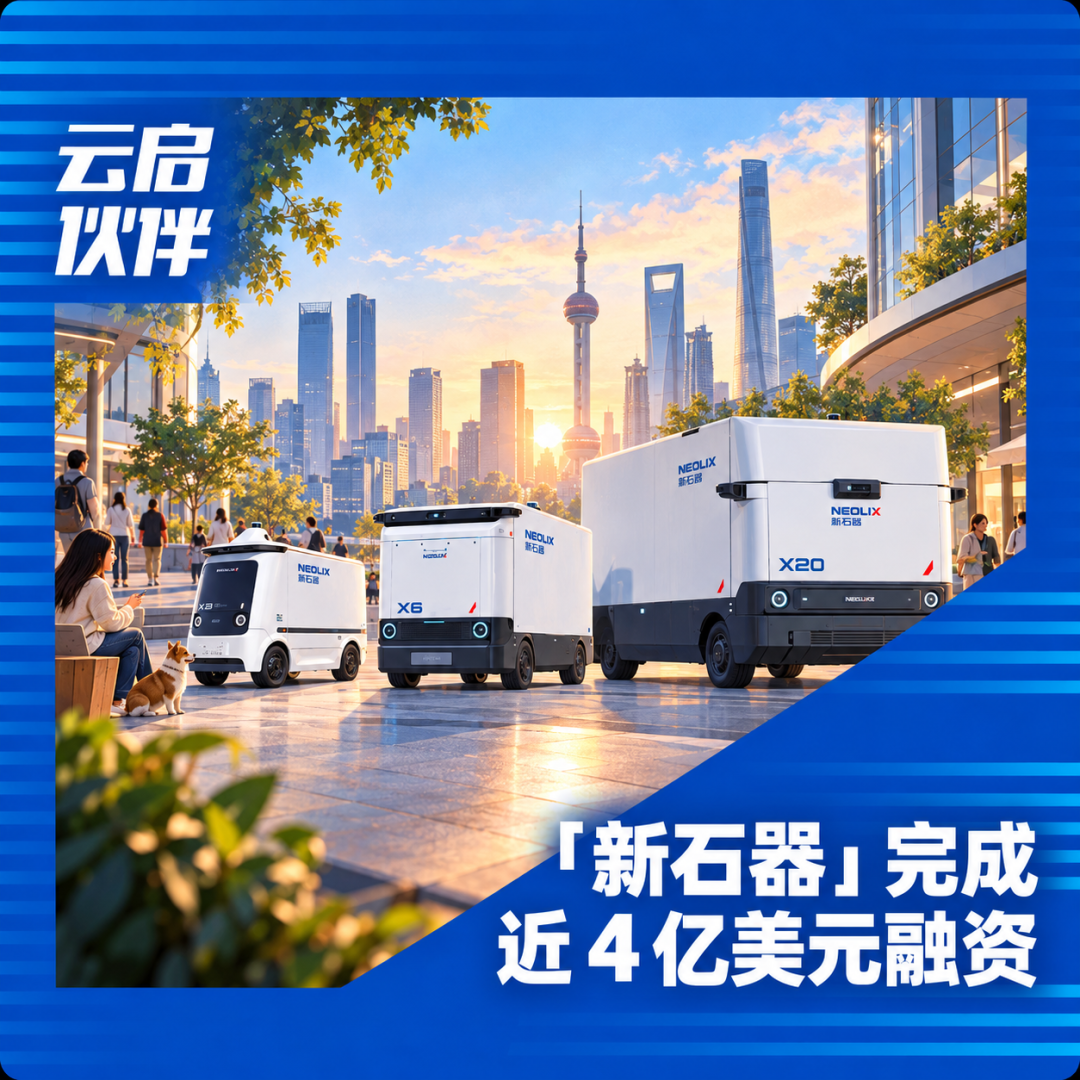
Yunqi Capital led the early-stage investment in Neolix, helping the company evolve from a single vehicle into a full network. The company now operates more than 30,000 L4 autonomous delivery vehicles globally, across nearly 20 countries and 300-plus cities, with cumulative autonomous driving mileage exceeding 260 million kilometers — just a year ago, those figures stood at 10,000 vehicles and 50 million kilometers.
Today, Neolix announced the completion of its nearly $400 million Series E round, co-led by Boyu Capital and a national-level fund, with Yunqi Capital continuing its support as an existing shareholder. This edition of "Yunqi Partners" shares the latest on Neolix.
The following is adapted from Neolix, IPO Zaozhidao, and Che Dongxi
Neolix was founded in 2018. Founder and CEO Enyuan Yu leads the company's R&D, manufacturing, and operation of L4 autonomous delivery vehicles for urban logistics scenarios.
The roughly $400 million raised in this round translates to approximately 2.68 billion RMB. It was co-led by Boyu Capital and a national-level fund, with participation from Alibaba AEF NextGen Hong Kong Fund, Monolith, GGV Capital, Vertex Growth (under Temasek), Meridian Capital, GAC Capital, Jinding Capital, Langmafeng Venture Capital, CP Robotics, Linghang New World, and Cygnus Equity; existing and long-term shareholders including Yunqi Capital, Stone Venture, CITIC Capital, Gaocheng Investment, SoftBank Ventures Asia, Beijing E-Town International Investment & Development Co., Ltd., Zhechuang Investment, Huixin Fund, CDH VGC, ChaoXi Capital, Yaotu Capital, Shanshui Capital, and Gaorong Ventures also followed on. Cygnus Equity served as the exclusive financial advisor for this round.
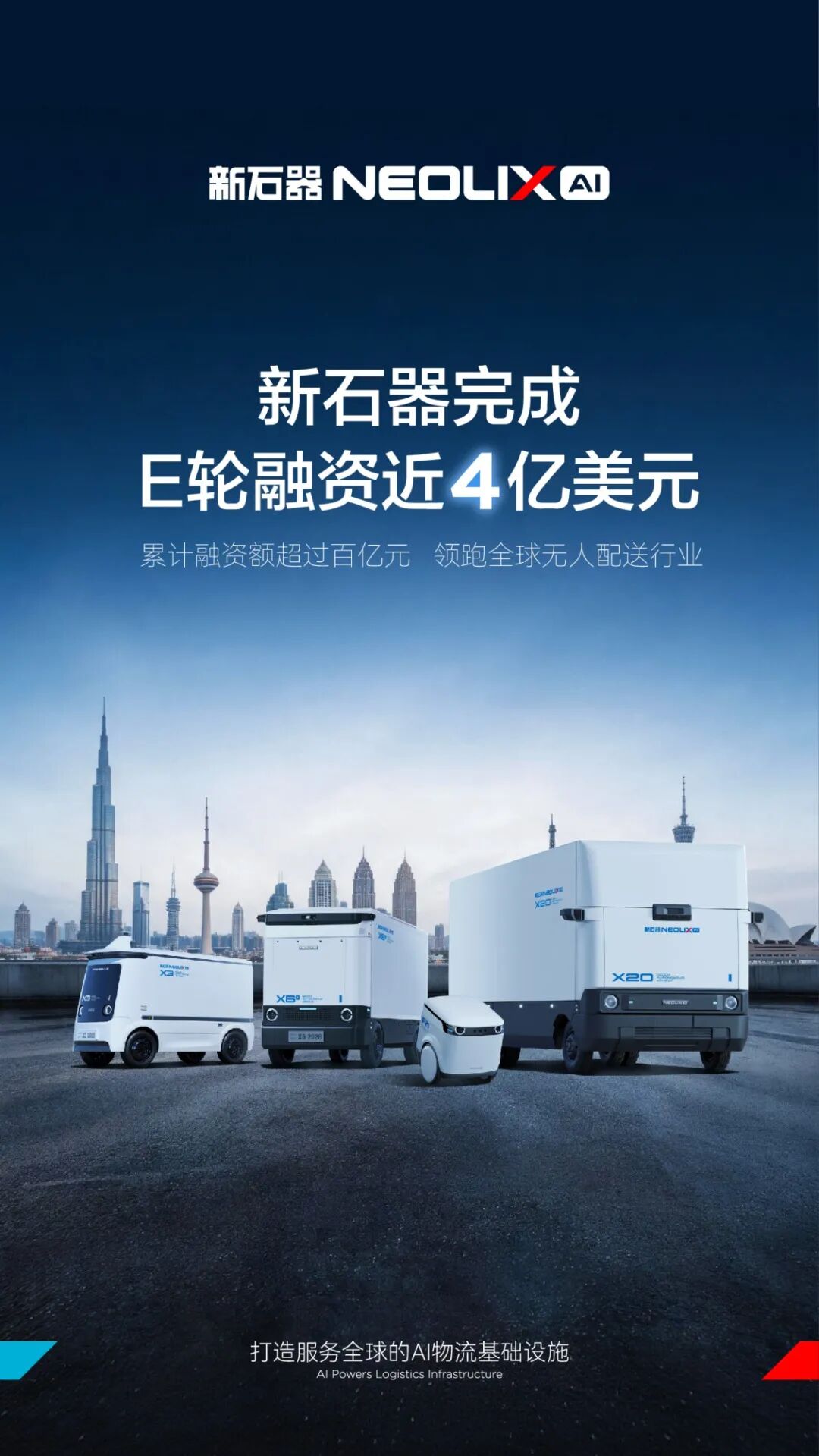
By the company's own disclosure, this represents the largest single financing in China's autonomous driving sector for 2026, bringing cumulative fundraising past the 10 billion RMB mark. Just a year prior, in October 2025, the company closed its over $600 million Series D — the two rounds combined approach $1 billion.
A Delivery Network Takes Shape
How 30,000 Vehicles and 20 Countries Were Built
The more miles driven, the more the delivery network matters — and scale itself drives down per-vehicle costs.
Neolix started with e-commerce express delivery, covering SF Express, JD.com, China Post, the "three links and one delivery" networks, and J&T Express. Since 2025, it has extended into building materials, factories, fresh groceries, pharmaceuticals, group meals, and auto parts. It now operates over 30,000 vehicles globally across nearly 20 countries and 300-plus cities, with fleet cumulative autonomous mileage exceeding 260 million kilometers and daily additions of over 1 million kilometers. Domestic cities including Qingdao, Linyi, and Hangzhou each have more than 1,000 vehicles deployed.
Night delivery routes in Shenzhen, Qingdao, and other cities represent an interesting piece of the puzzle — Shenzhen alone has opened 437 routes, putting underutilized nighttime road resources to work while cutting operating costs by 30% and filling gaps in urban nighttime supply chains.
On vehicle models, the company has rolled out the X3 and X6 in different sizes. In August, the X6 — co-developed with GAC Lingcheng — officially came off the line with 6 cubic meters of cargo space, targeting urban last-mile and feeder logistics. The two sides plan to develop larger 12-cubic-meter and 20-cubic-meter models going forward. Beyond selling vehicles, Neolix also provides delivery capacity as a service, extending into fleet operations and dispatch management.
Once the Data Starts Flowing
Models, Globalization, and Where This Round's Capital Goes
What underpins this scaled operation is a loop that feeds operational data back into the model.
Neolix is building a vision-centric end-to-end autonomous driving large model. Through a unified architecture combining cloud, edge, and vehicle-side models, it automatically collects, recognizes, and processes data generated in operations, converting it into structured training data to feed algorithm iteration. The company has already begun commercial delivery of its L4 mapless autonomous driving solution, reducing reliance on pre-mapped high-definition maps and improving deployment flexibility across different cities.
Overseas expansion is another parallel push. In the Middle East, Neolix secured a commercial RoboVan operating license in Abu Dhabi, is advancing scaled deployment with UAE-based K2 Group, and expanding into Saudi Arabia and Qatar. In Europe, its European headquarters is established in Luxembourg, with road testing underway in Belgium, Portugal, and Switzerland. In Asia, commercial operations have begun in South Korea, with testing progressing in Japan, Singapore, and Malaysia. Beyond autonomous driving challenges specific to each market, the company must also navigate local regulations, vehicle certification, and after-sales operations — another use of proceeds for this round.
Policy support has firmed up in recent months. In July, the Ministry of Transport indicated it would further advance digital and intelligent transformation of transport and logistics during the 15th Five-Year Plan period, planning pilot programs for standardized deployment of unmanned delivery vehicles. In August, the National Development and Reform Commission and Ministry of Transport jointly issued the "Logistics Network Construction Implementation Plan," explicitly calling for expanded commercial operation of unmanned delivery in express and instant delivery scenarios. In September, the Ministry of Industry and Information Technology and eight other departments issued the "Intelligent Connected New Energy Vehicle Industry Development 15th Five-Year Plan," clearly pushing for multi-scenario pilot applications of functional unmanned vehicles.
Enyuan Yu, speaking on the significance of this round, said that autonomous driving technology integrating into everyday logistics and generating real net economic benefits is becoming a pillar supporting modern economic circulation. "Through our efforts, we hope to build an efficient, reliable unmanned vehicle delivery network, using AI to drive globalized unmanned logistics infrastructure and help make inclusive logistics a reality."
Capital will be directed primarily toward two areas: first, deepening refined operational networks, accelerating the build-out of localized service hubs in major global regions to create a more responsive and efficient global customer fulfillment network; and second, increasing investment in the end-to-end large model data training loop, further improving autonomous driving safety levels and vehicle performance while continuously reducing total cost of ownership across the vehicle lifecycle.