First in China: NaKai Quantum achieves defect-free rearrangement of 4,000 qubits | Yunqi Partners

This marks the first time a domestic neutral-atom team has achieved both metrics on a single integrated machine.

Neutral-atom quantum computing has two make-or-break metrics: how many qubits you can build, and how long the system can run continuously. Naikai Quantum has now assembled its general-purpose quantum computer, the Qiyuan-1, integrating a 4,000-qubit defect-free array with continuous loading on a single machine — something no domestic neutral-atom team had publicly achieved before.
Behind the 853 optical components lies timing control measured in nanoseconds. Architecturally, Naikai achieved continuous loading on a single optical lattice — a design that overseas teams have typically required dual lattices to implement. This August, the Yunqi–Shanghai Jiao Tong University AI Angel Fund joined Naikai Quantum's angel+ round. In this edition of Yunqi Partners, we share the company's latest progress.
The quantum computing race is still heating up.
Recently, neutral-atom quantum computing company Naikai Qiyuan (Beijing) Quantum Technology Co., Ltd. (hereafter "Naikai Quantum") completed full assembly of its general-purpose quantum computer, the Qiyuan-1, achieving a 4,000-qubit defect-free array and breaking through on continuous loading technology. This marks the first time a domestic neutral-atom team has brought both metrics together on a single integrated machine.
Stepping into Naikai Quantum's lab, reporters saw the Qiyuan-1 spread across two optical tables. The main platform has three levels: at the center, a vacuum chamber and magnetic system where atoms are trapped and manipulated; above and below, optical paths. The second table is also dedicated to optics, delivering laser light into the vacuum chamber. Connected nearby are the electronics and control systems that handle timing for the entire machine.
Technicians explained that the machine alone contains 853 optical components, including mirror mounts, waveplates, AOMs, PBS mounts, and light shields. The system uses a moving optical-lattice conveyor belt to connect a cold-atom reservoir with the qubit manipulation zone. After atoms are captured by optical tweezers in the lattice transport region, they must undergo multiple handoffs between dynamic and static tweezers, and between preparation and storage zones, before loading and rearrangement are complete.
"Moving atoms isn't hard; the hard part is the sequencing," the technical lead told reporters. Timing control is the biggest hurdle for continuous loading — behind those 853 optical components sits a temporal order measured in nanoseconds.
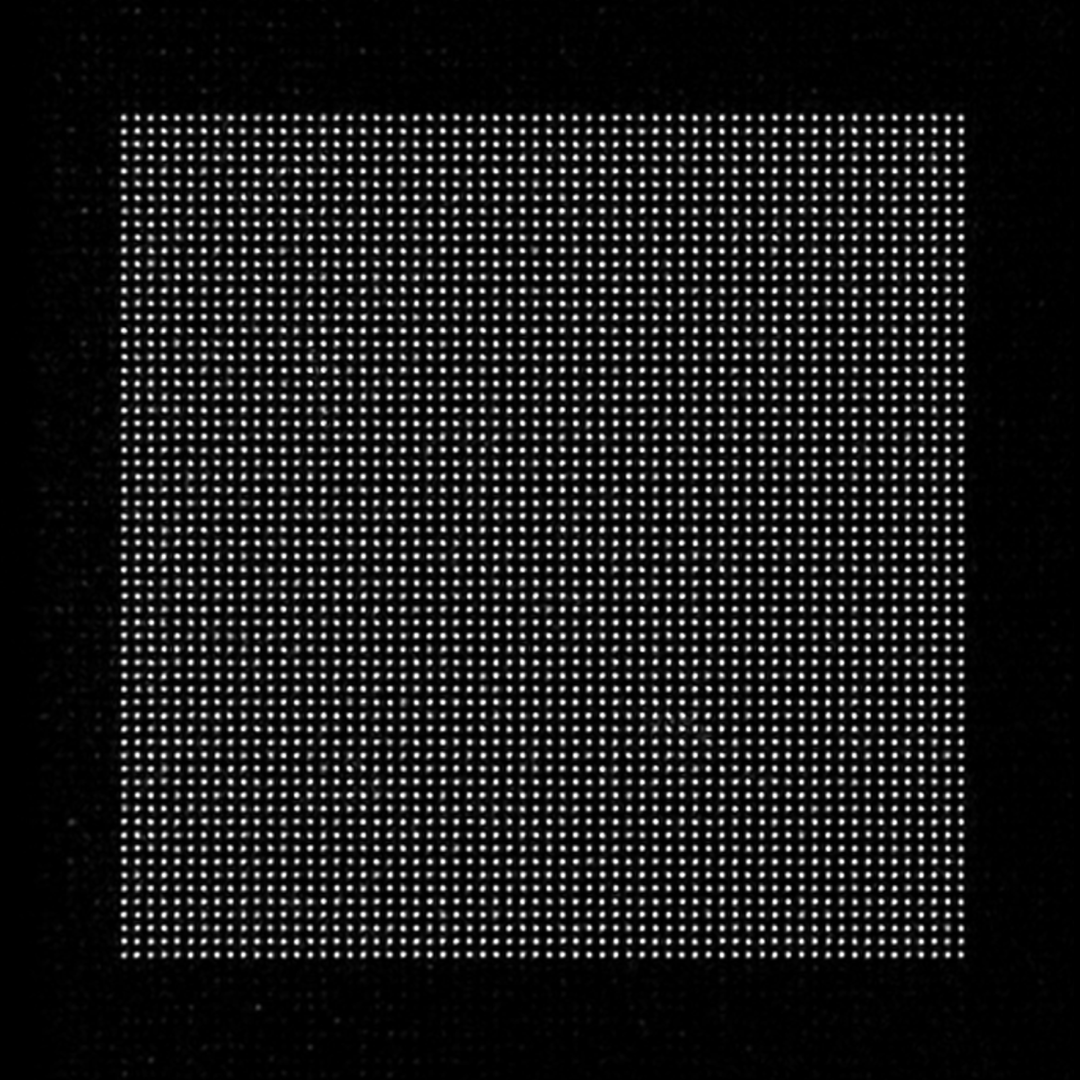
Figure: Qiyuan-1 demonstration of a 4,096 (64×64) large-scale defect-free array
Why 4,000 Qubits
In neutral-atom quantum computing, individual atoms are typically captured and manipulated by optical tweezers formed from tightly focused laser beams. But initial loading is probabilistic, producing arrays with vacancies, so atoms must be moved to fill target positions — this process is called rearrangement. "Defect-free" refers to the occupancy of the target array, not that quantum operations are error-free.
So why 4,000 qubits? The team's answer is straightforward: it's what the target and engineering constraints jointly dictate.
When scaling to thousands of atoms, more tweezers mean more laser power. For a 60×60 = 3,600 array, total power already approaches 15 watts at 3 milliwatts per tweezer. Factoring in diffraction efficiency and transmission losses through optical components, this is already near the usable output ceiling of the current optical path. Continuing to add atoms means first confronting the optical power budget.
Another constraint is the balance between scale and coherence. Naikai Quantum's approach requires pooling results from multiple loading rounds into a single array: 3,000 qubits would need roughly six rounds, each producing a ~500-qubit defect-free array. You can scale by loading more atoms per round or by adding more rounds, but both have costs — the former demands uniformity across a wider tweezer field and precise movement; the latter means atoms loaded earlier wait longer, imposing stricter requirements on storage and coherence preservation.
Then there's the field-of-view limitation of acousto-optic deflectors (AODs). AOD aperture size directly determines how many qubits fit; larger apertures cover bigger arrays. But preparation zones, storage zones, and atom movement channels all consume space. Once atom spacing and optical path conditions are fixed, the maximum feasible array has a hard boundary.
Weighing these practical constraints, plus the power needs for subsequent Raman and Rydberg beams, the team initially saw 3,000 qubits as the appropriate engineering target for the current stage — and ultimately overshot to 4,000.
The Core Is Continuous Loading
The challenge facing neutral-atom systems is atom loss. Traditional systems must recool and reload atoms after each computation, limiting runtimes to a few hundred milliseconds. Continuous loading supplies fresh atoms during operation while minimizing disturbance to existing qubits, extending continuous runtime.
Internationally, this technique was only recently validated. In 2025, Harvard's Lukin group first used an optical-lattice conveyor belt with separate preparation and storage zones to sustain an array of over 3,000 atoms for more than two hours, verifying that storage-zone qubit coherence was preserved during atom replenishment. Domestically, no team had publicly broken through on continuous loading before this.
Compared to the Lukin group, the Qiyuan-1 innovates architecturally: where the overseas team primarily used dual lattices, Naikai Quantum achieves continuous loading on a single lattice — a simpler architecture that still enables two-qubit gates.
Continuous loading also enables a longer-term possibility: if neutral atoms eventually form heterogeneous systems with superconducting or trapped-ion approaches, the Qiyuan-1 could serve as quantum memory, receiving computation results from other platforms and enabling long-term storage. "The more people doing quantum computing, the faster we build the ecosystem. A healthy competitive atmosphere is something we'd very much welcome," said Yaoyuan Fan, Naikai Quantum's founder and CEO.
Dual-Track: General-Purpose and Special-Purpose
Naikai Quantum hasn't put all its R&D into general-purpose quantum computing. Instead, it pursues a dual-track strategy of quantum analog computing and general-purpose quantum computing.
The Qiyuan series, aimed at general-purpose quantum computing, tackles mathematical and algorithmic problems like cryptography and financial portfolio optimization. These capabilities are viewed as long-term strategic reserves.
The Naikai series, dedicated quantum computers for quantum analog computing, addresses scenarios where the problem is fundamentally a quantum system — materials R&D, biopharmaceuticals — by building controllable quantum systems to simulate nature's uncontrollable ones.
To date, the Naikai-1 quantum analog machine has completed batch deliveries and secured commercial orders worth tens of millions of RMB; the Naikai-2 commercial quantum analog machine is expected to launch in 2027 with out-of-the-box usability.
Why cover both bosonic and fermionic atomic systems? Naikai Quantum's technical lead put it plainly: "Nature only has two kinds of atoms — bosons and fermions. Laying out both is about covering as much materials ground as possible."
On the technical foundation, Naikai Quantum's core team comes from Peking University, among the earliest domestic groups to pursue ultracold atom research. Cooling atoms to sufficiently low temperatures, combined with optical lattices, enables study of controlled quantum many-body systems; combined with optical tweezers and related manipulation techniques, this extends to atomic array platforms for general-purpose computing. Atom preparation, laser control, vacuum systems, and measurement and control infrastructure can all be shared across both product lines.
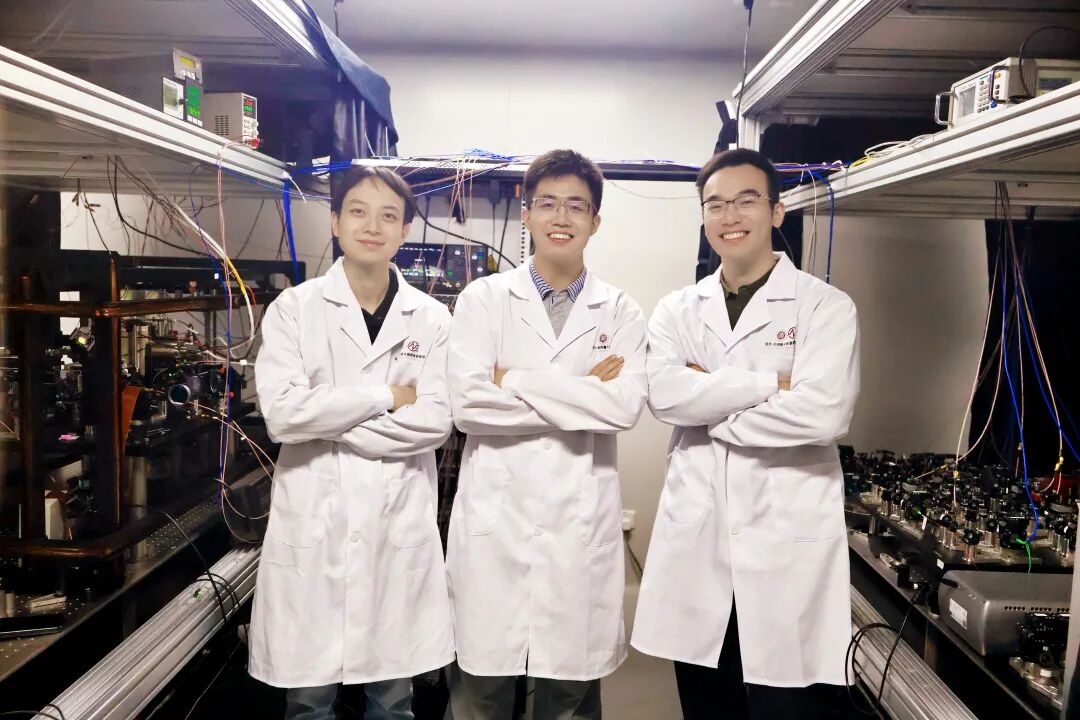
Figure: Naikai Quantum core team
Looking one to two years ahead, Yaoyuan Fan said the team will continue honing hard metrics like gate fidelity and global independent addressing, while also investing in frontier exploration like machine-to-machine interconnect — in his view, as neutral-atom arrays keep scaling, "how to connect beyond single machines" becomes the next question that must be answered. Meanwhile, the quantum analog product line will accelerate collaboration with industry partners to drive commercial deployment.
The Qiyuan-1 is planned for official release in Q4 2026, when more measured specifications and operational details will be disclosed.
Content adapted from Guangzi He (Photon Box)