From Single-Robot Intelligence to Multi-Robot Collaboration, Yunqi Capital Angel-Round Lead Project "Astribot" Releases CoMind | Yunqi Partners

Robot collaboration learns to "proactively lead with the key point"

When two robots work together, the hardest part is that the one piece of information that determines the next move is often held only by the teammate. Astribot, a company led by Yunqi Capital as lead investor in its angel round, has taken a different approach with its multi-robot collaboration framework CoMind: don't share everything — proactively say what matters. Each robot selects and compresses the information that affects its teammate's decisions and transmits it in real time, and each one directly generates its own actions. In extreme tests with fully occluded vision, the success rate of following each other across a wall to grab a pen rose from 0% to 100%; the accuracy of finding a box and placing an object after being blindfolded rose from 38.9% to 88.9%, while information transmission dropped by 80%.
This is Astribot's step — following the second-generation foundation model Lumo-2 — toward extending intelligence from a single machine to multi-robot collaboration. In this edition of Yunqi Partners, we share their latest news.
In daily life, there are always moments when "two hands aren't enough," from making the bed, moving and assembling large items, to handling multiple household chores. If you call someone to help, you also face the pain points of uncoordinated collaboration: how to divide the tasks, in what order to do them, whose opinion wins when you disagree, and who fills in when something goes wrong.
Coordinating multiple robots is even harder. How do you manage the complexity that keeps emerging, through limited communication, so that a group of robots works in sync as if sharing a single brain?
In July 2026, when Astribot released its second-generation foundation model Lumo-2, enabling multi-robot and human-robot collaboration on complex operations was one of the model's capabilities.
The multi-robot collaboration capability is getting another upgrade. Today Astribot is releasing the CoMind - Be My Eye framework (CoMind for short). It is the industry's first multi-robot collaboration model framework that proactively shares curated task context, opening a new collaboration paradigm: collaboration is not about sharing everything, but about proactively passing along the key information that affects decisions.
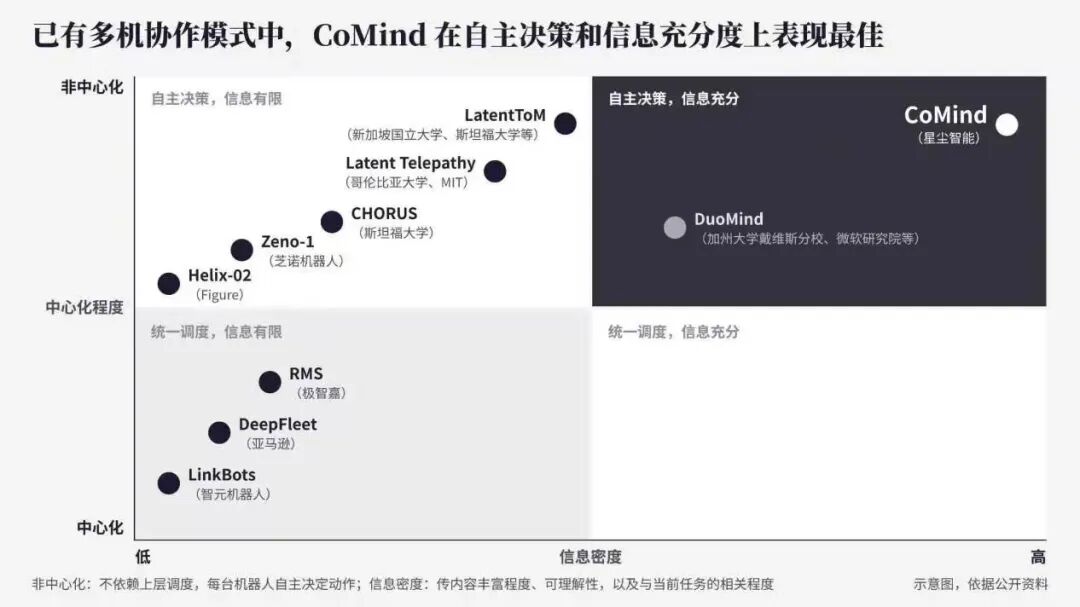
CoMind has two core features. First, decentralized proactive sharing: teammates exchange task context in real time, saying goodbye to passive, centralized scheduling where everyone waits for the boss to assign work. Second, curated information: the information a teammate needs and that affects decisions is filtered and compressed before being shared, rejecting the noise of a "one-click forward."
This efficient "proactively say what matters" communication gives robots faster, better, and more accurate collaborative synergy in complex chores such as assembling cardboard boxes and dumbbell plates, folding blankets and tidying up, and restocking the fridge.
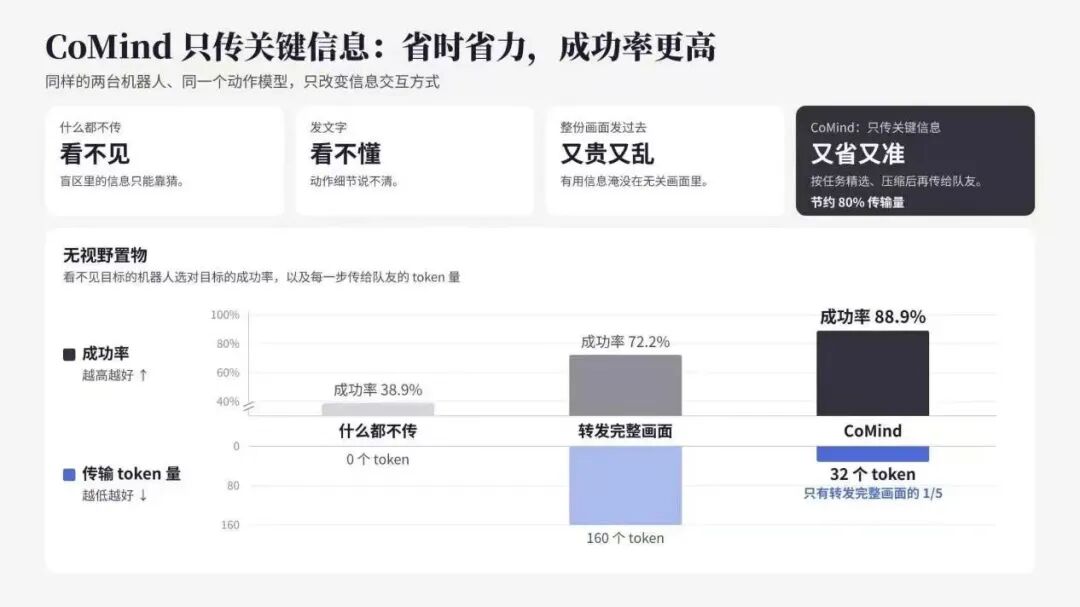
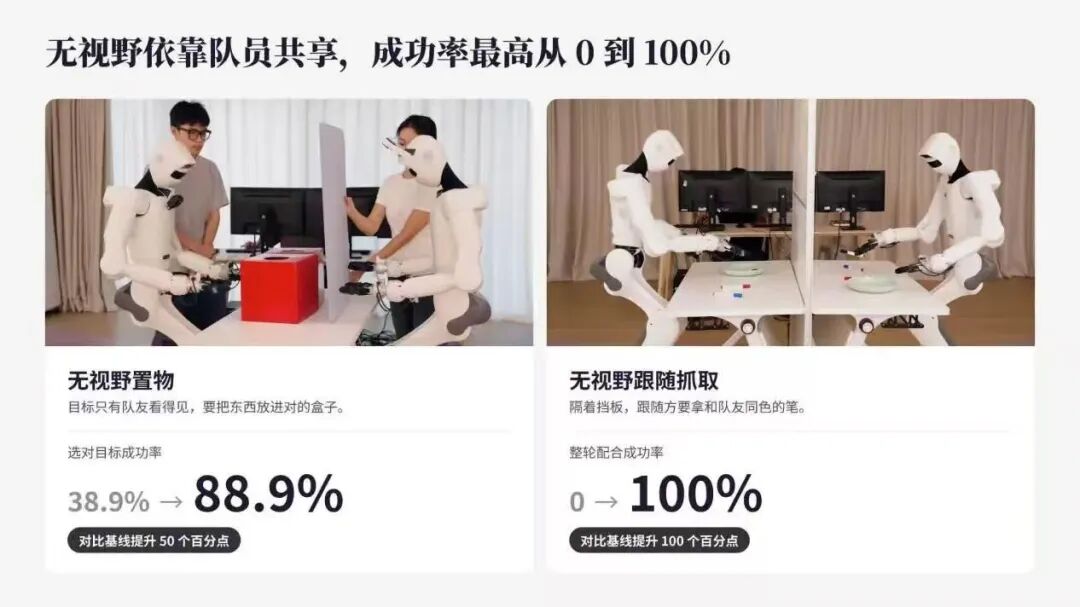
In extreme tests with fully occluded vision, CoMind gives robots the sci-fi superpower of "shared vision." When following each other across a wall to grab a pen, the success rate jumped from 0% to 100%. After being blindfolded, the accuracy of finding the designated box and placing an object went from a blind guess of 38.9% to 88.9%, while information transmission dropped by 80%.
CoMind extends intelligence from single machines to multi-robot collaboration, and in the future it plans to extend from "sharing information" to "sharing intent," so that robots no longer just react to each other but anticipate each other's future intent and proactively fill in — moving toward ultimate synergy and efficiency.
See the technical report and unedited real-robot videos at www.astribot.com/AI/CoMind
Six real-robot tests
One framework for different collaboration challenges
When two robots work together, the hardest part is that the piece of information that determines the next move is often held only by the teammate. To validate robots' ability to work across visual blind spots, Astribot tested how CoMind improves robot collaboration on complex manipulation tasks in home and extreme experimental scenarios.
Assembling cardboard boxes: coupled actions, fully occluded vision, assembly continues without pause
Cardboard box assembly requires high-frequency physical contact (contact-rich); the large box frequently blocks the line of sight as it flips; and the actions are highly coupled, requiring both sides to push and prop the box open in sync and to judge in real time whether the other is gripping or gluing, making it an extremely difficult continuous fine-manipulation task for robots. CoMind lets both sides perceive operation status and task progress in real time, and in extreme tests with fully occluded vision it "borrows eyes," keeping assembly and transport smooth and continuous until success.
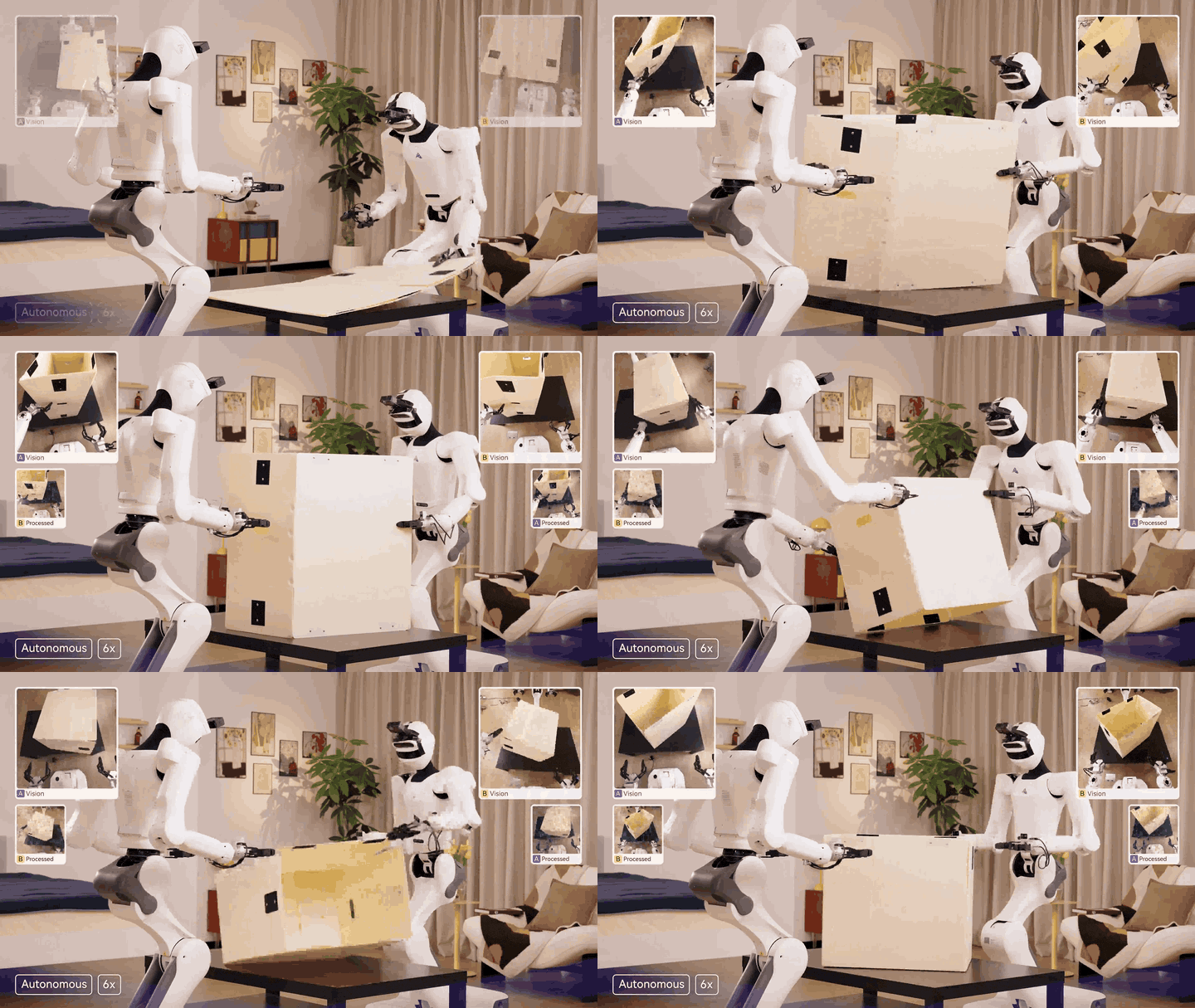
Folding blankets and tidying up: continuous manipulation of deformable objects, in step
Blankets are big and soft; their shape and edges keep changing as they are lifted, folded, and moved, posing a dual challenge to robot perception and control. CoMind curates visual context so both sides align action intent in real time amid high-frequency contact and dynamic tension, autonomously generating and synchronizing each step without any step-by-step instructions — and even under large deformation interference, they connect seamlessly with no pauses.
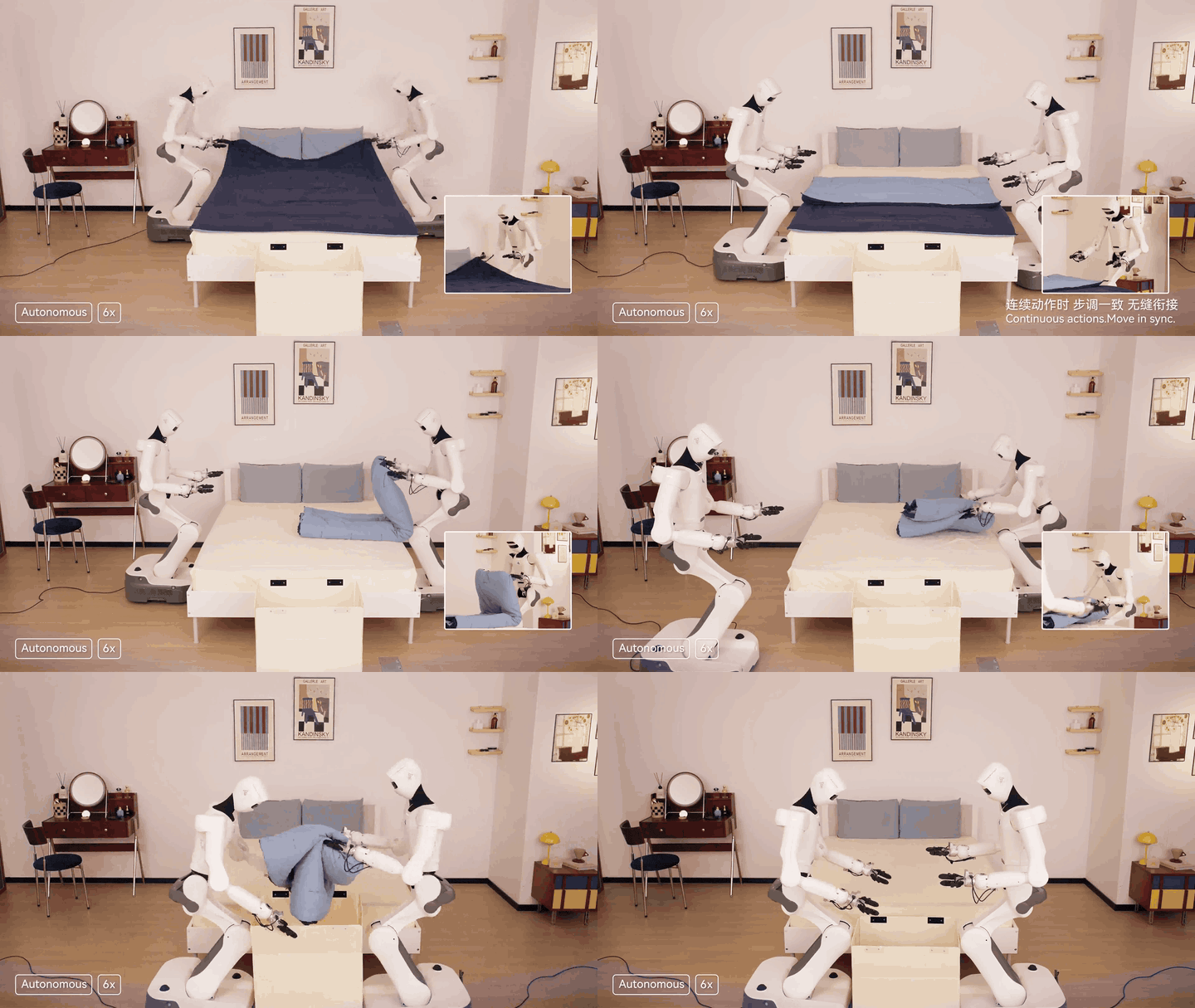
Fridge restocking: complementary vision, globally shared, efficient handoff
When key information is scattered across different fields of view: the robot on the left sees that the fridge is out of stock, while the one on the right sees drinks on the island counter. With CoMind, both sides borrow each other's "eyes" in real time to complete the global picture and start a seamless hand-and-pass relay, instead of repeatedly moving back and forth — saving time and effort.
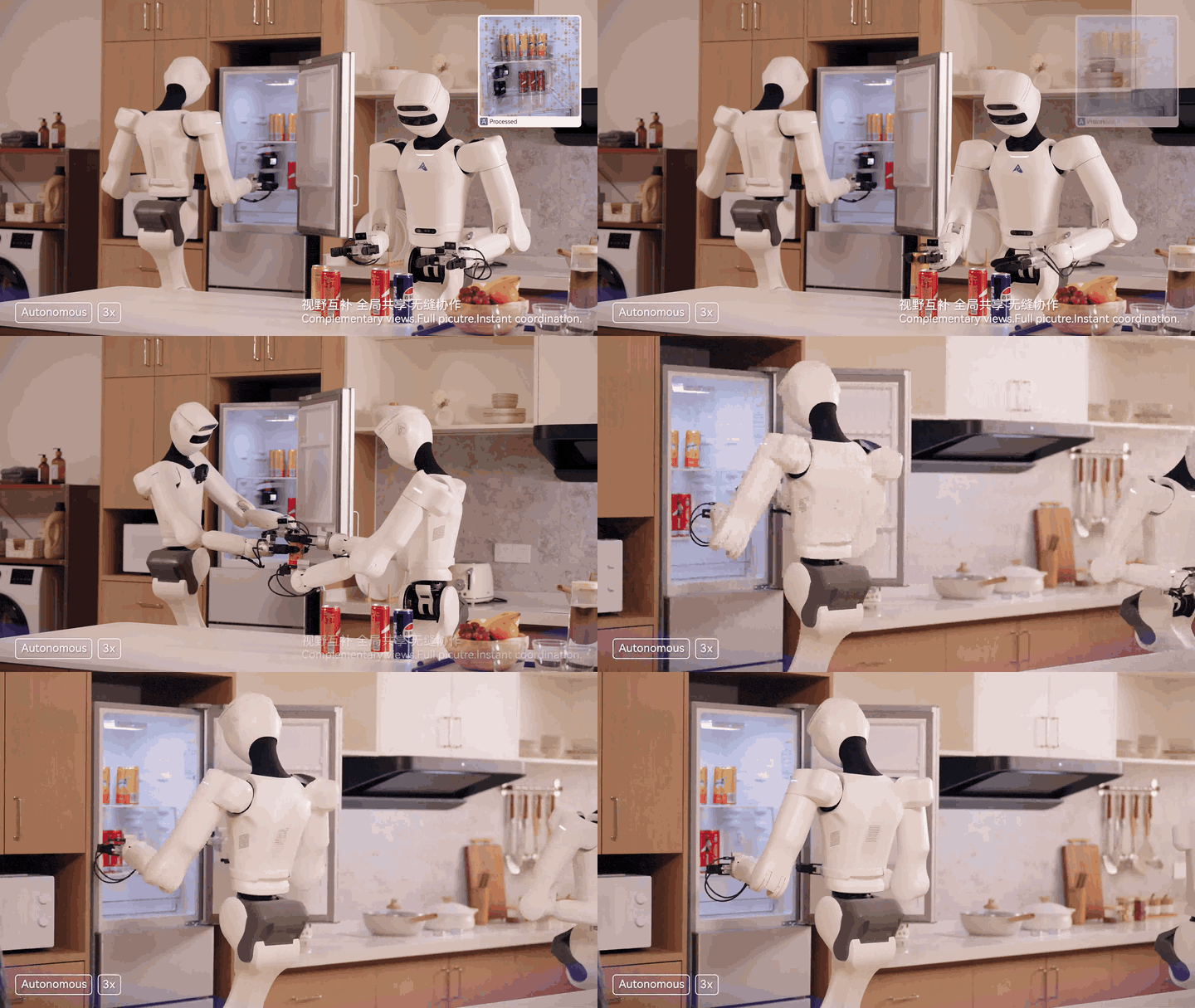
Assembling dumbbells: filling in limited viewpoints, precise even in motion
When assembling a dumbbell, the side threading the plate struggles to see the dynamic relative position of the bar and the hole at the same time. CoMind completes the spatial relationship from the teammate's viewpoint within milliseconds, letting the robot adjust its pose in real time and lock in alignment precision amid constant movement, completing a perfectly fitted collaborative assembly.
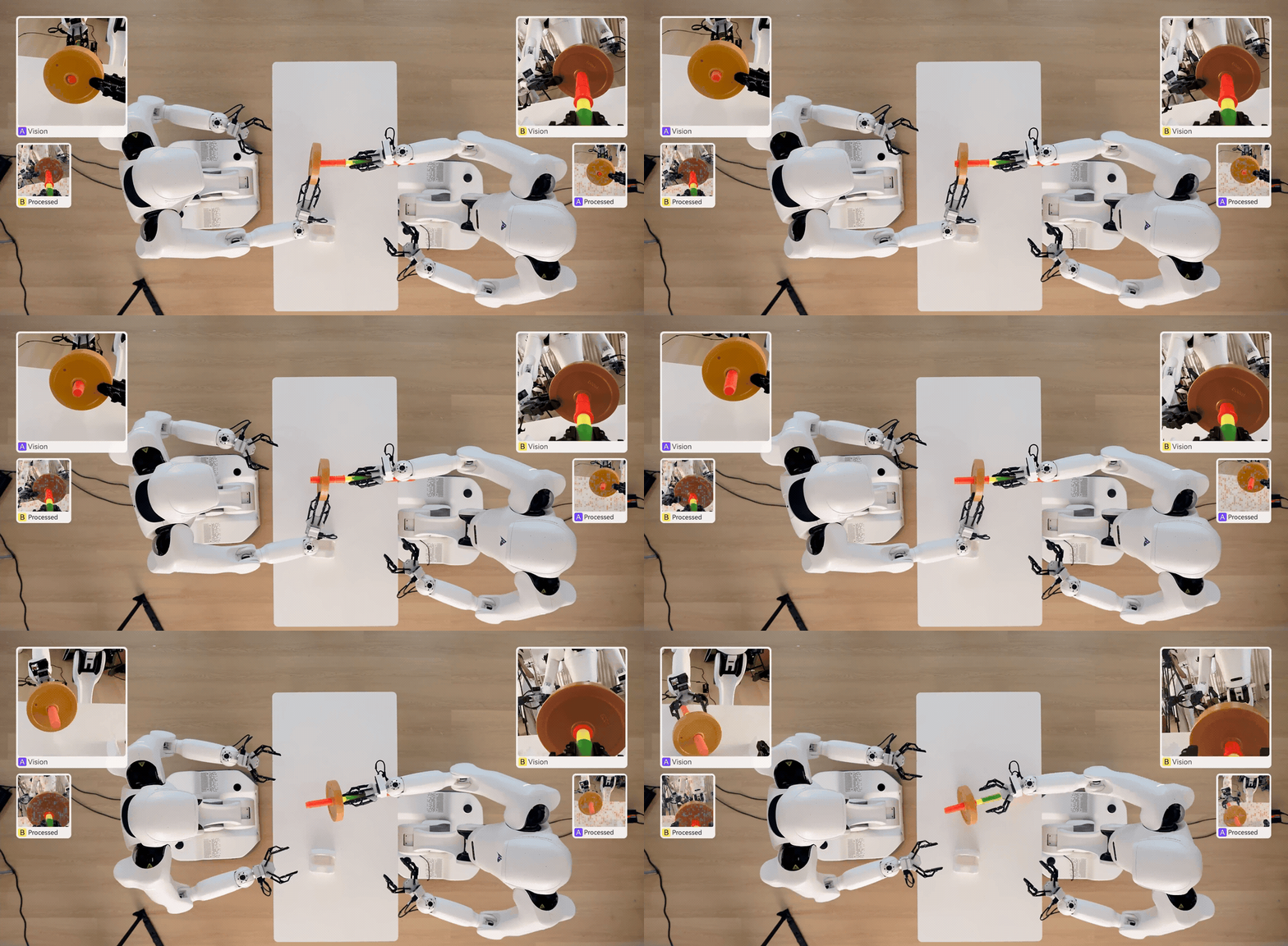
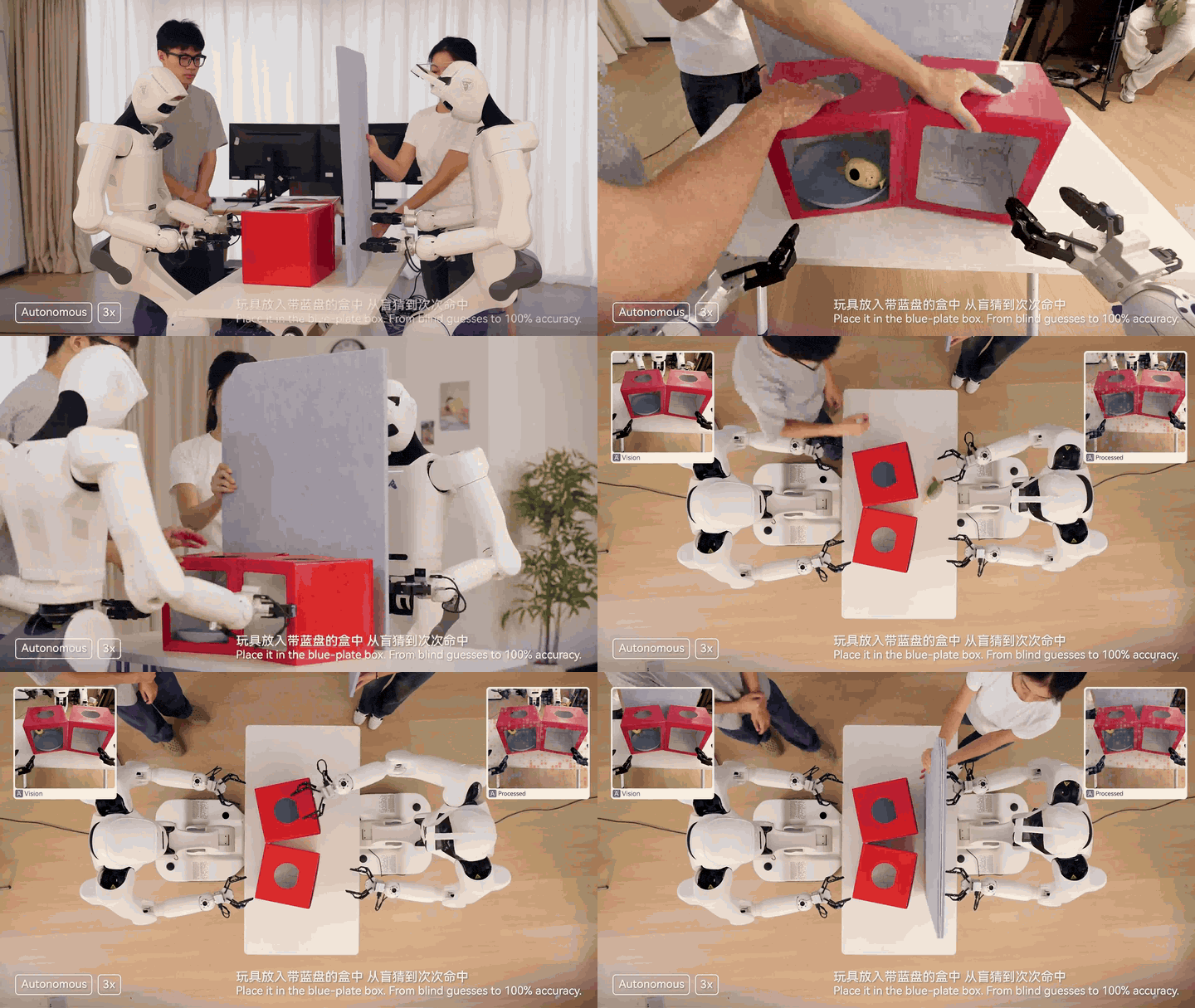
Blind-box placement: extreme occlusion, from blind guess to precise hit
A box with a blue plate inside changes position randomly; the robot on the left sees it clearly, while the robot on the right is fully occluded and knows nothing. With zero visible information, CoMind shares the key visual features from the left's view with the right in real time, turning a task that could only be done by blind guessing into a precise hit, with accuracy greatly improved (38.9% → 88.9%).
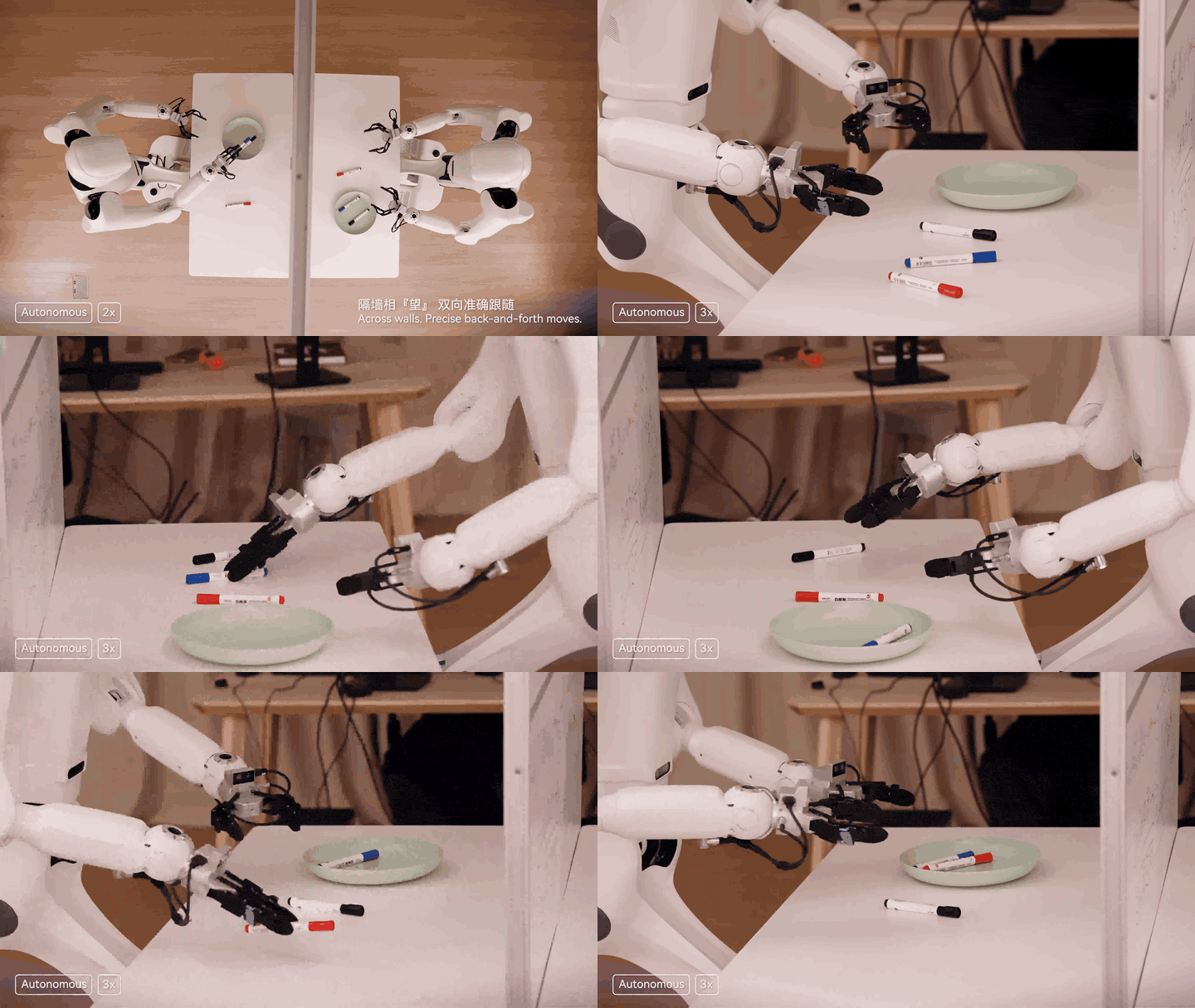
Mutual "watching" across a wall, yet 100% accurate following
Even when they can't see each other, through CoMind they share the target color and action timing in real time, and the two robots alternate between leading and following to grab the pen, with task success jumping from 0% to 100%.
Robot collaboration needs to "say what matters"
How CoMind works
Traditional multi-robot collaboration approaches are either "slow to schedule" or "shallow in communication."
Centralized scheduling is like an on-site commander: the macro plan is clear, but in millisecond-level cooperation such as two people lifting a table or folding a blanket, chain-of-command instruction passing turns it into "wait mode."
Decentralized approaches look flexible but are thin on information: if you look at a teammate while occluded or with your back turned, collaboration breaks off immediately; and even with communication, it is mostly text like "I'm moving" that is disconnected from the task, lacking the deep information that supports key actions. And the massive visual frames robots generate every second, if "forwarded with one click," would not only clog bandwidth but drown teammates in useless data.
CoMind has no commander. Each robot can proactively send key information to teammates and receive information from them. The receiver feeds this information, together with what it sees, the task instruction, and its own body state, into a vision-language-action (VLA) model and directly generates continuous actions.
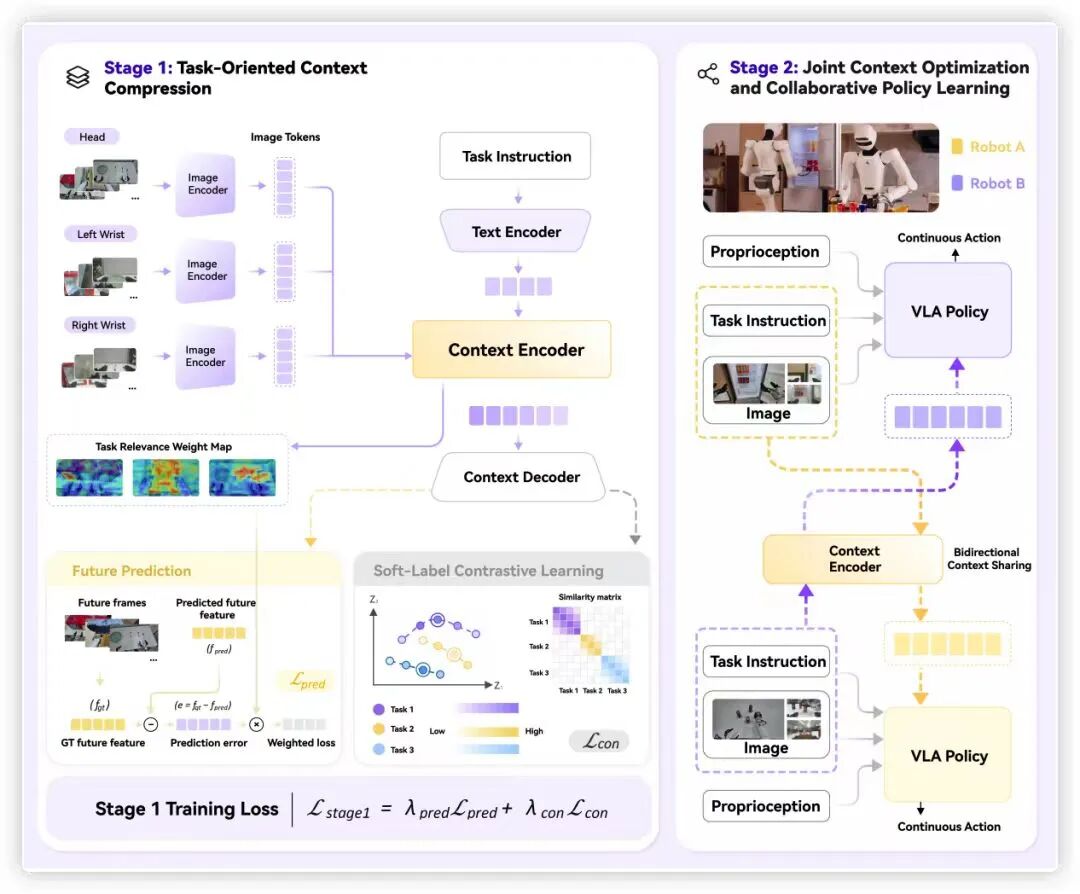
In the first stage, CoMind curates key task information; in the second, it shares bidirectionally and proactively, guiding each VLA model to output coherent actions.
Compared with other explorations in the industry, CoMind's breakthroughs lie in three points:
Saving time and effort: It transmits neither raw frames nor generic features unrelated to the task. The sender, combining its own task instruction, prioritizes content directly relevant to the current operation from multiple camera feeds — for example, the color of the item in the blind-box guessing test — and compresses it into a small set of representations to send to the teammate.
Synced coordination: It shares more than the immediate visual focus. During training, the model also learns to predict how the scene will change shortly after, and to retain clues about task progress — distinguishing "just started" from "almost done" — to help the teammate judge how to cooperate next.
Bidirectional feedback: During training, the receiver's action outcomes retroactively adjust the sender's encoder — this is "action-level backpropagation." For example, in the blind-box guessing test, if A, who can't see the target, reaches to the wrong position, this deviation in turn reminds B, who is responsible for transmitting information, that the target feature isn't salient enough. Over rounds of training, B learns to prioritize transmitting the information that most helps A make the right move.
Astribot's AI models
Enabling robots to act correctly in the real world
Behind CoMind, from the explicit reasoning of the foundation model Lumo-1 to Lumo-2 predicting how actions change the world so it can act better, we have always focused on this: robots are ultimately not just about understanding the world, but about acting correctly in the real world. And the full-stack system of "AI models - embodied OS - cable-driven body" keeps iterating, continuously advancing the application and scaled deployment of Physical AI.
Back to those "two hands aren't enough" moments at the start. We hope that in the future, what appears in commercial, industrial, and home scenarios is not just a capable robot, but a team of robots that anticipates each other's intent and proactively fills in.
The above is excerpted from Astribot