Double 11 Tech Mastermind: How Quantum Dynamics Is Rebuilding Logistics With Robots | Yunqi Shiganpai

The degree of automation in logistics is often overestimated by outsiders.

Today is Singles' Day. On Singles' Day 2018, Sam Li spent the entire night in a warehouse in Hangzhou's Xiaoshan district fixing a "deadlock" in the storage system: the picking area was completely full, yet every order had at least one item still sitting in the reserve storage zone. To ship orders, you had to move those items into the picking area; but the picking area had no space left. Around two or three in the morning, exhausted, he watched as the pickers around him kept pushing their carts at full speed. Eight years later, the Singles' Day surge has been gradually flattened out by systems, but at the weighing, label application, induction, picking, and packing stations, it's still people running the warehouse. The automation level in logistics is often overestimated by outsiders.
The company taking over these tasks is Quantum Dynamics. Founder Sam Li has spent sixteen years in logistics, formerly serving as CTO of Cainiao, having lived through the all-night emergency repairs of the Singles' Day warehouse "deadlock" and also led the scaled operation of over a thousand L4 autonomous vehicles. In the same year it was founded, the company began co-developing with customers; its general-purpose dual-arm robots have already completed deployment validation at real warehouse stations for weighing and induction, and have secured batch purchase orders for nearly 5,000 robots from multiple leading e-commerce platforms and logistics enterprises. This year, Quantum Dynamics completed a seed round exceeding RMB 100 million, jointly invested by Yunqi Capital and SenseTime Guoxiang.
In this issue of Yunqi Shiganpai, we share the business logic behind the 5,000-unit orders and an in-depth conversation with Sam Li: why logistics is the best starting point for Physical AI, why robot opportunities hide in long-tail tasks, and why he insists robots don't need to look human.
Why Logistics, and Why Weighing and Dimensioning First
Let's start with a conveyor line in cross-border logistics.
Cross-border logistics has a classic circular conveyor line: packages keep coming, workers sit in front, flipping each package over and placing it on the weighing conveyor, where it's weighed and dimensioned, then diverted according to system prompts. This process, known in the industry as "weighing and dimensioning," mostly happens in open-air dock warehouses, cold in winter and hot in summer, with concentrated nighttime operations. During peak sales events, labor demand spikes even higher. Data from the China Federation of Logistics and Purchasing shows that nationwide logistics loading and unloading workers (including temporary labor) numbered approximately 11.5 million in 2025 and are projected to drop to 8.2 million by 2030. The work isn't decreasing, but the people willing to do it are.
Quantum Dynamics is entering through this line. Li believes logistics is the industry most likely to make Physical AI work: package posture, material, and dimensions are constantly changing, requiring robots to observe, judge, and chain multiple actions together — exactly the kind of object that trains manipulation models; scan results can verify label placement, and a single failed package grasp doesn't stop the entire line, since the system can retry or hand off to human takeover. In manufacturing, one misaligned insertion might scrap a product or halt the line; in home scenarios, there's no clear feedback signal for the model to judge whether it's doing things right.
Within logistics, Quantum Dynamics narrows further, starting with e-commerce express parcels. Product SKUs are too messy and varied; parcels have more bounded scope, yet still offer sufficient variation in shape, material, and posture to build manipulation capability. Weighing and dimensioning, label application, and induction all revolve around parcels; in-warehouse picking, packing, and quality inspection are the demands to take on next.
Once deployed, the first hurdle is time. The conveyor moves at roughly 0.3 meters per second; from when the camera sees the package, to the signal entering the model, to inference completion, to command issuance, to robotic arm execution — the package is moving the entire time. Quantum Dynamics' approach is asynchronous input: each modality retains its native timestamp and is sampled independently, with the manipulation foundation model System 1 handling asynchronous data stream fusion; System 2 handles task reasoning and long-tail scenarios, providing operational guidance and anomaly recovery decisions to System 1. Motion generation uses a B-spline action head, where a set of control points can express continuous smooth trajectories, which are then passed to robot control for execution.
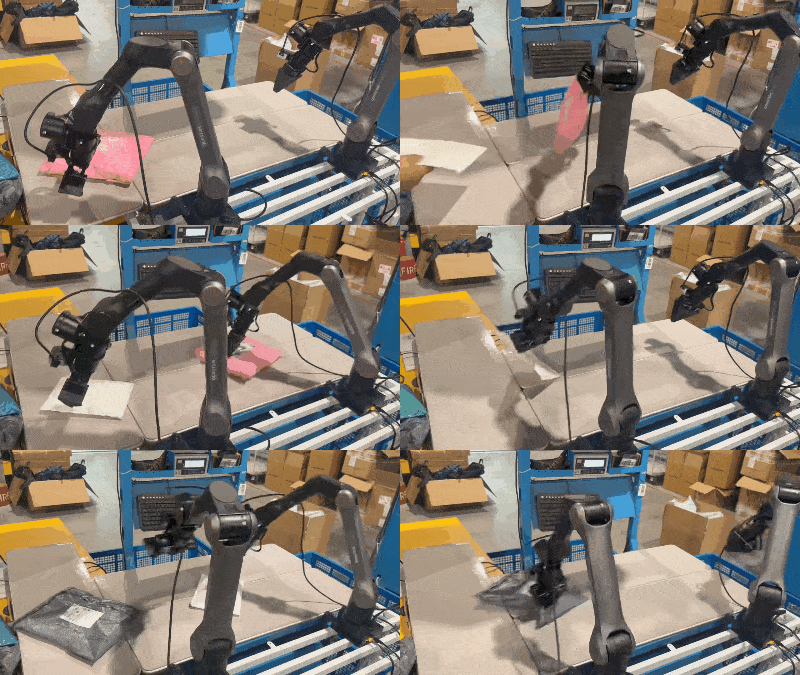
Quantum Dynamics robot performing sort-and-flip operations in a real logistics warehouse
The team's foundation is in autonomous vehicles. Li was responsible for Cainiao's autonomous vehicle business, having gone through scaled operations of over a thousand L4 vehicles; CTO Chunming Zhao formerly led algorithm teams at JiuShi and Cainiao's autonomous vehicles, from algorithm validation through mass production deployment. The company began co-developing with customers in July 2026; by around October, the technology was ready for scaling: general-purpose dual-arm robots had completed deployment validation at weighing stations, with induction efficiency exceeding 1,200 pieces per hour and 99% success rate; parcel weighing operations went live in a Hangzhou warehouse starting mid-September, running continuously for over a month with cycle times approaching peak human performance. Humans handle roughly 600 pieces per hour; the robot matched that level during some periods, with some variance.
The Data Flywheel: From One Hangzhou Warehouse to Nearly 5,000 Orders
Li isn't rushing to expand scenarios. He's making sure one task is thoroughly solved before extending to others. He's set several criteria for entering a site: minimal on-site modifications, complete coverage of the workstation's work, cycle time and success rate approaching or exceeding human levels, reliable and durable hardware, and a payback period that justifies the customer's investment. Based on his project experience, a two-year payback can support small-batch testing; only when it approaches 18 months is scaling worthwhile.
Every success, failure, human intervention, and recovery experience during deployment goes into Quantum Dynamics' Library of Chaos (real-world operational experience library), with each entry linked to robot state, task context, and final business outcome, available for subsequent task retrieval. Whether the data flywheel is spinning, Li answers with numbers: the first task started at just over 60% success rate, iterating to 95% in two to three weeks; the second task reached 95% in about a week. His target for the coming year: entering new warehouses and taking on new tasks with less post-training data, shorter time, higher initial success rates and cycle times, and faster ramp-up.
On commercialization, Quantum Dynamics offers per-piece payment, hardware purchase plus model subscription, and outright purchase options, with equipment performance tied to customer returns. The company has secured batch purchase orders for nearly 5,000 robots from multiple leading e-commerce platforms and logistics enterprises, covering weighing and dimensioning, induction, label application, picking, and packing, at various stages of signing, validation, R&D, or discussion. Every customer site Quantum Dynamics enters adds real tasks, a test workstation, and a warehouse operating condition. On November 5, Cainiao held an AI and Embodied Artificial Intelligence industry cooperation launch at its Hong Kong Smart Gateway, announcing it would open its global warehouse network to industry partners; Quantum Dynamics was present to sign, representing one of the first batch of partner companies. Overseas expansion is also underway: joint ventures with listed companies in Japan and Korea are under discussion, a North American subsidiary is being registered, and customer bids in Singapore and Australia are in progress.
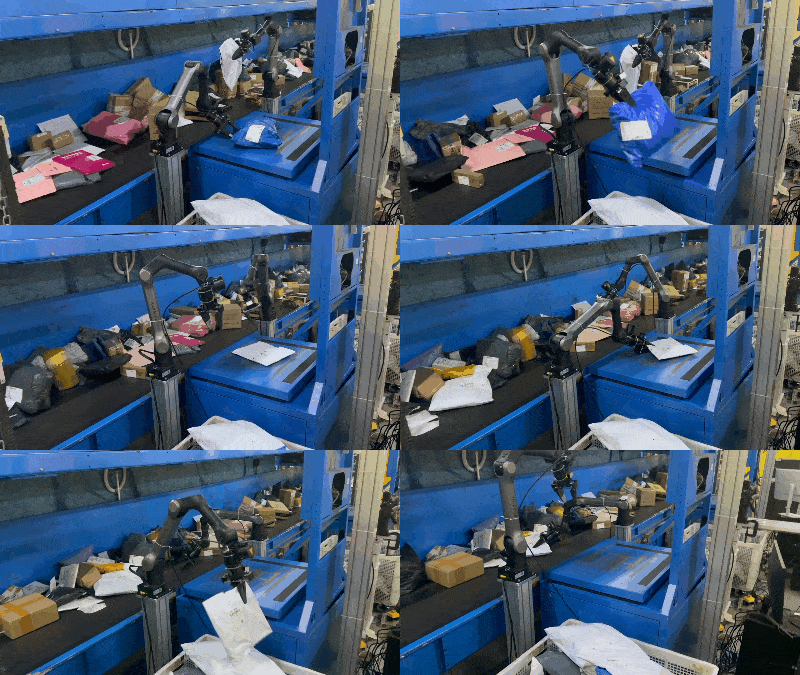
Quantum Dynamics robot performing parcel weighing on a logistics conveyor line
The following interview content is republished from the WeChat public account "Xinzhijia," written by Zhe Tian, edited by Xian Zhang

Logistics Is Far Less Automated Than People Imagine
Xinzhijia: You've been in logistics for many years now. When did you first truly enter this industry?
Sam Li: Around 2010.
I graduated in 2005 and first worked at Oracle in Beijing for three years, then joined Taobao in 2008. Even then, there was already internal discussion at Alibaba about whether to build logistics ourselves. One view was that e-commerce would eventually need to do it at scale; another was that relying on socialized logistics would be sufficient.
There were quite a few people at Taobao exploring logistics at the time. The first project we did was called "Wuliubao." In 2010, I was the project manager and R&D lead for Wuliubao 2.0 — that's when I truly started working on logistics technology.
In 2011, when Taobao, Tmall, and eTao were split up, I went to Tmall. Initially I was responsible for supply-side matters, including merchants, products, supply chain, and logistics; later I also worked on consumer-facing businesses like search, recommendations, and shopping guides.
Cainiao was founded in 2013, and part of Tmall's original logistics technology team moved over. In 2015, the company wanted Cainiao to truly become a technology and data-driven company, to do things in logistics that others wanted to do but couldn't, or couldn't do well. I moved from Tmall to Cainiao to start leading Cainiao technology.
The technology team was about 200 people then; by 2016 it had grown to around 1,000. Later I also served as CTO for Alibaba's globalization segment, responsible for e-commerce business outside mainland China, including payments, logistics, supply chain, and search recommendations; after that I returned to Cainiao to lead products, technology, and autonomous vehicles.
So counting from 2010, I've been in logistics for sixteen years.
Xinzhijia: After all these years in logistics, which scenes stick with you most vividly?
Sam Li: A few.
One was Singles' Day 2018. That year there was a design flaw in the warehouse system, combined with order volume exceeding expectations, which led to a kind of "deadlock" between the picking area and reserve storage zone.
The picking area had no space left, but every order still had at least one item in the reserve zone. To ship orders out, you had to move that item into the picking area; but the picking area was completely full, so the item couldn't be moved in.
I was in a warehouse in Hangzhou's Xiaoshan district that night, working through the problem all night. Around two or three in the morning, I was utterly exhausted, but the pickers in the warehouse were still pushing their carts at full speed.
That image left a deep impression — the front lines of logistics are truly grueling.
Another was building a warehouse in Jiaxing for Tmall Supermarket. It was a three-level steel platform, each level only a little over two meters high, very oppressive space, and brutally hot in summer.
Many new hires' first question was "Why is there no air conditioning?" But the warehouse had massive open docks and was extremely large. Even if you installed AC, the effect would be limited and the cost prohibitively high.
And then there were the earliest years of Singles' Day. The e-commerce department would celebrate record-breaking sales every year, but on the logistics side it was a completely different scene — packages piled everywhere, people, warehouses, and systems all pushed to their limits.
Xinzhijia: You mentioned the warehouse "deadlock" situation. How did it happen?
Sam Li: This experience left me with lasting respect for large-scale systems.
There was a kind of "order preprocessing" valve in the WMS warehouse management system. You can think of it like a shopping mall with too many people — let one batch in, they shop and leave, then let the next batch in.
There was a button on the interface, but when you clicked it, it didn't clearly tell you whether it had succeeded or failed.
During normal operations, the volume was low, so if an operator wondered "did that actually work just now," clicking again wasn't a big deal.
This UX issue was actually spotted in the first year, but no one thought it was serious enough to fix.
In the second year, business exploded and warehouse space was tight. Someone double-clicked, releasing two batches of orders at once, and the entire system immediately crashed.
A tiny product experience issue, at sufficient scale, can become a massive incident.
New Auto Intelligence: What do you do once the deadlock happens?
Sam Li: You need the physical and digital worlds to work together to untangle it.
First, find ways to free up a few empty slots in the physical warehouse. Then have the system calculate which SKU to move from storage to release the most orders. Once those orders go out, more space opens up. Then calculate which SKU to replenish next, gradually loosening the deadlock.
And frontline workers, warehouse managers, and technical staff have to coordinate closely. If the program has a bug—say, it's supposed to move A in but calculates backwards and moves B in instead—the problem only gets worse.
Later we gradually built out a very modular capability.
For example, before Singles' Day I could spin up a temporary warehouse in a month, deploying systems, equipment, and inventory; after Singles' Day, shut it down in two weeks.
How to open, how to close, how to deploy systems, how to install and dismantle equipment—all became standardized processes.
Our partnerships with HR service companies across the country also matured.
Plus Singles' Day itself changed. At first it might spike 100x or more in a single day; later it became 100x, 80x, 50x. What was concentrated in one day gradually spread into a longer period, flattening the peak.
So today, handling Singles' Day is well within everyone's comfort zone.
New Auto Intelligence: After all these years at Cainiao and Alibaba, what capabilities have you ultimately built up?
Sam Li: I'd say at least several categories.
First is building large-scale complex systems.
Whether logistics, e-commerce, or payments—these are all very complex large-scale systems. How to ensure stable operations—this capability is also important for robotics today.
Robots in the future won't be single machines either, but fleets of robots that still require complex scheduling and systems capabilities.
Second is understanding the logistics business itself.
From warehouses to sorting centers, last-mile stations, and parcel lockers; from domestic to cross-border and overseas; from FMCG, apparel, and electronics to Tmall Supermarket operations with same-day and next-day delivery requirements—I've been deeply involved in all of it.
Third is equipment and intelligence.
In logistics there used to be large amounts of rule-driven equipment, as well as unmanned vehicles, AGVs, and other equipment gradually moving toward model-driven, learning-driven approaches—I've worked on all of these.
Another is large organization management. As Cainiao CTO, my technical team was over 3,000 people; when I worked on Alibaba's globalization business, there were another two to three thousand, distributed across different Chinese cities and multiple overseas countries.
I also served concurrently as Cainiao's East China regional head, managing both PhDs and engineers as well as warehouse and delivery frontline operations.
New Auto Intelligence: Having managed teams of thousands in the past, is it particularly jarring now to lead a startup?
Sam Li: It feels about the same to me.
Cainiao always had extremely high requirements for technical efficiency and cost. Many logistics costs are calculated down to the li (one-thousandth of a yuan), so we were already very meticulous in management.
The bigger change is in how we collaborate.
Before, with a large team, many capabilities could be handled through internal coordination.
Now as a startup, we can't do everything ourselves, so we have to be more open. Hardware, complete machines, core components, systems, models—we partner wherever it makes sense.
This lets us stand on the shoulders of the entire industry, using relatively few resources to leverage greater capabilities.
The Opportunity for Robots Lies in Long-Tail Tasks
New Auto Intelligence: Looking at JD.com's Asia No. 1 automated warehouses, outsiders might think logistics barely uses people anymore. Why do you still see massive opportunity for robots here?
Sam Li: Because the reality isn't like that.
In warehouses, high-density storage and moving standard containers—these can be automated today if the business is stable and you're willing to invest. But the moment you need two hands to perform complex operations on goods, traditional automation technology falls short.
Take a bottle of shampoo: the nozzle needs to be wrapped with five layers of reinforcing material, tightly secured, or it'll leak during shipping. Traditional automation equipment struggles with this kind of task—it still ends up being done by people.
From a B2C warehousing perspective, labor costs roughly 40% to 60% of total warehouse costs. More automated warehouses might be at 40%; less automated ones can reach 60%.
So logistics remains a very labor-intensive industry.
New Auto Intelligence: And these jobs are physically demanding too.
Sam Li: Yes.
Warehouses have no air conditioning, might require all-nighters, and you can't bring your phone to work. Younger people increasingly don't want to do this, so the average age of frontline workers keeps rising.
With many people working long hours, all kinds of accidents happen. Minor ones might be crushed fingers; serious ones can be heatstroke, fainting.
Having been in this industry so long, I'm acutely aware of these things, and I genuinely care about these people.
On one hand, we know where the real problems are. On the other, we truly feel that this kind of grueling, exhausting work should be done by technology as much as possible—not left to humans indefinitely.
This is what drives us to build robots today.
New Auto Intelligence: With so many people still doing heavy manual work in logistics, why hasn't past automation reduced the physical intensity more?
Sam Li: I think there are three main reasons.
First, business changes too fast, but traditional automation equipment is too fixed.
Today's business looks like this; tomorrow it might be completely different. But once large traditional automation equipment is installed, dismantling and moving it is extremely difficult.
So companies worry: I spend a lot of money on equipment today, what if the business changes in two years?
Second, the objects being manipulated are too complex.
Picking, packing—these require hand-eye coordination, handling items of completely different shapes and materials. Even when companies were willing to invest, there simply wasn't usable equipment.
Third, much of the work is very long-tail.
Do task A in the morning, B in the afternoon, C at night. A person can flexibly switch, using all eight hours productively.
Traditional dedicated machines might only do A, and maybe only one hour a day requires A—the other 23 hours the equipment sits idle. The math doesn't work.
These three problems叠加起来 [stack up], which is why logistics worldwide still relies heavily on human labor to this day.
New Auto Intelligence: Do you think these three obstacles are starting to become solvable now?
Sam Li: Yes, and this is an important reason I started this company.
First, robots should be more general-purpose than traditional dedicated machines. Even if they can't do eight different tasks in a day, at least they can do A in the morning, B in the afternoon, C at night—improving equipment utilization.
Second, models' generalization capabilities for objects have improved significantly now.
You don't necessarily need highly complex dexterous hands. A good gripper, or gripper plus suction cup, combined with three- or four-finger low-degree-of-freedom end effectors, plus a good model—can already handle many different items. For picking and packing that was previously unsolvable, I can now see the technical path.
Third, robots have better mobility.
Even if the main body can't move autonomously, it can be relatively easily wheeled to another workstation; wheeled chassis can handle scenarios that require movement. When business changes, you don't need to demolish and rebuild an entire large installation.
So I believe general-purpose robots, manipulation models, plus a stable system—this combination is starting to have a chance at solving problems the industry has wanted to solve for over a decade but hasn't cracked.
New Auto Intelligence: You were at Alibaba for nearly eighteen years. Why did you still decide to start a company?
Sam Li: The desire to build something completely my own actually started very early.
Around 2014, after Alibaba's US IPO, I was thinking: I joined Taobao and Tmall early, participated in many things. If one day I could build my own company and do it well, that would be deeply satisfying.
Then I spent many more years at Alibaba, and now felt the time was right.
Also, there's the technology window I mentioned—current model capabilities, robot body costs, and compute prices have all reached a tipping point.
If you want to use new technology to solve problems logistics hasn't solved well for over a decade, I think startups are actually more suitable.
This stage requires very rapid validation, trial-and-error, and iteration. Large companies have their advantages, but for this particular task, I prefer the speed of a startup.
New Auto Intelligence: What kept you at Alibaba for those intervening dozen-plus years? And what finally made you decide?
Sam Li: In 2014 I wanted to build something from zero to one that I loved, but I only seriously started preparing to start a company last year while working on the unmanned vehicle business. By then I'd made up my mind, preparing to spin it out as an independent company with Alibaba as a shareholder but no longer the controlling shareholder.
Over 17 years at Alibaba, roughly every three to four years there would be new things and challenges, so I never actually left.
For example, in 2015 I moved from Tmall to Cainiao. Cainiao had just been founded, and Alibaba Group had high expectations for it—to become a technology-driven, data-driven company doing things others wanted to do but couldn't. I was responsible for Cainiao's technology then, with many new challenges including projects like electronic waybills.
After about three years at Cainiao, the Group began pushing globalization strategy. Chinese companies were all going overseas, and Alibaba made globalization a key corporate strategy. From roughly 2019 to 2021, I was responsible for overseas business for a period, needing to understand different overseas markets and work with local CEOs and management teams. Later I returned to Cainiao.
So over these dozen-plus years, every few years there were new things to do, and continuous new learning.
New Auto Intelligence: You had reached a fairly senior position at Cainiao and built your own team and resources. When you decided to leave, did anyone around you advise you to reconsider? After all, leaving a big company to start a business means facing a lot of uncertainty anew.
Sam Li: Quite a few people advised me not to leave.
On one hand, we'd worked together for so many years, with deep bonds—of course it was hard to part. On the other hand, in this rapidly changing era, staying at a big company is relatively stable, and I'd accumulated credibility and resources, with many people willing to support and help me.
But I ultimately decided to start a company, mainly because this era changes so fast, and I'd found something I particularly wanted to do that was also well-suited to me.
Once decided, you need to shed past光环 [halos/glory], go all in with no retreat, and do this thing well.
Even if I don't ultimately achieve what I want, I won't have regrets, because I truly committed.
If you stay at a big company enjoying original resources and stability while also trying to do something new, you risk doing neither well.
New Auto Intelligence: From the start, what kind of company did Quantum Dynamics want to be?
Sam Li: Our definition has always been clear: Deployment-driven.
You can understand it as a deployment-driven general-purpose Physical AI company, or a deployment-driven foundation model company.
The key is you can't have only models, and certainly can't have only demos—ultimately you must actually deploy.
New Auto Intelligence: After defining this, how did you build the team?
Sam Li: Basically, first figure out what types of people you need to do this, then fill the positions one by one.
First, we needed someone who truly understood the industry, the customer, and could deliver — so we brought on Dr. Zhu Lijun. He'd spent about ten years in logistics automation and knew the industry, customers, and technology inside out.
Second, if you're really going to deploy at scale, you can't just chase a flashy single-point algorithm. Every link in the end-to-end chain has to be stable. Once you scale up, nothing can break anywhere.
So we brought on Zhao Chunming as CTO. He'd spent roughly ten years in intelligent driving, with experience spanning from in-vehicle compute and models to upper-level systems.
Third, robots aren't devices that demo for thirty minutes in a lab. They have to run for long stretches in real environments like warehouses and factories — high heat, freezing cold, dust, they have to withstand all of it.
Durability and maintainability need to reach true product-grade levels, so we also brought in a hardware lead to solve this.
Finally, you still need models. How to learn more intelligence from less data, how to make post-training efficient enough that robots start with decent cycle times and success rates — this requires a very strong modeling team, so we brought on a chief scientist.
Figure out what you want to do, dig the holes, then fill them one by one.
New Auto Intelligence: Many robotics startups shift direction significantly as they go. Quantum Dynamics hasn't seemed to change much?
Sam Li: The broad direction hasn't changed.
Everyone who joined understood and bought into this path first, so there's no internal friction — no one saying do this while someone else says do that. Direction is clear, and the team are all veterans in their respective fields, so progress has been faster than I initially expected.
Originally we planned to match human efficiency in our first scenario by year-end. In reality, by September we were already near peak human efficiency, and by end of October we might hit the original target two months early. Of course, specific product and technology priorities iterate weekly.
The main thread stays constant, but what comes first and what comes after becomes increasingly clear.
New Auto Intelligence: Have there been projects where you invested R&D resources, then realized they weren't suitable to continue at this stage and temporarily shelved them?
Sam Li: One fairly typical example was apparel warehouse operations.
At the time we had a customer handling large volumes of clothing daily — unpacking, quality inspection, folding clothes and putting them back. We initially wanted robots to handle the entire workflow.
After some R&D, we found men's clothing was relatively manageable — T-shirts, short sleeves, dress shirts, standard-cut pants. These shapes were fairly regular, and robots could basically handle them.
But the customer's warehouse had a lot of women's clothing — dresses, plus more complex, irregular fashion items. Unfolding, inspecting, and re-folding these was significantly harder.
Getting robots to reliably complete these tasks at this stage remains quite challenging. So we temporarily shelved this initiative this year, deprioritizing R&D without fully abandoning it.
In the future we may adopt an Agent approach, using better System 2 for task planning. At the same time, System 1 also needs improved manipulation capability for deformable objects, including greater dexterity.
Both dimensions need to advance before we can truly handle complex women's clothing unpacking, inspection, and folding. We expect to revisit this around 2027 to 2028.
New Auto Intelligence: After you left, how did your former logistics industry partners react to this idea?
Sam Li: Basically, they all wanted us to move faster.
They're willing to provide requirements and scenarios, and want products in testing and piloting as soon as possible.
Because these are problems they've genuinely been hurting from for many years.
Master High-Frequency Tasks at Industrial Grade, Then Pursue Generality
New Auto Intelligence: In recent years, many logistics and manufacturing companies have run POC pilots with Embodied AI companies, but industry feedback has generally been that most POCs fell short of expectations. Industrialization hinges on extreme efficiency and controllable costs. Where specifically do you think things get stuck?
Sam Li: Industrial-grade requirements are actually very demanding — fast cycle times, high success rates, and long-term stable operation. The problem is that today, no one has achieved strong generalization while also fully meeting industrial requirements. You might demo 100 tasks the robot can do, but not a single one actually hits the customer's required cycle time, success rate, and stable runtime — then it's hard to deploy at scale.
New Auto Intelligence: Many embodied intelligence companies are currently pursuing "generality." How does Quantum Dynamics understand generality?
Sam Li: I think everyone wants to reach the same endpoint eventually — sufficiently general, able to do anything; and everything it can do, it does well.
So there are two path choices. One is Wide first, then Deep.
Start with a strong pre-trained model so the robot seems to know a bit of everything. Zero-shot, one-shot, few-shot — quickly learn something new. This is impressive, but a bit like a parrot learning human speech: "can do" doesn't mean "does well."
Our choice is the opposite: vertical first, then general.
New Auto Intelligence: How do you go vertical?
Sam Li: The underlying model architecture and robot hardware can be general, but first select high-frequency, robot-suitable tasks and do them thoroughly.
Accumulate enough data to get the model to very high cycle times and success rates on this task — first match humans, then exceed them.
Once this task truly deploys at scale, data starts generating naturally.
And it's not just successful trajectories — there are also large numbers of failure cases.
Success tends to be uniform, but failures each have their own problems. How robots recover and correct after failure — all of this is extremely valuable.
New Auto Intelligence: You place great importance on learning from failure cases. After a robot fails an operation in the warehouse, how does the team identify the problem, collect data, and redeploy the solution through model training?
Sam Li: Currently we can complete a model iteration in as fast as one day.
Failure cases fall roughly into two categories.
One is where the robot develops an incorrect understanding of the environment. For example, in early deployments, warehouse lighting caused the robot's left hand to see the shadow of its right hand in captured images, and the left hand would then try to grab that shadow.
This type of problem can be addressed through techniques like DAgger to supplement data — explicitly telling the robot not to grab when it detects a shadow — then retraining the model.
The other category involves operational capability in dynamic environments.
For example, grabbing packages on a fast-moving conveyor line: when the robot sees a package, it might still be at position A; after model inference and arm movement to the target position, the package has already moved to position B. There's a time gap between perception, inference, and execution.
Or in densely stacked packages, the robot needs to judge how to grab just one package without lifting multiple at once.
These problems need to be solved through offline simulation. We reconstruct real scenarios in simulation, explore extensively in the simulated environment, then update the operational policy. For package stacking, grab quantity, and dynamic grabbing on conveyor lines, we repeatedly test different operational policies.
The conveyor runs at roughly 0.3 meters per second. The robot needs to judge when to extend its arm so that the arm's arrival position and the package's position coincide.
New Auto Intelligence: So deployment itself is the training process.
Sam Li: Exactly. At scale, you encounter all kinds of objects, warehouses, and environments.
Bright warehouses, dark warehouses, high-spec facilities, low-spec facilities — once you've experienced them all, environmental generalization happens naturally.
If you do picking well, all kinds of goods worldwide eventually enter logistics after leaving factories, so I get to see extremely rich object variety. Grasping, placing — these foundational actions become increasingly proficient.
Then the learning cost for the second task is lower than the first, the third lower than the second.
Further along, the new data and investment needed for the Nth task may approach zero.
From needing large amounts of data for a new task, to needing only small amounts — you can gradually approach few-shot.
This is another path toward generality.
New Auto Intelligence: Is sorting Quantum Dynamics's first deployed scenario?
Sam Li: Strictly speaking, not sorting — it's parcel manipulation.
Weighing, dimensioning, label application, and induction feeding all fall under parcel manipulation; sorting is just one link. That's the first major category.
The second major category is operations on SKUs, on the goods themselves.
Replenishment, picking, packing, or value-added services: relabeling, more elegant packaging for cosmetics, and so on.
Currently the broad direction is these two categories.
New Auto Intelligence: Where are actual operations at now?
Sam Li: What's running fastest right now is various operations on parcels.
Weighing, label application, induction feeding, outbound induction feeding.
For earlier, relatively simpler scenarios, we're already testing at customer sites with efficiency near human levels.
More complex, later scenarios are currently at roughly half human speed. If a person does 600 units per hour, we're at about 300.
Different tasks have different complexity, so maturity varies.
Starting mid-September, we deployed a parcel weighing operation at a Hangzhou warehouse that's been running continuously for over a month, with cycle times already near peak human levels.
New Auto Intelligence: You mentioned the weighing operation's cycle time is near peak human levels. Can you be specific — what are the current human and robot processing rates?
Sam Li: Humans can process roughly 600 parcels per hour; robots are now near that level.
However, human operation pace is relatively stable, basically maintaining around 600 per hour. Robot performance still has some variance.
When conveyor parcel density is suitable, robots can match human levels. If parcels are stacked too densely, grasping difficulty increases, failure rates rise, and cycle times drop. If parcels are too sparse, robots have to wait, also affecting efficiency.
So "near human" currently means robots can reach human processing levels during some operating periods, but can't yet guarantee consistently maintaining this pace.
New Auto Intelligence: Quantum Dynamics robots have already landed in warehousing and logistics scenarios. What type was the first truly paying customer? From initial contact and requirements confirmation, to robot warehouse entry testing and pushing toward bulk procurement, how long did the whole process take?
Sam Li: I need to distinguish two customers here: the first truly paying customer and the first warehouse-testing customer weren't the same.
The first paying customer was an operator of high-end beauty and luxury goods warehousing, who signed and paid around September. However, our product wasn't fully ready at that point, so we hadn't yet entered this customer's warehouse for testing.
The first customer to actually enter warehouse testing was Alibaba's international logistics division. We started接触 around July, confirmed specific application scenarios, prepared the product in August, and entered warehouse testing in September. By October, both sides had progressed to bulk procurement contract negotiation and signing.
Customers mainly focus on several metrics. First is success rate — if it's not high enough, robots could negatively impact normal warehouse operations.
Second is operational cycle time. If robots occupy warehouse space and resources without sufficient output, it affects overall warehouse operational timeliness. Additionally, customers care about product lifespan — these are all factors determining whether true deployment is possible.
New Auto Intelligence: You already have paying customers and customers in warehouse testing. If switching between different warehouses or different tasks for the same customer, how much can robot capabilities transfer? For example, can data accumulated from the first task help the second task deploy faster?
Sam Li: Transferability is actually quite strong. First, we're using a general-purpose robot body, not specialized equipment designed for a single task.
Right now, we're already testing a second task at the second warehouse of our first pilot customer. Though the warehouse environment and specific operations differ, the objects being handled are all parcels — just different types of parcel operations — so there's substantial transfer potential between tasks.
Looking at actual progress: the first task at the first warehouse had a success rate of just over 60% when first deployed in the real environment. After two to three weeks of data accumulation and model iteration, that improved to around 95%.
The second task progressed much faster — roughly one week to reach basically the same 95% success rate.
Data accumulated from the previous task helped enormously with the subsequent one. Additionally, the entire desktop dual-arm robot uses the same hardware body, which can be reused across different tasks.
New Auto Intelligence: When will you expand from logistics to other industries?
Sam Li: We need to first establish a sufficiently clear leading advantage in our first industry, and have the data flywheel running very visibly, before expanding.
It's not that we lack the capability to expand — we simply don't want to spread ourselves thin right now. Physical AI doesn't just have scale effects; it has very pronounced data effects.
The more customers I serve in logistics, the more warehouses I operate in, the more diverse objects and environments I encounter, the more proprietary data I accumulate — and the higher my model's success rate and cycle time become.
The next time I go to a new customer, my day-one success rate may already be higher than competitors'. For a new scenario, I need less new data and less time. Only at this point does the data advantage truly start compounding.
Logistics happens to sit in a middle position. Upstream is factories, where you can do loading/unloading and assembly; downstream is retail and services. Secure the middle first, then expand to both ends.
New Auto Intelligence: Beyond single-robot capability, you've consistently emphasized robot swarm capabilities. Why?
Sam Li: Because ultimately it's not one robot working alone. Whether for people or equipment, you have single-unit capability on one hand, and the challenge of making 1+1 greater than 2 on the other.
In our past work on complex systems, operations research, and scheduling, we were often solving exactly this problem.
How do multiple robots divide labor? How do humans and robots divide labor? Assign to robots whatever tasks they're better suited for; give to humans whatever tasks humans currently handle better.
You also need to dynamically adjust today's allocation strategy based on yesterday's data.
When to work, when to charge, how to improve robot utilization rates, how to accomplish more work with fewer robots. Only then does overall ROI improve.
The outside world tends to focus on how dexterous a single robot is, but once you truly form productive capacity, the capabilities of the entire robot team matter just as much.
New Auto Intelligence: What's the maximum number of Quantum Dynamics robots that can currently be deployed simultaneously in one warehouse? How large a scale can your scheduling system support?
Sam Li: We already had a management system dedicated to robot scheduling, which has previously coordinated over 1,000 robots, including AMRs and other device types.
Currently, embodied robots are still in relatively early pilot stages — a warehouse might only have a few embodied robots — so we haven't reached large-scale deployment yet.
But in terms of scheduling system capability, managing over 1,000 robots simultaneously is not a problem. This system has already been validated through large-scale robot scheduling in the past.
New Auto Intelligence: When robots and humans work together in factories, how do you ensure they don't hold each other back and affect work progress?
Sam Li: Today's robot hardware, models, and systems aren't yet reliable enough for 100% uptime. So I much prefer humans and robots working in parallel.
If a robot is slow or breaks down, humans shouldn't be blocked by it — humans can even step in to help the robot, finishing whatever work remains.
If humans and robots are arranged in series, when one robot stops, the humans downstream stop too. Then the robot isn't helping people; it's dragging down the entire production line.
From a technology demonstration perspective, many human-robot serial collaboration demos, or multi-robot serial collaboration demos, look very cool. But I think many of these are more about showing off than representing the best product for actual deployment.
We'd rather give up on some particularly flashy demos, and first choose things that are less eye-catching but sufficiently simple, stable, and capable of being done well by robots over the long term.
New Auto Intelligence: In current actual deployments, how are tasks divided between robots and human workers?
Sam Li: Human-robot parallel operation starts with task allocation.
For example, if a warehouse originally had over 100 people doing weighing, we can first deploy some robots to have robots and humans complete weighing operations together.
Parcels in a warehouse aren't all identical — some are especially heavy, some are irregularly shaped. We can assign parcels suitable for robot handling to robots, while continuing to give particularly heavy or unusually shaped parcels to human workers.
That is, within the same location and the same task, allocate based on the respective capabilities of humans and robots.
As for whether robots need real-time human assistance during task execution, that need is already relatively minimal now.
We've deployed a VLM model on the robot side — what we call System 2. It can monitor whether anomalies occur during task execution, and provide System 1 with sub-tasks to assist System 1 in retrying through different policies, attempting to recover the situation.
The entire anomaly handling and task recovery is primarily completed by System 2, rather than relying on human intervention. We do have remote human intervention capability, but it's currently used relatively little in practice.
New Auto Intelligence: Is this the same approach for technology choices?
Sam Li: Yes.
We don't pursue "sounds the most advanced" — we first ask what approach is simplest, most effective, and can scale and replicate.
Take reinforcement learning. Offline methods, online RL in simulation, and real-machine online RL can all be done, but perhaps 70-80% of problems can already be solved with simpler offline methods. So get that layer right first.
For the remaining portion, go to simulation for online learning. If there are still unsolvable problems, then consider real-machine Online RL.
If you insist from the start that "I must do real-machine RL because it's the coolest and hardest," you may invest enormous time and resources, hit many pitfalls, and ultimately not necessarily achieve better results.
Complex technology should be reserved for problems that truly need it.
New Auto Intelligence: So you focus more on whether the product can truly generate ROI.
Sam Li: In the end, customers only look at two things: is quality higher, and are costs lower.
For this kind of blue-collar work in China, monthly labor might be six or seven thousand RMB, with total annual cost around 100,000 RMB.
If a dual-arm robot can bring total cost below this, there's commercial viability. Overseas, where labor costs are higher, the value of robot substitution becomes even more apparent.
New Auto Intelligence: Can work quality really exceed human performance?
Sam Li: I believe it ultimately can.
For a task requiring wrapping material five times, a person might sometimes wrap four times and decide it's close enough. A robot doesn't cut corners — if you set it to five, it does five.
And in the future there could be an AI system equivalent to having a master craftsman always sitting there supervising. If the robot makes a mistake somewhere, the system immediately detects it and has it redo the work.
Of course robots also make their own mistakes today. For example, a person generally wouldn't directly crush a product, but if a robot's force control isn't good enough, it might grip too tightly.
So at this stage, humans and robots each have different problems.
But as force control and perception continue improving, we can ultimately reach a point where robots don't make mistakes humans don't make, and also don't make mistakes humans do make.
Robots Don't Need to Be Human-Like; Scaled Deployment Matters More
New Auto Intelligence: How many types of robots have you actually built?
Sam Li: Currently roughly three hardware forms.
One is fixed dual-arm, suitable for work that doesn't require movement.
One is semi-humanoid — can't move autonomously, but can be wheeled to different stations.
The third is wheeled-base robots that can move autonomously.
The first-generation wheeled-base product has already been released, though our goal is more to first get the entire technical pipeline running smoothly.
We're also working on a new robot configuration specifically designed for logistics, currently in patent application, planned for official release by year-end.
It won't be particularly human-like — the structure will be simpler, but work efficiency will be high, and customizability for specific scenarios will be relatively strong.
New Auto Intelligence: Many companies are now building bipedal humanoid robots. Why does Quantum Dynamics simultaneously work on fixed dual-arm, semi-humanoid, and wheeled robots?
Sam Li: Because different scenarios require different capabilities.
If a job fundamentally doesn't require movement, putting a bipedal humanoid robot there is wasteful — the cost-performance will certainly be poor.
Fixed work should go to fixed dual-arm.
If you need to switch between different stations but don't need constant autonomous walking, make it semi-humanoid and just wheel it over.
Only for scenarios like "walking the aisles" in shelves to pick items, where movement is needed every moment, do you truly need an autonomously navigating mobile robot.
My principle is: just meet the requirement, with maximum cost-performance. Using an expensive bipedal humanoid robot for fixed parcel feeding is, in my view, over-engineering.
New Auto Intelligence: You seem to have always been somewhat skeptical about "robots must be human-like."
Sam Li: My own judgment is that robots aren't human, and shouldn't be constrained by human morphology. Good robots should pursue structures simpler than humans, but capabilities stronger than humans.
Human heads can't rotate 360 degrees — robots absolutely can. So why must robots be built exactly like human bodies? The more human-like, the more complex the structure usually becomes, the higher the cost, and the harder reliability is to achieve.
I prefer simpler body structures that can achieve movements beyond human capability.
Of course, this brings a problem: if a robot's body is completely different from a human's, human motion data can't be directly transferred.
So how do you train the model? That's a technical problem — we'll solve it.
But you can't dictate that robots must look human just because it's convenient for data transfer.
New Auto Intelligence: In the future models can be general-purpose, but robot bodies don't necessarily need to be "one machine for all uses"?
Sam Li: Right.
If robots truly become a very prevalent form of labor in the future, and robots can manufacture robots, then robot supply will be extremely abundant.
When labor supply is insufficient, one person might pick items in a warehouse in the morning, clean a hotel in the afternoon, and cook at home in the evening — because there's only this one person.
But if robots are plentiful enough, why must one robot work in a warehouse in the morning, a hotel in the afternoon, and cook at home in the evening? The warehouse robot can just stay in the warehouse, the hotel robot in the hotel.
So I think models can be more general-purpose, but robot bodies don't necessarily need to do everything.
A robot specialized in picking items, doing picking far beyond human level, might actually be more reasonable. "General-purpose" doesn't mean "all robots must look like the same humanoid."
New Auto Intelligence: Why do you consistently emphasize "deployment-driven" development?
Sam Li: Because what Physical AI currently lacks most is sufficient high-quality real-world data.
Only true scaled deployment continuously generates real-world data, so choosing the first scenario is extremely important.
I think logistics is a very good scenario at this stage. It has massive amounts of rough, tiring work with clear real demand; technically it's also at a difficulty level that's "within reach with a jump."
Compared to industry — industrial scenarios are usually more structured, with more uniform components. But logistics has everything, making it more generalizable.
Compared to homes — logistics also has very dense feedback signals.
Today a robot should handle 600 items per hour but only managed 300 — the result is crystal clear. Whether a package was properly labeled or delivered to the right place, the feedback is unambiguous.
In home settings, whether many tasks are done well often lacks such clear feedback.
So logistics is both sufficiently generalizable and densely feedback-rich, with a large enough market. I think it's an excellent starting point for Physical AI.
New Auto Intelligence: There's a lot of focus on pre-training large models right now, but you seem to emphasize post-training more.
Sam Li: I think both pre-training and post-training matter.
Pre-training ultimately tends to be a relatively simple model architecture, plus large-scale, high-quality data, plus ample compute.
What truly matters most is data.
With good data, it's also easier to secure compute resources. But over the next year or two, I think post-training will be especially critical.
Whichever company can more quickly raise a robot's — or a fleet of robots' — success rate and cycle time in a customer scenario to a level the client finds acceptable, even satisfactory, is more likely to achieve scaled commercial deployment first.
Once you have scaled deployment, it generates more real, high-quality data.
With that data, you can match better compute and talent to train better pre-training models. Only then does this flywheel truly start spinning.
So a core thesis at our company is: deploy first, get cycle time and success rates up, then use deployment-generated data to keep pushing the model forward.
In the end, what everyone may be competing on is who can complete this process faster.
New Auto Intelligence: What's your most important goal for next year? Number of customers, or revenue?
Sam Li: I'm more focused on the daily number of robots actually working in the physical world and the number of scenarios.
We want this number to reach first-tier levels. Customer count is relatively secondary.
Because only with enough robots every day in real environments, doing things that traditional automation couldn't handle — with generalized environments and objects — will we get large volumes of high-quality data, and will the data flywheel start spinning earlier.
New Auto Intelligence: Over the next three years, what kind of company do you want Quantum Dynamics to become? Which scenarios will robots enter?
Sam Li: We hope to truly bring Physical AI into the physical world, solving real-life problems that are currently difficult to address.
For example, dangerous jobs, harsh working conditions, or work that simply shouldn't fall on humans — we hope these can be handled by robots in the future. At the same time, we hope to contribute to the broader development of AI technology through these practical applications.
From a company perspective, we aim to become a globally leading company that achieves large-scale robot deployment, truly creating value and solving real problems. From a technology perspective, we also hope to contribute to the industry's development through this process.