Jensen Huang's 150-Minute GTC Keynote: NVIDIA's New Hardware and Future Unveiled | Yunqi Tech Pi

At 1 a.m. Beijing time on March 19, NVIDIA founder Jensen Huang took the stage for his annual GTC keynote as scheduled.
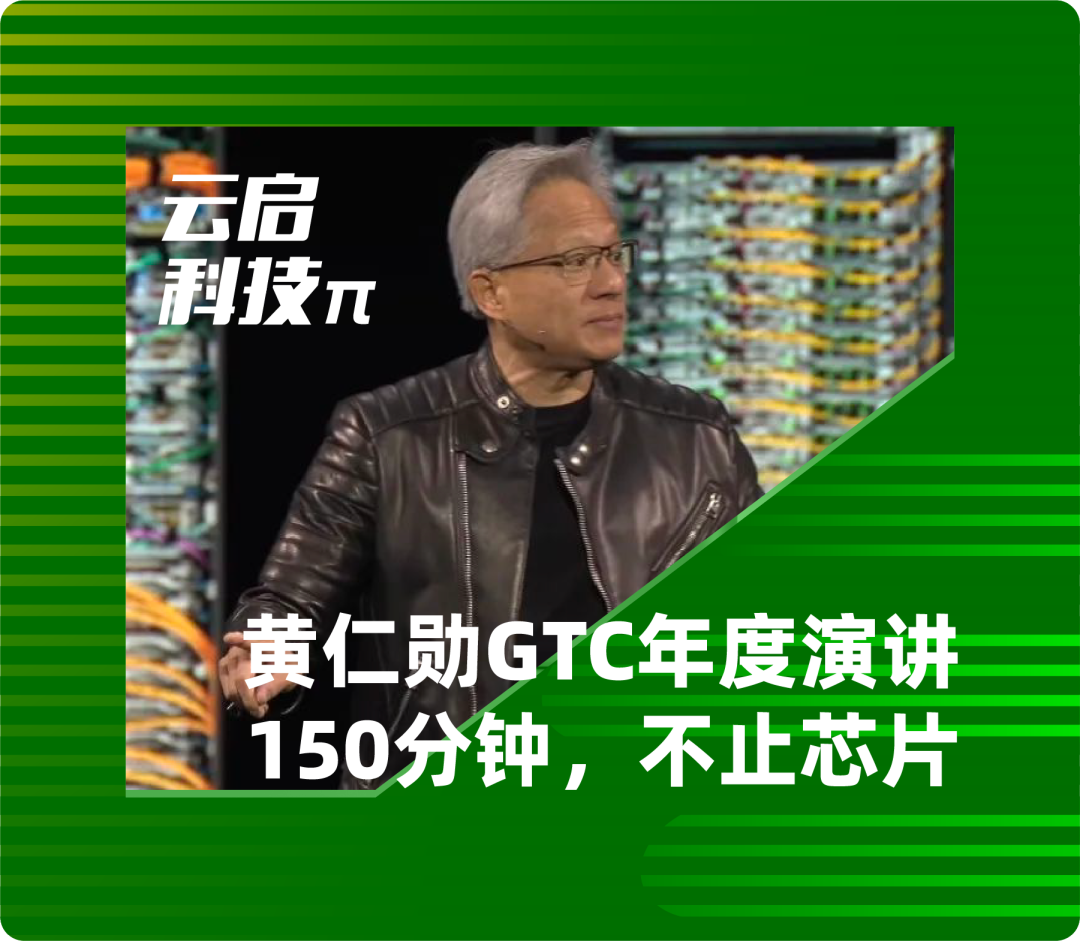
At 1 a.m. Beijing time on March 19, NVIDIA founder Jensen Huang took the stage for his annual GTC keynote.
It was the first GTC since NVIDIA's stock took a hit from DeepSeek, and over two and a half hours, Huang announced a slate of heavy-hitting products including the Blackwell Ultra chip and next-generation Rubin chip. Pushing back against market skepticism also seemed to run through the entire presentation, with repeated emphasis on how the inference era would continue to benefit NVIDIA.
What exactly did Huang say at this "AI Super Bowl"? This episode of Yunqi Tech Pi breaks it down for you.
This article is republished from GeekPark, originally titled "Huang's 2.5-Hour Keynote: NVIDIA Has Entered the 'Agentic AI' Era," by Wanchen, Li Yuan, and Zhang Yongyi.
"The AI Spring Festival Gala" has long been one of GTC's nicknames, but at GTC 2025's opening keynote, NVIDIA's founder — the leather-jacket-loving "Lao Huang" — co-opted it. "I think GTC has become the Super Bowl of AI," Huang said, describing the event's scale. "But here, AI will make everyone a winner."
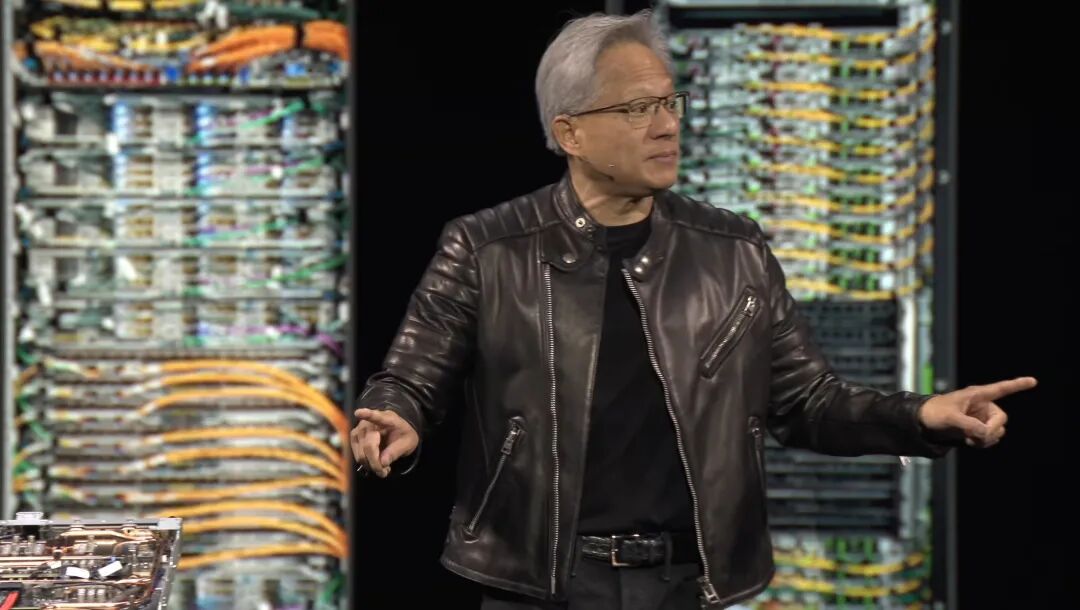
Yet facing recent stock plunges — especially skepticism epitomized by DeepSeek R1 and the question "Do we really need this many GPUs?" — GTC as the "Spring Festival Gala" meant NVIDIA had to bring out more genuinely crowd-pleasing "hard goods." Whether also affected by the stock pressure, Huang's delivery today was noticeably more halting than usual. Still, over 150 minutes, he laid out the future for multiple industry ecosystems spanning AI agents to data center chips to embodied intelligence. Once again, NVIDIA sees AI's future. Now they need the world to believe it too.
01
Agentic Saves NVIDIA
"It's all about tokens."
Unlike past GTCs where he opened with NVIDIA's hardware, Huang spent 40 minutes today unpacking NVIDIA's raison d'être in the Agentic AI era: processing tokens ever more efficiently. Tokens handled per unit time growing a hundredfold or ten-thousandfold, while compute cost and energy consumption per unit drop.
In his view, over the decade-plus that NVIDIA has ridden the AI wave, the technology has gone through three paradigm shifts. First came discriminative AI (speech recognition, image recognition), then generative AI, and now the Agentic AI we currently inhabit, with Physical AI that impacts the physical world coming next.
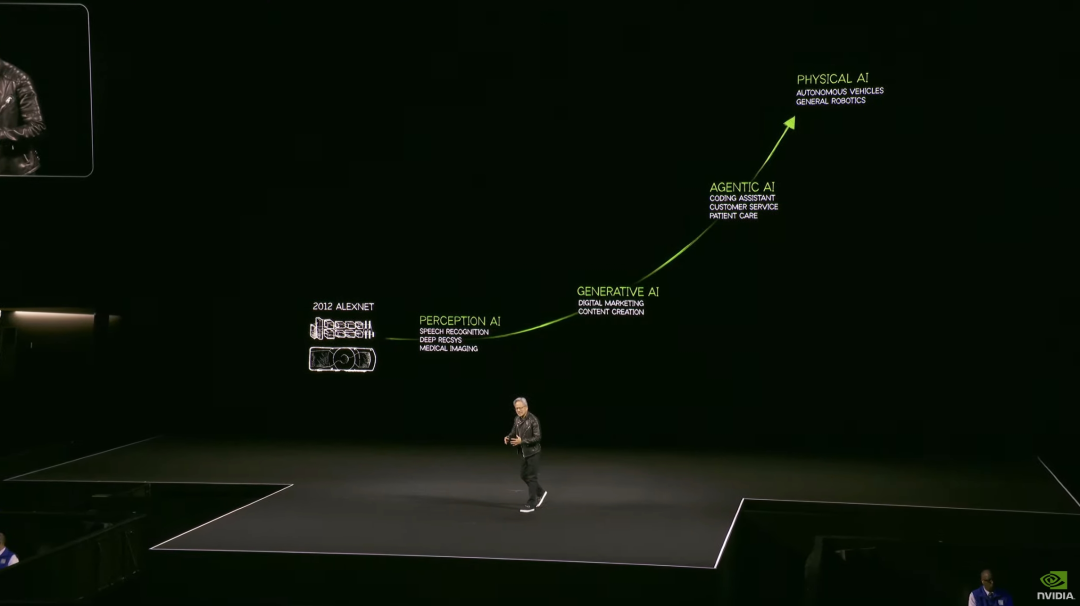 Huang lays out the path of AI's technological evolution | Image source: NVIDIA
Each generational shift changes how computation works. From AlexNet to ChatGPT, the transition was from retrieval-based to generation-based computation. And when AI moves from ChatGPT's next-token-prediction — prone to hallucinations — toward agentic applications like Deep Research and Manus, every layer of computation differs, requiring 100x more tokens than imagined. Because in Agentic AI, each previous token becomes context for generating the next, part of a step-by-step chain of perception, planning, and action.
Right now, Agentic AI is the era we're in. AI is hitting a new inflection point, growing smarter and more widely applied, while also demanding more compute to support it.
Huang illustrated this using the same prompt with two open-source models representing different paradigms — Llama 3.3 and DeepSeek-R1 — showing how reinforcement-learning-driven inference applications consume ever more tokens while also making AI applications more reliable.
The prompt: "For my wedding reception, I need 7 people seated around one table. My parents and in-laws shouldn't sit together. Also, my wife insists she looks better in photos when seated to my left, but I need to sit next to my best man. How do we arrange this round? What if we invite the priest to join us?"
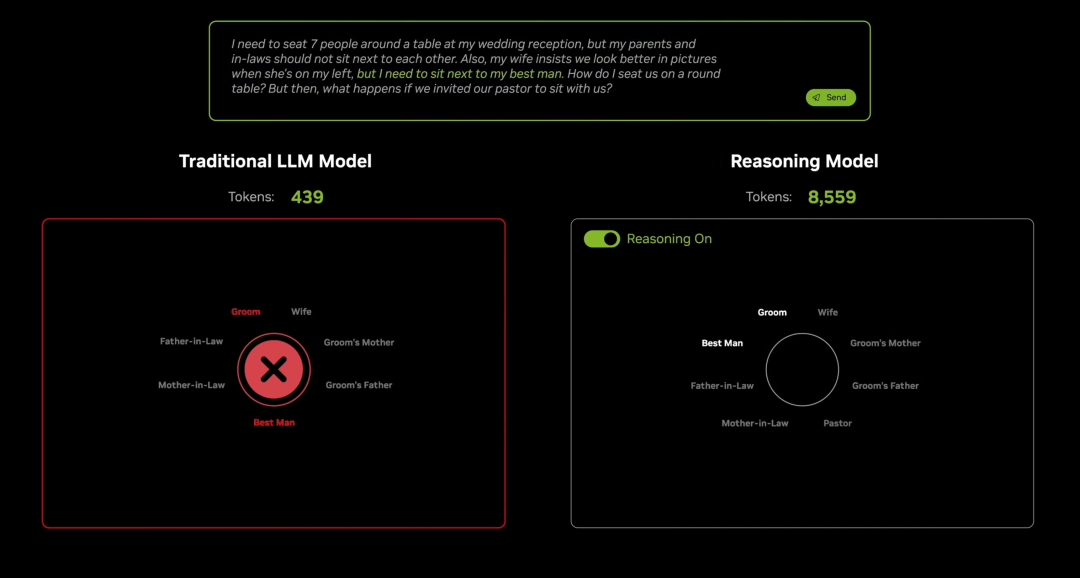 DeepSeek R1's reasoning model used nearly 20x the tokens of traditional large models | Image source: NVIDIA
As shown on the left above, Llama 3.3 as a large language model answered quickly using under 500 tokens, but the seating arrangement didn't meet the requirements. By contrast, R1 as a reasoning model on the right used over 8,000 tokens to arrive at the correct answer.
The difference: the LLM on the left tried once; the reasoning model on the right tried all possible permutations, then reflected on and verified its answer. And reasoning models need more computation because they're more complex. R1 has 680 billion parameters; its successor may have trillions.
Going further, Agentic AI applications involve countless calls to reasoning processes like DeepSeek-R1, requiring even more computation. This is also why ChatGPT can be free, while Deep Research and Operator can't — OpenAI currently charges $20 and $200 respectively.
Judging NVIDIA by the slowdown in pre-training is premature, because the Scaling Law story isn't over yet.
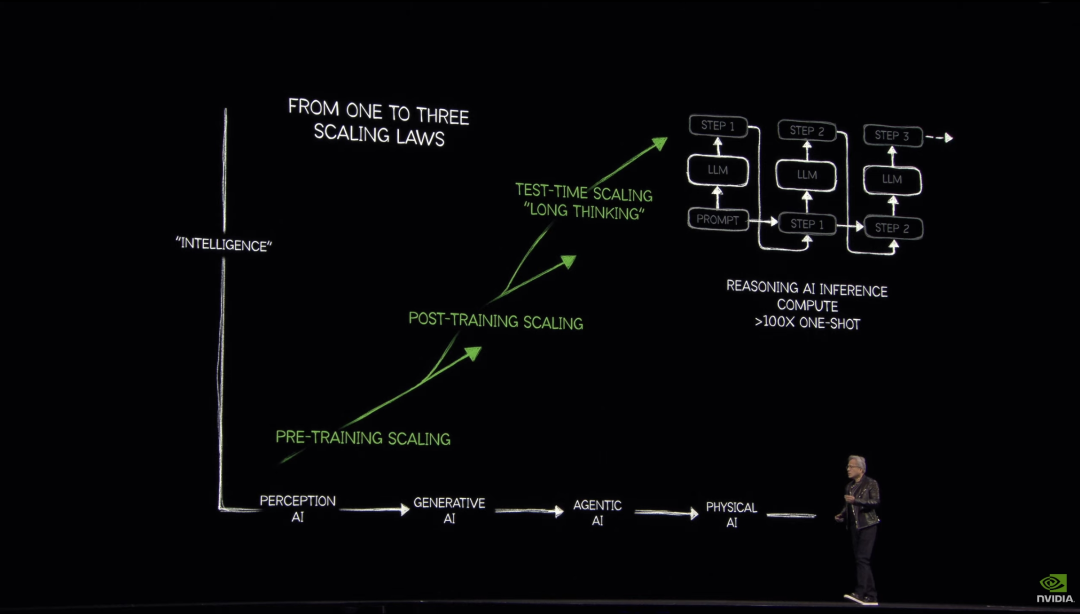 Long-thinking models show multi-fold increases in token demand | Image source: NVIDIA
Huang noted that beyond pre-training and post-training (fine-tuning), test-time Scaling Law is just beginning. (Referring to dynamically allocating compute resources during model inference to improve performance — e.g., automatically extending "thinking time" based on problem complexity, or generating multiple candidate answers through repeated inference and selecting the best.)
In an official NVIDIA GTC blog post, tokens are described as AI's language and currency — the unit of data AI processes during training and inference, used in every scenario of prediction, generation, and reasoning.
In Huang's view, the new type of data center accelerating AI workloads — the "AI factory" — must efficiently process these tokens, converting them from AI language to AI currency: intelligence. Through integrated hardware-software optimization, handling more tokens at lower compute cost.
Thus, when more complex, intelligent reasoning models need to throughput tokens faster and in greater volume, having a compute system that addresses this efficiently through both hardware and software becomes key to whether AI applications can turn a profit.
This is the new Huang's Law curve under Agentic AI.
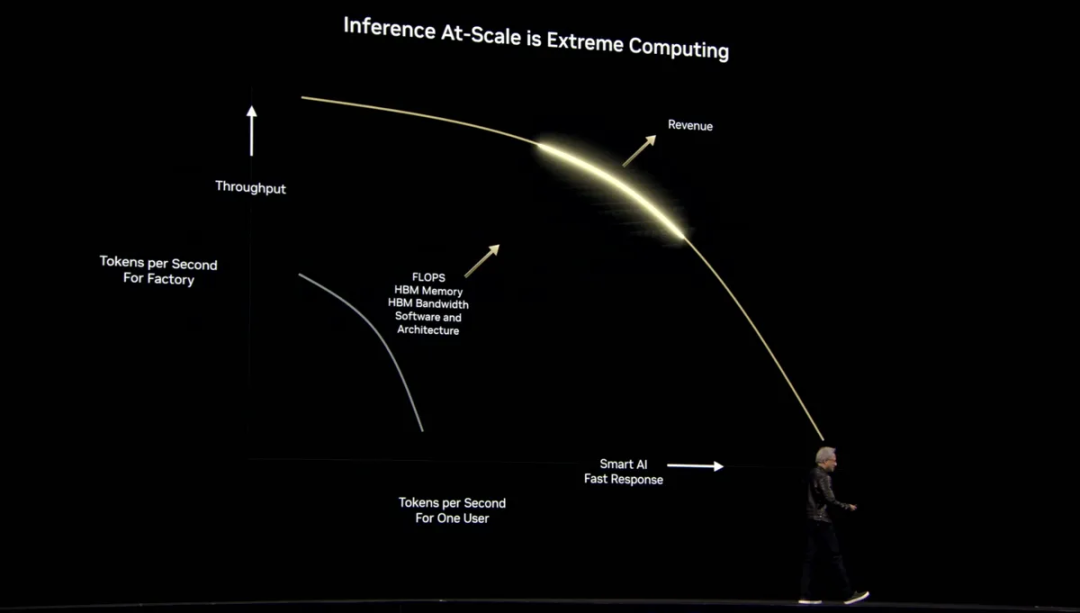 Under multi-dimensional curves of performance, tokens, and revenue, vendors still have room to profit | Image source: NVIDIA
And to reach that "Revenue" slice — to close the commercial loop on AI applications — you still have to buy NVIDIA. Still "the more you buy, the more you save" — no, now it's "the more you buy, the more you earn."
02
The "AI Factory" OS — Dynamo
Not long ago, news went viral that "DeepSeek achieved 550% theoretical profit margin through hardware-software co-optimization." Don't forget: those who understand NVIDIA best include NVIDIA itself. The infrastructure ammunition DeepSeek deployed? Huang's got you covered too.
NVIDIA unveiled a new operating system for the "AI factory" engine: Dynamo. With it, token throughput and latency can be dramatically optimized further.
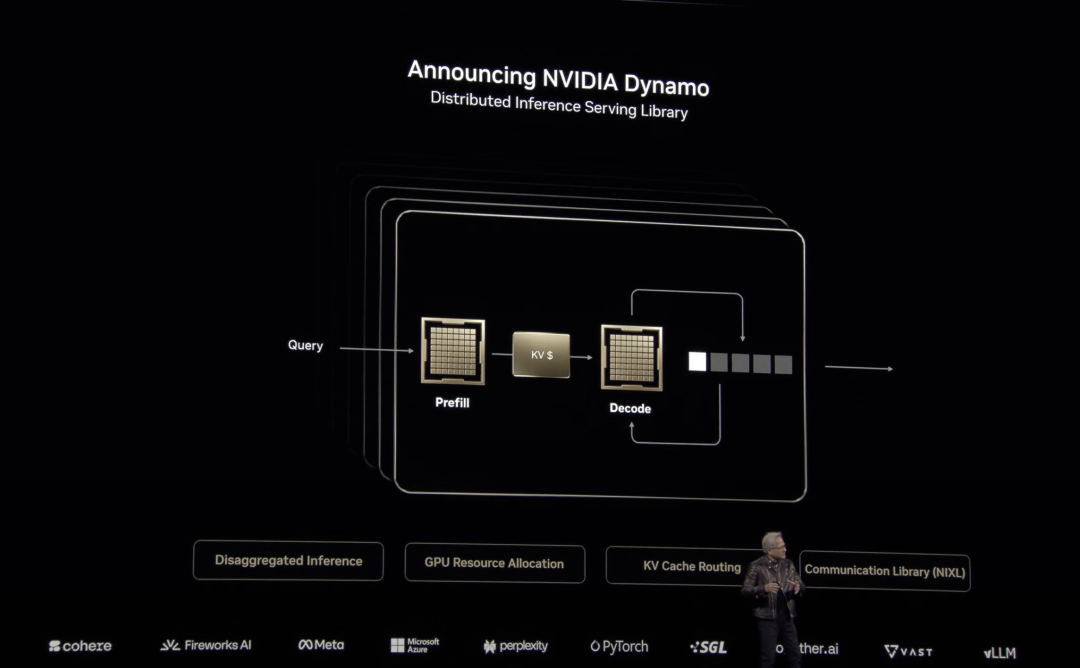 Huang explains how Dynamo enables PD separation | Image source: NVIDIA
Making a larger model produce tokens more efficiently has itself become an engineering problem. How to properly utilize pipeline parallelism, tensor parallelism, expert parallelism, in-flight batching, PD separation, workload management; how to manage KV cache — different players have proposed different solutions.
NVIDIA's solution this time is Dynamo. Huang compared this inference serving library to the new era's VMware, capable of automatically orchestrating how AI runs better in the inference era — generating more tokens per second.
Next, Huang practically spoke directly to data centers needing to procure NVIDIA: every future data center will be power-constrained. Your revenue will be power-constrained; the power available determines your potential revenue.
With Blackwell, you get better performance under the same power budget; add Dynamo, and Blackwell optimizes further — Hopper can optimize too, just not as much.
By NVIDIA's account, using Dynamo to optimize inference can boost DeepSeek-R1 throughput on Blackwell by 30x. Dynamo is also fully open-source.
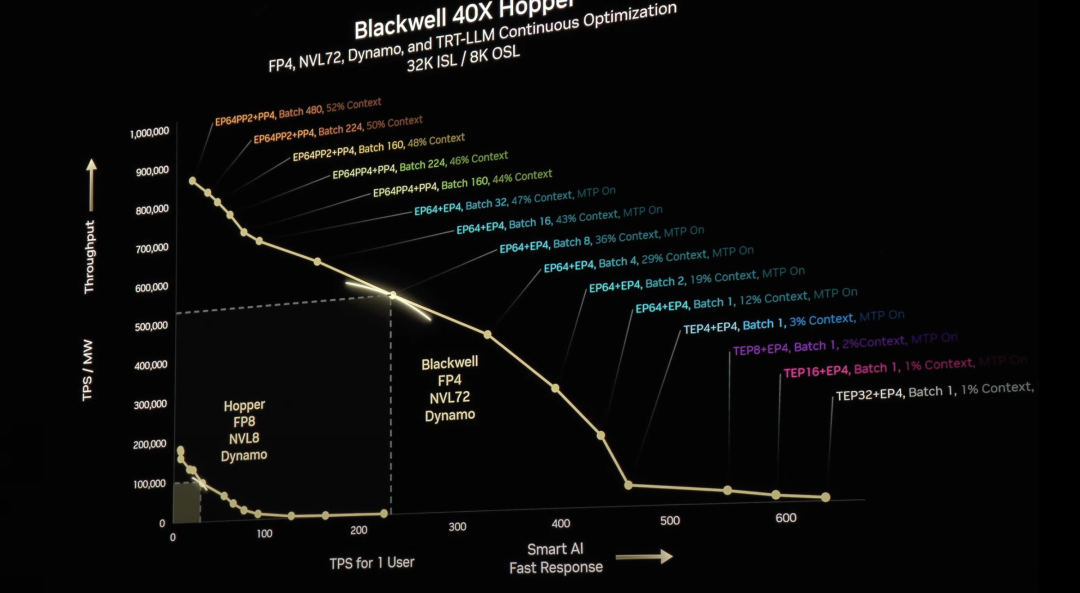 Performance comparison between Blackwell and Hopper series chips with FP4 and Dynamo introduced | Image source: NVIDIA
Huang did the math for enterprises directly: under equivalent power, Blackwell delivers 4–5x the performance of Hopper. In "inference model" benchmarks, Blackwell performs roughly 40x better than Hopper.
The same 100-megawatt data center: using H100 requires 1,400 racks producing 300 million tokens per second; using GB200, just 600 racks producing 1.2 billion tokens per second.
Lao Huang: The more you buy, the more you save!
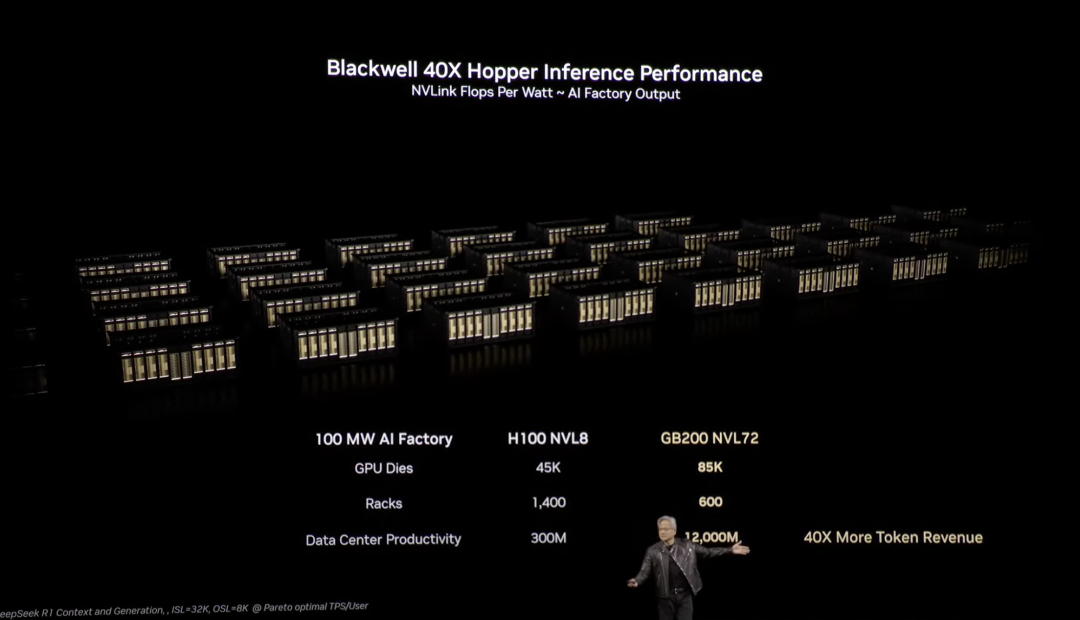 100-megawatt data center math problem | Image source: NVIDIA
03
Not Just Blackwell "Super Size"
But Also Silicon Photonics Landing
On the hardware front, Huang also announced the next evolution of the Blackwell AI factory platform — Blackwell Ultra, designed to further boost AI inference capabilities.
Unlike existing Blackwell, Blackwell Ultra is purpose-built for AI inference, Huang explained. Following DeepSeek R1's release, OpenAI o1 and Google Gemini 2.0 Flash Thinking are already on the market as inference model products.
Blackwell Ultra specifically comprises the GB300 NVL72 and HGX B300 NVL16 systems, with 1.5x the AI performance of its predecessor. The GB300 NVL72 connects 72 Blackwell Ultra GPUs and 36 Arm Neoverse-based NVIDIA Grace CPUs in a rack-scale design. Compared to the Hopper generation, the HGX B300 NVL16 delivers 11x faster inference speed on large language models, 7x more compute, and 4x more memory. It also supports the simultaneously announced NVIDIA Dynamo inference framework.
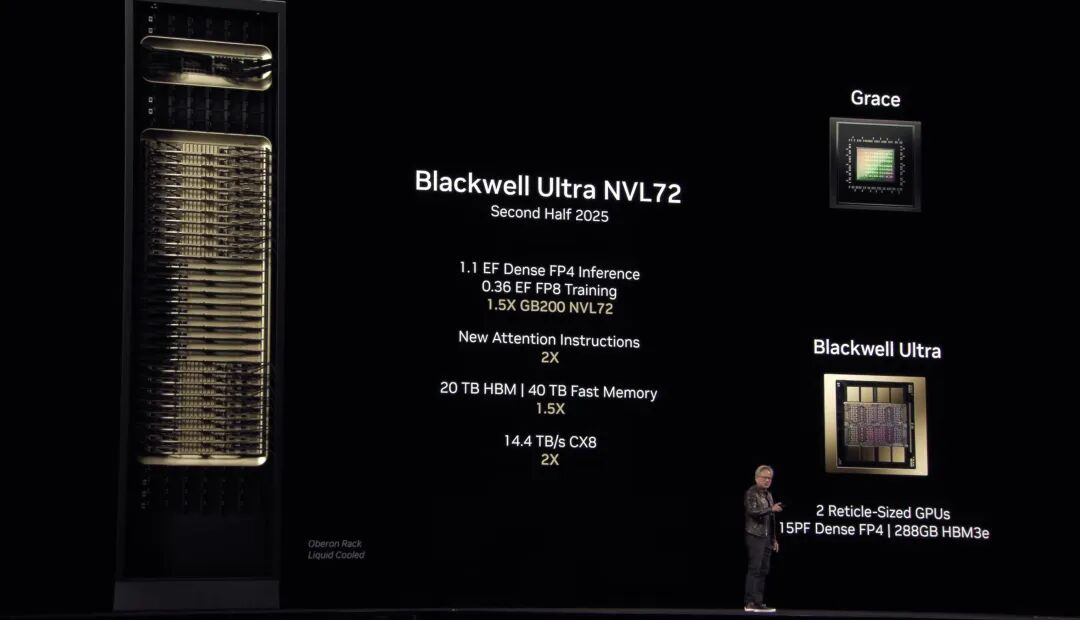 Blackwell Ultra debuts as the "super size" | Image source: NVIDIA
Major tech companies and cloud providers including AWS, Google Cloud, and Microsoft Azure will offer Blackwell Ultra-powered instances starting in the second half of 2025.
Beyond Blackwell Ultra, NVIDIA also updated its data center roadmap for 2026 and 2027, including plans for the next-generation AI chips Rubin (named after astronomer Vera Rubin) and Rubin Ultra.
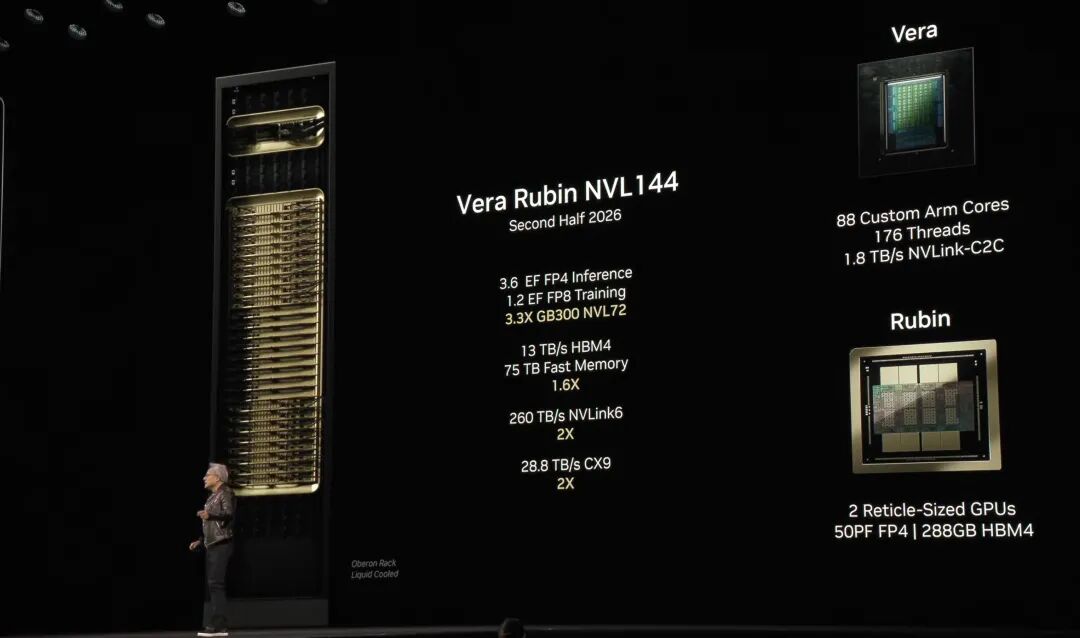 Next-gen AI chip codenamed Rubin | Image source: NVIDIA
The Rubin NVL144 rack will be directly compatible with existing Blackwell NVL72 infrastructure. Rubin Ultra's entire rack will be replaced by a new layout: NVL576, accommodating up to 576 GPUs per rack.
Beyond these relatively dry chip iterations, NVIDIA also publicly disclosed its silicon photonics progress in AI computing for the first time. Huang called it:
"The next generation of AI infrastructure."
Silicon photonic chips feature high operation speed, low power consumption, and low latency, without requiring the extreme shrinkage of process nodes. In manufacturing, they also don't demand the stringent requirements of electronic chips — specifically EUV lithography machines, which became widely known through the "chip wars."
Currently, NVIDIA isn't applying photonic chip technology directly to AI chips. Instead, it's partnering with TSMC, using TSMC's silicon photonics platform Compact Universal Photonic Engine (COUPE), which employs TSMC's SoIC-X packaging technology and combines Electronic Integrated Circuits (EIC) with Photonic Integrated Circuits (PIC). This produced two switches using silicon photonics technology: Spectrum-X and Quantum-X.
As "AI factories" spring up worldwide, energy consumption and operating costs have become critical constraints on mega data center expansion. Thus NVIDIA is also using silicon photonics technology to further optimize existing mega data centers.
These are precisely scenarios where silicon photonics shines. Silicon photonic chips have potential to radically transform data processing speeds while accelerating quantum computing development. The new photonic technology could also save megawatts of energy for GPU clusters in data centers.
"AI factories are a new type of data center at extreme scale; network infrastructure must be transformed to keep pace," Huang said, describing silicon photonic chips' application prospects in data centers.
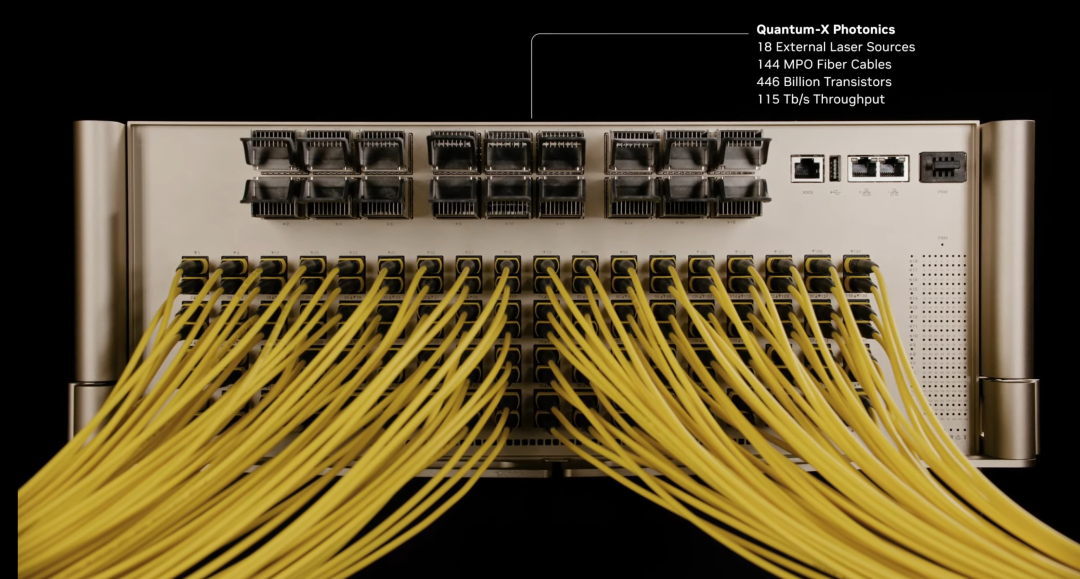 Quantum-X InfiniBand switch uses special cabling to accelerate operation | Image source: NVIDIA
According to NVIDIA's public information, Spectrum-X offers 100 Tb/s total bandwidth, 400 Tb/s total throughput, and up to 1.6 Tb/s per port — twice the speed of current top-tier copper cable transmission. Huang himself joked, "There are way too many TBs in this description."
The Quantum-X photonic InfiniBand switch will be available later in 2025, while the Spectrum-X photonic Ethernet switch is planned for 2026 release.
Finally, Huang also announced the architecture name following Rubin: Feynman, derived from Richard Phillips Feynman, who made major contributions to quantum computing and laid the conceptual foundation for modern quantum computers by proposing the quantum computer concept in the 1980s.
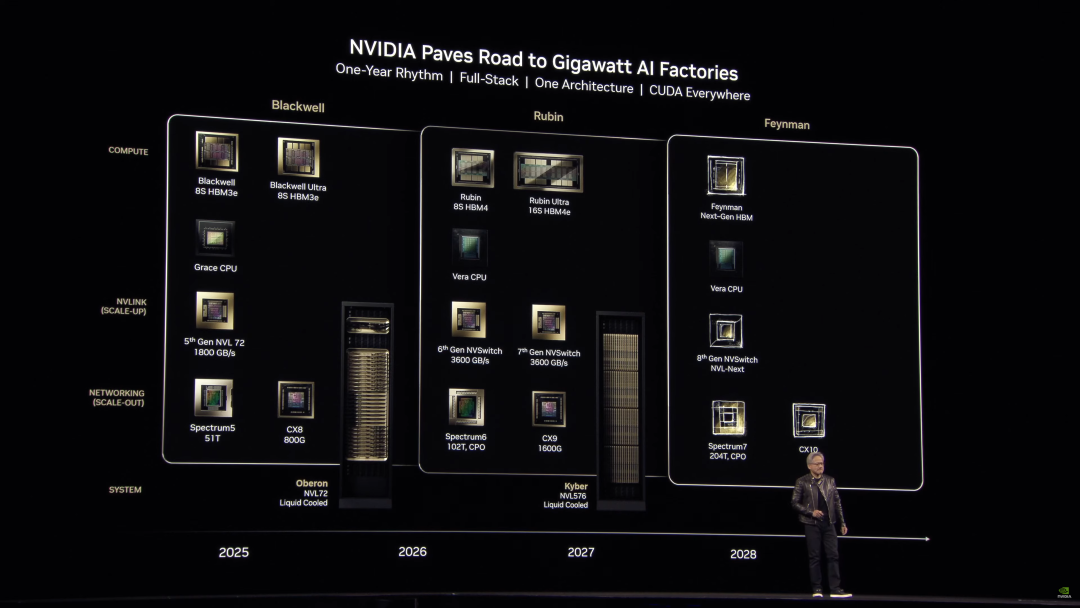 NVIDIA AI chip hardware roadmap through 2028 | Image source: NVIDIA
Per Huang's disclosed roadmap, the Feynman architecture will debut in 2028 — perhaps by then, we'll truly see major breakthroughs in quantum computing technology.
04
NVIDIA's Robotics Ecosystem Takes Full Shape
Last year at GTC, Huang extending his arm to stand in a row with humanoid robots became an iconic moment. This year, simulation data and robots still appeared everywhere at GTC. Even at the very start of his speech, Huang's script placed Physical AI at the pinnacle of AI's development.
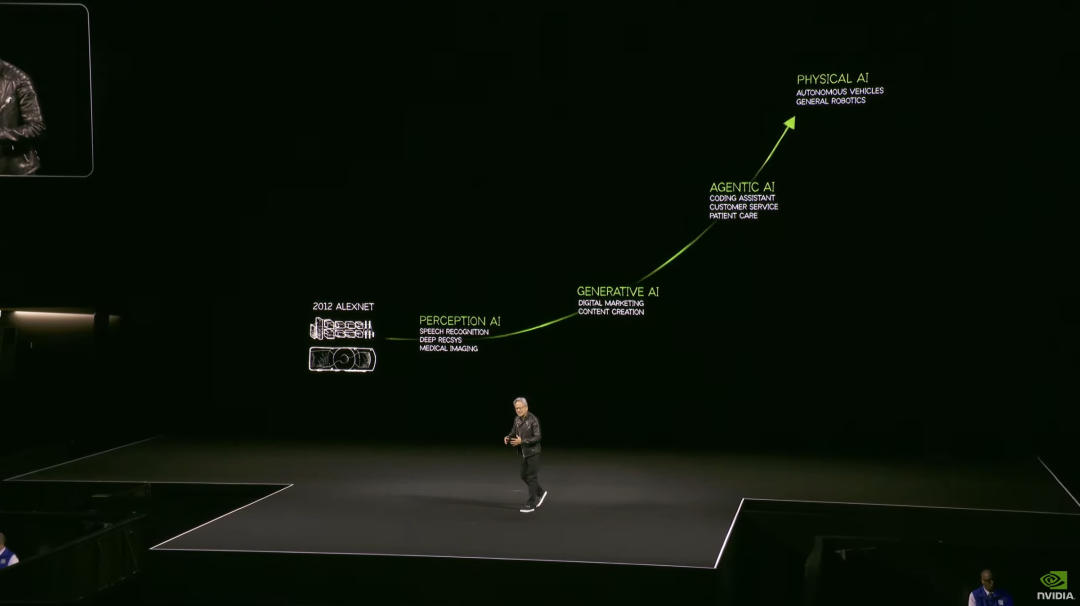 Stages of AI development: the latter three are generative AI, Agentic AI, and Physical AI | Image source: NVIDIA
However, across the entire GTC, the time devoted to Physical AI wasn't as substantial as imagined. Autonomous driving and robotics segments combined probably totaled under half an hour.
Though brief, NVIDIA's announcements still revealed the company's ambition.
For all AI, data, algorithms, and compute are the most critical elements.
The generative AI we're familiar with was trained on massive internet text and video data; NVIDIA's contribution was primarily in compute.
But moving to Physical AI, NVIDIA aims to exert full force across data, algorithms, and compute — an industrial map is taking shape.
On compute, NVIDIA has its previously released Orin and Thor chips.
On data, NVIDIA is also a major contributor. Physical AI emphasizes enabling AI to understand the physical world, yet the world hasn't accumulated sufficient 3D environmental data as it has text and video. Mass-producing such data depends on simulation data progress driven by NVIDIA.
Through several GTCs, NVIDIA has fully filled out the data production pipeline: Omniverse digital twin environment, essentially a powerful 3D editor capable of generating realistic scenes and objects. Developers can integrate real-world sensor data or demonstration data according to different domains, robot types, and tasks.
Cosmos model training platform, essentially a virtual world built specifically for vehicles and robots. Training Cosmos with Omniverse enables Cosmos to generate infinitely diverse virtual environments, creating data that is both controlled and systematically infinitely scalable.
Combined, these produce unlimited varieties of virtual simulation data across environments, lighting, and sets. As shown below, robots in Omniverse appear candy-colored, emphasizing digital twins of reality, while Cosmos backdrops can transform completely to generate different scenes.
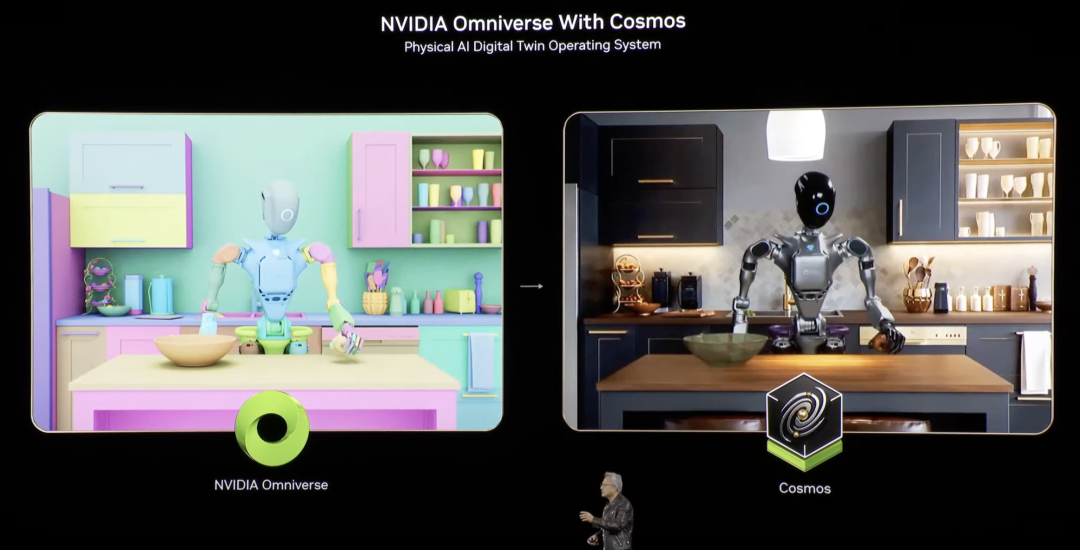
Omniverse and Cosmos robot data effects | Image source: NVIDIA
For humanoid robots specifically, NVIDIA also introduced a suite of additional tools, such as this year's flagship blueprint tool Mega, which can test large-scale robot deployment effects.
NVIDIA hopes humanoid robot developers will first collect some real-world data, import it into Omniverse, then use Cosmos to convert this real-world data into diverse virtual data, directly importing it into NVIDIA's Isaac Lab for further training — either through imitation learning to replicate behaviors, or reinforcement learning to acquire new skills through trial and error.
In autonomous driving, where deployment is faster, this interdependent Omniverse-Cosmos data capability is already showing results. At this GTC, NVIDIA announced that General Motors has chosen to partner with NVIDIA to build future autonomous vehicle fleets. Beyond using simulation environments to improve factory and vehicle design, NVIDIA will also help GM enhance its intelligent driving experience.
What GM likely values most is Cosmos's complete end-to-end AI training system. 3D Synthetic Data Generation can transform log data into high-precision 4D driving environments through Omniverse, combining maps and images to generate digital twins of the real world, including pixel-level semantic segmentation. Cosmos then expands training sets with this data, generating more accurate and diverse driving scenarios, narrowing the simulation-to-reality gap.
Cosmos also provides specialized optimizations for model training, enabling model distillation and closed-loop training.
In humanoid robotics, where deployment is slower, between last year's and this year's GTC, we've even seen NVIDIA making algorithmic strides.
Following last year's GR00T model release, this year NVIDIA announced GR00T N1. NVIDIA declared this the world's first open, fully customizable general humanoid robot reasoning and skills foundation model.
GR00T N1 is built on technical foundations of synthetic data generation and simulation learning, adopting a dual-system architecture of "fast thinking and slow thinking." The "slow thinking" system enables robots to perceive environments, understand instructions, and plan correct actions, while the "fast thinking" system converts plans into precise, continuous robot movements.
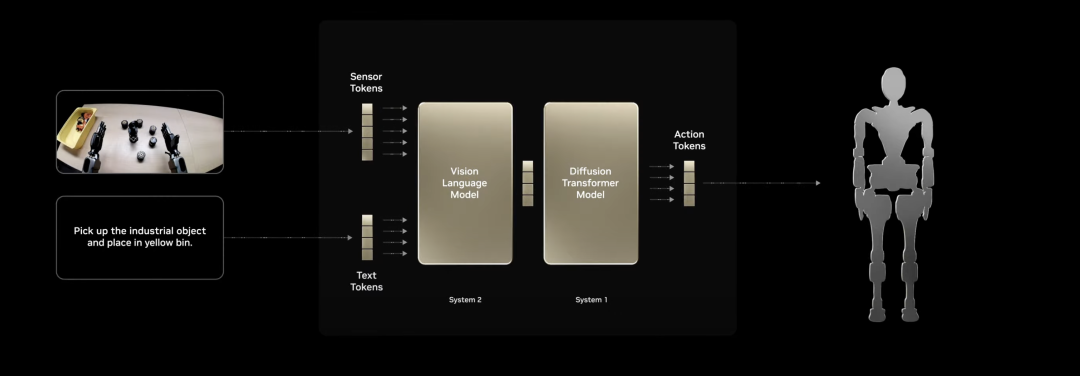
GR00T N1 architecture | Image source: NVIDIA
GR00T N1 itself isn't a major technical breakthrough — Figure AI's Helix and other models previously adopted similar dual-system architectures.
NVIDIA's clear aim is that by open-sourcing an advanced model, plus a complete synthetic data generation and robot learning pipeline, humanoid robot developers worldwide can fine-tune GR00T N1 for different environments and task scenarios across industries — much as DeepSeek catalyzed the AI industry.
NVIDIA's robotics progress seems unceasing, constantly filling every gap in the industrial chain at astonishing speed. Only when robot development becomes as easy as current AI application development might it pause.
Specifically for robot R&D, this year NVIDIA also partnered with DeepMind and Disney Research to jointly introduce a new physics engine: Newton.
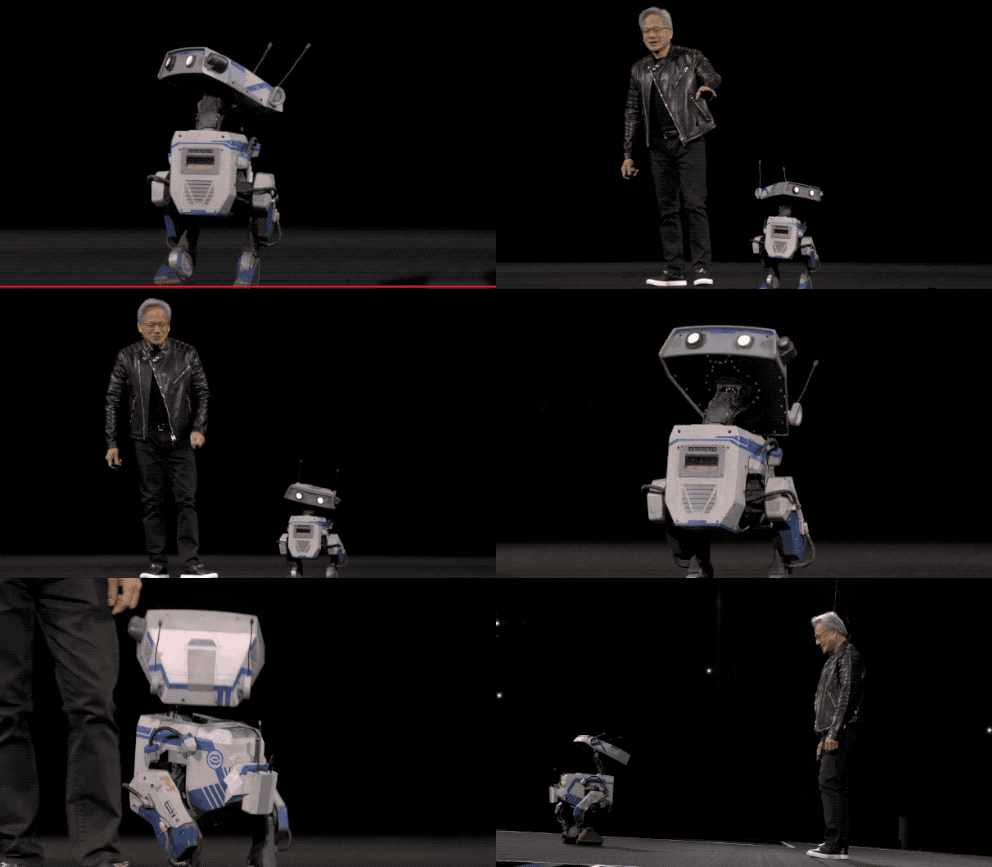
Huang interacts with Disney robot | Image source: NVIDIA
Most current physics engines are designed for specific needs — large mechanical simulation, virtual worlds, or video games — whereas robots need engines capable of precisely simulating rigid and soft bodies, supporting haptic feedback, time-series skill learning, actuator control, and GPU acceleration to train AI models at astonishing speeds in super-real-time virtual worlds.
At the speech's conclusion, a small Blue robot took the stage. The Blue robot contains two NVIDIA chips, and its training was completed entirely in NVIDIA's built training system and Newton engine through real-time simulation.
NVIDIA's investment in robotics shows no signs of stopping. Robot demos continually experiencing minor glitches and stealing Huang's spotlight may become a regular GTC highlight in coming years.
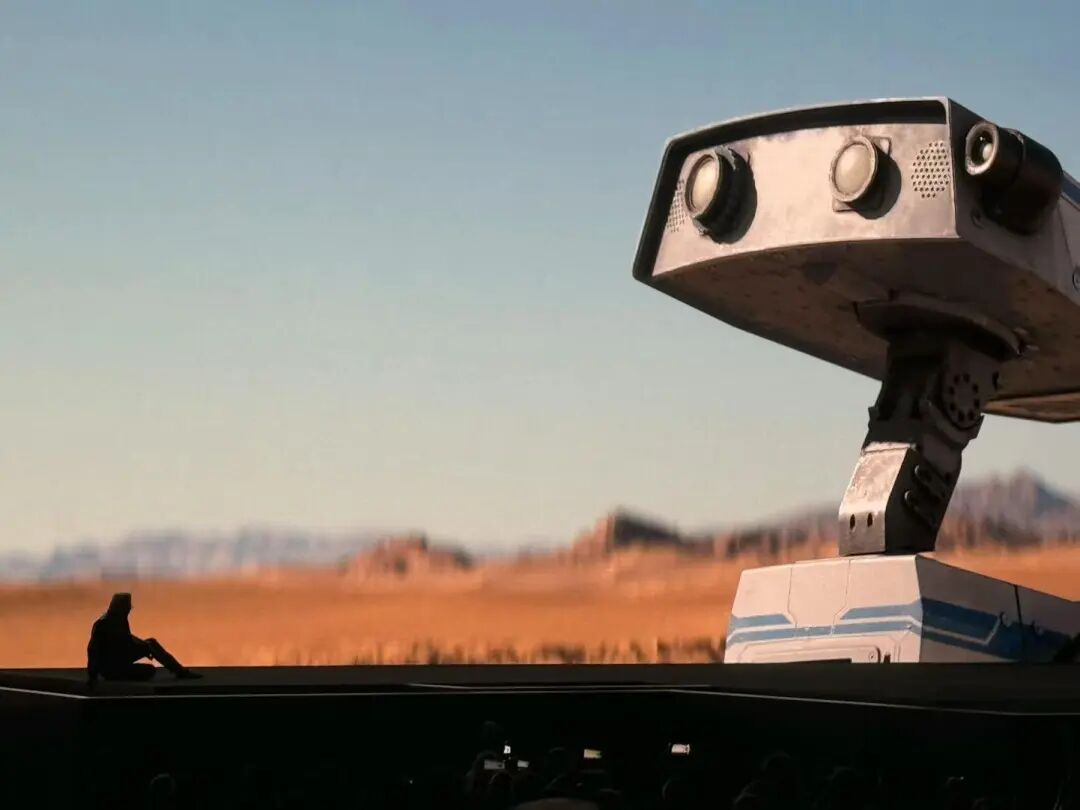
Iconic moment before the speech's end | Image source: Guanglun Intelligent founder & CEO Xie Chen
Before the GTC main keynote concluded, during a video playback gap, Huang struck a pose. You could call it spontaneous, but in a sense, this iconic image — clearly a mirror of the famous painting The Creation of Adam — may recur throughout future AI technology history.