Yunqi Capital Solely Invests in Synrise's Pre-A Round, Advancing AI-Powered Active Prosthetic Knee Toward Human Augmentation | Yunqi Partners

Mass production within a year of founding, with orders exceeding 10 million yuan.
The hardest thing about a lower-limb prosthesis is timing: the knee joint must determine in milliseconds whether the user wants to climb stairs or walk on flat ground. Too early, and it's interference; too late, and it's a burden — which is why mainstream smart knees have long remained stuck at "following movement." The Tsinghua alumni-founded team Synrise handed this judgment problem to its self-developed algorithmic base, SynchroMind. Within a year of founding, that capability became a mass-produced product — 6 million fatigue cycles, over 40 million steps of real gait training, and more than 20,000 kilometers of walking distance — validated first in Europe, where standards are most stringent, with domestic and overseas orders exceeding ten million yuan.
Recently, Synrise announced the completion of its Pre-A funding round, with exclusive investment from Yunqi Capital. In this edition of Yunqi Partners, we share Synrise's latest developments.
Yunqi Capital's Investment Thesis:
Human augmentation is AI's most personal entry point into the physical world. Synrise entered through smart prosthetics, where technical demands are most rigorous, and achieved mass production and overseas validation within a year. Every unit shipped feeds back real human motion data — an irreplicable moat. Its active powered knee and subsequent product lines demonstrate the team's clear path from assistance to augmentation. We look forward to SynchroMind serving broader populations.
Recently, Synrise (Chengdu) Technology Co., Ltd. announced the completion of its Pre-A funding round. This round was led exclusively by Yunqi Capital, with Inspur Capital serving as long-term financial advisor. The funds will be used primarily for SynchroMind algorithmic base and next-generation product R&D, as well as global market expansion.
Founded in 2025, Synrise is an AI human-machine collaboration technology company with human augmentation as its long-term direction. Centered on its self-developed algorithmic base SynchroMind, the company enables devices to understand human movement intent in real time and collaborate with it. The goal is to use the same human-understanding capability to serve a broad population ranging from those with limited motor function to general consumers. Within a year of founding, its first product, the Synrise S5 biomimetic intelligent hydraulic knee, achieved mass production, completed validation in the European market, and secured over ten million yuan in orders across domestic and overseas markets.
Following the S5, the company's second product — a new AI-driven active powered knee — has entered the R&D phase, pushing devices from "following human movement" to "actively outputting power for the human body." Based on the same base, these two knee joints, together with consumer-grade exoskeletons and performance-enhancement devices, constitute the company's product ecosystem plan for the next three to five years. The roadmap is clear: starting from compensating for missing motor function, gradually moving toward human augmentation that serves broader populations.
Derui Liu, Founder and CEO of Synrise, stated: "Prosthetics are our starting point, not our destination. When a device can truly understand a person's movement intent, what it can do goes far beyond replacing a leg — it can help anyone walk more steadily, farther, and with less effort. We believe human augmentation will become one of the most direct ways AI enters daily life."
Human Augmentation
The Next Entry Point After AI Enters the Physical World
AI is moving from the digital world into the physical world. In this process, one category of devices has the closest relationship with people: they are worn directly on the human body, coupling in real time with every movement. The ultimate direction of such devices is human augmentation — enabling machines to understand the human body, compensate for, extend, and enhance human motor capabilities.
Embodied Artificial Intelligence is becoming the next major thread in the AI industry: as large models provide machines with a "brain" for understanding the world, how to give AI a "body" capable of perceiving and acting upon the physical world has become a new industrial proposition. Among all physical interaction targets, the human body is the most complex and most valuable — devices worn on the body must understand human intent and collaborate with it within millisecond-level response times, representing the highest density of Embodied Artificial Intelligence technology and the form most embedded in daily life. And precisely because it is embedded in daily life, the market ceiling for human augmentation is not determined by medical demand: from functional compensation to movement assistance and capability enhancement corresponds to a leap from professional equipment markets to mass consumer markets.
Human augmentation is not a distant concept. Globally, those affected by motor dysfunction number in the hundreds of millions; with population aging, muscle decline and gait instability are becoming daily problems for even larger populations; and among healthy individuals, demand for athletic performance, exercise safety, and movement efficiency is being rapidly awakened by consumer wearables. The needs of these three groups differ, yet all point to a common technical capability: devices must understand human movement state and intent, and deliver the right response at the right moment.
In the past, these three needs were met by fragmented, disconnected products: prosthetics and orthotics, rehabilitation equipment, and athletic wearables. Each compensated for some capability, but all faced two common problems: "high cost" and "hard to use." The root cause was that devices could only run on preset parameters, unable to truly understand the user.
Synrise's judgment is: when algorithms can understand human movement in real time, these three product categories will converge into a single technical system. The company's path is to enter through smart prosthetics, where technical demands are most stringent and validation standards most clearly defined, build the capability to understand human movement into a reusable base, and then gradually extend to broader populations.
The Human Movement Loop
The Common Starting Point for Three Product Categories
That prosthetics, assistance devices, and athletic wearables can converge into one technical system is because they all address the same object: the human movement loop.
Human movement is essentially a dynamic "intent—execution—feedback" loop: the brain generates movement intent, transmits commands through neural pathways, muscles complete execution, and proprioceptive and tactile sensing pathways feed movement state back to the central nervous system, forming continuous perception, judgment, and correction.
Restricted movement capability is essentially the weakening or failure of some link in this loop: it may be damage in the execution link, blockage in command pathways between nerves and muscles, or insufficient execution due to muscle decline. In healthy individuals' performance-enhancement scenarios, devices need to provide appropriate assistance and capability enhancement to the execution link.
Synrise's entry point is to reconstruct a complete movement loop on the device side: a sensor matrix perceives human movement state in real time and feeds results back to the algorithm; SynchroMind understands movement intent and determines how the device responds; hardware then completes execution in different ways — intelligent knee joints and active powered knee joints collaborate with the user to complete execution of the missing limb, with the latter also able to actively output power, while exoskeletons provide assistance to broader populations. Product forms differ, but perception and understanding in the loop are always completed by the same SynchroMind base. This is precisely why the three product categories can converge.
- SynchroMind: One Base, Multiple Products
SynchroMind is Synrise's self-developed human-machine collaboration algorithmic base. It is not an algorithmic module developed for a single product, but a layer of reusable underlying capability: a multi-source sensor matrix collects the user's movement information in real time, the algorithm fuses and processes multi-source data, recognizes movement state, predicts movement intent, and then dynamically adjusts device output through the control system; after output, the algorithm recalculates based on actual movement response and automatically adjusts control parameters, continuously learning and optimizing during use.
This capability has achieved commercial deployment on the intelligent knee S5, is currently supporting active powered knee R&D, and will extend to exoskeletons and consumer-grade human augmentation products. Hardware can be copied, mechanical structures can be reverse-engineered, but the algorithmic loop formed by real user movement data, and the engineering experience accumulated through long-term hardware-software collaboration, can only gradually precipitate through real use. Every unit shipped is a terminal that continuously feeds back real human movement data; every real step taken makes this base understand the human body better.
- S5: The First Commercial Validation of the Base, Now in Mass Production with Over Ten Million Yuan in Orders
The Synrise S5 biomimetic intelligent hydraulic knee is SynchroMind's first mass-produced vehicle.
Compared to traditional microprocessor knees, the S5's difference lies not only in mechanical structure, but more fundamentally in control logic. Traditional products rely on prosthetists for manual parameter tuning, which remains relatively fixed once set; the S5 autonomously optimizes within safety boundaries based on the user's physical characteristics and walking data, becoming increasingly attuned to individual gait habits with use. The device thus moves from "executing on fixed parameters" to "continuously adapting during use."
In terms of experience, damping bidirectional control is more precise and flexible, locking mechanisms respond more promptly and reliably, and terrain recognition better fits real walking scenarios. For example, when descending stairs, users of traditional mechanical knees often need to turn sideways and step down one by one; the S5 can identify the stair scenario from the first step and adjust damping in real time, allowing the user to descend with normal alternating steps.
Before launch, the S5 passed 6 million fatigue cycles, completed over 40 million steps of real gait training, and accumulated over 20,000 kilometers of walking distance. The company first completed validation in the European market, where standards for intelligent assistive devices are most stringent and high-end brands most concentrated. Currently, the S5 has achieved mass production, with domestic and overseas orders exceeding ten million yuan, and the company is simultaneously laying out domestic and North American markets.
In the high-end intelligent knee market long dominated by a few imported brands, with unit prices often reaching several hundred thousand yuan, the S5 leverages China's intelligent hardware supply chain to significantly lower the price barrier while matching the performance of high-end products.
- AI Active Powered Knee: From "Following Movement" to "Outputting Power"
The S5 and current mainstream intelligent knees are all passive devices: they adapt to the user's movement by adjusting damping, but provide no power. When users climb stairs, rise from chairs, or walk long distances, they still must rely entirely on their own muscle strength and their intact limb.
Active powered knees are a widely recognized technical pinnacle in the smart prosthetics field, with only a handful of commercially available products globally. Synrise's next-generation product under development uses AI to recognize movement intent in real time, determining when and how much power to output, placing it at the frontier of this direction. It adds motor drive atop the S5's perception and understanding capabilities. The device will provide corresponding power in different scenarios based on recognized intent: actively extending the knee step by step when alternating upstairs, providing timely knee extension assistance when rising from a seat, and driving lower leg swing during walking.
The technical challenge of active powered knees lies not in the motor itself, but in the precision and timing of intent recognition: power output earlier than intent is interference, later than intent is burden, and mismatched with intent is risk. This is precisely where SynchroMind comes into play. The tens of millions of steps of real gait data accumulated by the S5, covering different users, terrains, and movement scenarios, gives the active powered knee's intent recognition a foundation rooted in real walking from the very start. Power can thus be delivered at the right time, with appropriate force, and always within safety boundaries.
The significance of this product extends far beyond prosthetics itself. "Understanding intent and actively outputting power" is the core capability of exoskeletons and performance-enhancement devices; the active powered knee will validate this capability in the most demanding scenarios, and will be the company's critical step from intelligent assistive devices toward human augmentation.
Team
The Crossed Genes of Algorithms and Robotics
Derui Liu, Founder and CEO of Synrise, graduated from the Institute for Interdisciplinary Information Sciences, Tsinghua University, with a cross-disciplinary background in AI and robotics. He is responsible for the company's overall strategy, product definition, and commercialization path. Co-founder and CTO Jie Gao graduated from Tsinghua University's "Yao Class" (Computer Science Experimental Class), where he was a gold medalist in the National Olympiad in Informatics (NOI). He has deep expertise in deep learning, reinforcement learning, and robotic control, and leads the R&D of the SynchroMind algorithmic base and algorithms for the full product line. The two founders had prior co-founding experience together, and have developed a stable division of labor through the complete cycle from algorithm research to product deployment.
Beyond the two founders, the core team brings together talent with backgrounds in robotics engineering, intelligent hardware, and ISPO internationally certified prosthetic and orthotic technician qualifications, with core members all born after 1995. Going from founding to first product mass production and shipment in just one year reflects the team's iteration speed and execution capability. Currently, the company has assembled a core R&D team of over 20 people and established research collaborations with more than 30 institutions.
Jie Gao, Co-founder and CTO, stated: "The human body is the most complex and most honest physical environment. There are no shortcuts for algorithms here — every parameter adjustment will be validated in the next step you take. The S5 has allowed us to accumulate tens of millions of steps of real data; the active powered knee is the first step in turning that data into active capability."
Three Overlapping Tailwinds
The Industrialization Window Opens
Synrise's sector is undergoing three concurrent transformations.
Demand upgrade. Users of human movement devices are expanding from those with motor dysfunction to elderly populations with walking assistance needs, and healthy populations concerned with athletic performance and exercise safety. Related demands cover different levels from "can I move" to "how to move more stably, with less effort, and more efficiently." What increasingly determines product ceiling is the algorithm's ability to understand individual state and movement intent.
Technology maturation. Advances in Embodied Artificial Intelligence and edge computing are making it possible for devices to understand users in real time and continuously self-adapt. Personalized modeling, online learning, and multimodal intent recognition — previously difficult to implement on terminal devices — are becoming engineering-viable.
Global supply restructuring. China's intelligent hardware supply chain provides a scalable manufacturing foundation for complex human-machine interaction devices, enabling both high performance and affordable pricing, and creating conditions for products to move from professional markets to mass consumption.
The convergence of these three factors is pushing human-machine interaction from a "mechanical assistance" to an "intelligent collaboration" paradigm, opening the industrialization window.
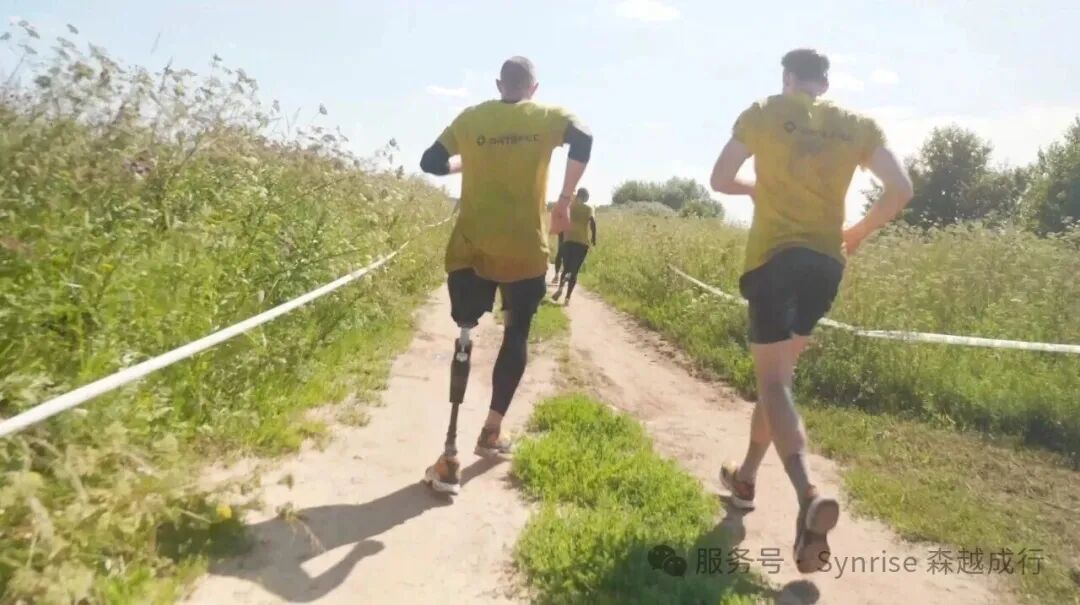
From Intelligent Assistive Devices to Human Augmentation
A Coherent Path of Expansion
With SynchroMind as its base, Synrise's product system is expanding along a continuous spectrum of populations.
The current core market is intelligent prosthetics. Starting from the S5, the company is extending toward active powered knees. China has approximately 24.12 million people with limb disabilities, including about 16 million with lower limb disabilities; the global intelligent prosthetics market is expanding at a compound annual growth rate of 15.9%, but penetration has long remained low due to price and product limitations. This is a track with clear demand, distinct willingness to pay, and a global high-end market long dominated by imported brands.
The first incremental market is active assistance. It targets walking assistance for elderly populations and daily assistance for those with declining motor function; with population aging, the relevant population has already reached hundreds of millions. The "understand intent and actively output power" capability validated by the active powered knee will enter this market in lighter, more affordable product forms, bringing active assistance from medical scenarios into daily life.
The larger space lies in consumer-grade human augmentation. This direction uses exoskeletons and performance-enhancement devices as vehicles, targeting healthy individuals' needs for athletic performance, exercise safety, and movement efficiency, with potential users also numbering in the hundreds of millions. As consumer wearable products continue to cultivate user awareness, this market is gradually maturing — human augmentation may truly enter the daily lives of ordinary people.
According to the company roadmap, Synrise will go through three stages: "product commercialization," "scalable replication," and "building product ecosystem." Human augmentation, in this context, means starting from compensating for functional deficits, and gradually providing extension and amplification of movement capabilities for all people — using the same human-understanding algorithmic capability to serve a continuous spectrum from those with motor dysfunction to mass consumers.
There are many ways for AI to enter the physical world. Synrise's chosen way is to have intelligent devices interact directly with human movement, understand the human body, and collaborate with people in real movement. The difficulty of this path lies in having to simultaneously confront the complexity of human movement and the rigor of hardware engineering, and accept validation through long-term real-world use.
The S5's mass production and orders have proven this path's feasibility; the active powered knee will advance this path to an entirely new stage of active assistance. Starting from this point, the company is extending its validated capabilities to more people and more scenarios along the path of "intelligent prosthetics — active assistance — consumer-grade human augmentation."
Let AI move from understanding the digital world, toward understanding the human body and its movement.
Move as Will.