Taiyi Liangsheng Closes New Funding Round to Accelerate Path to Large-Scale Fault-Tolerant Quantum Computing | Yunqi Partners

Building the Next-Generation Computing Industry Ecosystem
Quantum computing is moving beyond the competition over isolated physical benchmarks and into the next phase of systems engineering. In the eight months since its founding, Taiyi Liangsheng has already delivered three critical engineering milestones, while launching industry exploration in nuclear energy, energy and chemicals, new energy and materials, and biomedicine.
Taiyi Liangsheng is an early portfolio company of the Yunqi Capital–Shanghai Jiao Tong University AI Angel Fund. The company recently completed a new funding round. In this edition of "Yunqi Partners," we share the latest updates from Taiyi Liangsheng.
The following content is adapted from Taiyi Liangsheng.
On October 10, Taiyi Liangsheng (Shanghai) Quantum Technology Co., Ltd. (hereinafter referred to as "Taiyi Liangsheng") announced the completion of a new funding round.
This round brings together market-oriented professional investment institutions, state-backed platforms, and industrial capital: new investors include Jinqiu Fund, Cedarlake Capital, Hongruida Investment, Chengdu High-Tech Vision Fund, and Lingang Frontier Investment, while existing shareholders Huakong Fund, Hengxu Capital, BioTrack Capital, Gaomai Investment, and Yarui Capital continued to significantly oversubscribe. The participation of all three types of capital reflects firm conviction in the ytterbium (Yb) neutral-atom technical approach, the systems-engineering path, and the long-term value of next-generation computing.
The proceeds will primarily fund continued R&D investment and ecosystem development, including global scientific talent recruitment, deepening capabilities in quantum error correction and systems engineering, and industry collaboration and open-source ecosystem building — all to support the long-term development of large-scale fault-tolerant quantum computing.
Starting from the Fault-Tolerance Endgame
Building Differentiated Quantum Computing System Capabilities
The quantum computing industry has always faced a fundamental challenge: how to translate ever-growing physical qubit counts into logical computing power that is correctable, scalable, and actually usable for computation.
From day one, Taiyi Liangsheng chose a differentiated innovation path: using large-scale fault tolerance as the guiding objective for technology selection and system design. It has pursued an integrated layout spanning the physical substrate, system architecture, quantum error correction, real-time control, and software stack — with the ytterbium (Yb) atomic system at its core — to advance a general-purpose quantum computing platform oriented toward practical deployment and scaling.
Truly practical quantum computing requires not just scale, but the sustained ability to control errors, execute computation, and scale further as size increases. The transition from physical scale to large-scale fault tolerance is the critical stage quantum computing must cross to become practical.
Three Engineering Milestones
Connecting the Full Technical Chain for Large-Scale Fault Tolerance
Practical quantum computing requires coordination across the full machine, real-time control, and software systems: the full machine provides the physical substrate, real-time control handles measurement, feedback, and manipulation, and the compiler connects upper-layer algorithms to underlying hardware. Together these three form the critical technical chain from physical system to executed computation.
In just over eight months since its founding, Taiyi Liangsheng has achieved key engineering progress across all three layers.
Full machine prototype integration completed in six months. Neutral-atom quantum computing systems involve numerous complex modules: atom manipulation, vacuum systems, lasers, optics, measurement and control, real-time control, and software. Taiyi Liangsheng completed full prototype integration in just six months, moving discrete technical modules into a unified system with coordinated debugging — advancing R&D from single-point breakthroughs to systems engineering.
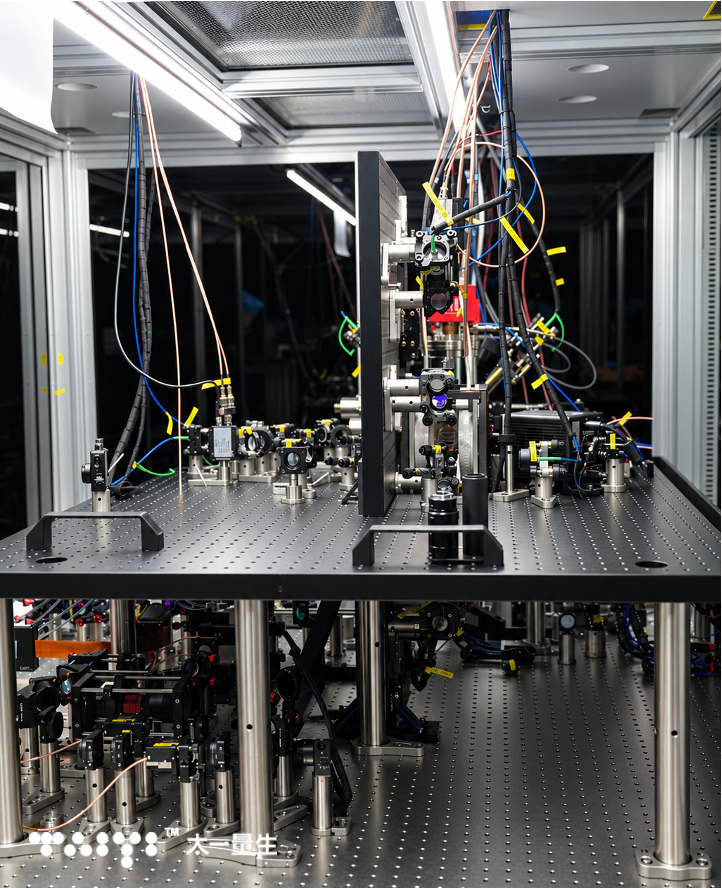
Taiyi Liangsheng first-generation prototype (core section)
Real-time control latency reaches 10-microsecond level. Taiyi Liangsheng has initially closed the loop from camera input through data processing to atom rearrangement, with real-time control latency reaching the 10-microsecond level — a world-class benchmark. This establishes critical engineering foundations for subsequent continuous loading, quantum manipulation, and automatic error correction.
Quantum compiler "LUOSHU" open-sourced globally. The compiler connects upper-layer algorithms to underlying physical hardware, translating computational tasks into low-level operations executable by the quantum system. Open-sourcing LUOSHU further lowers the barrier for developers, providing an open foundation for research in algorithms, compilation, and hardware-software co-design.
From physical substrate through real-time control to software stack, Taiyi Liangsheng is building a hardware-software co-design technical system oriented toward large-scale fault tolerance. "Fault-tolerant computing is not a breakthrough in any single technical metric, but a complete systems engineering effort," said Dr. Liu Hongbin, founder and CTO of Taiyi Liangsheng. "What we are truly trying to do is transform ever-expanding physical scale into system capabilities that are correctable, scalable, and computable."
"5+2" Industry Exploration:
From Real Industrial Problems to Next-Generation Computing Ecosystems
In parallel with systems engineering, Taiyi Liangsheng continues to expand the connections between quantum computing and real industries, as well as next-generation computing ecosystems.
To date, Taiyi Liangsheng has engaged in joint research, scenario exploration, technical validation, and POC collaboration with research institutions and industrial enterprises across five priority industry directions: nuclear energy, energy and chemicals, new energy and materials, biomedicine, and finance. It is also actively exploring frontier computing directions including Quantum × AI and complex optimization, while further connecting with next-generation computing ecosystems.
These collaborations are developing along two vectors: First, moving downward into real industrial problems. Around complex scientific computing, chemical and materials simulation, energy dispatch, and complex optimization, Taiyi Liangsheng is working to earlier identify which real industrial problems carry sufficient computational value and what algorithmic and system capabilities will be needed in the future. Second, connecting outward to next-generation computing ecosystems, exploring possible paths for QPUs to collaborate with AI, HPC, and cloud computing, and to enter real research and industrial workflows.
Starting from real industrial problems, Taiyi Liangsheng is exploring the path for quantum computing to enter next-generation computing systems.
Nearly 100 Global Research and Engineering Talents Assembled
Building an Interdisciplinary R&D System Oriented Toward Fault Tolerance
In a systems-engineering field like quantum computing, top talent is the strategic asset that determines generational technical advantage. Since its founding in January 2026, Taiyi Liangsheng has assembled nearly 100 global research and engineering talents, building an interdisciplinary R&D system covering quantum physics, system architecture, optics, control, software, and algorithms.
Core members come from top domestic and international universities including MIT, University of Cambridge, University of Pennsylvania, Ludwig Maximilian University of Munich, Tsinghua University, and Peking University; world-leading research institutions including JILA (Joint Institute for Laboratory Astrophysics) and the Centre for Quantum Technologies (CQT) in Singapore; and global technology leaders including Microsoft and Zurich Instruments.
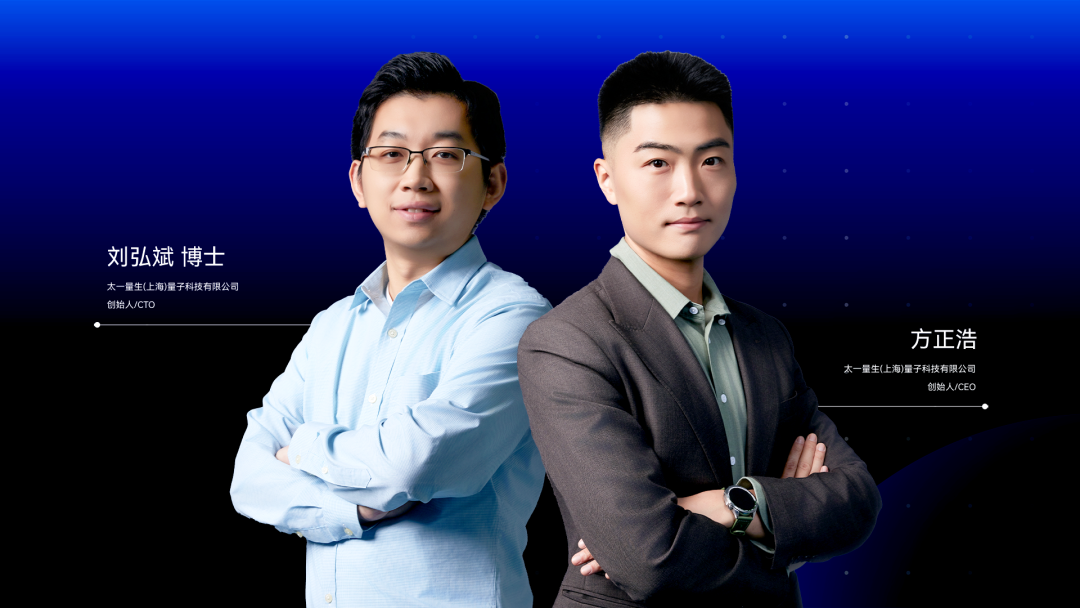
Taiyi Liangsheng Founder and CTO Liu Hongbin (left)
Taiyi Liangsheng Founder and CEO Fang Zhenghao (right)
More notably, Taiyi Liangsheng is developing direct appeal to world-class quantum technology talent. The team already includes foreign scientists and engineers who chose to come to China and join Taiyi Liangsheng; some of them received job offers from leading overseas neutral-atom quantum computing companies including QuEra and Oratomic, yet ultimately chose Taiyi Liangsheng. This means Chinese quantum technology companies are evolving from primarily attracting overseas Chinese to return, toward directly competing in the global talent market against international leaders. These research and engineering talents from diverse disciplines, countries, and industrial backgrounds collaborate around unified system objectives — and this is the foundation enabling Taiyi Liangsheng's rapid advancement across full machine integration, control, error correction, and software stack.
Gathering Global Innovation Forces
Accelerating Toward the Era of Fault-Tolerant Quantum Computing
The 15th Five-Year Plan incorporates quantum technology into forward-looking future industry planning, and the Ministry of Industry and Information Technology along with six other ministries has proposed advancing fault-tolerant general-purpose quantum computing development. As quantum computing moves from competition over isolated physical metrics to competition in systems engineering, building complete computing systems that are scalable and correctable is becoming the central proposition for the industry's next phase.
To date, Taiyi Liangsheng has established momentum with its "four-horse carriage" of talent density, engineering progress, capital velocity, and industry breadth advancing in coordination. "Quantum computing is a long-cycle systems engineering effort," said Fang Zhenghao, founder and CEO of Taiyi Liangsheng. "Capital must ultimately be converted into engineering capability, engineering capability is built on talent density, and technology must ultimately empower industry. Taiyi Liangsheng aims to organize talent, technology, capital, and industrial forces together to steadily advance toward fault-tolerant quantum computing — and to make the future of fault-tolerant computing happen in China."
From a single ytterbium atom to a complete system; from core technology R&D to real industrial problems — Taiyi Liangsheng will continue advancing systems engineering and industry exploration, accelerating toward large-scale fault tolerance.