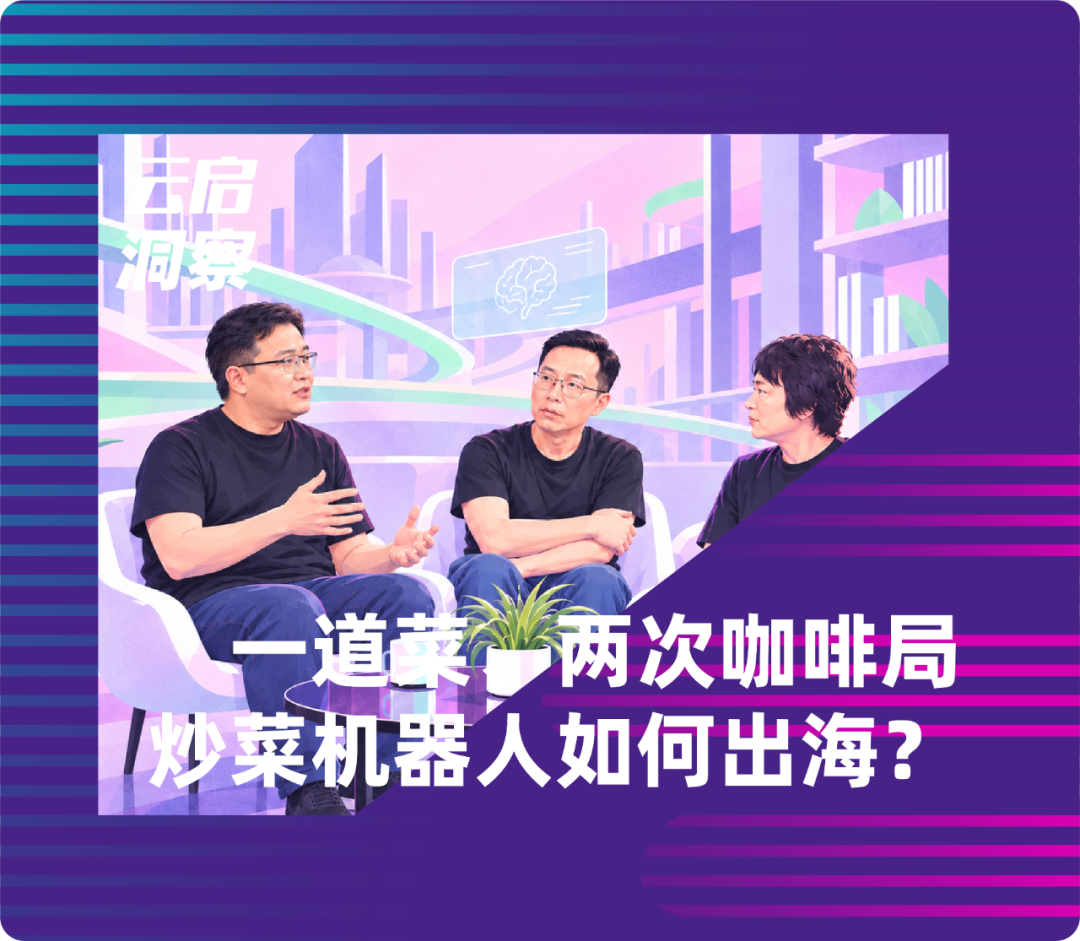
One Dish, Two Coffee Meetings: How a Stir-Fry Robot Goes Global|Finance Toutiao X Yu Chen X Qianyi Intelligence

Why Do Cooking Robots Have Trillion-Yuan Potential?
Cooking robots have gone from prototype to mass delivery in just two years. The real challenge in the next phase is turning "cooking a good dish" into a consistently profitable business model.
Recently, Kaiping Geng, CEO of Qianyi Intelligent (formerly T-Chef), an early Yunqi Capital portfolio company, sat down with Yu Chen, Managing Partner at Yunqi Capital, for a conversation with Caijing Toutiao. They started with how a single dish won over an investor — the meal that sparked their first deep conversation. They discussed the two coffee meetings that helped the company navigate the industry downturn of 2023–2024; where cooking robots go next as physical AI enters the picture; and what overseas expansion logic to follow as international markets become a second growth curve.
The following is adapted from the "Qianyi Intelligent" WeChat account
"Don't think about moving fast. Actually, going slow and not making mistakes is the most correct strategy right now."
— Yu Chen, Managing Partner at Yunqi Capital
This remark from Yu Chen left a strong impression on Dr. Kaiping Geng, CEO of Qianyi Intelligent (formerly T-Chef). In Geng's view, the company will first be a smart hardware company, and inevitably evolve into a "big data + supply chain" integrated solutions company. On the cooking robot track, using large models and multimodal technology to replicate a dish that hasn't been made before is precisely the important direction for intelligent development.
A Culinary Encounter
Getting Hands-On with Hard Tech
Rui Lihua:
How did you and Chen find each other, spark a connection, and finally get to the investment stage?
Kaiping Geng:
Our first meeting was at the end of 2021, before the Spring Festival.
Yu Chen:
We had an LP who knew we were systematically looking at the robotics track, and introduced me to Dr. Geng.
Kaiping Geng:
After talking about the product — we already had a prototype by then — I cooked a full meal for Chen.
Rui Lihua:
Was it his food, his wok hei, or Kaiping Geng himself that won you over?
Yu Chen:
I'm from Guangzhou, and as they say, "Eat in Guangzhou." Growing up in that atmosphere, I'm somewhat picky about food. When we evaluate robots, the most important standard is whether the food it cooks tastes good. At least from the dishes, I could tell that Qianyi Intelligent was genuinely committed to making a good product. That's why we decided to follow up.
Rui Lihua:
Dr. Geng, I feel like you saw yourself as "the chosen one" from the start.
Kaiping Geng:
"The chosen one" is an exaggeration. I think it's more about getting your hands dirty. If you don't immerse yourself in the field, without deep understanding of the kitchen, the restaurant business, cooking, the industry — in my words, without your feet touching water or hands touching oil — it's hard to do this well.
Just yesterday we were at a client's kitchen. I arrived at 11, left at 2, spending three hours moving around their kitchen. The client was the chairman of a very large listed company. He passed by, greeted me, and after chatting, privately told his executive VP: "For this company, let's give them all seven of our other factory campuses." Why? Because the boss was willing to get his hands dirty. That this company is reliable and professional is extremely important.
Two Coffee Meetings
Leading the Company Through Cycles
Rui Lihua:
I actually heard from our team about two coffee meetings between you and Chen that were quite moving.
Kaiping Geng:
After the 2022 Spring Festival, Shenzhen went into lockdown. We had thought that after restrictions lifted at year-end, 2023 and 2024 would bring an explosion in consumption, and opportunities for our industry. But it was colder than we imagined, and recovery was slower.
I remember very clearly, once Chen was going to Hong Kong and asked me to meet at the Starbucks on the first floor of Ping An Tower. I went over. Actually, on my way there, I felt a bit guilty — another year had passed without major progress. We talked about many things, and one very important thing he said was: "In this market environment, don't think about moving fast. Actually, going slow and not making mistakes is the most correct strategy right now."
Kaiping Geng:
The next time I saw him was at the end of 2024, at the Mandarin Oriental in UpperHills, late at night, another coffee meeting.
Yu Chen:
Right, we happened to be there for our annual meeting, our LP conference.
Kaiping Geng:
That time we talked very happily. Everyone agreed that you found the right team, the right direction, and even brought in a new partner. After our discussions through 2024, 2025 and 2026 will be years of multiplication for the company.
I'm especially grateful to Chen. One thing he said deeply moved me: "An outstanding tech company — its founder must be a lone brave who can cross cycles."
The Physical AI Era
Reconstructing Cooking Robots
Rui Lihua:
Jensen Huang was also talking last year about how physical AI could disrupt the entire model of supply chains and manufacturing in the future. So I'd like to ask, where does the advantage of cooking robots lie going forward?
Yu Chen:
Robots are basically like this. Things like MiniMax or Doubao belong to the purely digital world. But in reality, when you have to deal with people and physical objects, this kind of AI is what we call "physical AI" — cooking robots are a clear example. The second development direction is so-called "generalization": when your working environment is disturbed or changes, it can quickly adapt. This is also a topic for future research. The third direction is using large models combined with multimodal technology — I can take a picture of a dish, or a text description, and infer what raw materials the dish uses, what its cooking method probably is, and thus replicate a dish it hasn't encountered before. I think this is also a very important direction for future intelligent development.
Kaiping Geng:
First there's multimodal perception, then decision-making, then execution, then feedback iteration — this is a typical process. We now have a fairly good small model, though it still needs to evolve further. Eventually we perform feedback and control, and finally use big data for iterative learning and improvement. I think we'll definitely continue to do well in this direction.
Anchored by a Unique Overseas Logic
Rapidly Expanding the Global Map
Rui Lihua:
Once the direction is right, you need to accelerate the process. You just mentioned that it's actually a virtuous decision-making environment. So how do you view going overseas?
Kaiping Geng:
Going overseas is first of all important — it's company strategy. Early on we also asked ourselves: is overseas expansion simply about taking products validated in China, getting them certified, and shipping them abroad? So I conducted in-depth investigations of all major overseas markets. Overseas markets are actually different from China. To do well going overseas, you need deep insight into foreign markets; you have to truly understand their needs.
Yu Chen:
Right. Overseas markets: first, demand is equally huge; second, margins are relatively a bit higher.
But the challenge is that eating habits differ by region, and kitchen conditions differ too. For example, in places like Japan and Singapore, space is tight, so your machines need to be miniaturized; while in the United States, there may be other different needs. So this is also a direction we can see for the company's future development.
Kaiping Geng:
Chen knows our style well: if we don't strike, we don't strike; if we strike, we must understand everything completely and hit with one blow. Once you figure it out, product definition comes first. Our current main strategies:
First, follow Chinese manufacturing and Chinese infrastructure going overseas. I think we've basically made this path work;
Second, follow Chinese restaurant brands going overseas. This is essentially a cultural export question — how to bring Chinese cuisine, Chinese delicious food from domestic to overseas. Overseas Chinese and华侨, what we call Chinese restaurants, have long been a rigid "pain point."
This year I discovered a new change: some shops purely doing Turkish food, Middle Eastern food, Russian food — all foreigners, not Chinese — using it to make local cuisine. This market is bigger than we imagined.
Braving the Deep Waters
The Scaling Battle for Cooking Robots
Rui Lihua:
Cooking robots are already doing well, they're being noticed. Is this the underlying logic?
Yu Chen:
Right, I think they chose this path, and at least the business model has been proven to work on a small scale. So next, whether it's brand upgrading or organizational structure upgrading, it's actually preparation for fighting a hard battle in the next two to three years. For example, as everyone knows, new embodied intelligence and new technologies are emerging — will they disrupt the existing market? As a tech company, should we also embrace new technologies? At different stages, the company will have different topics to research and solve.
Rui Lihua:
The other day I was talking with Dr. Geng — from raw to cooked, that stage is no problem; from cooked to delicious, at this stage, how critical a role does our technology play in the product?
Kaiping Geng:
I think we've actually passed that stage. The questions we're now exploring: first, strategically we must embrace new technology, meet new challenges, set the company's strategy high and look far. Second, for the present, as Chen just said, in the next two to three years we still need to fight a scale battle, a brand battle, a service battle. In this process, technology is always in service of the product, and the product is always user-oriented, always in service of scenarios and customer value. In the commercialization process, you'll find that the restaurant business actually divides into many细分场景, such as simple meals, fast food, takeout, formal dining. So what battle are we fighting now? A battle of refined operations and management — what we call entering the deep waters — the battle of the back-kitchen revolution.
In this process, I think we've now thought quite clearly about product and technology: first, for different细分场景, we need to build our product matrix, because different product matrices correspond to different细分 markets; in supporting the product matrix to meet customer needs and solve customer pain points, product definition must first be done well. Second, on the technology side, our product actually has several characteristics: hardware, software, AI recipes — what we call community ecology — it's a strongly coupled whole.
So technology must first ensure the consistency and stability of the product's entire use at the customer site — this is extremely important. As a productivity tool, it must be stable. Safety and stability are ranked first; if you can't achieve safety and stability, then don't even talk about it.
Rui Lihua:
So I feel this is a founder who is very confident in his product, believing it's rugged, durable, and safe, giving everyone great confidence in wanting to use this cooking robot in the future.
Kaiping Geng:
For the company's future: first it's a smart hardware company; later it's an integrated solutions company that solves customer stickiness and customer efficiency; further on, I think we'll definitely be a data and intelligence-driven "big data company + supply chain" integrated solutions company. With this, we can penetrate from large B to small B, and from small B possibly to C.
Rui Lihua:
When I interviewed Kaiping Geng before, he said they've been doing a comprehensive upgrade in strategy and branding, changing from T-Chef to Qianyi Intelligent.
Kaiping Geng:
The core represents a strategic upgrade for the company. "Qian" means many; "Yi" is the yi from博弈 (game/strategy), representing big data — many is big data, yi is machine learning. I think it represents that in the future, even if we're rooted in kitchens and rooted in the restaurant business, we're embracing AI, embracing robotics, embracing new technology, letting a traditional industry, supported by technology, welcome new development, new models, new scenarios.