Yunqi Capital Backs Honghu Future Energy to Build Global Stellarator Hub with Shanghai Jiao Tong University | Yunqi Partners

Stellarators Are Entering a Window Worth Accelerating Investment In
Magnetic confinement fusion has two mainstream approaches: tokamaks have taken the lead, while stellarators trade higher engineering barriers for inherently steady-state operation and lower disruption risk. With simultaneous advances in high-temperature superconductors, computational design, and advanced manufacturing, stellarators are moving from "theoretically superior but harder to build" into a window where accelerated investment makes sense.
Honghu Future Energy has chosen the high-barrier path of high-temperature superconducting stellarators, embedding AI and advanced manufacturing into its core R&D workflow. It has partnered with Shanghai Jiao Tong University to establish a Future Energy Research Institute and a joint laboratory, and recently completed a financing round of several hundred million yuan, with participation from the Yunqi-SJTU AI Angel Fund and others.
In this edition of "Yunqi Partners," we explore Honghu Future Energy. We continue to track the intersection of AI and frontier engineering, and the further breakthroughs in energy limits that nuclear fusion may bring.

Yunqi Capital's Perspective:
We have long been bullish on controlled nuclear fusion as a next-generation energy technology. As high-temperature superconductors, computational design, and advanced manufacturing continue to advance, fusion is moving beyond scientific feasibility validation toward a competition in engineering and systems capability. Honghu has chosen the high-barrier route of high-temperature superconducting stellarators, integrating AI optimization, digital twins, and advanced manufacturing into device R&D. We value the team's potential to build systematic capabilities across fusion physics, computation, and engineering, and expect Honghu to validate its technical path through key devices and engineering milestones, pushing stellarators toward practical application.

Recently, Shanghai-based Honghu Future Energy completed a financing round of several hundred million yuan, with participation from Yunqi Capital, Shanghai Future Industry Fund, Social Security Fund Zhongguancun Independent Innovation Special Fund (managed by Legend Capital), Luminous Ventures, SJTU Endowment Fund, Shanghai Fortera Capital, Shanghai Minjin Investment, Yaotu Capital, and other institutions. Early investor Dr. Lizhong Dai also continued to increase his stake. The proceeds will fund R&D and construction of the Honghu Zhiyuan-1 high-temperature superconducting stellarator, team expansion, and general operations.
This unified endorsement from national and local strategic industry funds, top global university resources, and market-driven investors validates the completeness and leadership of the Honghu team. It also sends a clear signal to the market: stellarator development is entering a critical inflection point in China, not just in the United States and Europe.
Stellarators: A Long-Frustrating, High-Performance Path, Now Uniquely Positioned to Benefit from AI-Driven Engineering Acceleration
As AI-era compute demand explodes, stable and sustainable energy supply has become a new variable in international competition. As the fusion industry transitions from experimental validation to engineering commercialization, "system reliability, maintenance accessibility, and continuous power generation capability" have become hard metrics determining the ultimate economics of future commercial plants. Stellarators have long attracted high expectations from European and American academia and industry for their unique advantages in inherently steady-state continuous power generation, high energy efficiency, and immunity to major disruptions.
But for just as long, these advantages have come with higher design and engineering barriers — the three-dimensionally complex magnetic fields impose extreme demands on high-performance configuration design, superconducting coil manufacturing, and overall assembly precision. This complexity has historically limited stellarator R&D efficiency and commercial attention.
Today, as a "latecomer," the stellarator has reached a major technological inflection point.
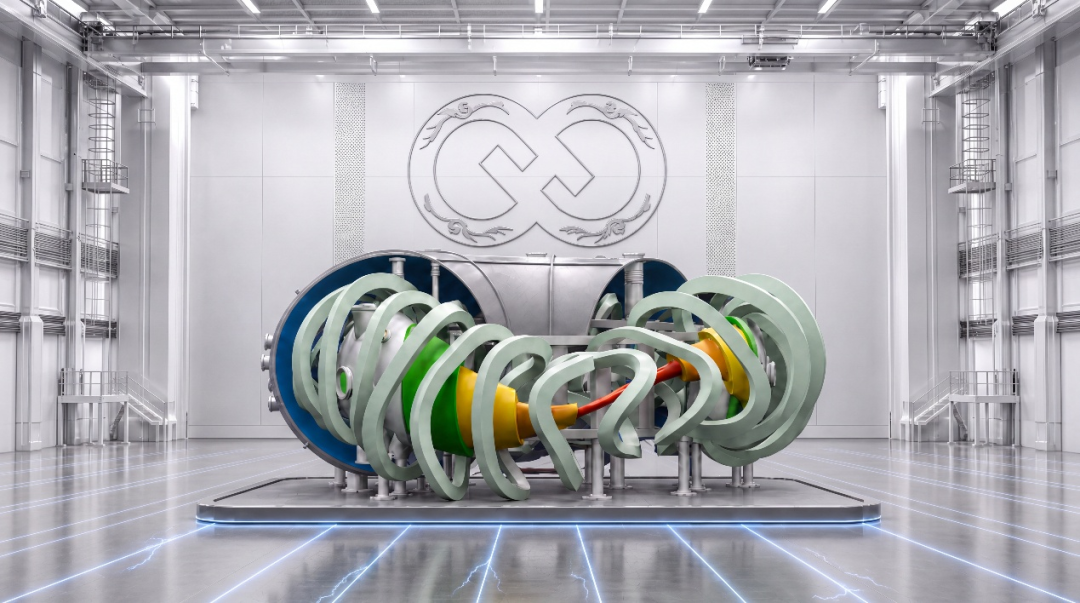
In 2025, Germany's W7-X stellarator achieved 43 seconds of high-performance plasma discharge, raising the "triple product" to levels comparable to much larger tokamaks — delivering quantifiable, benchmarked validation of advanced stellarator advantages. With continued optimization of magnetic configurations, stellarator confinement performance still has significant room for improvement. In 2026, Proxima Fusion, the company behind W7-X, secured €411 million in investment from Google, RWE (the German energy giant), and others, while American companies Thea Energy and Type One Energy each raised approximately $100 million.
Stellarators now have a clear path for triple-product improvement, requiring brick-by-brick technical breakthroughs — including high-temperature superconducting magnets, precision manufacturing, high-performance computing, and AI-assisted design. How to integrate these multidisciplinary advances into engineering capability is a central challenge for every nation pushing fusion forward.
Honghu — Assembling Global Cross-Disciplinary Talent, Led by Top Scientists, to Bring Stellarators to Reality
The high degree of synergy among AI, design, materials, and engineering implementation demands cross-disciplinary teams that can methodically execute engineering validation and delivery, not merely showcase individual technical points. Honghu was founded precisely for this window: leveraging a top-tier team and SJTU's platform to accumulate technology, and using market-oriented, globalized, and hybrid mechanisms and talent to accelerate engineering progress.
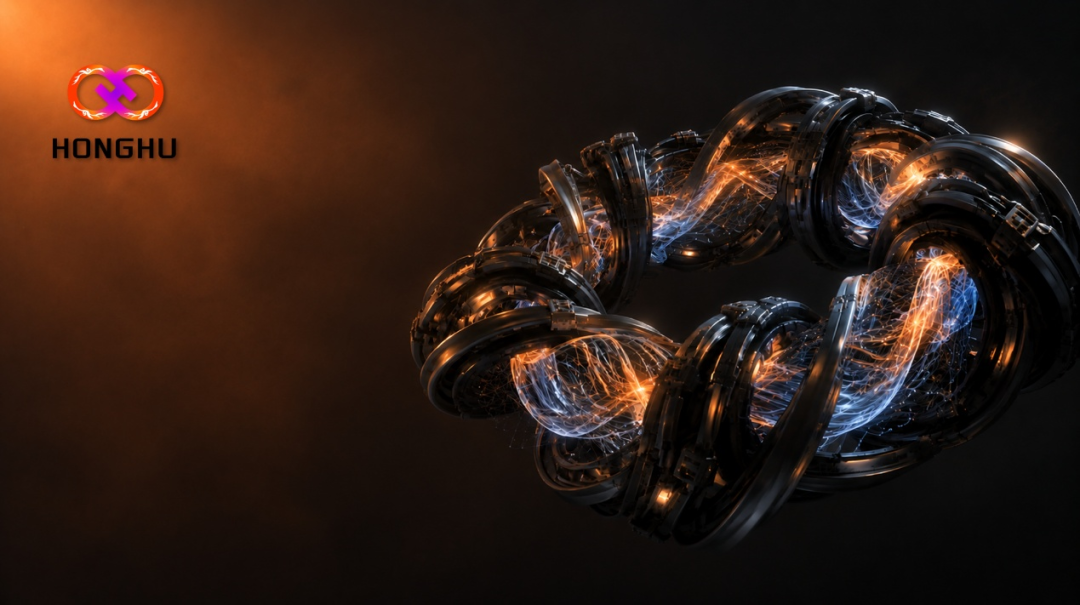
Specifically, Honghu focuses on three critical links: magnetic configuration design optimization, 3D high-temperature superconducting magnet R&D, and advanced device integration. Through Honghu Zhiyuan-1, it aims to close the loop from design to critical components to full-device validation, striving to produce stellarator engineering achievements that represent China's advanced level and are internationally competitive.
Decades of foundational work building the stellarator's solid base: As early as the 1990s, the company's core team was the first in the world to reveal the important physical mechanism of zonal-flow-modulated turbulent transport, sparking a two-decade global research wave of experimental zonal-flow observation. The first-principles simulation program developed through years of team accumulation remains a flagship simulation tool in international magnetic confinement fusion research and one of the field's critical cornerstones globally.
Recruiting global scholars from top universities, accelerating breakthroughs through university-industry collaboration, building a world stellarator hub in Shanghai: Advanced optimized stellarators are complex systems engineering projects requiring deep multidisciplinary integration, with extremely high demands for scientific originality and engineering execution capability. To this end, Honghu and Shanghai Jiao Tong University have combined strengths around device engineering, led by internationally top-tier teams, to establish a university-level Future Energy Research Institute and co-build the "SJTU-Honghu" Joint Laboratory, collaborating to tackle the Honghu Zhiyuan-1 optimized stellarator. The joint laboratory integrates SJTU's strengths in science, engineering, and AI into a single R&D chain, opening a full-spectrum innovation channel covering "basic research — key technologies — engineering application." It also combines university-origin innovation, government policy support, and commercial capital, assembling top domestic and international teams around device milestones to accelerate key technologies into engineering validation.
The joint laboratory has already assembled a globally rare, fully constituted stellarator R&D team, spanning the complete chain from high-performance numerical simulation, device physics design, high-temperature superconducting magnet development, to engineering systems integration. The team has completed Generation I stellarator magnetic configuration optimization and superconducting coil design, and in partnership with Yixi Technology has pioneered the manufacturing and performance testing of 1:1 double-pancake coils. Core capabilities have advanced from front-end design to critical component validation, laying a solid technical foundation for the device to enter full engineering construction.
Going forward, Honghu Future Energy will remain anchored by top fusion teams as its technical core, use university platforms to assemble research resources, and employ market-oriented mechanisms to drive commercial fusion innovation:
-
By 2028, the company will partner with Shanghai Jiao Tong University to advance the world's first batch of high-temperature superconducting stellarator experimental devices — Honghu Zhiyuan-1 — using device progress to continuously validate design and engineering capabilities, with planned completion in 2028;
-
In the 2030s, the company plans to complete validation of its Generation III demonstration reactor, achieving power generation demonstration capability and validating plant-level operations, maintenance, and economic models, providing the final blueprint for future commercial fusion plant design.