Yunqi Capital co-invests in Suoge AI's angel round to accelerate AI-driven new materials commercialization | Yunqi Partners

Already partnered with leading companies in solid-state batteries and chemicals.

Material simulations that once required national supercomputing centers now run efficiently on clusters of just a dozen or so general-purpose GPUs — thanks to SogSci Computing's original stochastic batching algorithm, which has reduced the computational complexity of many-body simulations from quadratic to linear. Founded by Zhenli Xu, a distinguished professor at Shanghai Jiao Tong University's School of Mathematical Sciences and recipient of the National Science Fund for Distinguished Young Scholars, the company has already partnered with leading enterprises in solid-state batteries and chemicals. Today it announced the completion of its angel round, with investment from the Yunqi-SJTU AI Angel Fund.
In this edition of "Yunqi Partners," we explore SogSci Computing's work in AI for Materials — a key direction in AI for Science that we've been tracking closely.

Yunqi Capital's Investment Thesis:
AI for Materials is a critical direction within AI for Science that we continue to watch closely. SogSci Computing is reconstructing the paradigm of materials R&D through original algorithms. Led by Professor Zhenli Xu, its interdisciplinary team has co-established an AI New Materials Research Center with Shanghai Jiao Tong University and already embedded its technology into the R&D systems of leading battery manufacturers. We look forward to the company continuing to translate its original algorithms into industrially reusable R&D tools, enabling AI for Materials to make the crucial leap from laboratory breakthroughs to production-line deployment.

The following is adapted from Hard Kr
By Ou Xue, edited by Silai Yuan
SogSci Computing (Shanghai) Technology Co., Ltd. [hereinafter "SogSci Computing"], an AI for Materials company, recently completed an angel round of tens of millions of RMB. The round was led by Fosun Capital, with participation from Nantong Industrial Holdings Siyuan AI Pioneer Fund, Yunqi Capital, and Zhongying Ventures, as well as follow-on investment from existing shareholders including Zizhu Sci-Tech Investment. The funds will be used primarily for continued R&D and iteration of automated new materials pipelines, laboratory construction, team expansion, and industrial talent recruitment — all aimed at advancing domestic self-sufficiency in high-end materials.
Founded in 2025, SogSci Computing is a deep tech company focused on driving new materials R&D through original AI computing engines and integrated technologies. Addressing critical challenges in materials design under national strategic priorities, the company combines materials atomic foundation models, high-performance simulation, and wet-dry experimental closed loops to bridge cross-scale R&D pathways and advance breakthroughs in core technology localization and key materials self-sufficiency.
Founder and Chief Scientist Zhenli Xu is a distinguished professor at Shanghai Jiao Tong University and director of its AI New Materials Research Center, as well as a recipient of the National Science Fund for Distinguished Young Scholars. The core team brings together expertise in mathematics, artificial intelligence, and materials science. The company has assembled an R&D team of over 30 people, organized into four research centers: AI algorithms, applied technology, intelligent agents, and quantum computing. Its advisory network spans AI algorithms, materials R&D, and industrial resources, forming a dual-engine architecture of "fundamental research + industrial deployment."
Why does new materials R&D need AI?
According to Hard Kr, traditional materials R&D relies on trial-and-error methods. Taking a new material from laboratory discovery to commercialization typically takes decades, with high costs and opaque mechanisms. As industries like new energy and fine chemicals accelerate toward higher generations, existing materials supply increasingly fails to match escalating demands for next-generation high-performance materials, leaving clear gaps in self-sufficiency for critical materials.
But using AI to accelerate materials R&D has its own challenges. Interatomic interactions are easy to calculate at short range, difficult at long range. Traditional AI models rely on "message passing" layer by layer — slow, expensive, and often ineffective when switching to different materials. SogSci Computing's breakthrough addresses this problem at the algorithmic foundation.
The company's technical system centers on three original algorithms:
SOGNet, solving the "calculate accurately" problem. While traditional models can only see nearby interactions, SOGNet learns long-range atomic correlations directly in Fourier space, adaptively learning decay characteristics at different distances. Related research was published in Phys. Rev. Lett. (2025) and selected for Editors' Suggestion.
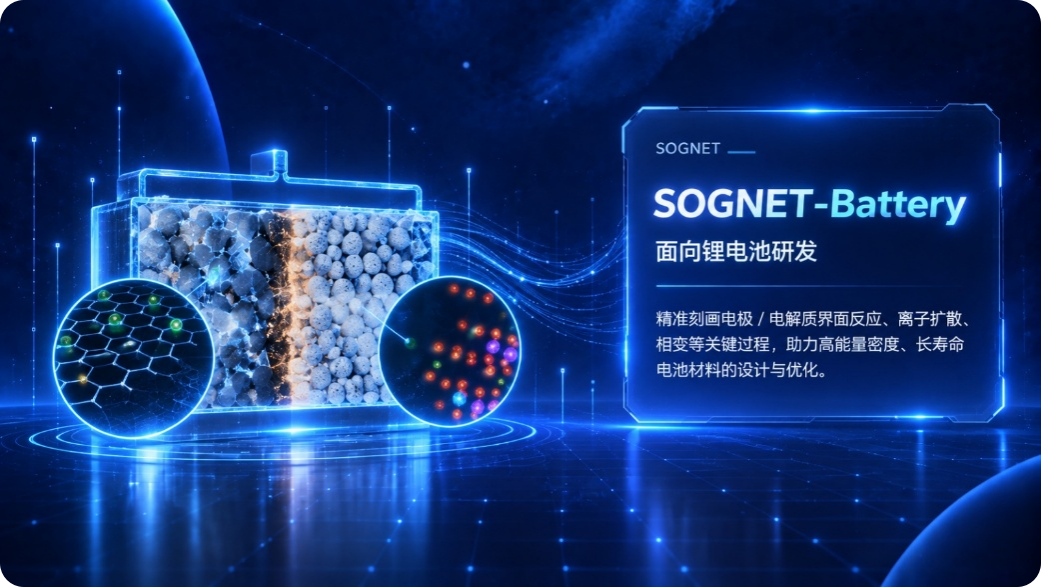
Materials atomic foundation model built on SOGNet (Image source: Company)
Stochastic batching algorithm, solving the "calculate fast" problem. While traditional algorithms achieve only 20%-30% efficiency with 10,000-core parallelization, the stochastic batching algorithm reaches over 95%, improving computational speed by tens to hundreds of times and making large-scale materials simulation practical. This work received the First Prize of Shanghai Natural Science Award.

New materials dedicated simulator NanoTitan Ultra (Image source: Company)
R2D multi-field coupling model, solving the "calculate realistically" problem. Traditional electrochemical modeling relies on homogenization assumptions; the R2D model breaks through this framework to precisely capture multi-physics coupled evolution during battery charge-discharge cycles — including ion transport, interfacial reactions, stress evolution, and failure mechanisms.
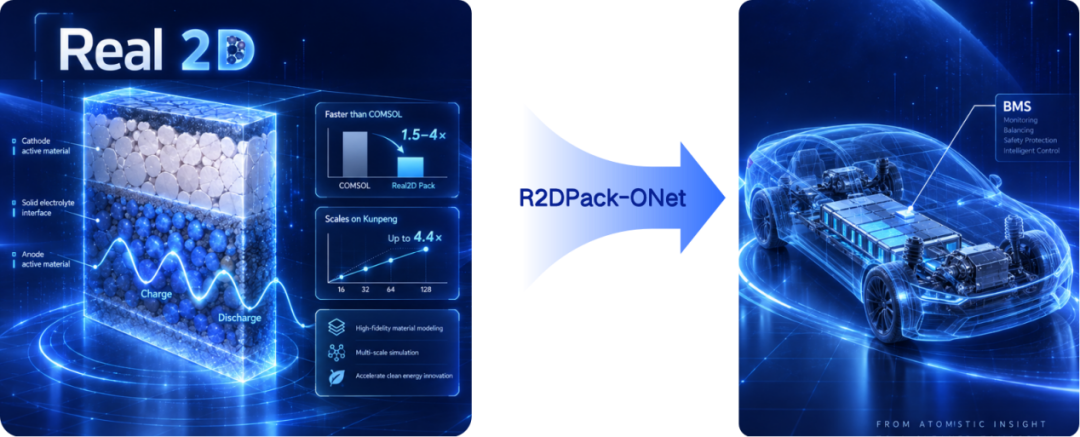
Next-generation battery automated simulation software
R2DPack and AI surrogate model R2DPack-ONet (Image source: Company)
Based on these algorithms, SogSci Computing has developed a proprietary product matrix that spans the full chain of materials design, computational validation, industrial simulation, and independent R&D: the SOGNet atomic foundation model for vertical domains such as lithium batteries and polymers; the high-performance simulator NanoTitan; the materials-device simulation platform R2DPack; and the autonomous R&D intelligent agent SOG Omni.

SOG Omni materials R&D autonomous intelligent agent (Image source: Company)
Among these, the lithium battery materials domain model SOGNET-Battery is the core product for the lithium battery sector. Lithium battery materials involve complex processes including ion migration, interfacial evolution, and coating stability that traditional models struggle to address with both accuracy and efficiency. SOGNET-Battery's approach: train the model with professionally curated and autonomously generated lithium battery data, enabling it to "see accurately at short range, see clearly at long range, and remain fast at scale."
In measured performance across six categories of lithium battery materials, SOGNET-Battery achieves higher accuracy than general-purpose potential models with larger parameter counts, despite its smaller parameter scale. More critically, its transfer capability: with only small amounts of fine-tuning data on new systems, it adapts rapidly. For the Li-Li₆PS₅Cl system, for example, fine-tuning on just 359 configurations reduced atomic force error by approximately 68% and energy error by approximately 83%. In inference speed, SOGNET-Battery exceeds general models by over 80%, processing more atomic configurations with the same compute.
The company has already consolidated these core technologies and products into reusable automated materials design pipelines with continuous iteration capability. In the cell design process for a solid-state battery enterprise, the team used R2DPack to conduct cell-level multi-physics simulations, coupling material parameters, interfacial properties, and cell structure to enable rapid performance prediction and design optimization — significantly reducing reliance on repeated experimental validation in traditional cell design, accelerating solid-state battery cell R&D iteration. For in-vehicle real-time computing requirements, it achieves millisecond-level response under equivalent compute conditions on mainstream automotive chips, laying groundwork for lightweight deployment and real-time prediction on hundred-thousand-unit-scale new energy vehicle mainstream automotive chips.
For a listed chemical enterprise's intelligent discovery and rapid screening of polymer materials, the team used SOG Omni to recommend candidate formulations meeting the company's needs, followed by precise prediction and screening through multi-scale computing engines; results have already entered wet experimental validation.
Additionally, SogSci Computing has begun deploying in new materials design for major national strategic needs, including rare-earth permanent magnets and radiation shielding materials. It is co-building AI R&D and application systems with leading enterprises and research institutes to support self-sufficiency in critical strategic materials.
Looking ahead, SogSci Computing aims to achieve breakthroughs in high-value new materials design capabilities through self-sufficient product technologies. On the product front, the company plans to build full-process simulation automation platforms for lithium batteries and chemical polymers — starting from intelligent agents, using AI to recommend materials, then conducting large-scale computation, simulation, and screening, and finally device-level simulation to complete the full workflow. It will also launch automated computational screening platforms for polymers, chemicals, and other domains.
The following is an edited excerpt of Hard Kr's conversation with founder and Chief Scientist Zhenli Xu:
Hard Kr:
What is SogSci Computing's core technical moat?
Zhenli Xu:
Our core moat is original algorithms. SOGNet solves the bottleneck of long-range interaction potential functions, the stochastic batching algorithm breaks through scalability bottlenecks in microscale computing, and the R2D multi-field coupling model enables high-fidelity computation.
These three algorithms are not simple engineering optimizations but original breakthroughs from foundational mathematics. Based on them, SogSci Computing has built a complete closed loop of data — model — simulation — experiment.
Hard Kr:
Competition in the AI for Materials track is intensifying. How does SogSci Computing respond?
Zhenli Xu:
Materials science has many sub-directions and different technical routes, so there are abundant commercial opportunities. Our advantage lies in algorithmic efficiency and accuracy. Going forward, everyone will be competing on compute utilization — with the same compute investment, higher algorithmic efficiency and accuracy mean stronger predictive capability.
Additionally, we provide hardware-software integrated products that further exploit synergistic acceleration between algorithms and hardware, while fully accommodating materials enterprises' needs for on-premise deployment. We're also building pipelines: starting from intelligent agents, using generative AI to recommend materials, then conducting large-scale computation, simulation, and screening, and finally device-level simulation — completing the full automated workflow.
Hard Kr:
What is the company's future commercialization path?
Zhenli Xu:
We operate on two levels. First, using joint R&D at the proof-of-concept stage as a starting point for collaboration, we aim to establish technical feasibility first in high-value materials directions before deepening deployment. Second, we will deepen strategic partnerships, anchoring on high-value critical materials tracks with focused deployment in photoresists, semiconductor packaging adhesive materials, and other segments — advancing deeply into new materials molecular design, formulation development, and production-line deployment.