Yunqi Capital Co-Leads Investment in Lightelligence, Optical Computing Chips Already Taped Out | Yunqi Partners

Let computation meet its next beam of light.
At present, multiple optical computing technology paths are advancing in parallel domestically, yet few products are commercially available. Most can only run small-scale specialized tasks, and switching tasks requires redesigning the architecture. The real watershed moment lies in engineering: whoever can deliver optical chips stably and at scale into customer environments.
"Luminary Photonics" has chosen a reconfigurable all-optical computing architecture, integrating interference, diffraction, and Chiplet into a single framework while simultaneously advancing "optical-transmission optical-computing" — allowing communication light to directly participate in computation, reducing critical optoelectronic conversions. Since its founding six months ago, the company has completed five consecutive seed funding rounds totaling several hundred million yuan, with participation from the Yunqi-SJTU AI Angel Fund. Chips for both its Zhulong and Xuanjian product lines have already been taped out, with deployable products planned within six months.
In this "Yunqi Partners" feature, we take a closer look at Luminary Photonics. We continue to track the foundational shifts happening in AI computing infrastructure.

Yunqi Capital's Investment Thesis:
We have long been bullish that optical computing could bring breakthroughs to AI computing infrastructure. The Luminary Photonics team has deep expertise in reconfigurable all-optical computing architecture, combined with industrial experience spanning chip R&D to large-scale customer delivery. We are optimistic about Luminary Photonics's long-term potential in optical computing and look forward to the team driving next-generation AI computing architecture toward scaled deployment in real-world scenarios.

Recently, optical computing chip company Luminary Photonics completed a seed funding round of several hundred million yuan. Since its establishment, the company has completed five consecutive seed rounds, with investors including Haitong International Innovation Center, Yunqi Capital, Guotai Haitong Securities, K2VC, Atomic VC, Tongxin Capital, and Shanghai Jiao Tong University AI Future Fund. The proceeds will primarily fund core chip R&D and tape-out iterations, senior talent recruitment and team building, and application scenario expansion and ecosystem partnerships.
Luminary Photonics was founded in May 2026, focusing on reconfigurable all-optical computing architecture and photonic processor development. Leveraging the parallel computing properties of light to directly participate in AI computation, it bypasses the bottlenecks of traditional electronic chips in process scaling, power consumption, and thermal management, pushing optical computing from specialized acceleration toward more general-purpose computing platforms.
Currently, Luminary Photonics has assembled an R&D team of nearly 50 people, with core members having long-term expertise in optical computing and chip design, having collectively completed the design, tape-out, and verification of dozens of optical chips, and published nearly 20 papers in Nature/Science and their subsidiary journals. Founder Yuan Cheng is an associate professor at Shanghai Jiao Tong University's School of Artificial Intelligence, with extensive research in photonic chips and edge intelligence. He previously served as co-founder and CTO of Simir Technology, where he led the development of the full-stack product system.
On the product front, Luminary Photonics is developing two product lines: server-side optoelectronic acceleration boards and edge-side optical computing chips. First-version chips for both products have already been sent for tape-out, with deployable products planned for rollout within the next six months.
Currently, AI computing competition is shifting from pure peak performance pursuit to how much effective intelligent output each kilowatt-hour can support. As AI evolves from single-turn Q&A to agent-based continuous reasoning, tool invocation, and task execution, token consumption is growing rapidly, and cost, power supply, and cooling are becoming real constraints on computing expansion.
Traditional electronic chips are approaching the upper limits of Moore's Law, and process scaling alone can barely keep pace with demand growth. Optical computing's approach is to map matrix operations onto light's interference and diffraction processes, using light propagation itself to complete massive parallel multiply-accumulate operations.
Cheng said that AI needs a truly low-power, process-node-agnostic, engineering-viable computing substrate, and optical computing has inherent advantages in parallelism, latency, and energy efficiency.
The optical computing industry is currently in the early stages of engineering deployment. Multiple technology paths are advancing in parallel domestically, with few commercially available products, most of which are small-scale specialized computing that cannot support real large-scale tasks or switch between tasks.
"General-purpose optical computing is the industry trend, but it requires coordinated advancement in architecture, devices, process, packaging and testing, and software systems," Cheng said.
Specifically, Luminary Photonics's technical approach is a reconfigurable all-optical computing architecture. Through spatiotemporal reconfigurability, it achieves flexible adaptation to different models and computing tasks; it fuses the technical advantages of interference computing and diffraction computing, using Chiplet to modularize interference and diffraction within a single architecture, cascading multiple optical computing cores on a single chip to expand computing scale while balancing precision and flexibility. Additionally, the company is simultaneously advancing "optical-transmission optical-computing" and all-optical nonlinear technology, reducing optoelectronic conversions in critical computing stages, and improving computing precision and chip consistency through hardware-software co-calibration.
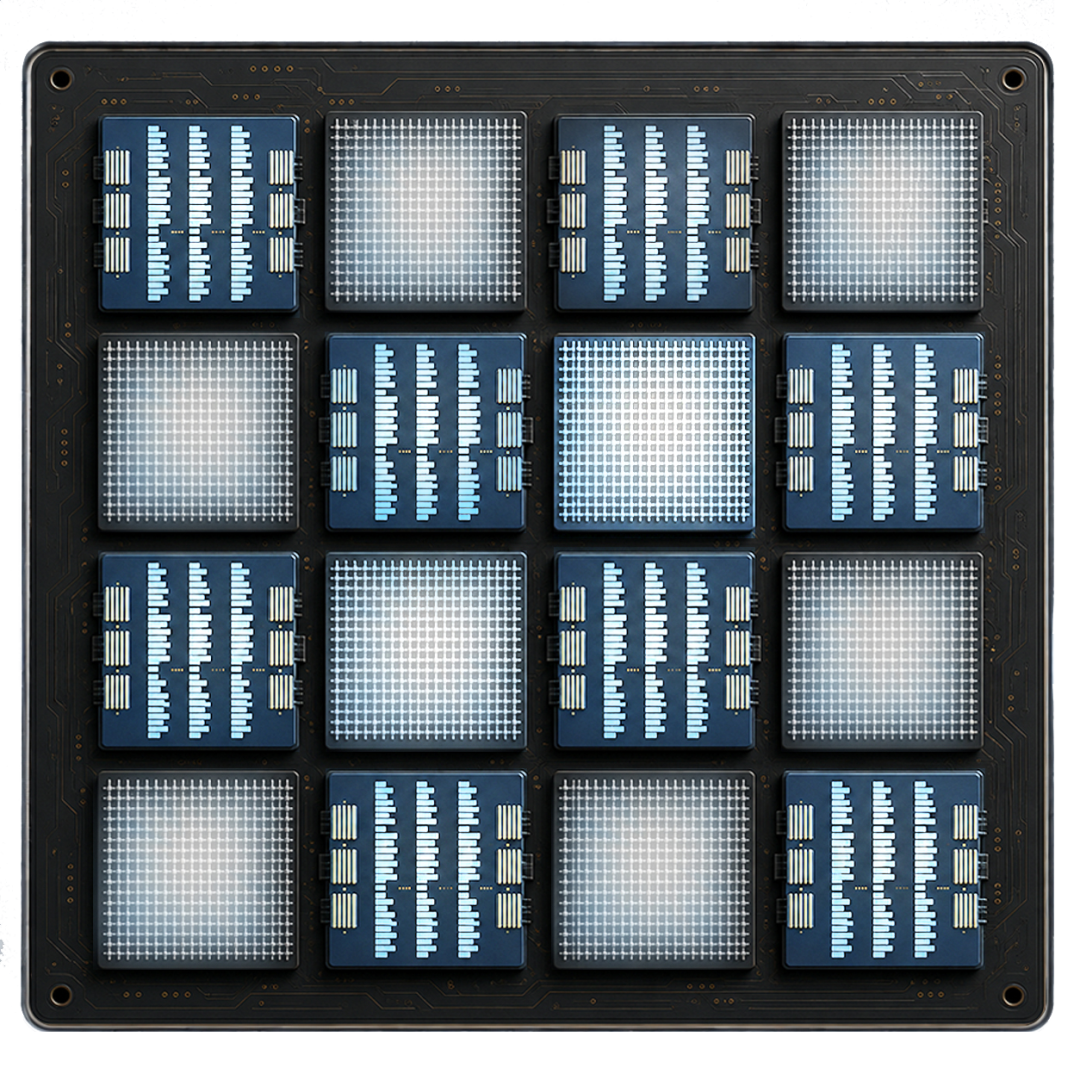
Reconfigurable: Interference × Diffraction × Chiplet (Source/Company)
"Reconfigurable" determines how many tasks optical computing can adapt to. Luminary Photonics designs spatiotemporal reconfigurable architecture from the chip level, modulating computing relationships in space and time. When tasks change, it adapts by reconfiguring optical paths or adjusting scheduling algorithms, rather than redesigning chips for each application. "All-optical" points to energy efficiency: letting communication light directly participate in computation, keeping critical nonlinear operations in the optical domain, and driving optoelectronic conversions in the computing chain toward zero.
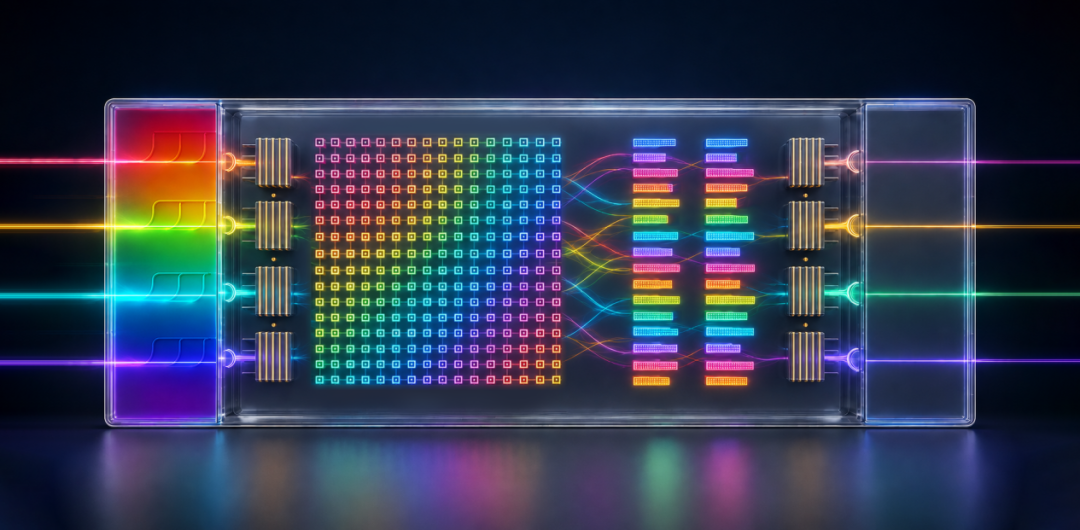
All-Optical: Optical-Transmission Optical-Computing × Nonlinearity (Source/Company)
At the product level, Zhulong OPU-08 targets server computing acceleration, adopting a PCIe optoelectronic acceleration board form factor, focusing on large-scale matrix operations in AI inference, with specs of 256×256 computing cores and 150 TOPS compute, connectable to existing servers to provide "photonic tokens" for large model cloud deployment. Xuanjian TOCU-07 targets edge-side low-power intelligent devices, with specs of 128×128 computing cores and 100 TOPS compute. Beyond optoelectronic computing, it can also collect weak ambient natural light for direct computation, eliminating optoelectronic encoding on that input path.
Cheng said that Zhulong is consistent with current mainstream server optoelectronic acceleration board form factors, with highlights in more general-purpose matrix acceleration and model deployment capabilities; Xuanjian targets edge-side low-power scenarios where comparable products are still rare. The longer-term goal is a training-inference unified general-purpose photonic GPGPU, with a first version expected by end of 2027 or early 2028.
Server Optoelectronic Acceleration Board Zhulong OPU-08 (Company/Source)
On the engineering front, optical computing faces consistency challenges from device variation, noise, and temperature drift. Luminary Photonics addresses this through hardware-software compensation modules, incorporating automated nanosecond-level calibration modules in optical chips. The company claims it can reduce matrix operation error to 10^-6 levels, improving precision consistency across batch production. The company is currently working with domestic foundry and packaging/testing partners to advance volume production, though product performance still requires verification after chip return.
Per the company's roadmap, near-term priorities include completing packaging and testing for Zhulong and Xuanjian, board-level integration and tuning, model adaptation, and customer validation, ensuring products launch as planned; subsequently advancing larger-scale optical computing boards and general-purpose photonic GPGPU.
The company aims to leverage its team's accumulated expertise in frontier R&D, chip engineering, and system-level product deployment to accelerate optical chip commercialization by 2-3 years. Achieving this goal still requires upstream and downstream industry chain coordination.
Cheng said the company will also focus on AI computing infrastructure, optical communications and silicon photonics industry chains, and manufacturing and packaging/testing upstream and downstream segments. The maturity of optical communications and silicon photonics industry chains provides device, process, and packaging foundations for optical computing; industry cooperation will center on process and packaging, server manufacturers, edge-side application partners, and model adaptation.
Long-term, Luminary Photonics is committed to driving general-purpose optical computing deployment, enabling the same hardware to adapt to different models and tasks within the computing scope where light excels, and ultimately building training-inference unified photonic GPGPU and supporting software systems.
"Specialized computing is optical computing's first step toward application; general-purpose is its next step to becoming computing infrastructure," Cheng said.
The following is an edited excerpt from Hard Kr's interview with Luminary Photonics founder Yuan Cheng:
Hard Kr: Combining interference and diffraction on a single optical computing chip — why do few in the industry do this? Why did Luminary Photonics choose this path?
Cheng: Integrating interference and diffraction on a single optical computing chip is first and foremost an architecture-level innovation. Our team has long advanced system-level model deployment from the reconfigurable architecture perspective, with research at the international frontier.
We adopted this technology to break through the limitations of traditional optical computing architectures in flexibility and computing scale, achieving reconfigurability inside optical chips, and adopting an interference-diffraction-based all-optical computing path. Reconfigurability determines how many tasks optical computing can adapt to; the all-optical path opens greater energy efficiency space, driving optoelectronic conversion requirements toward zero. Only by achieving reconfigurability and all-optical operation can so-called general-purpose optical computing be realized — adapting to different tasks and models on the same hardware. The challenge lies in how to control internal optical computing operations, implement reconfigurable algorithms inside optical chips, while ensuring consistent performance across every chip. This requires coordination across the entire chain from architecture design, process, to packaging and testing.
Hard Kr: Your products have already been taped out. What's the status with customers and mass production?
Cheng: We've already accumulated considerable prospective customers. One board manufacturer plans to launch an optoelectronic acceleration board, where our optical chip will serve as a coprocessor acceleration module on their GPGPU. On mass production, we've established partnerships with well-known domestic foundry and packaging/testing vendors, and are advancing related volume production work. At the same time, we're using hardware-software calibration and compensation modules to ensure consistency after optical chips come out.
Hard Kr: What's the hardest barrier for optical computing to cross in reaching practical application?
Cheng: The hardest part is stable delivery and batch consistency. Single-chip experimental performance must become stable performance of batch products in customer environments. Device variation, noise, and temperature drift all affect computing results, so we've incorporated hardware-software co-designed nanosecond-level calibration modules at the foundation level, and moved packaging/testing and model adaptation forward to the design phase, solving engineering challenges at the source rather than leaving problems for the delivery stage.
The above content is adapted from the WeChat account "Hard Kr," author | Xue Ou, editor | Silai Yuan