Yunqi Capital Joins First-Round Financing of OneX Intelligence to Accelerate Life Intelligence Foundation Model R&D | Yunqi Partners

CEO Weidi Xie has just been awarded the inaugural "Young Scientist Award," making him one of six recipients worldwide.
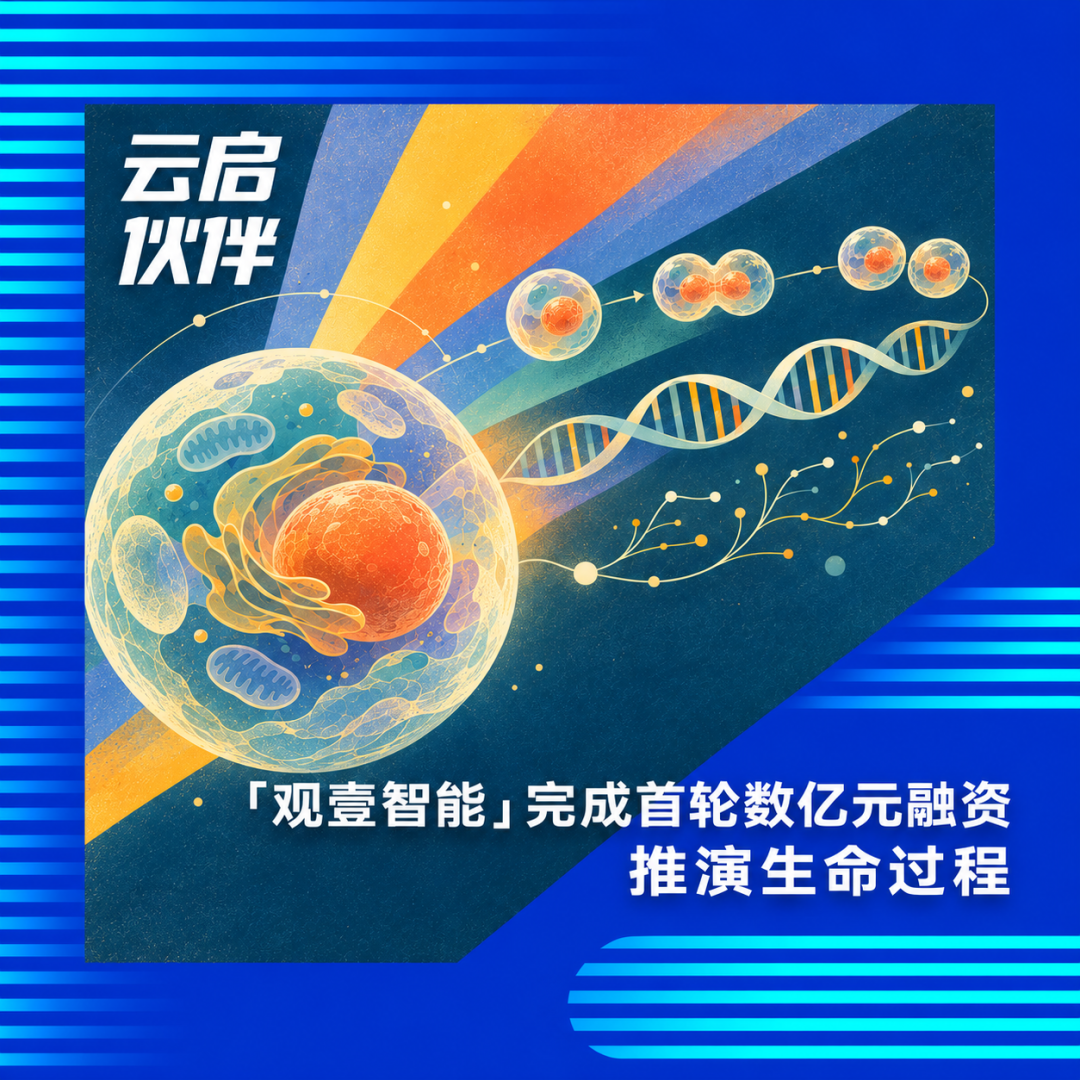
As AI enters the life sciences, most progress so far has been about making researchers' existing work faster. Whether it can discover things people didn't previously know is the higher expectation the field holds for AI. That's precisely the step OneX Intelligence is targeting: using foundation models to understand and simulate biological processes.
Most of this Shanghai Jiao Tong University-affiliated team's research can be verified: the rare disease evidence-based reasoning system DeepRare was published in Nature, the cellular perturbation prediction model MAP was published in Nature Machine Intelligence, OpenPheno was accepted by Nature Chemical Biology, and KEEP was published in Cancer Cell. Just before this funding round was announced, CEO Weidi Xie received the inaugural "Young Scientist Award" at the 2026 World Laureates Forum, one of six recipients worldwide.
Recently, OneX Intelligence announced the completion of its first funding round, raising several hundred million yuan, with participation from the Yunqi–SJTU AI Angel Fund. In this edition of "Yunqi Partners," we share the latest from OneX Intelligence.

Yunqi Capital's investment view:
AI is moving from assisting with data analysis toward participating in scientific discovery, and the life sciences is one of the most long-term valuable and most challenging directions within that. The difficulties in this field include bridging connections across levels — from molecules and cells to disease phenotypes — and accurately predicting what a given intervention will change. The OneX team has top-tier research strength on both the AI and life sciences sides. From cellular intervention response prediction to pathology foundation models, it has already demonstrated, through a series of representative results, its ability to translate complex biological problems into model capabilities. We endorse OneX's clear path with virtual cells as a key direction, and look forward to OneX growing into an important force in China's life sciences foundation model field.

Recently, biological model intelligence company OneX Intelligence announced the completion of its first funding round, raising several hundred million yuan, led by IDG Capital, with participation from Yunqi Capital, CCV, Cedarlake Capital, and SJTU Hanyuan Asset Management, with Zonglv Capital as financial advisor. The funds will be used primarily for life intelligence foundation model R&D, building a wet lab platform, and industrial collaboration and validation.
According to ChinaVenture CVSource data, OneX Intelligence was initiated by Professor Yanfeng Wang of the School of Artificial Intelligence at Shanghai Jiao Tong University, with Ya Zhang and Weidi Xie as co-founders, and Weidi Xie serving as CEO and chief scientist. The company's goal is to develop general artificial intelligence for the life sciences and build foundation models capable of understanding and simulating biological processes.
From computer vision
to the life sciences
Before this funding round was announced, Weidi Xie had just received the inaugural World Laureates Award "Young Scientist Award" at the 2026 World Laureates Forum ceremony on October 31, becoming one of six recipients worldwide. Earlier, his rare disease evidence-based reasoning system DeepRare was also published in Nature, and the cellular perturbation prediction model MAP was published in Nature Machine Intelligence.
This means that, from medical evidence reasoning to cellular response prediction, this SJTU-affiliated team has already made progress on different research tasks in the life sciences. Now, as an entrepreneur, Weidi Xie must answer: can these capabilities enter a shared model system, so that what is learned from one problem can help with more problems that have yet to be fully studied and solved?
Weidi Xie's research career and several pivots all revolve around one judgment: what else can AI solve next?
He studied communications engineering as an undergraduate, then went to University College London in the United Kingdom in 2013 for a master's degree, researching the use of computer vision to recognize handwritten Arabic script. At the time, the potential of deep learning was not yet widely recognized. He taught himself the relevant knowledge through open online courses, completed his research project, and then went to Oxford University's Visual Geometry Group (VGG) for his PhD, studying under Andrew Zisserman and Alison Noble, and receiving the inaugural Oxford-Google DeepMind Scholarship.
Through research in multimodal self-supervised learning and medical imaging, Weidi Xie gradually shifted his interest toward more complex scientific problems. After returning to China in 2022 to join Shanghai Jiao Tong University, advances in language models and vision models led him to start thinking: could these capabilities be used to further understand the processes of disease onset and changes in living systems?
Medicine thus became Weidi Xie's first stop. "I happened to have a medical imaging background, so I went into healthcare first, and then gradually moved from the external manifestations of disease deeper into the underlying problems of the life sciences," Weidi Xie said.
This pivot also has roots in the team. Co-founder Ya Zhang is currently vice dean and distinguished professor at the School of Artificial Intelligence at Shanghai Jiao Tong University. She earned her undergraduate degree from the Department of Biological Science and Technology at Tsinghua University and her PhD from the College of Information Sciences and Technology at Pennsylvania State University in the United States, and previously served as a senior R&D manager at Yahoo Labs. Before founding the company, she long worked on research at the intersection of AI and healthcare, with academic backgrounds in both biology and AI as well as industry R&D experience.
In recent years, as AI has reshaped the life sciences, the team's research direction has gradually extended from medical problems to life science modeling. Among these, DeepRare organizes medical evidence around rare disease diagnosis to form a traceable reasoning process; MAP introduces biomedical knowledge into cellular perturbation modeling, exploring prediction of how cells respond to new interventions. At the same time, the team has also conducted research including OpenPheno, a model for predicting cellular phenotypes and biological activity, and KEEP, a knowledge-enhanced pathology foundation model.
According to the team, OpenPheno has been accepted by Nature Chemical Biology, and KEEP has been published in Cancer Cell.
Behind these results is the team's sustained investment in model training, multimodal learning, medical reasoning, and life science modeling. ChinaVenture has learned that for OneX Intelligence, this not only provides a foundation for R&D but also links the company's long-term goals — connecting capabilities across different tasks.
The goal:
a foundation model that simulates biological processes
Weidi Xie's judgment of AI's value is direct: "What people could already do, AI can do faster — that's efficiency gains. But if it can discover things humans didn't previously know, it can push out the boundaries of what we're able to explore."
The life sciences offer exactly this kind of research space. Imaging, omics, and experimental technologies continue to advance, and observation of parts of biology is becoming ever deeper, yet how a single molecular change or drug intervention affects cells and tissues and ultimately changes health status remains difficult to predict. Disease mechanism research, target discovery, drug design, and experimental validation are also often carried out in separate stages, making it hard to connect knowledge and results across different steps.
What OneX Intelligence wants to do is target this direction — "Biological Intelligence." The company will use foundation models as a base to connect information across different levels — molecules, cells, and tissues — as well as disease phenotypes and related medical knowledge, so that models can learn the patterns of connection and change in living systems.
"The key here is to let the model accumulate and transfer capabilities across different research tasks," Weidi Xie said. For example, when facing an intervention, researchers need to understand which cellular functions it will change, whether it might affect other processes, and what experiment should be used next to make a judgment. To support such research, the model needs to combine scattered observations, existing knowledge, and experimental results to gradually develop the ability to simulate biological processes.
On this basis, OneX Intelligence will use foundation models to build a biological simulation model centered on virtual cells, exploring prediction of changes in cellular states and functions under different conditions and interventions, and providing support for disease mechanism research, target discovery, and drug design.
In Weidi Xie's view, this requires being driven jointly by data and knowledge. An experiment records a state under specific conditions, and the model also needs to understand the conditions behind the observations and existing mechanisms, as well as use language models to retrieve literature, integrate knowledge, call tools, and organize scientific reasoning, working in coordination with capabilities such as cellular modeling to help researchers propose hypotheses and plan experiments.
According to Weidi Xie, in the language model area, the company at this stage will use existing pretrained models to carry out further training oriented toward the life sciences, while also advancing multimodal integration. It is understood that the related R&D will be advanced in coordination with cellular modeling, experimental feedback, and other work.
Taking rare diseases as an initial validation scenario, Weidi Xie said that some rare diseases have relatively clear mechanistic clues, making them suitable for testing around specific questions whether the model can offer valuable explanations, predict intervention responses, and provide a basis for target selection and candidate design. This validation work covers mechanism research, target discovery, drug design, and prediction of intervention effects.
"As understanding and capabilities continue to accumulate, the company will apply these capabilities to other diseases and broader life science problems."
Bringing experimental feedback
into model iteration
The capabilities of biological intelligence ultimately need to be tested against real experiments. To this end, OneX Intelligence plans to build its own wet lab platform, incorporating model R&D, biological observation, and experimental validation into a single R&D loop.
Weidi Xie said that existing models integrate existing knowledge, propose mechanistic hypotheses, and assist in designing experiments; researchers can test predictions through experiments and, based on the results, revise judgments and determine the next research direction. "And new experimental results can both deepen mechanistic understanding and provide a basis for model training and evaluation, driving continuous model improvement."
In addition, the experimental platform will also carry out observation and measurement around specific scientific questions and model learning needs, closely linking data generation with model R&D. OneX Intelligence hopes to continuously accumulate observational and intervention data corresponding to research conditions through this process, shortening the cycle from model prediction to experimental feedback.
This kind of loop determines how OneX Intelligence collaborates. It is understood that the company will focus on model capabilities and mechanism discovery, conducting joint R&D with pharmaceutical companies and research institutions around specific topics to test whether the model can bring real value to target discovery, candidate design, and experiment selection.
To date, the team's DeepRare has been deployed on-site at Xinhua Hospital, and internal testing is underway, with subsequent plans to use it for quality control in rare disease diagnosis and treatment. In the drug R&D field, OneX Intelligence is also in talks with pharmaceutical companies and contract development and manufacturing organizations (CDMOs) to explore joint research and experimental validation. These efforts are at different stages, and the company hopes to use specific collaborations to gradually establish a path from model capabilities to R&D results.
In terms of business model, OneX Intelligence also hopes to participate in the distribution of the value of results through joint R&D. "If the model discovers a target or candidate worth further development, the company will seek to work with partners that have the downstream development capabilities to advance it." As Weidi Xie put it: "For us, what's more attractive is the value created by new drug discoveries, rather than simply charging by model usage volume."
This pursuit of exploring the life sciences also places higher demands on the team: model training, scientific reasoning, living systems modeling, and experimental research need to work around the same question. With this funding round complete, OneX Intelligence will continue to advance model and experimental platform development, and also looks forward to outstanding talent in related fields joining.
From research breakthroughs on existing tasks, to foundation models that can serve more scientific questions, to R&D results validated through experiments, what this team is targeting is always the ability of biological intelligence to build sustainable accumulation in real research — and the generality of biological intelligence foundation models.
The above content is excerpted from the WeChat public account "ChinaVenture," author: Mei Chen | editor: Qingwu Wang