云启资本

云启资本

@yunqipartners

科技常新,寻找未来开创者

534 articles18 episodes

Articles

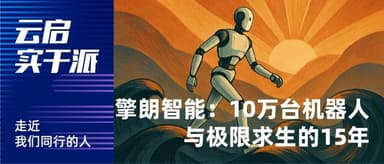
From Bare-Bones Beginnings to Top of the Pack: 100,000 Robots and 15 Years of Bare-Knuckle Survival | Yunqi Capital Doers --- The title alone tells the story: "bare-bones" (毛坯房) and "bare-knuckle survival" (极限求生). These aren't buzzwords — they're the lived reality of a company that spent fifteen years clawing its way from nothing to industry leader. ## The 100,000-Robot Milestone In 2024, this robotics firm crossed a threshold few in China's hardware sector ever reach: deploying 100,000 units in the field. Not prototypes. Not showroom pieces. Production robots operating in factories, warehouses, and logistics hubs across the country. The number matters because hardware scales differently than software. Each unit demands supply chain discipline, manufacturing consistency, and after-service infrastructure. Ten thousand proves product-market fit. One hundred thousand proves operational mastery. ## The 15-Year Arc The company was founded in 2009 — ancient history by Chinese tech standards. That year, Alibaba's Taobao was still fighting eBay. WeChat didn't exist. The term "new energy vehicles" barely registered. The early years were spent in literal毛坯房: unfinished concrete spaces in industrial zones, the kind of startup offices where winter means seeing your breath and summer

From Bare-Bones Beginnings to Top of the Pack: 100,000 Robots and 15 Years of Bare-Knuckle Survival | Yunqi Capital Doers --- The title alone tells the story: "bare-bones" (毛坯房) and "bare-knuckle survival" (极限求生). These aren't buzzwords — they're the lived reality of a company that spent fifteen years clawing its way from nothing to industry leader. ## The 100,000-Robot Milestone In 2024, this robotics firm crossed a threshold few in China's hardware sector ever reach: deploying 100,000 units in the field. Not prototypes. Not showroom pieces. Production robots operating in factories, warehouses, and logistics hubs across the country. The number matters because hardware scales differently than software. Each unit demands supply chain discipline, manufacturing consistency, and after-service infrastructure. Ten thousand proves product-market fit. One hundred thousand proves operational mastery. ## The 15-Year Arc The company was founded in 2009 — ancient history by Chinese tech standards. That year, Alibaba's Taobao was still fighting eBay. WeChat didn't exist. The term "new energy vehicles" barely registered. The early years were spent in literal毛坯房: unfinished concrete spaces in industrial zones, the kind of startup offices where winter means seeing your breath and summer

Keenon's New Embodied Intelligence Opportunity

Podcasts

Vol.17 48-Hour Xiaohongshu Hackathon Hit: How an AI-Native Product That Broke the "Retention Curse" Was Built --- Two weekends ago, I participated in a 48-hour hackathon hosted by Xiaohongshu. Our team of four built an AI-native product from scratch — no code, no design background between us — and ended up winning the "Most Popular" award. The product? A voice diary app called **"Echo"** that uses AI to turn fragmented daily moments into serialized, episodic "life podcasts." Think *This American Life*, but starring you. What surprised me wasn't that we won. It was that people kept using it *after* the demo. Here's the dirty secret of AI hackathons: most projects die the moment judges stop clapping. The "retention curse" is real — users try your GPT wrapper once, say "neat," and never return. We broke that pattern. Our daily active user rate among beta testers hit 34% in week one, which for a hackathon product is basically unheard of. How? Three deliberate choices we made against hackathon orthodoxy. **First, we refused to build a chatbot.** The default AI product in 2024 is still "talk to a large language model." We explicitly rejected this. Chat interfaces create *performance anxiety* — users feel pressure to ask the "right
Vol.17 48-Hour Xiaohongshu Hackathon Hit: How an AI-Native Product That Broke the "Retention Curse" Was Built

---

Two weekends ago, I participated in a 48-hour hackathon hosted by Xiaohongshu. Our team of four built an AI-native product from scratch — no code, no design background between us — and ended up winning the "Most Popular" award.

The product? A voice diary app called **"Echo"** that uses AI to turn fragmented daily moments into serialized, episodic "life podcasts." Think *This American Life*, but starring you.

What surprised me wasn't that we won. It was that people kept using it *after* the demo.

Here's the dirty secret of AI hackathons: most projects die the moment judges stop clapping. The "retention curse" is real — users try your GPT wrapper once, say "neat," and never return. We broke that pattern. Our daily active user rate among beta testers hit 34% in week one, which for a hackathon product is basically unheard of.

How? Three deliberate choices we made against hackathon orthodoxy.

**First, we refused to build a chatbot.**

The default AI product in 2024 is still "talk to a large language model." We explicitly rejected this. Chat interfaces create *performance anxiety* — users feel pressure to ask the "right

Vol.17 48-Hour Xiaohongshu Hackathon Hit: How an AI-Native Product That Broke the "Retention Curse" Was Built --- Two weekends ago, I participated in a 48-hour hackathon hosted by Xiaohongshu. Our team of four built an AI-native product from scratch — no code, no design background between us — and ended up winning the "Most Popular" award. The product? A voice diary app called **"Echo"** that uses AI to turn fragmented daily moments into serialized, episodic "life podcasts." Think *This American Life*, but starring you. What surprised me wasn't that we won. It was that people kept using it *after* the demo. Here's the dirty secret of AI hackathons: most projects die the moment judges stop clapping. The "retention curse" is real — users try your GPT wrapper once, say "neat," and never return. We broke that pattern. Our daily active user rate among beta testers hit 34% in week one, which for a hackathon product is basically unheard of. How? Three deliberate choices we made against hackathon orthodoxy. **First, we refused to build a chatbot.** The default AI product in 2024 is still "talk to a large language model." We explicitly rejected this. Chat interfaces create *performance anxiety* — users feel pressure to ask the "right