
On June 10, Manifold Tech officially launched Odin1, the world's first spatial memory module.
This compact module houses an NPU capable of processing image semantics, object recognition, spatial mapping, real-time updates, and shared memory — what the team calls the robot's "hippocampus." It fills the most critical gap in robotic perception systems: spatial memory.
The company was born in a basement boiler room. Aaron Qin and Eric Xu first met at the University of Hong Kong's Haking Wong Building. The MaRS Lab there was spacious with high ceilings — perfect for flying drones. The two, along with their lab mates, crashed drones nearly every day, testing algorithms while watching their laboratory grow from a steam boiler room into a top-tier robotics research hub. Their open-source project FAST-LIO has become one of the most influential systems in the SLAM field, earning over 3.3k stars on GitHub and pushing robotics from "offline mapping" toward "online spatial understanding."
In 2022, both earned their PhDs. Manifold Tech had already been founded, dedicated to providing general perception capabilities for embodied intelligence. Ninety percent of technological achievements never leave the lab — Manifold is among the rare survivors. Its first product, MindPalace 360, turned profitable within three months of launch, and that same year the company secured seed funding from ZhenFund.
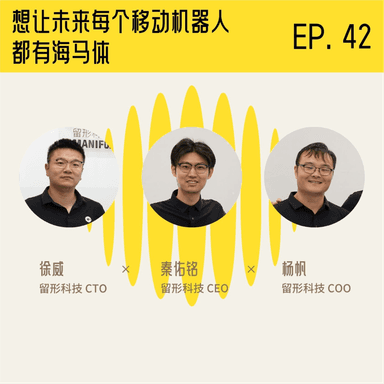
In this episode, we're joined by Manifold Tech CEO Aaron Qin, CTO Eric Xu, and COO Yang Fan to discuss the story behind Odin1: What is spatial memory? Why does a robot need a "hippocampus"? What's still missing before embodied intelligence can truly land in the real world? Here's what three PhDs have to say.
Opening Introduction
02:16 Three HKU PhDs, starting from a basement, founded Manifold Tech 03:55 Odin1 launch: the world's first sensor with spatial memory, compact, tight, ready out of the box 06:53 Spatial memory means understanding space and making judicious, context-aware decisions 08:18 Lidar cost reductions + embedded CPU breakthroughs made this tiny module possible 10:31 The module's light weight determines drone thrust-to-weight ratio, handling, and flight time 11:16 Why the hippocampus is key to robotic 3D perception: stability, logical reasoning, and real-world adaptability
How Odin1 Enters the Real World
15:24 In GPS-denied indoor environments, spatial memory helps robots better serve humans 17:23 The hippocampus of mobile robots needs to stay one step ahead of the "brain" 18:34 The significance of spatial memory: real-time refresh, shared memory, advancing multi-robot collaboration
Expanding Odin1's Application Scenarios
21:07 Efficient, low-cost, high-precision 3D data collection — optimizing products by working backward from customer needs 23:19 Cultural heritage preservation application: MindPalace documented the final images of the Tai Pak Seafood Restaurant 24:37 Odin1 can be used for: personnel positioning, 3D modeling, forest surveying, fire rescue, and more
Manifold's Non-Consensus Technology and Convictions
25:38 The over-mythologized end-to-end approach can't solve everything; learning-based methods and mathematical modeling are equally important 26:50 Memory isn't the model itself, but it's the core of multi-machine collaboration — and may someday even surpass human capability 30:04 Spatial memory is the starting point, opening the imagination for everything to connect to spatial intelligence
Commercial Considerations for a Technical Startup
32:28 Reasonable pricing is what lets technology products reach end users 33:14 Business metrics: can you expand the market, do you have actual sales volume 33:39 Competing against traditional workflows: solve user pain points, win on price and performance
Manifold's Moat
36:01 Algorithmic strength helps select optimal supply chains; manufacturing is a race of speed and cost 37:04 Users are the ultimate moat; Odin1 and legacy products will form a spatial perception ecosystem 38:58 Designed and optimized for robots: light, stable, cheap — the form factor itself addresses user pain points 40:50 The hard-won experience from the PhDs' drone-crashing days makes system design more grounded in real-world scenarios 41:59 Good wine fears no dark cellar — but the challenges of building perception systems need to be proactively explained to customers
Team and Entrepreneurial Story
45:43 Manifold is an atypical engineer-founded team, crossing the valley of death in research, capable of both ideation and execution 48:31 Why choose entrepreneurship: love of tinkering, no desire for big tech, wanting to turn ideas into reality 57:27 The most tempting offer: working on localization and mapping algorithms, collaborating with world champions, HKU MaRS Lab credentials, and the chance to focus on tech in an ideal engineer culture
Executive Producers: Jiamin, Cindy, Wendi
Post-Production: Keyone Studio
This Really Matters is a general business podcast produced by ZhenFund, where the ZhenFund investment team will share the latest hot topics and industry insights with leaders across various fields.
Founded in 2011, ZhenFund is one of China's earliest angel investment institutions. Since its inception, ZhenFund has been actively seeking out the most outstanding entrepreneurial teams and era-defining investment opportunities in artificial intelligence, chips and semiconductors, robotics and hardware, healthcare, enterprise services, new energy, cross-border expansion, consumer lifestyle, and other sectors.
ZhenFund — your first stop for entrepreneurship!