First Whistle! Predict Your 2026 World Cup Champion

A new journey has begun — remember this summer.
In 1998, 11-year-old Lionel Messi was still playing in the youth academy of Newell's Old Boys in Rosario.
At the time, he stood only 1.27 meters tall, but the moment he stepped onto the pitch, everyone was drawn to him.
His coach, Ferraro, later described him this way: "The ball seemed glued to his left foot. He surged forward at a dizzying speed, yet remained completely aware of everything happening around him."
But it was also around then that Messi was diagnosed with growth hormone deficiency — a condition with a probability of one in twenty million. Without intervention, he might not reach 1.70 meters until age 25. For a child dreaming of becoming a professional footballer, this was nothing short of devastating.
He didn't stop.
In 2000, 13-year-old Messi traveled to FC Barcelona for a trial. Carles Rexach paid out of his own pocket to draft an agreement on a napkin, securing funding for Messi's medical treatment as well.
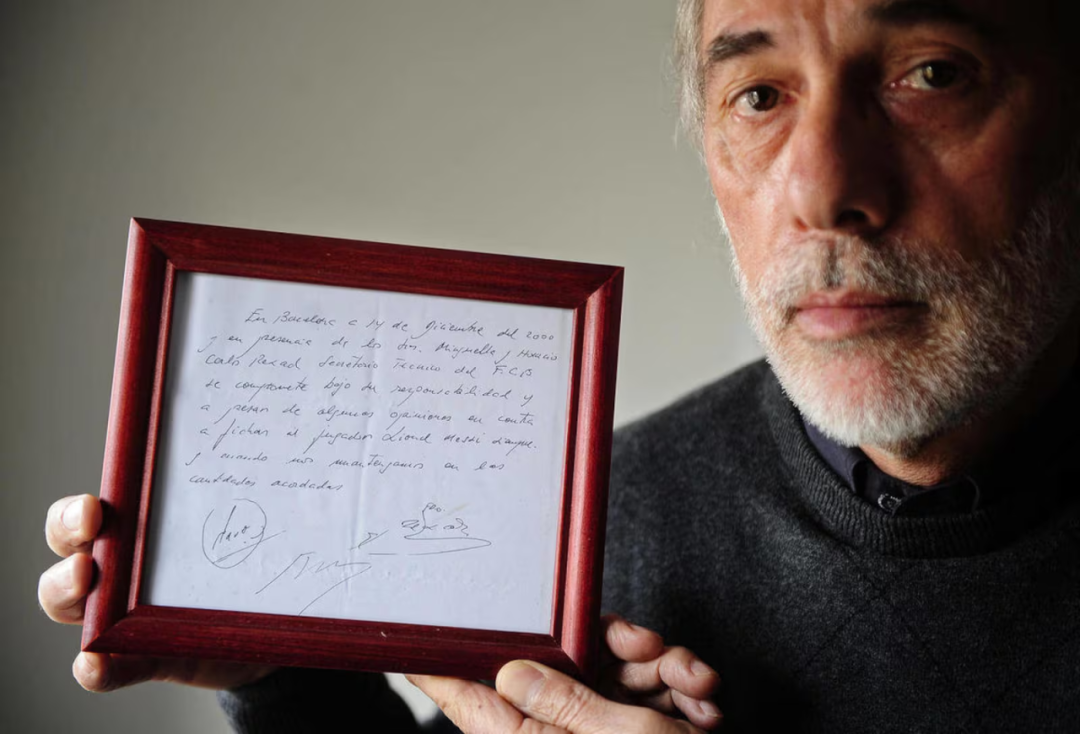
December 14, 2000 — Rexach asked a waiter for a napkin and signed the first "napkin contract"
Too short, too young, repeatedly brought up by team management as someone to let go — yet Messi kept playing.
In 2004, 17-year-old Messi made his La Liga debut, becoming one of the youngest players in Barcelona's history to appear in a league match. That same year, he shone at the FIFA World Youth Championship. From then on, he would maintain elite-level competitiveness for nearly two decades.
The essence of sporting spirit has never been about pursuing guaranteed victory within fixed rules. It's about attempting the impossible in environments of incomplete information, constantly shifting rules, and extreme randomness.
The 2026 World Cup will be co-hosted by the United States, Mexico, and Canada — the first tournament in history to expand to 48 teams. Twelve groups of four teams each, 104 matches total. The top two from each group advance directly to the knockout stage, while eight of the best third-placed teams also qualify, entering a newly introduced Round of 32 — a first in World Cup history.
FIFA has officially announced up to 495 possible bracket configurations, designed to prevent group winners and runners-up from meeting too early in the knockout rounds while balancing strength across each half of the draw.
Among these 495 possibilities, how do you choose?
Football match prediction is a classic complex decision-making problem. The variables influencing a single result are far more numerous than one might imagine. You must consider hard metrics like player market value, goals scored, possession rate, distance covered, and FIFA rankings, as well as intangibles like tactical style, hunger to win, and refereeing leniency.
A single second of hesitation can alter the course of a match.
When sharing its public predictions for all 104 World Cup matches, Moonshot AI wrote: "Football's charm lies in breaking conventions, while technology's value lies in exploring boundaries."
Prediction isn't about absolute accuracy — it's about witnessing, participating, and sharing.
A bracket is the tool that visualizes every matchup and advancement path through the knockout stage.
Our colleague Fangzhou Vibe Coded a "ZhenFund World Cup Bracket." Open it, and you can simulate the entire tournament, generating your own predictions: select the top two finishers from each group (click twice in sequence), pick the eight best third-placed teams, forecast the knockout matchups, and ultimately crown your champion.
Points are automatically calculated after each match, with live leaderboard updates.
From the opening whistle of the first group-stage match at 3 a.m. on June 12, to the final shot of the final night, every prediction is an early participation in the making of the future.
A new journey has begun. Let us witness the crowning of a champion together, and remember this summer.

Producer | Fangzhou Text | Cindy