Betting on AI Startups Four Years After a VAM Gamble: The Full Story of a Data Startup's Acquisition
I was going to ring the bell; how could I have sold the company after just four years?
On a cold morning at the end of 2019, Tony Ren Dongni signed his name one last time atop a towering stack of thick legal documents. From naming the company at its founding to putting pen to paper on the acquisition agreement, the whole journey seemed to flash by in an instant.
In that moment, he sold OneSight Data — the company he'd founded fresh out of his PhD — to Ascential, committing to a four-year earnout.
Tony represents a rare founder archetype from the past decade. He completed the full acquisition cycle of his first company, then decided to start again the moment his earnout ended.
After OneSight Data was acquired, Tony remained as CEO and led the team through the entire earnout period. When OneSight was eventually folded into Flywheel, Ascential's digital commerce brand, he became Flywheel's Chief Product Officer for Asia-Pacific, overseeing a 400-person R&D team across the region. As Amazon's largest advertiser, Flywheel helps brands manage hundreds of billions of dollars in ad spend on Amazon annually.
When the earnout concluded, he left Ascential and reunited OneSight's original team for a second act. In late 2023, they founded "Recurve" (now renamed Reorc), focused on Data & AI infrastructure. ZhenFund decided to invest again — eight years after backing OneSight Data, a decision that had taken just ninety minutes.
The interview took place in a conference room Tony had temporarily borrowed from his former employer. Old colleagues greeted him warmly when they ran into him. Tony arrived with his backpack, and would fly out to Ho Chi Minh City after our conversation to visit Reorc's engineering team there. We talked through the acquisition from start to finish, how to read an acquirer's psychology from the inside, and his decade-long arc from founder to executive to serial entrepreneur.
Here is the full interview:
01
After Four Years of Earnout, a New AI Data Company
Q: When did you hear that clear voice inside saying, "It's time to start another company"?
Tony: Actually, a year and a half earlier, I had already reached an understanding with Ascential's global CEO. Four years had passed since the OneSight acquisition, and the earnout had just ended. I didn't give a specific date, but I said I would definitely go out and build something new.
Q: And that something new was "Recurve"?
Tony: Yes. We founded "Recurve" right after National Day holiday in 2023, working on Data & AI infrastructure.
We want to use GenAI — through more natural, simpler methods — to migrate the core capabilities of modern data systems from tech giants to more industries. We're building a future-facing enterprise data foundation, redefining how data is collected, flows, and gets used, removing barriers between people and data.
Q: What's the core problem Reorc is trying to solve?
Tony: "Recurve" addresses three core problems: pipeline modeling, data modeling, and semantic modeling.
First is data ingestion and orchestration. Enterprise data comes from everywhere — user data, ecosystem platform data, public monitoring data. How do you cross-verify, cross-analyze, and generate insights? Everything starts with getting that data into the system.
Second is modeling — how to represent business meaning and the operating rules of the physical world in databases or data tables, interpreting upstream and downstream connections to the physical world. Without modeling, engineers can still produce what clients need, but the database's scalability and maintainability will be relatively poor.
Third is semantics, meaning operational metrics. How do you use data to guide business decisions? We can distill data into clear metrics — channel growth rate, profit margin, sell-through rate, conversion rate, and so on. These metrics started as descriptive (prescriptive) indicators defined by mathematical formulas. With advances in machine learning, they've gradually evolved into predictive and attribution analysis.
We call this internally "a bright lamp" — using data to guide production, demand, allocation of next year's media budget, and so on. This is also the most critical step in how generative AI connects to and understands enterprise data.
Q: What's the most important thing for Reorc right now?
Tony: The most critical parts of the product are now built and entering iterative testing. The next most important thing is finding product-market fit — discovering the optimal product form that can serve the market.
Q: Will this process be much faster than your first startup?
Tony: OneSight took at least two years. This time will definitely be faster.
02
An Acquisition, From a Cold Message
Q: When did you decide to sell OneSight Data?
Tony: Actually, we weren't actively seeking a buyer. One day in 2018, we suddenly received a message on LinkedIn — an FA asking if we'd be interested in a chat.
At first I thought the company behind it (Ascential) wanted to invest. Ascential was quite sincere, flying all the way from the UK to Shenzhen for visits, conducting several rounds of discussions. But as we talked, something shifted — what they ultimately put on the table was an acquisition offer.
Q: Did you struggle internally before deciding to accept?
Tony: There were definitely some delusions at the time — I was going to ring the bell, how could I sell the company after just four years?
But all three founders were very rational and calm. We sat down together and did the math, analyzing a full whiteboard of SWOT. We realized the upside of accepting the offer outweighed the risks — we could spend another ten or twenty years taking the company public, or we could trade equity, control, and returns for a bigger card. That card was time.
When we received the term sheet at the end of 2018, globalization was a huge opportunity. And data is a notoriously slow industry. If we did it ourselves, getting our product out of Asia and into the world might take ten years. But with Ascential, we could sell globally within three.
Q: What else was on that SWOT whiteboard?
Tony: We analyzed that independent development definitely had many advantages. If we could go public, the upside would certainly be higher than selling midway, and we'd have more autonomy.
But we calculated the ceiling for China's online data measurement market at around 5 billion RMB. Continuing on our own, we'd most likely end up as a mid-sized B2B services company, not a ten-billion-dollar company.
Meanwhile, accepting the acquisition offer had many benefits too, like greater certainty. Ascential also promised to gradually move all of the group's data and AI R&D to Shenzhen, building it into a global R&D center. In such a larger system, the entire team would have a bigger stage and better growth opportunities.
Q: Compared to where you did it, you cared more about getting it done?
Tony: This was actually a crucial point for us — what was the acquirer's background and motivation?
In a very dominant system, it's likely that within three months of acquisition, the startup would be completely swallowed or even dismantled. Everyone takes what they need, and the company ceases to exist.
So we very carefully studied our acquirer. It's actually quite an interesting company — although it's listed on the London Stock Exchange, it functions more like a holding company. The parent company has no specific business; its portfolio companies are all quite similar to us.
In fact, when we raised our Series A with ZhenFund in 2016, we had used another of its previously acquired companies as our benchmark, saying we wanted to become "China's Clavis Insight." This was a story investors loved to hear (laughs).
Because of this connection, Ascential naturally gave us a sense of kinship — that you understand our industry, and your taste is pretty good, having picked the best company at the time.
Ascential was also very sincere. To convince us, they specifically arranged for founders from two previously acquired companies to talk with me, helping me understand what life after acquisition would look like.
I found that everyone seemed quite happy. The founders felt that although the company wasn't theirs anymore, the brand could be preserved, and terms guaranteed four years of independent operation post-acquisition, with the CEO retaining 100% control.
In the end, the relationship with the parent company was more about mutual help. The parent provides funding support and client resources. With the backing of a multinational, plus client referrals from sister companies, you have much greater advantage in expanding overseas.
Q: Did you consider bringing in other competing bidders?
Tony: There were three potential acquirers in total. Besides Ascential, there were two top-tier international consulting firms and advertising companies.
Although we didn't close with them, these two companies provided excellent reference points. After investors learned we were considering a sale, they enthusiastically helped make introductions.
This advertising company had a very complex organizational structure in China. After their China head spoke with me, he had his "eight generals" underneath all talk to me too. Eight people, each with an ambiguous attitude. What I gathered was that there were various political dynamics inside, and I'd need to know my place.
And this consulting firm was essentially a craftsman at heart. Like, I want to meticulously carve the world's finest blue-and-white porcelain bowl. From a technology value orientation, we leaned more toward assembly-line mass production — joining them, we'd likely become a project outsourcing team.
But the Ascential team in China was tiny at the time. We would've clearly become their go-to-market engine, so the value we'd deliver would be much greater.
Q: What was the main factor in ultimately choosing Ascential?
Tony: It still comes down to the acquirer's objectives. What are they actually acquiring for?
Some acquisitions are defensive. The acquirer wants to expand market share, prevent competitors from growing, and consolidate their monopoly position. That's not particularly founder-friendly.
Others are traditional enterprises seeking transformation. They need fresh blood, more tech-driven teams to join. But the larger the system, the more complex the politics. How to avoid getting drowned in relationships and vested interests, and actually move such a massive system — that's a real test of team capability.
What we ultimately chose was a non-intrusive acquisition. In a non-intrusive acquisition, what the acquirer needs most is your business capability itself and your P&L (Profit and Loss). As long as you can grow, make money, and show revenue and profit growth, that's a good deal for them.
Q: Between buyout and earn-out, you chose the latter.
Tony: We definitely chose earn-out, and accepted a four-year window, because "if you still want to run it, then it's 100% yours to keep running."
I also know founders around me who took buyouts, exiting all at once. After bringing the business to a certain height, they wanted to do something else or take a breather, so they immediately sold their shares and took all the cash.
But fundamentally, we wanted greater control over the company, and to share more of the upside as we grew. Because we were betting on higher growth in the coming years, we wouldn't take as much cash upfront. Under the earn-out mechanism, the founding team's payout ratio is tied to annual performance metrics — revenue, contribution margin, and so on — with floors and ceilings.
If you plot the earn-out payout ratio as a curve, it's actually a second-order function. You'll find its slope increases as revenue grows larger. This mechanism gave us tremendous drive. We were determined to push through the first slope, reach the second slope, and achieve a step-function leap.
03
On paper,
this deal couldn't have happened
Q: What was the overall acquisition process like?
Tony: It was actually an incredibly draining process. From getting to know Ascential to receiving the term sheet, it took a full year. From taking the TS to communicate with investors to the due diligence team coming in, another full year. Fortunately, we managed to get signatures on paper a month before the COVID-19 outbreak in 2020.
There weren't many reference cases domestically. And past acquisition cases involving British companies hadn't gone smoothly — some British and Australian capital had tried to acquire Chinese companies, ending in complete messes.
So we just fretted on one hand, and pored through the investor's financial reports on the other. The reports actually spelled things out quite clearly — how much they spent on previous deals, how they conducted acquisitions, how they structured things.
Fortunately, the whole process was quite professional and reassuring. Because we were Ascential's first acquisition target in China, the legal fees, due diligence fees, and various acquisition-related expenses totaled over ten million RMB.
But on the other hand, due diligence was extremely painful. On all pricing matters, the acquirer hired external accountants. Because there was a fairly rigorous valuation model, any revenue recognition would affect the model's output.
You know how startups are — we didn't have particularly professional annual financial statements or revenue recognition. We only looked at cash: how many contracts signed, how much collected, but which quarter or year would the revenue composition actually be recorded in? Not particularly clear.
The acquirer's accounting team helped us go through every single contract from start to finish. Every contract, every transaction — they'd ask the person responsible, what kind of transaction is this? Is it one-time or recurring? What's the situation with this client? Our finance person was nearly driven crazy.
Chinese law was also unfamiliar to them, so they were especially cautious. On all tax matters they also hired legal teams. The whole process was extraordinarily draining. That year I really didn't have much energy for business development. Almost half my time was spent on M&A matters.
Q: Did you hire an FA yourselves?
Tony: They came to us through an FA, but we didn't hire one. They also suggested we hire a financial advisor and a commercial advisor. Lawyers were unavoidable of course.
In the end we didn't hire any of them, because it was so expensive. Everyone just pulled their hair out themselves.
Q: What was the most difficult part of the acquisition process for you?
Tony: Negotiating with investors during the acquisition was actually very tough. I often say, you see someone's true character when you break up. What does that mean? At the moment of your M&A or IPO exit, from the investor's standpoint, they have both the right and the obligation to maximize their own returns, to be responsible to the LPs behind them.
We had seven investors in total. If you went strictly by the paper agreements, this deal could not have happened. To make this deal happen, nearly every investor had to make concessions on their terms. But at the time, Anna said she 100% believed in our choice, and ZhenFund was willing to make concessions first. As long as we felt selling the company was the best choice for the team, ZhenFund wouldn't set up any obstacles.
04
If I could do it again, I'd ask for a higher valuation
Q: Did you consider what would happen if the deal fell through?
Tony: Until the day of formal signing, you always prepare for both scenarios. Only when that moment truly happened did we finally know that we would all be one family going forward.
We didn't seek out additional acquirers, but we were always simultaneously advancing on two tracks: being acquired, and continuing to operate independently to capture market share.
The acquirer previously had its own business in China, which was also our direct competitor. On some projects we would even proactively go after their clients — truly negotiating while fighting.
Q: If you could start over, what would you do differently?
Tony: I would definitely ask for a higher valuation.
After joining Ascential, I also helped them with technical due diligence on acquisitions in Asia-Pacific and China, providing some reference opinions. Later I discovered that as the first company they acquired in China, ours was the most cautious case of all their acquisitions. Actually, if we'd been bolder at the time, we could have asked for a significantly higher price.
Our pricing approach at the time was investor-driven: the acquirer took the lead in proposing a valuation framework, and we negotiated based on their proposal. The overall thinking was to add a premium on top of the last round's valuation, which would ensure all investors made money and were motivated to facilitate the transaction.
We were quite naive then. We didn't try to maximize the valuation the investor side offered, so the valuation negotiation was actually the smoothest part.
Because there had always been this inertia — feeling that a higher valuation in fundraising isn't necessarily better, the pressure is enormous. But the inertia made us fail to realize: this was the last valuation negotiation. You had to ask for everything upfront. Because there wouldn't be a next time.
Q: What should a good pricing strategy look like? What advice would you give other founders?
Tony: Find more references. A good starting point is a premium or discount to the last round's valuation, but founders should propose more valuation frameworks.
For example, if you're confident in revenue, you could price based on forward PS — a high multiple of next 12 months' revenue.
Another good reference framework is other deals in the market — for instance, finding out how much they previously spent acquiring companies, or "the acquirer's competitor acquired a similar company at a sky-high price."
Q: In the process of helping with other deals inside Ascential, what new understanding did you gain about the acquirer's psychology?
Tony: The acquirer won't tell you their bottom line, but you can more or less sense their willingness and determination to acquire.
For Yimian Data, our acquirer was a public company. Its pricing model is based on financial models, applying sufficient multiples based on the company's future revenue and profit growth expectations.
Both sides do their own calculations during an acquisition. Internally, we'd project five-year revenue expectations and growth to arrive at a reasonable valuation.
Correspondingly, the other side's due diligence team would also come up with a number, often more conservative than ours. But if you can convince them to factor in post-acquisition growth potential, their expectations will adjust upward accordingly.
In the end, from the M&A Director's perspective, they also want the deal to happen. If they've already spent millions on due diligence, hired all kinds of external paid advisors to talk with you, and it ultimately falls through — that's a massive loss of money and time for them.
Q: After gaining a complete acquisition perspective, how does this guide your future planning for starting a new company?
Tony: Fanqu is still in the 0-to-1 stage; 90% of our energy is on finding Product-Market Fit. Whether it's independent development, acquisition, or IPO — none of that matters much before finding PMF.
But this is a very good question. Many US B2B founders anchor their exit strategy from the very beginning of entrepreneurship. For example, in Silicon Valley there are many veterans from core departments of major tech companies who know exactly that Google, Microsoft, or Apple has specific internal needs. After leaving the big company, they found a startup, and at 10-18 months, sell the company at 10x to 20x the founder valuation. After exiting, they throw themselves into the next bigger, more visionary entrepreneurial project. Every major wave of technological innovation has similar examples.
A few years ago, domestic investors would mention that many entrepreneurs' business models were "to-BAT." There was probably some mockery in that phrasing. Under the influence of public opinion and information, people felt that selling a company too early was embarrassing. But actually, if you can sell to a major tech company quickly and create value within it, I think that's also a very good thing.
Q: Will there be more founder M&A exit cases in China going forward?
Tony: I'm quite optimistic — there will definitely be more opportunities.
In recent years, the scale and maturity of China's major tech companies are in no way inferior to America's top-tier tech giants. These companies' understanding of capital deployment is also shifting, entering the next phase — focusing on core businesses that generate commercial value.
Previously, the thinking was "I'm a major tech company, I have endless talent, I can do anything I want." But recently many major tech companies have been re-examining this path, gradually cutting some middle-office and infrastructure departments — "Even though I have enough money to try, it's not my strength. Rather than building it myself, can I really do it better than outsiders?"
In Silicon Valley, many startups that get quickly acquired by major tech companies have technology value that exceeds commercial value. Before breaking even on costs, or even before commercialization, the startup becomes one small piece of a larger puzzle.
This type of startup was previously uncommon in China. Part of the reason was that everyone could generate revenue from the start and had commercialization options, so early-stage M&A exits rarely crossed their minds. But with the emergence of large language models this time around, we're seeing AI Infra, AI Ops, and all kinds of technology companies emerge. Going forward, this path has a real chance of working in China too.
05
On a Big Ship,
Spending Big, Leveling Up
Q: What was the first thing that happened after joining Ascential?
Tony: Within six months of the acquisition, I quickly lost control over HR and finance. It actually stung quite a bit.
But the British are old hands at this kind of business. I was the China CEO, with HR and finance reporting directly to the UK, yet the group still had me participate in interviews from start to finish. They said, "If I directly appoint someone, you two will definitely clash down the road. So I'll let you find the person, let you choose."
Q: What matched your expectations and what didn't about being a CEO at a large platform? One founder once said that working at a big company made him realize he never wanted to have a boss again in his life.
Tony: What matched expectations: our acquirer was indeed a group that values integrity, after all, the British have been doing business globally for decades. It respected all terms, and its promises were ultimately honored.
What didn't match expectations: we underestimated how difficult it is to push things forward within a large system. Often everyone knows the right direction to move something, but driven by different interests and the need to respect existing arrangements, you can't just make bold changes. Between short-termism and long-termism, sometimes you have to do short-term things to show results, to please your capital providers, shareholders, board of directors.
So when a company reaches a certain scale, if it can still persist in doing more long-term things, that's extremely difficult and extremely rare.
Q: Looking back at these four years of earn-out, what do you wish you'd done better?
Tony: I think I could have been more proactive and aggressive in seeking integration with the group and greater development.
After an acquisition, there are many things people get particularly attached to — your own brand, your own team — hoping to preserve your independence, resisting some potential integration.
But the fact is we're all on the same boat. From our group's CEO, to the APAC boss, to the M&A colleagues handling our project, everyone wanted to have something to show the board and the shareholders behind them, to prove their decision was correct.
The APAC Managing Director who facilitated our acquisition even had salespeople on his payroll help sell our products. The higher our revenue, under the earn-out mechanism, the more the group actually subsidized us in cash — our revenue exceeded the profit we generated.
And he very much wanted to give us more money. Why? Because the more successful we were, the higher our revenue, the more it proved his strategy correct, his vision sharp.
When we were first acquired, this logic wasn't so intuitive, but looking back, the more open your mindset, the more opportunities you could get.
Q: Founder vs. executive at a large company — what's different about lifestyle and mindset?
Tony: Being an executive at a large company is pretty comfortable, with fairly high compensation and considerable authority. You don't need to do things yourself; the team can handle most of it. Less pressure too, because the risk isn't on your own head — no worrying about making payroll next month.
But at a large company, one obvious feeling is everyone doing their own job, each contributing their part. It's more about doing your own responsibilities well, waiting for the boss to assign targets and push execution. You might attend 10x more meetings, and when you want to push something, there are stakeholders everywhere, but it's just more physically exhausting.
Startup pressure is greater. But driven by that pressure, your overall drive and creativity are stronger. When founding a company, you constantly add more things to your plate, proactively exploring and trying many things.
At a large company as an executive, if you're always messing with this and that, everyone will hate you, haha, increasing workload for people around you. But entrepreneurship is different — every day you're finding things for people around you to do, finding things for yourself to do.
Another mindset shift was learning to spend money. When we founded our own company, everything and everyone was about cost-effectiveness. The thinking for hiring a CFO or buying software was the same — use the cheapest thing to hit the target.
I'd ask my boss, "This CFO seems a bit expensive? At our scale we probably don't need it." My boss would often lecture me: it's not your money you're spending, why are you saving money for the group?
Later I realized he made a lot of sense. Spending money on a big ship, leveling myself up, hiring the world's best employees — I actually come out ahead.
Including later when we purchased Lark, to the point that when Lark went to sell to other companies, they'd put on their PPT slides "We have a client called Yimian Data." Later friends saw it and told us, "Oh, you guys are that rich." Lark was a bit excessive.
Q: Even though you were so "comfortable" at the large company, you still told yourself you needed to go out and start another company?
Tony: Without a doubt. I often joked with my boss that at this stage, the company doesn't really need me that much. I'm someone who's especially good at spending money, haha, especially loves building new things. Building new things means you have to spend a lot of money, but that money might have no short-term return.
Q: But wasn't being acquired precisely so you could spend big money and do big things on a big ship?
Tony: At first yes, but many things happened later. In 2019 our acquirer was growing rapidly, with 50%+ organic growth annually. With acquisitions, revenue could multiply several times over. Back then the group wanted you to spend money building new things, capturing market share.
Later the winds shifted. On one hand, Ascential was seeking to spin off, delist from the UK, and relist on NASDAQ in the US. On the other hand, Ascential itself had major acquisition offers.
In this context, the group's business objectives also changed. What used to be constantly trying new things became focusing on what you're best at, rapidly scaling, generating profit, achieving healthier growth.
My boss also told me, if you go out to start a company I'll definitely support you. Though it would give him more of a headache, because he'd need to find someone else to manage everything below. After founding Recurve, whether business cooperation or even capital investment, he was willing to support me.
On one hand, many things aren't suitable to do entirely in-house within the system — too expensive, too costly. On the other hand, these new attempts are actually very important for business development. He needs trusted partners to do these things relatively independently, so there will be cooperation opportunities in the future. This also gave me a lot of confidence.
So going out to start a company was a better choice for both sides. He'd say, "Well, Tony is still someone who's very good at spending money, and also making money." Since within the current system, what we expect more is certainty, then Tony, you might as well go outside to raise money and do things with better risk-return matching.
06
Day 1 Globalization
Q: After ten years in the data industry, what led you to conceive the idea of founding "Recurve"?
Tony: In 2017-2018, a concept called "Modern Data Stack" was very popular in Silicon Valley. Traditional enterprise software was extremely heavy — actual implementation took nine to twelve months or even longer.
Because technology in the data domain evolves quite rapidly, the day the system went live it was already outdated, unable to keep up with evolving needs. So this concept was more an expression of deep hatred for massive monolithic software.
So back then people started constantly developing small open-source frameworks to solve point problems. Connect these frameworks together and you could replace heavy software — this was the so-called "Modern Data Stack." Below you'd have some object storage, compute engines, query engines; above you'd layer on open-source scheduling tools, visualization frameworks, BI tools, and so on.
But at Yimian Data, the first time we helped a client build a data system, we found Modern Data Stack complex. It sounded great in theory, but first, its technical barrier was high, requiring many senior engineers and architects to implement.
A few years in, you'd see tech bloggers coming out to bash Modern Data Stack, saying "We've now entered the Post Modern Data Stack era." From modern to postmodern — already getting a bit abstract. We found that even when solving a minor peripheral problem, you'd have to cobble together five or eight different tools.
Up to now, the data industry has reached a relatively stable stage. With the power of GenAI, we believe the optimal timing has arrived for data technology's "military-to-civilian conversion." Through more natural, simpler methods, we can migrate the core capabilities of data systems from tech giants to more industries.
Data is a fascinating industry. It sounds complex, and every few years Gartner invents new terms to raise the learning curve, but when you really get down to it, it's quite simple. Everything is quite similar to Excel data processing. As a company grows, when the data system becomes increasingly massive — one data analyst becomes hundreds or thousands of people up and down — it's hard to rely on just one Excel file to transmit all data information.
So we use various tools to replace Excel, or expand out some link in Excel's process. Following this logic, you can understand all kinds of data terminology and tools.
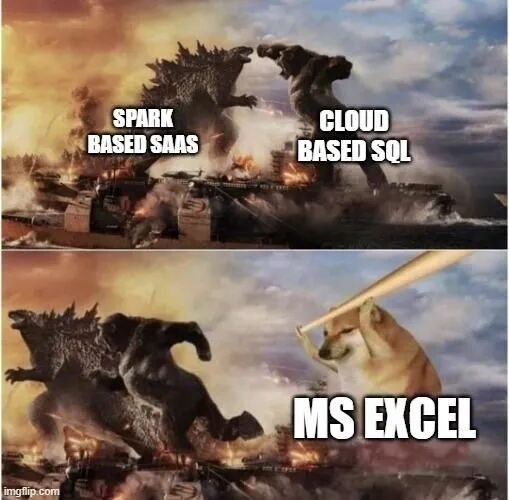
Tony: Given last month's Snowflake and Databricks spat, a meme is appropriate here
Q: What's the most core difference between this serial entrepreneurship and your first startup?
Tony: I think it's not getting in the way. Founders sometimes like to do everything themselves, but they're actually not that professional and end up holding the team back.
Although I carry the title of computer PhD, if I actually got down to writing code for everyone, I'd definitely be despised. The founder not doing proper work, coming to cause trouble every day — the code you write, people have to spend double the time reviewing it for you (laughs).
Q: Recurve's team is distributed around the world. Did you decide from Day 1 to build a global company this time?
Tony: From the start we decided to choose global markets and build a global company structure. To accommodate differences in user habits across mainstream markets including Asia, Europe, and America, Recurve assembled its product and R&D team in Ho Chi Minh City, and also brought in European and American investors targeting its key markets.
Going toB is widely acknowledged as harder than going toC. But when I went to the US for exchanges, I discovered that Chinese people have their own advantages. In Silicon Valley tech companies — whether Meta, Google, or OpenAI — we found that 80% of the data scientists are Chinese. You could even give a sales pitch in Chinese. That's actually pretty wild.
When I attended the Ostrich Club last year, Recurve hadn't been formally established yet. A mentor advised us to think through the company's registration location, structure, and market from Day One. That was enormously helpful for us.
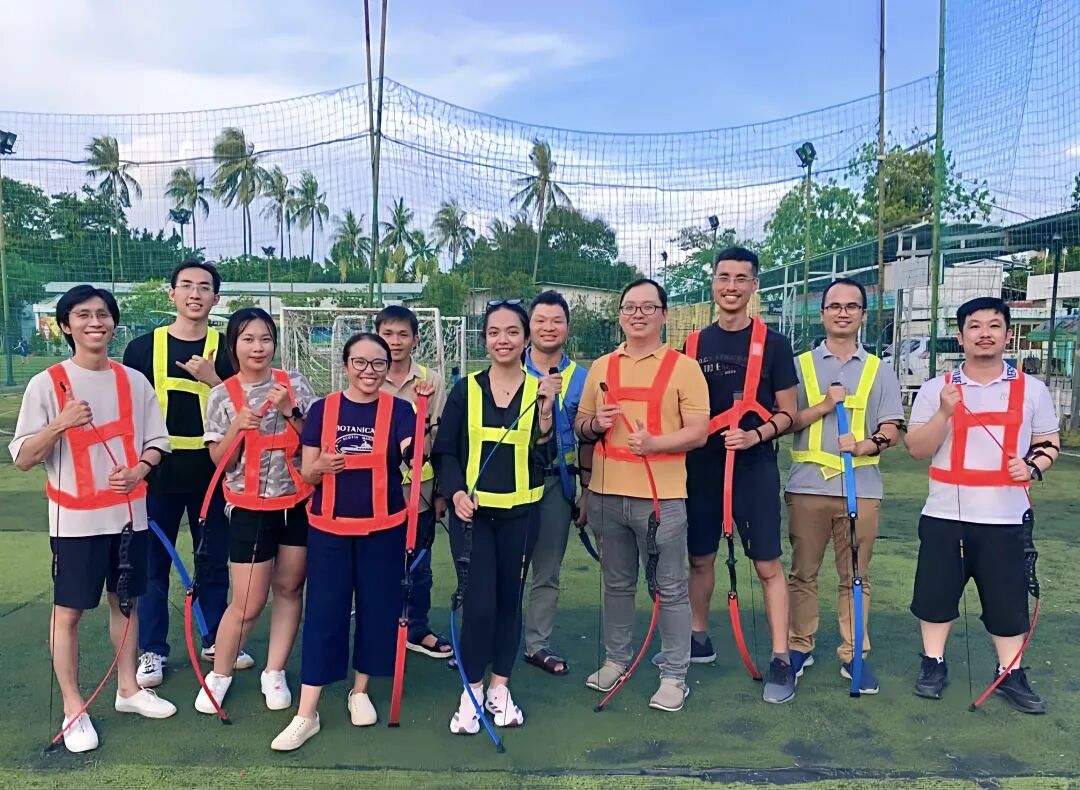
Recurve Vietnam team building
Q: The name "Yimian Data" supposedly alludes to the Möbius strip. What's the story behind "Recurve"?
Tony: If you asked a feng shui master, "Recurve" would definitely be the first name they'd reject. Because the entrepreneurial path is going backward again, and extremely winding, hahaha. But that's not what it means — it's not about cervical spine reversal either.
I don't know if you've seen a recurve bow in archery (any League of Legends players here?). A regular bow has a reverse curve at both ends. It's such a small, exquisite design that allows the bow to store tremendous energy.
"Recurve" fits very well with what we want to do. Data infrastructure isn't a heavy-asset business like data storage or compute engines. We want to organize data in a more exquisite, more efficient way — multiplying the value of data many times over.
07
Recurve's founding team is the same crew from Yimian
Q: You spent 11 years at HKUST before founding a company.
Tony: Yes, I was at HKUST for a super long time. Came right after high school in 2003. From undergrad to master's to PhD, graduated in 2014 — pretty much the typical student entrepreneur.
During my studies I did four or five industry internships. My advisor Gary Chan had many friends in industry; half my internships came through his introductions, including at Tencent, Huawei Noah's Ark Lab, and so on. That also planted the seed of wanting to use new technology to solve concrete problems.
I only learned from Anna's朋友圈 post that when Daniel was an analyst at ZhenFund, he printed himself business cards saying "Partner." Thanks to Gary, within two years of graduating, I was secretly dropping the "intern" part and telling people I had ten years of work experience.
Q: Was there anything memorable during those 11 years?
Tony: Definitely the LG7 chicken drumsticks — I'd go eat them every afternoon.
But you only realize after starting a company that the friends you made in university stay with you for life. I really wish I had spent more time with my fellow PhD students back then.
PhD startups often form with lab mates, seniors, and juniors. My co-founder pulled two dorm roommates from Tsinghua; four or five of Yimian Data's founding team were his classmates.
Q: How did you make the leap from PhD to entrepreneur?
Tony: A lot of people say you should first have an idea, or a plan, or a team, or funding before starting a company. "When to start a company" — a thousand entrepreneurs might have a thousand answers.
For me personally, two things mattered most: opportunity and mindset.
After graduating from HKUST, I joined what was ranked the #3 PC-era company in China. #1 was Tencent, #2 was 360, and #3 was a company called Kuaibo — a video player that took the whole country by storm.
But one month after I joined, Kuaibo got shut down. The scene of that day is still vivid in my memory... I thought, damn, I studied for eleven years, finally graduated and found a job, and I'm unemployed after one month.
The so-called entrepreneurial opportunity was: "employed and immediately unemployed." It just so happened that 2014 was the best era of mass entrepreneurship and innovation — gold everywhere, angels everywhere.
So I decided to take a gamble. What to do? Didn't know. Who to serve? Didn't know. Knew absolutely nothing. But I knew I really liked my colleagues. We were all unemployed together — rather than going our separate ways to work for others, why not gather and build a new company, solving new problems in a new industry?
What is the entrepreneurial mindset? I went to high school in Shenzhen. A classmate from the same year, Reynold Xin (Xin Shi), is an entrepreneur thousands of times more successful than me. Also right after finishing his PhD, he immediately founded Databricks with his lab mates — now a super-unicorn in the US.
I once heard him share that if he had taken a job after graduating and worked for three to five years, he might not have had the courage or the right mindset to throw himself into entrepreneurship. Because the PhD life is tough. Right after finishing a PhD, your income is actually quite low — not much material desire, no real attachments, full of curiosity. That mindset is very well-suited for entrepreneurship.
Q: How did Yimian Data find product-market fit?
Tony: We actually spent a full two years finding PMF. A very long time thinking: exactly what kind of people should we provide what kind of service to? Why would they pay us?
We took many detours during those two years. We once spent nine months in closed-door development, burned through over a million in funding, building what we thought was an incredibly great analytics software that would transform the entire industry.
Turns out when we went out to sell it, not a single customer bought it. Nobody bought. Only later did we realize how naive we were, thinking we could change an industry that had existed for over a century with some code.
We also tried many directions. The very first direction was selling data to hedge funds and PE firms to help them trade stocks. Actually quite profitable — our biggest customer brought in several hundred thousand dollars a year. But then we realized there weren't many customers like that. Globally there were fewer than 20 funds of that scale. I could maybe build a very small, beautiful company, but it would end after making some money — no broad market.
Later we shifted from serving funds to directly serving enterprises — if I could help you make money trading stocks by analyzing company data, why couldn't we sell data directly to these companies to help them operate better? We kept working in the industry, learning, communicating with partners, gradually changing our value proposition, product form, and customer base.
Gradually we realized that in toB, your customers always understand themselves better than you do. They always understand better than you how to make money in their industry. We found that the products that ultimately succeeded and generated commercial value were all defined together with our customers, with their help.
Q: What kind of customers can co-create products with you? What makes a good customer?
Tony: When visiting partners, you typically get two types of reactions. The first type: after you've passionately explained your product and vision, they'll compliment how fantastic and impressive your product is, how much they admire it. And then... nothing.
The other type will approach from a critical angle, trying to pick out all kinds of flaws — this isn't good, this problem wasn't considered, this approach can't help me solve my problem.
These customers have a much higher probability of becoming long-term co-creation partners. Because they don't want to brush you off with敷衍 or compliments to quickly end the conversation — they're truly putting themselves in a collaboration scenario to think it through.
Q: Yimian Data once had a partnership-level equity restructuring. How did the founding team face role redefinition and equity redistribution?
Tony: Actually quite calm. Probably disappointing to hear, but there was no drama. The three of us are engineering guys with small egos and strong mutual trust.
When one of our co-founders had to step away due to family reasons, he made an enormous sacrifice. He distributed his shares to the two of us remaining founders without compensation.
But he said he was actually the most practical and rational one. Because he felt that if he didn't do this, the two of us might not persist in building the company for various reasons — either the returns wouldn't be big enough, or "uneven distribution of spoils," or not having strong enough control over the team.
The Yimian Data team has been entrepreneuring for ten years, going through the entire company lifecycle. Now the founding team of our second company, Recurve, is the original crew from Yimian — exactly the same founding team.
The biggest quality is the mutual trust and openness of mindset. When we started Yimian Data we only had one idea; in between we went through very many transformations,否定 ourselves, tearing things down and rebuilding.
But in our team, anything can be discussed, anything can be negotiated. It's not like we've never fought — but often when discussions get most intense, someone will say, stop, let's talk tomorrow! Let's go get some midnight snacks first.
I think human language is truly a奇妙 thing. Often when we're discussing something, our viewpoints are the same. In arguments we're not refuting the matter itself, but the linguistic concepts the other person has expressed. When we put aside the文字交锋, we find our starting points and destinations are all aligned.
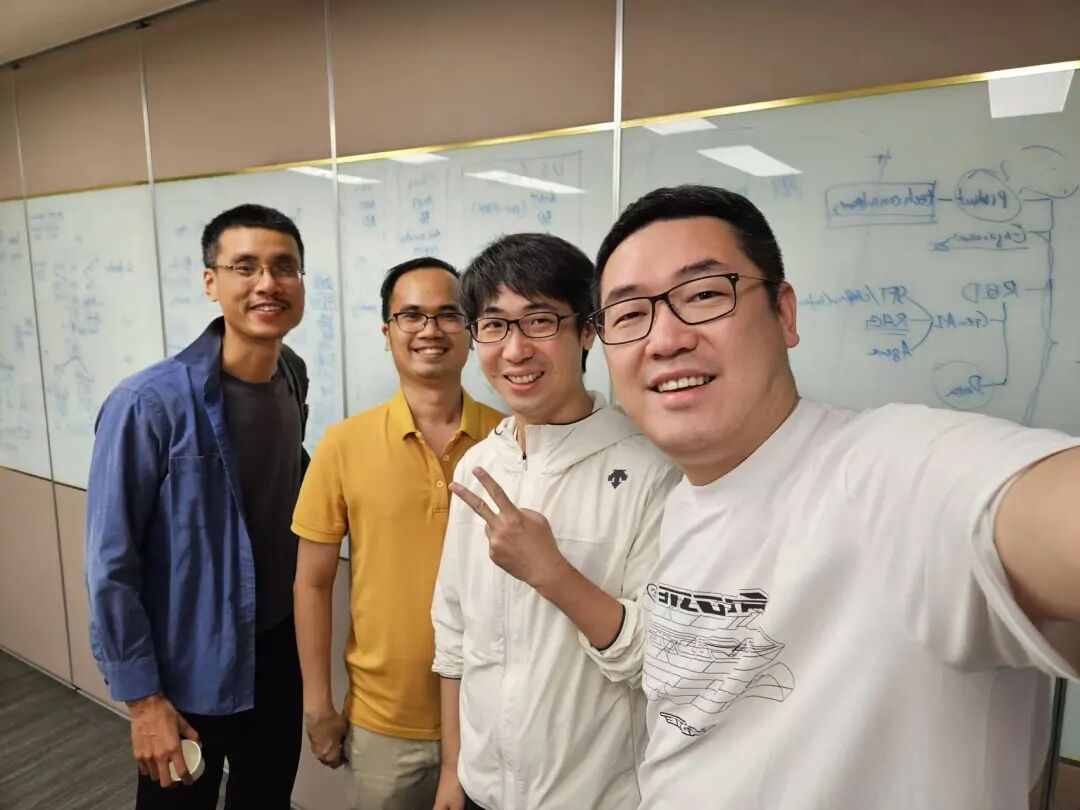
Tony (second from right) and Chao (far right) with Recurve Vietnam's CTO and CPO
Q: Is there any unspoken competition between you?
Tony: No, the few of us share relatively aligned values but vastly different capabilities. I still position myself in product and technology. Our other two founders — one spends more energy on company operations and project execution, the other has business acumen and experience far above ours. It's relatively a division of labor where each handles their own domain.
Q: After Yimian Data found PMF, it took just an hour and a half to get funding from ZhenFund.
Tony: Right, the first meeting with ZhenFund was at their国贸 office. Talked with Anna for about an hour, I explained the general product plan and business path. Anna said, "Hmm, I think you guys are pretty good, let's cross the street downstairs to Teacher Xu's place and tell him too."
At Teacher Xu's place, I spent 15 minutes telling the exact same story, word for word. I'm 100% sure Teacher Xu didn't understand a thing, haha. But Teacher Xu has incredible energy — he was absolutely thrilled, and on the spot he said, "We're going to invest in your company."
It was a truly magical moment. ZhenFund wasn't the first VC we'd met, but I had assumed it would take much longer, more hardship, more grilling from investors to secure funding and support. Instead, it took just an hour and a half.
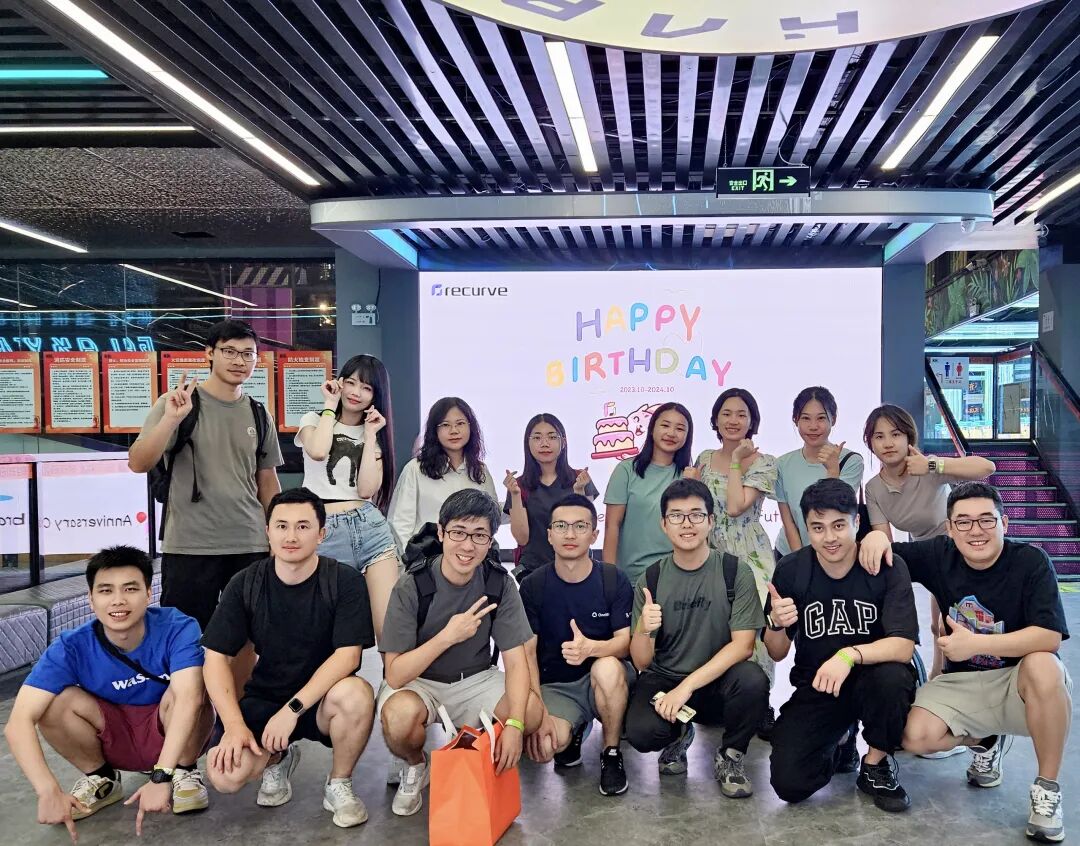
Recurve's first anniversary! Shenzhen team offsite
08
"Nobody Understands 'From Intern to CEO' Better Than Me"
Q: When you left Yimian Data, the person who succeeded you as CEO had once been an intern at Yimian?
Tony: She joined Yimian Data as an intern in 2015. She started from there and gradually grew into the role.
Because once the earnout was completed, regardless of whether I stayed at the group or not, I had to step down as CEO. As long as the founder remains at the company, the team can never truly integrate into the larger group system.
When I left, I had internally developed someone to take over as CEO. People often ask me, "Tony, how did you cultivate her?" Looking back now, I find it hard to say I "cultivated" anyone. More than anything, I hoped to provide better opportunities and environments for people.
Some people become CEOs, some become technical experts, some grow into top-tier salespeople. All growth depends on each person's traits, interests, and strengths — these gradually guide them to develop in different directions.
Q: What traits enabled her to grow into a CEO?
Tony: I think the most important trait is perceptiveness about people.
For a company that's already reached a certain scale, with a team to manage, having even a little human touch is incredibly important. Knowing what the team wants, what they need, why they're struggling, what motivates them. What do my clients want? How do I communicate with them? What are they worried about? Why do they choose me or not choose me? All of this requires a feel for people.
There are also more fundamental traits, like being open-minded. And having a smaller ego — being able to reach consensus with others.
Q: Is she more like you, or different from you?
Tony: I think there are similarities, but more importantly, she did many things I simply couldn't do.
The stages a company goes through require different CEO qualities. I decided to leave a large platform and return to a very small team because I could sense that my strengths, interests, and where I could contribute most were right here — at the startup stage.
When a company reaches a certain scale, I also recognize my own limitations. There are things I genuinely can't do, and someone else can do them better, can lead our company to a higher state. I saw this complementarity in her.
Q: Yimian Data's website has a dedicated section recording all the interns who have ever interned at Yimian.
Tony: We've done this since Day 1, partly because I personally love interning.
The output from capable interns is beyond question. Interns are, in a way, a great supplement to the existing team — they can work on things unrelated to daily operations but highly beneficial to the company overall.
Also, having done many internships myself, I know what interns want. Beyond work experience and real project exposure, we wanted to put everyone's credentials on the website. If Yimian becomes increasingly well-known, it serves as a nice endorsement for them when applying to schools or jobs in the future.
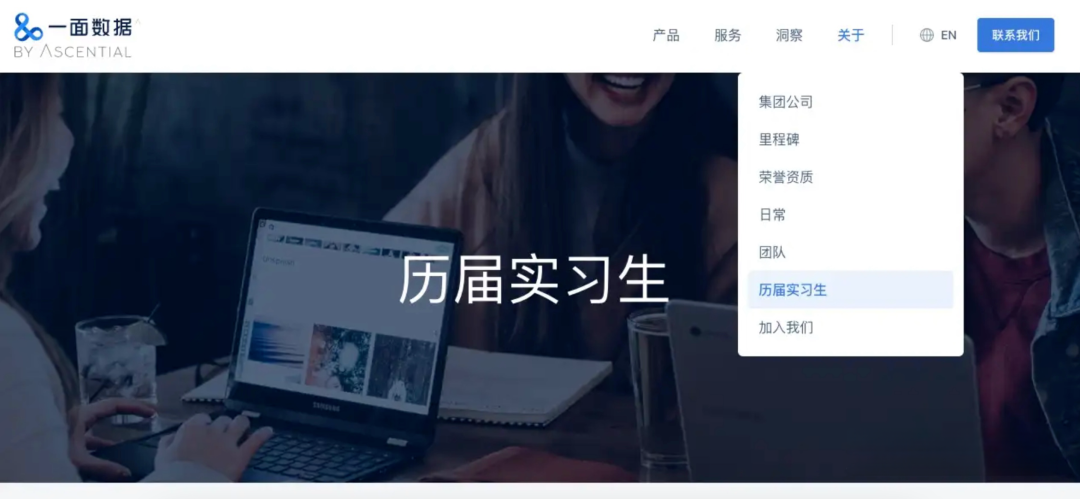
Yimian Data's former website
Q: What role do interns play at Yimian and Recurve?
Tony: Every intern's role is different, depending on their background and goals.
For example, some students come knowing they can intern for six months or even longer — they're essentially no different from full-time employees. For short-term interns, we mostly hope they can use winter or summer breaks to participate in industry projects, serving as supporting roles to help full-time employees manage workload during peak seasons.
There are also more special cases, like PhD students. The company has some relatively open-ended problems that aren't suitable for full-time employees. The more open-ended a problem and the less defined its output, the harder it is to convert into KPIs, and the less direct help it offers for a full-time employee's career growth within the company. But for PhD students, these problems are interesting.
Some PhDs come with their own research topics, and we let them lead independent, more forward-looking projects, which helps them integrate with their research, publish papers, and graduate sooner.
Q: A Yimian employee wrote on Zhihu that colleagues felt like university classmates, and leaders felt like counselors or senior peers. Do you prefer young people and this campus-like atmosphere?
Tony: We particularly like hiring young people.
We've actually tried — our first choice is always to find people with both experience and capability who are also a good match. But often in newer industries and startups, this is an impossible triangle. If someone has both experience and capability, you probably can't afford their salary. If they're young and promising, they may not have the experience you need.
Later we realized: since what we're doing is relatively new, we can't find particularly well-matched people on the market. Rather than struggle with this, we'd rather attract younger, more driven young people, invest more time in them, and grow together with them. It's actually very similar to ZhenFund's hiring philosophy.
Q: But some founders have said that if you view each team member as an opportunity cost, they'd rather spend more money hiring more experienced people, keeping the team small and highly efficient.
Tony: This doesn't necessarily apply to all industries. For R&D-driven companies where core technology accounts for a high proportion, the more people you have, the higher your management costs. Team coordination and project management themselves are forms of waste.
But for enterprise services, the two most important words are "service." The service team's headcount grows with client payment amounts — this is an objective law.
Although technology and Gen AI will flatten this growth curve to some degree, you still need more people joining the team. Having chosen the enterprise services track, we need the awareness to build a more combat-ready team and leverage more people.
Organizing a team from promising young people has excellent precedents. Our first FMCG client was P&G. P&G's management trainee system is known in the industry as the Whampoa Military Academy — P&G has its own alumni association, and even ventures specifically investing in P&G alumni founders.
Young people's growth is extremely rapid. Even if the first year is a loss, by the second or third year, they produce tremendous results.
Q: What's the advantage of young people in entrepreneurship?
Tony: In recent years people often talked about being a friend of time. But I think technology itself is the enemy of time.
I studied computer science at USTC for so long and even earned a PhD, but my technical skills are far inferior to what freshly minted PhDs can produce.
The technologies young people learn in school and the experiments they run are absolutely ahead of the entire industry, ahead of old tech hands like me who've been at it for 11 years. The Yangtze's waves drive the waves before — in technology, this is brutally, realistically true.
Recurve website: recurvedata.com
Recommended Reading