A Flying Action Camera That Raised Over $4.4 Million on Overseas Crowdfunding | Z Talk

Within two hours of going live, the crowdfunding campaign hit one million dollars.
Z Talk is ZhenFund's column for sharing insights.
The HoverAir X1 PRO and PROMAX flying cameras have officially gone on sale, building on the original X1 model with upgrades to imaging performance and scene applications. After launching on the overseas crowdfunding platform Indiegogo, they hit $1 million in just over two hours, with cumulative funding now exceeding $4.4 million.
"HoverAir" is a flying camera brand established by Zero Zero Robotics in 2022. In 2014, Zero Zero Robotics was co-founded by two Stanford PhDs, Mengqiu Wang and Tong Zhang, bringing together talent from top universities and research institutions at home and abroad. In the first half of this year, Zero Zero Robotics' sales grew more than fivefold year-over-year. ZhenFund made an angel investment in Zero Zero Robotics in 2015 and continued to double down in the Series A round.
As action flying cameras gain increasing attention, the HoverAir X1 PRO and X1 PROMAX are bringing new possibilities to imaging technology and flight performance.
Author | Yiting Hu
Editor | Silai Yuan
Cycling, skiing, weaving through dense forests... people are taking their gear outdoors, recording and checking in amid nature. Phones, cameras, and drones have gradually expanded our perspectives, but they still constrain our hands to varying degrees — which is how the smart-following action flying camera came to be.
Select a shooting mode, point the lens at your subject, and it takes off from your palm on its own, capturing both the person and the scenery. The action flying camera offers an alternative shooting angle without requiring any manual control.
In 2016, just two years after its founding, Zero Zero Robotics began launching such a camera, naming it "Hover Camera Passport" with autonomous following and lightweight portability as its main features. The following year, it entered more than 400 Apple retail stores across over 30 countries.
After testing the market with its first product, Zero Zero Robotics established the "HoverAir" brand in 2022, launching the HoverAir flying camera X1 and formally entering this product category.
The HoverAir flying camera X1 enables palm takeoff and landing with follow filming, equipped with more than ten shooting modes; its foldable design keeps the entire device at just 125g — lighter than an iPhone 16 — making it easy to carry around. Since its global launch, cumulative shipments have reached several hundred thousand units.
Over the past decade or so, drone manufacturers led by DJI have cultivated a consumer base passionate about shooting grand aerial scenes, gradually expanding into industrial applications such as agriculture, geographic surveying, and logistics through successive iterations. By comparison, action flying cameras remain focused on everyday consumer use, attracting a broader age demographic through features like simple operation, portability, and close-range shooting.
Nearly two years later, the PRO and PROMAX products based on the HoverAir flying camera X1 have launched with upgrades to imaging performance and scene applications. Both products debuted first on the overseas crowdfunding platform Indiegogo, hitting $1 million in just over two hours, with cumulative funding now exceeding $4.4 million.
01
Smart Following, Imaging Upgrades
A flying camera, as the name suggests, is a camera that combines wide-angle shooting in action scenarios with unmanned aerial flight capabilities. In practical use, it also fills gaps in the shooting limitations of the latter.
185 years ago, the camera capable of imaging and recording was invented, gradually being used to capture the external world. When flip lenses and phone selfie functions emerged, people widely began taking selfies. However, how to integrate the shooter and scenery into the same frame without relying on a third party or tool — few enough products have achieved this effect.
To realize this new shooting mode, Zero Zero Robotics began developing the corresponding category ten years ago. From the first-generation Hover Camera Passport, the HoverAir X1 camera, to the upcoming X1 PRO series, it has continued the concept of the action flying camera, making customized investments in imaging performance, flight power, and remote sensing systems.
Multi-mode smart following is the flagship feature of action flying cameras. According to Zero Zero Robotics CEO Mengqiu Wang, the X1 flying camera can already complete front, side, and rear multi-angle following after simple device setup, and with automatic shooting mode coordination, it can automatically generate visual effects like jib arms, sliders, and cable cams.
The recently launched X1 PRO series integrates and upgrades these functions in following effectiveness and stabilized imaging. Both products apply AI algorithm-based automatic recognition technology to achieve high-speed smart following, with following speeds up to 42 km/h. Even when a person suddenly accelerates to 60 km/h, the camera won't lose track.
Meanwhile, the X1 PRO series inherits multiple flight modes from the previous generation, enabling classic modes such as hover, pull-away, top-down shot, and orbit to capture dynamic moments; it can also complete advanced modes including parallel follow, super front follow, and manual control.
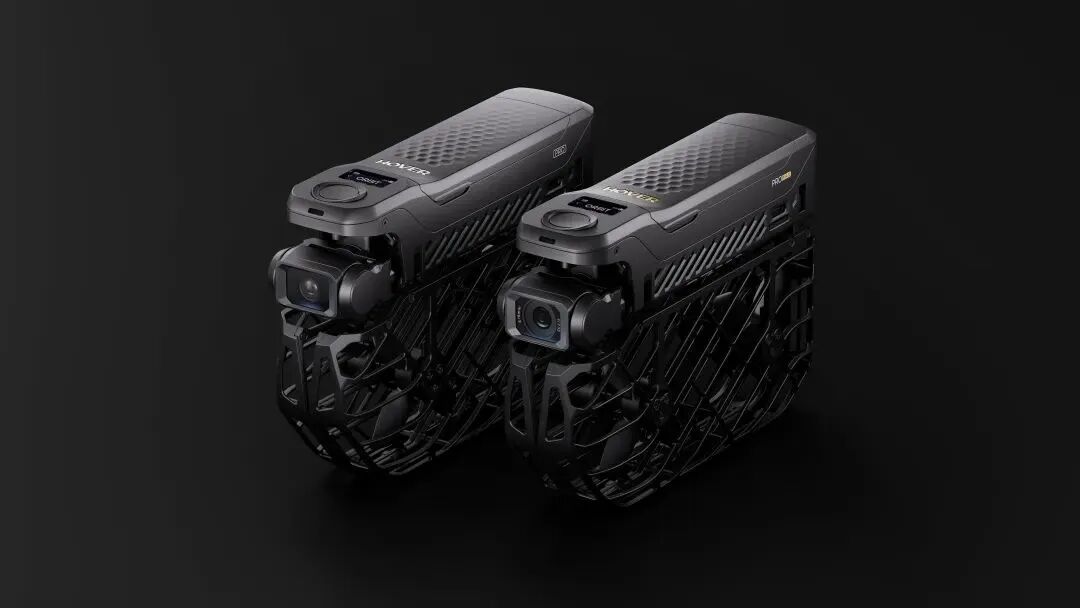
HoverAir flying camera X1 PRO series, image source: company
In stabilization and imaging, the X1 PRO series adopts a dual-axis gimbal + EIS (Electronic Image Stabilization) + horizon correction, capable of resisting up to level 5 wind force (10.7 m/s) during outdoor shooting.
Mengqiu Wang told 36Kr that even after all electronic stabilization and cropping, the PROMAX maintains 8K resolution, while achieving approximately 107-degree wide-angle effects during shooting.
8K imaging is also a highlight feature of the PROMAX this time. Wang explained that this stems from optimization and integration across the entire imaging system chain. This flying camera features customized upgrades throughout the entire chain from gimbal, lens, image sensor, to ISP image processing chip. To achieve both imaging quality and compact size, the lens employs a combination of 6 plastic lenses and 1 glass lens, maintaining strong resolving power while compressing volume.
At a time when 8K has yet to become mainstream in imaging effects, the positioning of the HoverAir X1 PRO and PROMAX also differs slightly. The former focuses on sports, suitable for outdoor scenarios like cycling and skiing, with imaging performance achieving 4K 60fps shooting, priced at 3,499 RMB ($499 overseas), offering relatively better value compared to the PROMAX.
The PROMAX features 8K imaging, better suited for content creators or photography enthusiasts with higher demands for image quality. Its official standard configuration is priced at 4,999 RMB ($679 overseas), making it a rather rare sub-1,000-dollar 8K device. Currently, the X1 PRO series is available for purchase on online platforms.
02
Covering Multiple Age Groups, Facing the Global Market
Flying cameras belong to a sub-category of drones. For most people, this type of product remains relatively novel, but with the boom in outdoor travel in recent years, the user base for HoverAir flying cameras has gradually grown.
Compared to consumer drones on the market, HoverAir flying cameras don't target photography enthusiasts who are passionate about and skilled at photography, but rather ordinary people of all ages who casually pick up their phones or other devices to record and check in.
In the already-launched Hover X1 APP, a community is designed for users to upload and share photos or videos. Browsing reveals short videos uploaded by different groups — teenagers cycling outdoors, young people with pets, middle-aged and elderly travelers checking in — using various shooting modes in outdoor scenarios.
To facilitate users generating short videos for sharing across multiple platforms, the HoverAir X1 PROMAX supports 4K 30fps high-definition vertical shooting mode, matching corresponding quality and specifications.
Additionally, beyond the APP community, HoverAir flying cameras have nearly a hundred WeChat groups and overseas social media communities, where users spontaneously share footage from daily life, travel, cycling, skiing, and other sports.

HoverAir flying camera applications in skiing and cycling scenarios, image source: company
While trying to match broader demographics, HoverAir also continuously expands applications for complex scenarios. Compared to indoor environments, the outdoors contains many unpredictable factors, and complex, variable terrain environments challenge devices' recognition and reaction capabilities — a moment of inattention and a drone may crash.
Previously, drone users crashing in complex environments like water surfaces and dense forests has been common. Some models from manufacturers like DJI and Skydio also include warnings before use to exercise caution when flying over water and other scenarios where devices are difficult to control.
Mengqiu Wang told 36Kr that water surfaces are unsuitable mainly because water absorbs wavelengths — when drone equipment emits lasers over water and gets no reflection back, it cannot confirm its own position; with constant water surface fluctuation, drones also struggle to calculate and assess how to adjust themselves.
The previously launched HoverAir X1 flying camera had this limitation. To achieve complex scenario applications, the X1 PRO series adopts multi-sensor fusion technology, equipped with an all-terrain flight system capable of flying over water, snow, cliffs, and low-light environments.
Alongside iterative upgrades, HoverAir has launched sales both domestically and overseas. Overseas, it is available on Amazon and its independent site; domestically, it mainly sells through e-commerce platforms like Taobao and offline experience stores. Currently, overseas sales account for a higher proportion than domestic sales.
To enter more countries and regions, HoverAir flying cameras customize products for local markets. In Japan, where laws stipulate that drones under 100 grams can be used without registration, it launched the HoverAir flying camera X1 Smart, sacrificing the foldable function to reduce weight to 99 grams, facilitating user shooting.
This product was launched through crowdfunding in both Japan and Taiwan, with crowdfunding reaching approximately 212 million yen (about $1.41 million) in Japan; and exceeding 28 million New Taiwan dollars (about $870,000) in Taiwan.
To date, HoverAir flying cameras have established preliminary frameworks for overseas marketing, distribution, compliance certification, and after-sales service.
At a time when consumer drone growth is slowing and product homogenization is increasing, even though the flying camera category remains relatively niche, competition has already begun. In the second half of this year, DJI launched the Neo drone, also featuring palm takeoff and smart following as core functions, with pricing nearly 1,000 RMB lower than HoverAir's previously launched X1 flying camera. Less than two months after release, sales through a single online official flagship store channel have already exceeded ten thousand units.
After years of upgrades and iterations, flying cameras are gradually becoming less unfamiliar, and the entry of giants may usher them into a new stage of development.
Recommended Reading