Three PhDs from HKU born in the 1990s want to give every mobile robot a hippocampus | Z Talk

How do you cross the "valley of death" from lab to industry and build the "Odin's Eye" for robotics?
The team behind Manifold Tech first met in the basement of the Wong Chik Hang Building, one of HKU's oldest structures on Pok Fu Lam Road. When Youming Qin and Wei Xu first arrived at HKU for their PhDs, MaRS Lab was still a steam boiler room. The cavernous space and unusually high ceilings made it ideal for drone flight tests. From the sunless basement to breezy beaches, Qin and Xu spent their days alongside lab mates testing algorithms and crashing drones.
During their doctoral years, they also watched MaRS Lab transform from a dilapidated basement into one of academia's premier drone research labs. The lab's open-source FAST-LIO project garnered 3.3k stars on GitHub, making it one of the most influential open-source systems in SLAM (Simultaneous Localization and Mapping) in recent years. FAST-LIO helped shift robotics from "offline mapping" to "online spatial understanding." Years of accumulated expertise in perception — and the pain of countless crashes — led Qin and Xu to want to lower the barrier for the broader robotics community to access this technology.
In late 2022, Qin and Xu graduated from MaRS Lab, having already co-founded Manifold Tech to provide the most critical perceptual capability for general-purpose embodied intelligence. Ninety percent of technological breakthroughs never leave the lab; Manifold is among the rare survivors. Their first product, MindPalace 360, turned profitable within three months of launch. That same year, ZhenFund led the seed round.
Their newly released third-generation sensor, Odin1, is what the founding team calls the robot's "hippocampus." Odin1 fills the most critical gap in robotic perception systems — spatial memory. It packs a small NPU capable of processing visual semantics, object recognition, spatial mapping, real-time updates, and shared memory systems.
If compute-rich large models are the robot's "brain" and precise execution controls its "cerebellum," then Odin1 is its "hippocampus."

The iPhone Moment for Sensors
Powering 3D Perception and Autonomous Decision-Making
Q: Let's start with brief introductions from each of you.
Youming Qin: I'm Youming Qin, CEO of Manifold Tech. I did my undergrad in electrical engineering at Virginia Tech, then came to HKU where I worked with Professor Fu Zhang on drone research. That's where I met my co-founder Wei Xu. In October 2021, before graduating, we founded Manifold Tech in Hong Kong.
Wei Xu: I'm Wei Xu, CTO at Manifold. My bachelor's and master's were at Beihang University, and I did my PhD under the same advisor as Youming, graduating right after him. My research focused on 3D mapping and localization, mainly on the algorithms side. Manifold still centers on 3D perception, providing robotic localization and navigation solutions.
Yang Fan: I'm Yang Fan, serving as COO. My background's a bit different — I studied mechanical engineering at HKU as an undergraduate, and Youming and I were "cross-temporal" roommates. Later I got my PhD in aerospace at UIUC. This is my third time joining a ZhenFund-backed startup. I've done robotics work before, and now I oversee overall operations, international markets, and brand communications.
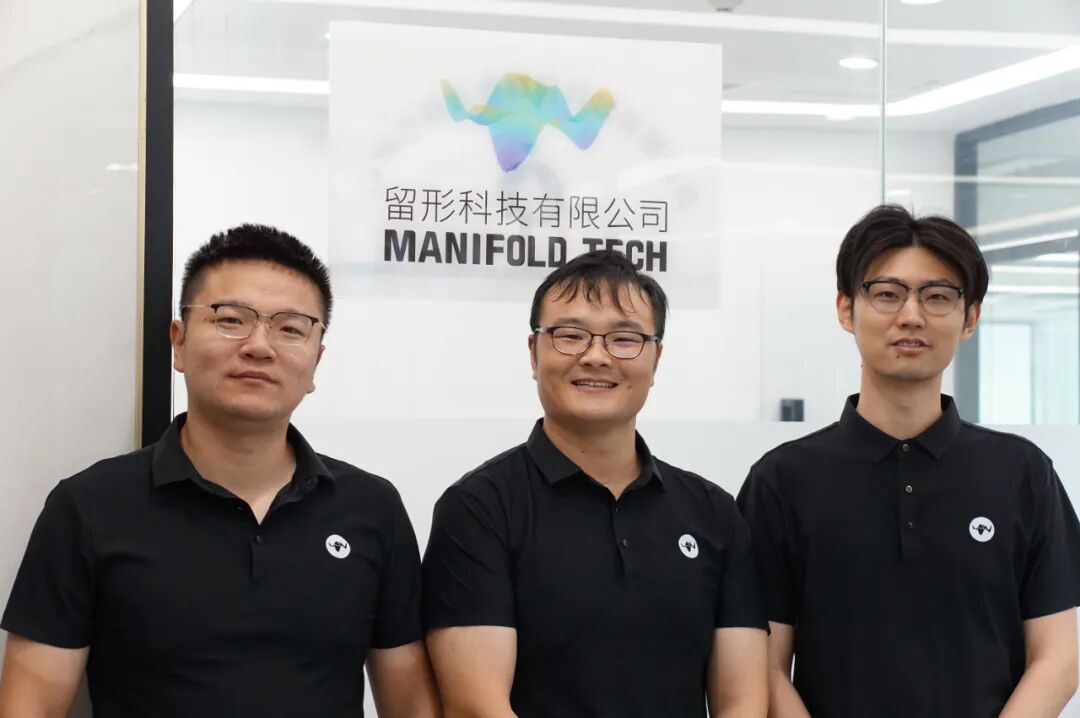
Wei Xu (left), Yang Fan (center), Youming Qin (right)
Q: Manifold has released several product generations since 2021, evolving from 3D data capture devices to Pocket and beyond. How do you position Odin1 within this product lineage? If you had to summarize its defining characteristic in one sentence, what would it be?
Youming Qin: Compared to the first two generations, Odin1's biggest change is that it's far more compact and truly ready to use out of the box. Previous devices were like "brick phones"; Odin1 is more like a smartphone. You could say it's finally having its iPhone moment.
If I had to position Odin1 in one sentence: it's the world's first sensor with spatial memory capability.
This "spatial memory" has two layers. The first is perceiving space: knowing what's around, what shapes things are, where they're located. Like Sherlock Holmes reconstructing a crime scene in his mind's eye with eyes closed, piecing together scattered clues. Our previous product was called MindPalace for exactly this reason.
The second layer is understanding space: not just "seeing" objects but grasping their significance. Recognizing there's a microphone on the table and realizing I'm speaking into it. Or noticing a water bottle by your computer and judging it might pose a risk to the machine.
This is what we call "yanlijian'er" — having perceptiveness. When embodied intelligence truly becomes widespread, we won't want robots standing there asking, "How many degrees should I turn?" or "Which object should I hand you?" Instead, when you say "Go next door and pour me a glass of water," it should automatically understand: find a cup, find the door, choose a path, get it done. That requires spatial memory.
Wei Xu: Spatial memory means a robot can remember every position and orientation it's ever reached. Just as we instinctively memorize landmarks and sketch mental maps in unfamiliar places, our sensor can do the same.
This need has recurred across countless robotic systems in the past. The problem was that solving it used to be prohibitively expensive, with limited approaches. We wanted to combine this capability with increasingly mature upstream sensors and edge computing, integrating everything into a compact, usable module adaptable to various robots.
Odin1 is our smallest and most advanced product yet. Whether LiDAR, cameras, or CPU — all are custom-developed, achieving high integration.
Yang Fan: For users, Odin1's significance is that it lets robots truly ditch the remote control for the first time, autonomously perceiving, deciding, and moving through complex indoor spaces. Spatial perception is ubiquitous in nature — nearly all living things have it. Many teams have tried to replicate it, but none have truly delivered. Odin1, we hope, is that inflection point.
Q: When did you realize spatial memory could be your entry point?
Wei Xu: The demand for spatial memory has always been there. What changed was the past year. The entire upstream chain matured thanks to autonomous driving development — supply chains grew richer and more standardized, chip performance improved. We recognized late last year that the timing was right and jumped in immediately.
Two industry trends drove this:
First, sensors are evolving toward lower costs and solid-state designs. Companies like Hesai and RoboSense are pushing in this direction. Once costs come down, sensors will become as ubiquitous as cameras are today.
Second, embedded CPU upgrades. Starting in 2023, whether NVIDIA or domestic manufacturers, everyone began releasing powerful embedded CPUs and MPUs. This made integration and miniaturization possible for us.
We also had an accumulated advantage: algorithm capabilities developed through years of research that could be rapidly deployed to hardware. Not everyone can easily replicate this — it involves massive hardware-software co-development. Our team's speed in this area is a real strength.
Q: How did your three product generations evolve?
Youming Qin: We planned Odin1 very early on. Like how Tesla did Model S before Model 3, we wanted to start high-end, then miniaturize for mass adoption. Team experience carries over, and the pace is faster.
The first generation was MindPalace 360 — about the size of two water bottles, launched in February 2023. Right around then we'd just finished a project scanning the Tai Pak Floating Restaurant from Stephen Chow's film The God of Cookery.
There were only two floating restaurants in the world: Jumbo and Tai Pak. The year we started our company, both entered "midlife crisis" and desperately needed maintenance. Jumbo sank, and Tai Pak realized it needed a complete digital record fast — so they came to us.
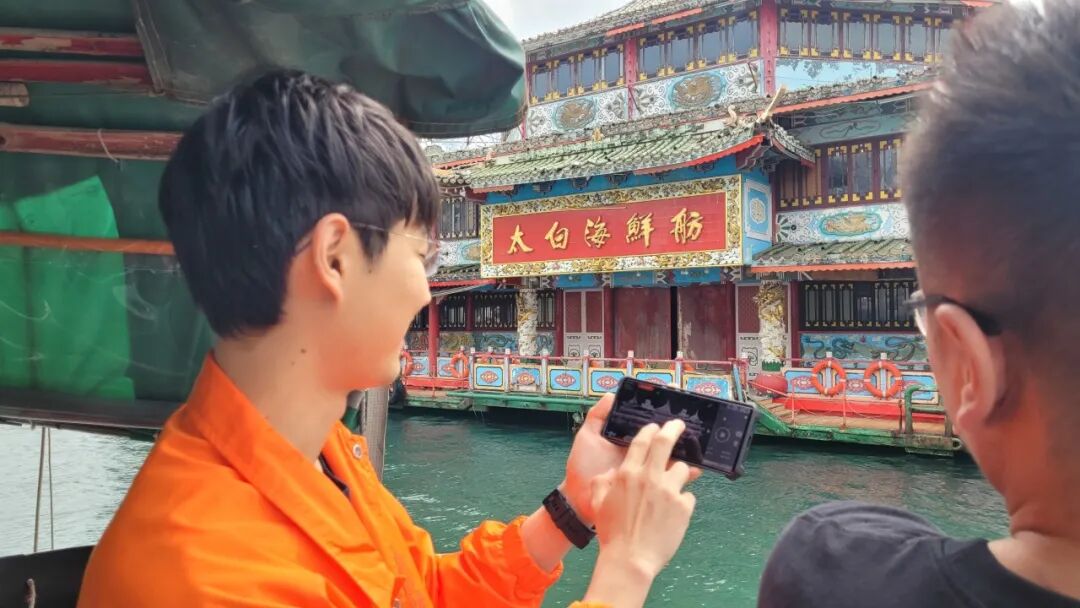
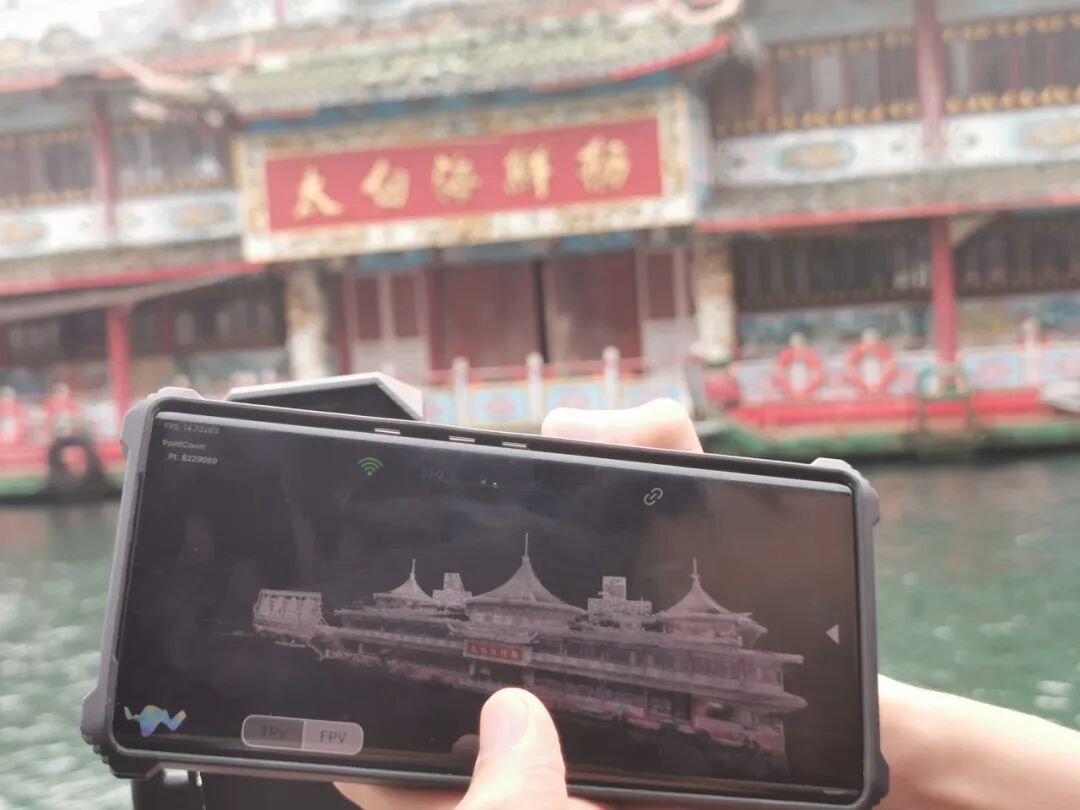
In 2023, the Manifold team conducted heritage digitization work at Tai Pak Floating Restaurant
Filming on a boat wasn't easy — oblique photography didn't work, GPS had no signal. Our first-generation Manifold device finally got its real-world test. Shortly after repairs finished, a typhoon hit Hong Kong, and our captured data was used for top-level restoration.
Back then, the core components alone were so bulky that adding a screen would have made the whole thing medium-format camera-sized. But we kept shrinking. The second generation, MindPalace Pocket, already fit in your pocket — fist-sized.
By the third generation, Odin1, we entered full smartphone form factor. We hope it becomes standard equipment for researchers, like how your first purchase as a PhD student is a main control board — and the default sensor on that board is Odin1.
Why does "small" matter so much? For those of us with drone backgrounds, every gram added or subtracted affects thrust-to-weight ratio, determining whether you can fly and for how long. For instance, DJI's Matrice drones can fly an hour unloaded, but only 20-30 minutes with payload. Lightweight is non-negotiable.
Q: Did you have Odin1's ultimate form in mind from day one?
Youming Qin: Yes. If you dig up our 2021 Bilibili video, you'll see behind-the-scenes footage shot on an iPhone. Even then we were already envisioning what the third and fourth generations would look like, rendering concepts in that direction.
We called it the "spatial camera." Imagine it like a DSLR, except instead of capturing 2D photos, it records complete 3D environments. Because if VR or MR truly becomes mainstream, we'll need a camera that can record "space."
There's a shot in that video where someone pulls a phone-sized device from their pocket, and the environment is instantly captured in 3D, becoming a freely explorable game world. Our ultimate vision is: dissolving the boundary between virtual and physical, making the two worlds seamlessly connected.
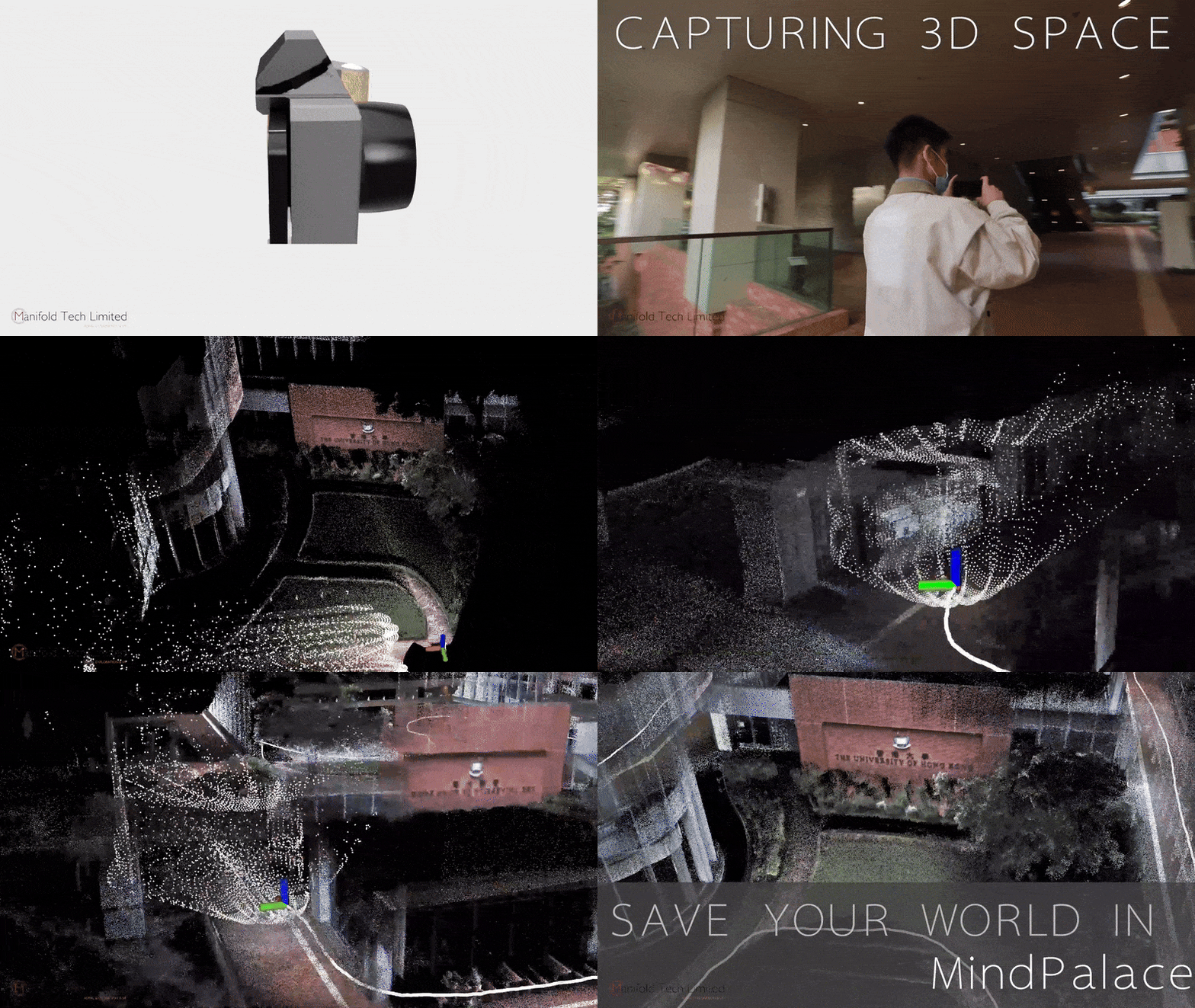
A clip from the MindPalace video Liuxing posted on Bilibili at the end of 2021
So in 2022, we came up with a new slogan: "Bridge the gap between virtual and reality."
Think back to the 1970s, when humans invented the 2D printer; decades later, 3D printers emerged, capable of printing a drone directly. We already live in a three-dimensional world — why should we still use two-dimensional tools to express and produce?
For instance, if you have the raw 3D data of a house, you can use AI to automatically generate renovation plans and have them custom-produced at a factory. At that point, space is no longer just "something you see" — it's "something you can use."
The same goes for robots. Today's large models output answers that are essentially text, one-dimensional, not even truly two-dimensional visualization. That's linear thinking. But once we achieve three-dimensional-level understanding and expression, virtual and reality can truly connect.
I believe "spatial memory" isn't a deconstruction of the existing world, but an opening — bringing everything into the possibility of spatial intelligence. Anything can be understood and interacted with in space. It opens up an entirely new dimension, and the imaginative possibilities are only beginning.
Xu Wei: Odin1 maintains strong continuity with its predecessor. Many customers who used our second-generation product are thrilled about this new one, because Odin1 delivers substantial improvements for them — smaller volume, lower cost, and especially impressive cost control, allowing them to capture 3D data far more efficiently.

Every centimeter smaller, every cost reduction
Is a negotiation with reality
Q: What application-layer optimizations have you made for robotics, your primary use case?
Qin Youming: Weight, volume, price, robustness, stability — these are the dimensions we care most about when designing a robotic system. Odin1 is compact, but every centimeter shaved off involves optimizing the underlying sensors. We have to consider not just hardware specs, but software adaptation as well.
Our goal is for Odin1 to become the "first spatial perception system" for many small teams — unbox it, get it running quickly, and leap from remote-controlled cars straight to embodied intelligence. We redesigned Odin1's "Hello World" specifically to lower that barrier.
Xu Wei: Many sensors previously used on robots were originally designed for human vision, with bulky modules or aviation connectors that are unfriendly to robots. In this generation, we switched directly to USB-C, and the form factor aligns with many stereo cameras, fitting right against the "eyes" for easy, seamless replacement of legacy systems.
Qin Youming: During my PhD, I built countless systems myself. Every paper was like launching a new product, starting the platform from scratch each time. Many drones I literally crashed into existence.
After countless failures, I realized: some foundational, repetitive work isn't worth redoing for every generation of researchers. Odin1 was built to solve this. We want others to stand directly on the system we've built, and pour their energy into real revolutions instead.
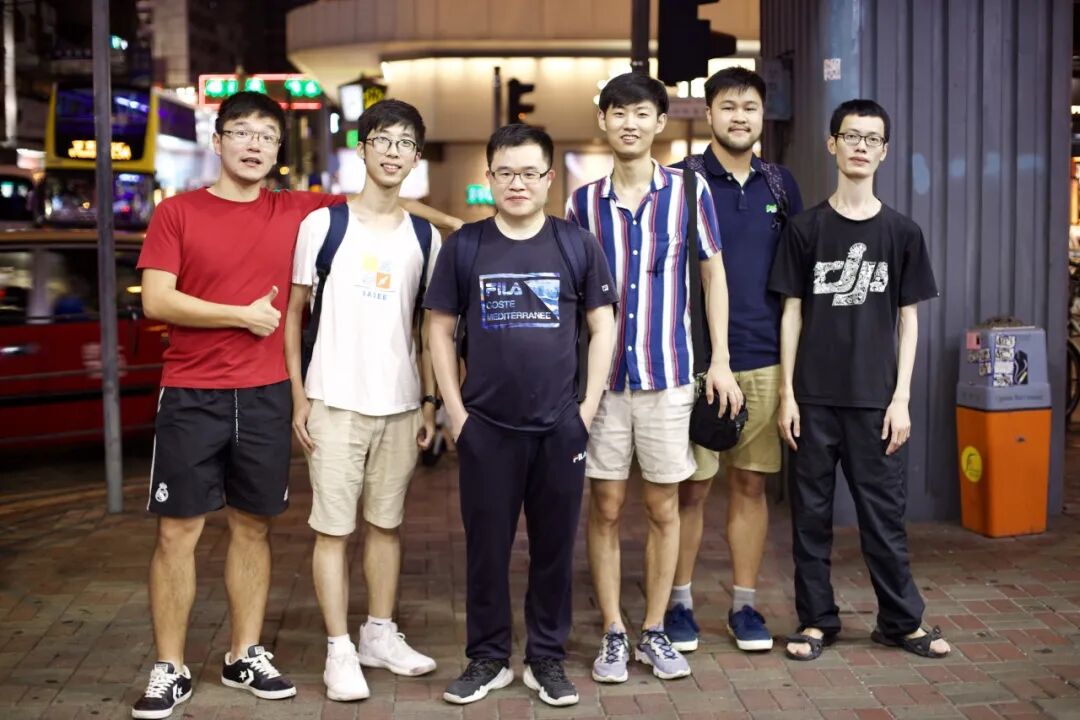
The Liuxing team in 2019, during their doctoral studies Xu Wei (far left), Qin Youming (third from right)
Q: Have you had to make any difficult trade-offs?
Xu Wei: Almost every parameter required balancing. Our initial weight target was 200 grams; we ended up at 299 grams. Every dimension, every interface demanded extensive validation — all of it "dancing in shackles." We tried our best to find the optimal point among performance, cost, and manufacturability.
Q: You've mentioned that certain prerequisites are needed for a robot "hippocampus" to emerge. What are the current technical bottlenecks?
Xu Wei: Short-term technical bottlenecks exist, but they'll be solved eventually. The real challenge is how to effectively bring the product to market.
Our first-generation device cost around 70,000–80,000 RMB, and it was still multiple sensor components assembled into one unit — we couldn't integrate the robot's "hippocampus" into a compact module at that time. But with this generation — Odin1, the robot's "hippocampus" — we've done deep work on cost and structure, managing to perfectly integrate all components into a single module while bringing the price down to a range that enables mass adoption in robotics.
Yang Fan: Cost control is one of the critical factors. The most commonly used, most fundamental sensor in robot design is the camera. Looking at trends, all robot sensors should learn from cameras, evolving toward smaller size, lower power consumption, and higher integration.
For a startup, surviving the death curve requires doing two things simultaneously: getting the price into a reasonable range, and getting to market fast to build shipment volume. Only when volume rises does cost drop, enabling scale. Technology must be advanced, but it must also achieve commercial viability.

Every mobile robot needs a hippocampus
Q: We're seeing rapid development in robotics and embodied AI agents — brain functions (large models, world models, etc.) are proliferating, and the cerebellum (motor control, reinforcement learning algorithms) continues to evolve, but hippocampal capabilities remain underdeveloped. Why is the hippocampus important for robots?
Xu Wei: Getting robots to complete complex tasks requires far more than dancing or pouring coffee. The real challenge is enabling them to autonomously chain multiple tasks together, moving from one room to another, continuously achieving different objectives.
This is what we're calling Physical AI today — teaching robots how to interact with the physical world. Despite the flood of demos, real deployment remains difficult. When tasks grow complex, the ability to stably decompose, sequence, and execute them is a massive challenge.
The good news is that robotic perception can improve dramatically. On one hand, advanced sensors and front-fusion algorithms can expand the boundaries of robot perception. On the other, we can achieve detailed spatial recognition and memory at the edge, at lower cost.
Once a robot has a spatial memory map, it can break complex tasks into a series of executable subtasks, completing them in order. This foundational capability is the basis for stability and leaps in 3D perception.
Yang Fan: Let's look at a few real-world application scenarios.
The "brain" uses large models to understand instructions and environments; the "cerebellum" controls action output. What capability does the "hippocampus" provide?
It's not about replacing humans, but accomplishing tasks humans struggle with or that are dangerous. For example, we've received feedback from users who want robots to enter high-risk fire scenes in place of firefighters. But current robots still rely on remote control — they can't independently execute missions.
With frequent earthquakes recently, rescue footage shows robots still being fed into narrow spaces via tethered remote control. In the future, could they autonomously explore rubble and transmit critical information in real time? The prerequisite is knowing where they are and understanding what's around them.
That's the hippocampus's role. In the human brain, it handles spatial memory and cognition — something robots still lack. Fei-Fei Li's concept of "spatial intelligence" was based on this very observation.
While 2D video understanding and content generation have matured enormously, robots' ability to interact with 3D physical space remains constrained. Many people mistakenly think navigation and localization have solved this problem. Yes, outdoor navigation is highly precise — think Amap. But what about complex indoor environments?
Current mainstream city-level positioning technology is primarily designed for outdoors. Getting robots to truly understand, remember, and adapt to complex, ever-changing indoor environments still has a long way to go.
Qin Youming: Odin1 is essentially a "spatial translator."
Before it existed, robots could only execute fixed motions according to programmed instructions. But extend the timeline — say, to when they're living on Mars — we can't still be sending commands from Earth. With signal delays that long, they must learn to adapt autonomously based on their environment. You're a mature robot now; make your own judgments, save humans the trouble.
As a spatial translator, Odin1 is profoundly significant. It enables large models to process more than just text — to truly understand space, and extend their reasoning capabilities into the physical world.
We've seen data showing humans spend over 70% of their time indoors, where GPS coverage is minimal. In these environments, if robots can't self-localize, navigate, and understand space, they can never truly enter our daily lives.
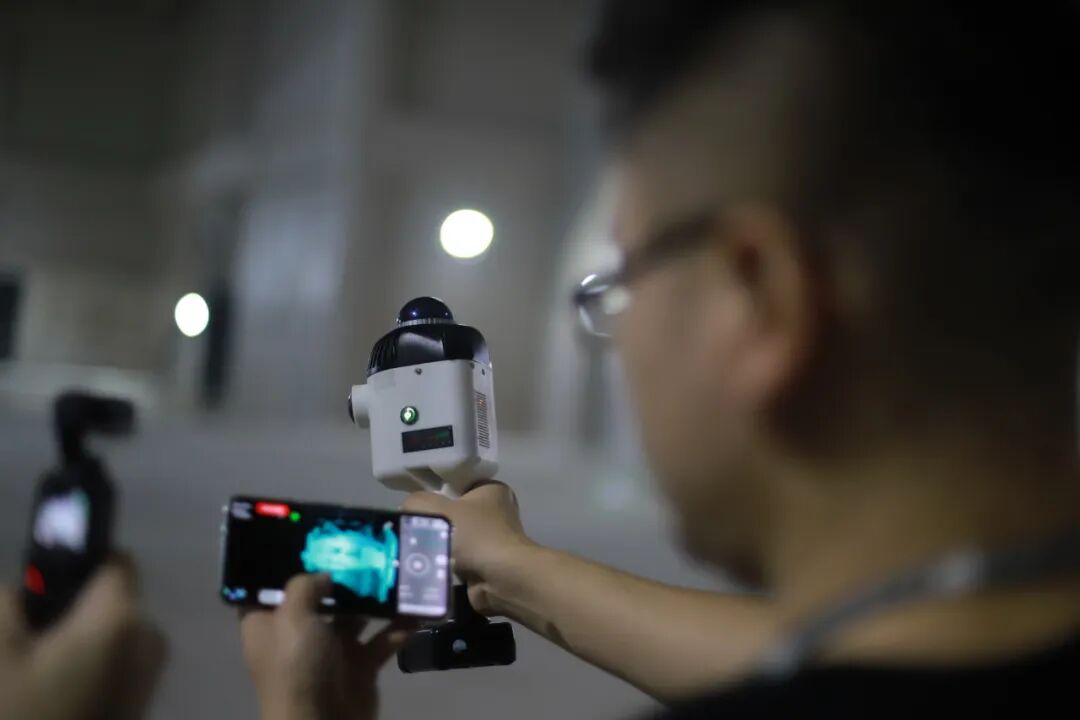
March 12, 2023: Liuxing's first small-scale deployment, participating in renovation progress management at the Hong Kong Museum of History
Yang Fan: Many people probably remember that starting in 2020, hotel delivery robots became common, carrying takeout from the front desk to hotel room doors. But this is very rudimentary indoor navigation. If a user wants the robot to go one step further — say, picking up garbage left outside the door — the system fails with even minor environmental changes, like a newly placed obstacle in the hallway.
The system we want to develop doesn't rely on static maps, but can continuously grow and autonomously adapt in real environments, achieving higher-level spatial intelligence.
Q: With spatial perception capabilities still incomplete today, what are some beliefs you hold strongly that are non-consensus but correct?
Yang Fan: Spatial navigation itself hasn't formed a unified consensus. Especially under the influence of autonomous driving, more people are exploring the limits of "end-to-end" approaches — do we really need fully end-to-end systems? Are there better hybrid paths?
You Qinming: End-to-end approaches were once somewhat "mythologized." Some believed that with enough data, an end-to-end model could solve every problem. But reality is far more complicated than that.
Odin1 reflects our chosen path: we employ learning-driven perception capabilities while preserving pure mathematical models for precise navigation modeling. This is a dual-track design for spatial intelligence.
Xu Wei: When people talk about AI today, they often overlook "memory."
What large models call "memory" is really just one-time information intake and output — there's no clear memory unit inside. But for living organisms, memory is obviously central.
Imagine if robots could share memory across multiple agents, continuously optimizing through team collaboration. Their learning efficiency would improve dramatically. In other words, we don't want memory to dissipate within every isolated model, but rather to achieve something shareable, updatable, and evolvable.
Google is also exploring this path, for instance by stripping memory modules out of neural networks as independent subsystems for storage. The key question is: when a robot enters a new factory or new space for the first time, can it simultaneously perceive and bind spatial structure with task workflows into a "memory body" to share with other agents?
Ultimately, we hope to achieve an experience like this: just like the "construct" in The Matrix, an environment perceived and constructed by one robot would not only be usable by itself, but could provide a visualized, interactive memory interface for all systems.
Associative memory is not only an important part of robot intelligence, but may also be the key to how they differ from humans — even surpassing them in certain aspects. Some capabilities don't need to imitate humans; they can forge their own path and perform even better.
Yang Fan: What Dr. Xu said is quite interesting. Today, judging whether a large model is strong often comes down to how close its error rate is to human error. But in machine perception, this standard may not apply. Take Odin1 — it can accurately obtain depth information for every single pixel, which is stronger than human capability.
Xu Wei: Humans are the natural evolutionary result of carbon-based biology. It's not as if wheels are more efficient than legs, so humans would grow wheels. Even if wheels far outperform legs, they wouldn't automatically change our original way of living.
The same goes for sensors. Fortunately, we've already developed perception devices stronger than the human body. The question is: should we remain trapped in the path dependency of "robots should be like humans"? I consider this a misconception. We should fully unleash the potential of modern sensors rather than remaining fixated on imitating human form.
Q: What's your view on the significance of spatial memory for robots? Is it a high-level module that gradually emerges from completing other tasks, or can it be developed in parallel with the "brain" and "cerebellum"?
Xu Wei: It should be parallel. Because that's how nature evolved.
In the mouse hippocampus there are "place cells" that form specific responses to certain areas of the environment. This shows that even low-intelligence organisms possess spatial memory systems.
The strength of human sense of direction is also closely related to hippocampal structure. This means that during brain development, it's not one module before another — multiple functions grow in parallel.
So I believe robots with mobility will inevitably have spatial memory systems in the future. Otherwise it would be difficult for them to truly understand complex environments. Of course, robots fixed to desktops doing repetitive motions could be an exception.
Yang Fan: Currently most humanoid robots focus on the cerebellum, while large models as the brain are also developing rapidly. But without memory, especially spatial memory, the value of mobile robots becomes hard to justify.
For a robot to move, it must understand space. Odin1 has a small NPU that can process image semantics, do object recognition, and spatial composition. And the memory system can be updated and shared in real time.
When I walk into a room and see five people, I don't just see obstacles — I can identify "who belongs in this room" and "who's a stranger." A robot vacuum can hardly do this. What it sees are just "things" to go around.
Spatial memory lets a robot know that there was a row of boxes in this area last time, and now they're gone, meaning it's passable now. This is almost identical to how we adjust our path when we enter a room and find the table has been moved.
Qin Youming: And it's not just memory refresh — each agent's map can be shared. You can analogize this to navigation apps like Waze: you report traffic jams, and the system judges road conditions through everyone's speed.
Future robots could work this way too. Robot A finds the road damaged, updates the map, and warns all other robots not to take this path; it could even sync to road maintenance robots to dispatch a team. This is the most efficient form.
Just like how we use navigation now — where there's traffic, everyone avoids it — robots with data, perception, and sharing capabilities will eventually achieve this kind of swarm collaboration too.
Q: We've talked a lot about FAST-LIO's value as underlying technology before. Could you explain more about how you cut from lab technology to industrial scenarios? From finding that first building surveying use case to today, has your understanding of application scenarios evolved?
Qin Youming: Our initial MVP landed in Hong Kong, with construction industry clients. The most direct opportunity came locally, and Hong Kong itself places high importance on digital construction. Rather than us seeking them out, it was users who found us and helped define our first-generation product.
We determined early on to do spatial perception. But first-generation product deployment chose the most realistic, most urgent scenarios. As we expanded into the market, we encountered needs like forestry inspection and infrastructure surveying, so the second-generation product began iterating toward greater generalization. By the third generation, we further optimized module structure — software became reusable, hardware was aggressively cost-reduced, finding balance between performance and cost.
This three-generation product lineage reflects a principle we've consistently upheld: using high-precision, low-cost, high-efficiency data collection systems to connect with the complex demands of real-world scenarios.
Xu Wei: From the first generation, we've focused on high-efficiency, high-quality 3D data collection. Construction, firefighting, surveying, and other scenarios all use our products for rapid mapping, supporting frontline personnel operations. The entire product technology stack has continuously expanded, now far exceeding our original lab vision and becoming a truly systematic platform.
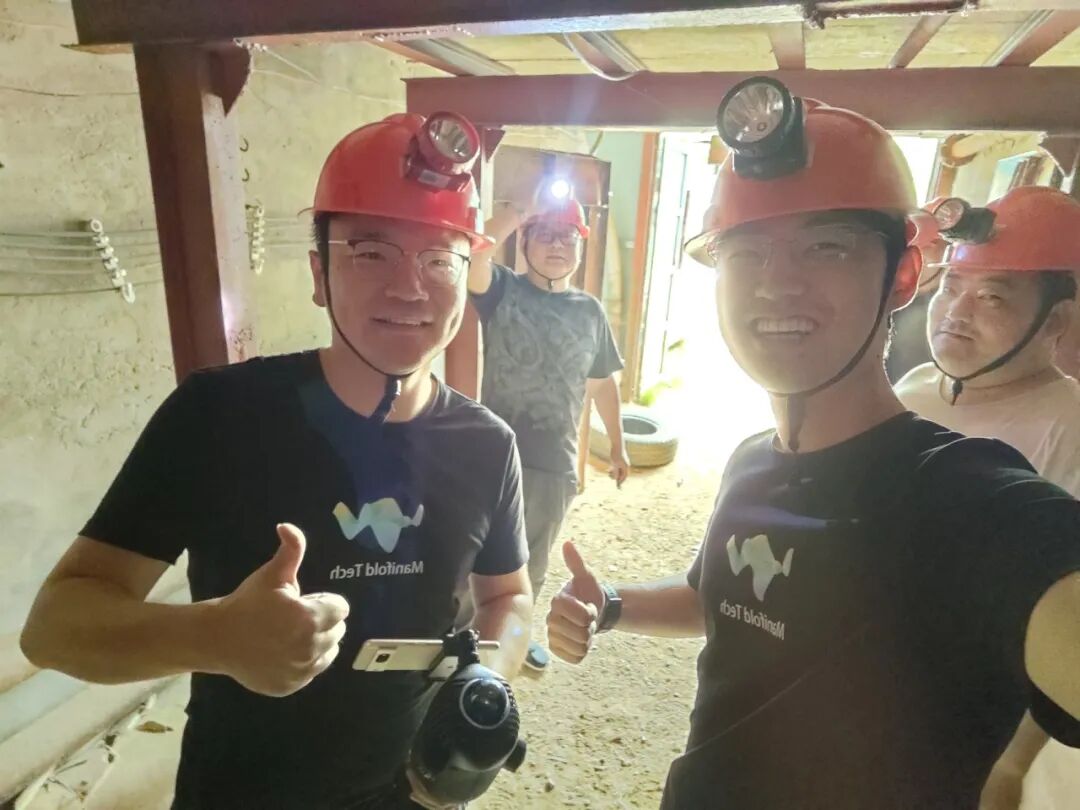
June 2023: Liuxing's early field test case at a gold mine in Henan
Q: Beyond construction and home renovation, what other scenarios are undervalued for 3D data?
Qin Youming: Take the recently viral Black Myth: Wukong, which used real-scene 3D to recreate historical and cultural sites, achieving millimeter-level precision through Gaussian rendering. Many players weren't even fighting monsters — they were "cloud touring."
3D modeling technology is now heavily used in film and games, whether for documentary and series backgrounds or full-segment green screen virtual production — all relying on spatial reconstruction capabilities. Ecosystems like Unity and UE have already integrated such functions.
Yang Fan: In my view, what's most lacking in robot development is high-quality real-scene 3D data — what academia often calls the "real-to-sim" problem: how to quickly restore real space into virtual simulation environments.
Why do this? Because most robot training happens in simulation environments. Without a virtual space close to real application scenarios, robots can hardly "learn well," let alone possess truly intelligent behavioral capabilities.
By comparison, image data training is already much more mature — after all, there are massive amounts of photos available on the internet. But high-quality 3D spatial data is almost impossible to find. Say I want to train a robot to perform tasks in my home — my home environment simply doesn't exist online.
We need a simple, fast, low-cost method to collect these 3D environments and build simulation spaces.

Crossing the "Valley of Death" from Lab to Industry
Q: Whether AI or embodied intelligence, technology moving toward industry cannot avoid the "valley of death." It's said 90% of lab results stop at engineering, and truly deployed solutions are even fewer. Liuxing started from HKU's MaRS Lab — how did you cross this valley?
Qin Youming: Actually we ourselves didn't expect to come this far. Many on the team have done robot competitions, others have serial entrepreneurial experience. We don't view problems too idealistically, while also having strong engineering execution capabilities. We're relatively closer to users — people often call us an "atypical engineer team."
The so-called valley of death often happens because technical people are too far from real users, walking too far in imagination. Liuxing didn't rush to expand, but continuously refined technology and repeatedly validated products with users. In the highly uncertain financial environment of recent years, being able to survive and survive fairly well was largely due to this.
Xu Wei: The core thing for a company is creating real value for customers. Not making a product that looks theoretically impressive, but truly solving customers' actual problems. If technology can't help the customer, its value is greatly diminished.
Many entrepreneurs fail to see the essence of the problem, instead constructing a demand that doesn't exist — this is especially common in academia. Large numbers of papers propose hypotheses that are themselves meaningless, because what they solve are fictional problems.
Yang Fan: From my previous entrepreneurial experience, I've deeply learned that if you don't respect the market, the market will educate you.
Our team often asks ourselves two questions. First, are we providing value that customers truly need? Especially for ToB customers — their understanding of application scenarios directly influences how we design products. We frequently review with customers to understand their specific demands for parameters and performance.
Second, are customers willing to pay for this solution? Only when customers are willing to spend money is the product's value real. If no one wants to buy it, that means it doesn't have sufficient significance in that industry.
Qin Youming: Let me give a small example. There's a Hong Kong company we know, just two people, the founder is Indian. The problem they solve is very specific: in an underwater lab 20 meters deep, monitor 24/7 whether fish are biting coral. Sounds simple, but because they found the right users, this company survived.
I also know another company that failed. They kept focusing on improving their sensor technology, overly obsessed with parameter improvements while ignoring customers' real needs. Ultimately, customers might only care about how many times fish bit, not how many digits the monitoring sensitivity reached.
Customers buy solutions — systems that can run long-term and continuously generate value, not technology itself. However complex the technology, if it doesn't truly address the right problem, it's hard to go far.
Yang Fan: The biggest difference between productization and academic research is consistency. When papers say some technology improved by how many times, much of that was achieved under specific laboratory conditions. A paper only needs to succeed once. Products cannot.
A real product has to stay reliable across tens of thousands of uses — it can't fail. A lot of designs that push performance to the extreme might not actually run stably in practice. If customers don't trust it, you get stuck in an endless cycle of after-sales headaches.
We're not the type to show off our products. We'd rather grind away at making sure they run stably. Especially given how complex many of the environments we deal with are — if the product can't hold up, it's not a question of whether the team worked hard enough. It's that you picked the wrong path.
Q: There's talk that your product turned a profit within three months of launch. Is that true?
Qin Youming: Even before we formally incorporated, customers were coming to us, pushing us to register the company quickly because they genuinely needed this product.
From first contact with a customer to actually getting the product deployed, there's a long road in between. Our pace has been fairly steady — more about grinding and refining. There's no fairy-tale moment of pulling a bottle out of a box and suddenly going viral. Those kinds of stories tend to hide a lot of effort behind them.
Much of how Odin1 was defined came from back-and-forth with customers. One thing that really stuck with me: years ago when I was competing in RoboMaster, a team captain described a system that ended up looking almost identical to what Odin1 became. At the time, Odin1 had only been in development for a few months.
I panicked for a moment, thinking there must have been some kind of information leak. Only later did I realize that a lot of real pain points are already common knowledge within the industry. Starting from first principles, Odin1 naturally converged on the optimal solution.
We have deep roots in RoboMaster. I used to do commentary for the competition, my first job was at DJI, and I later started a team in the US. Every year the competition has basically the same pitfalls, but people keep falling into them because the team members keep cycling out.
Building a system might take a year to train new people, and just when you've got them trained, they graduate. So if you look at a lot of school teams, the technical knowledge doesn't get passed down — they're constantly retracing the same old steps. What we're trying to solve are these long-standing pain points.
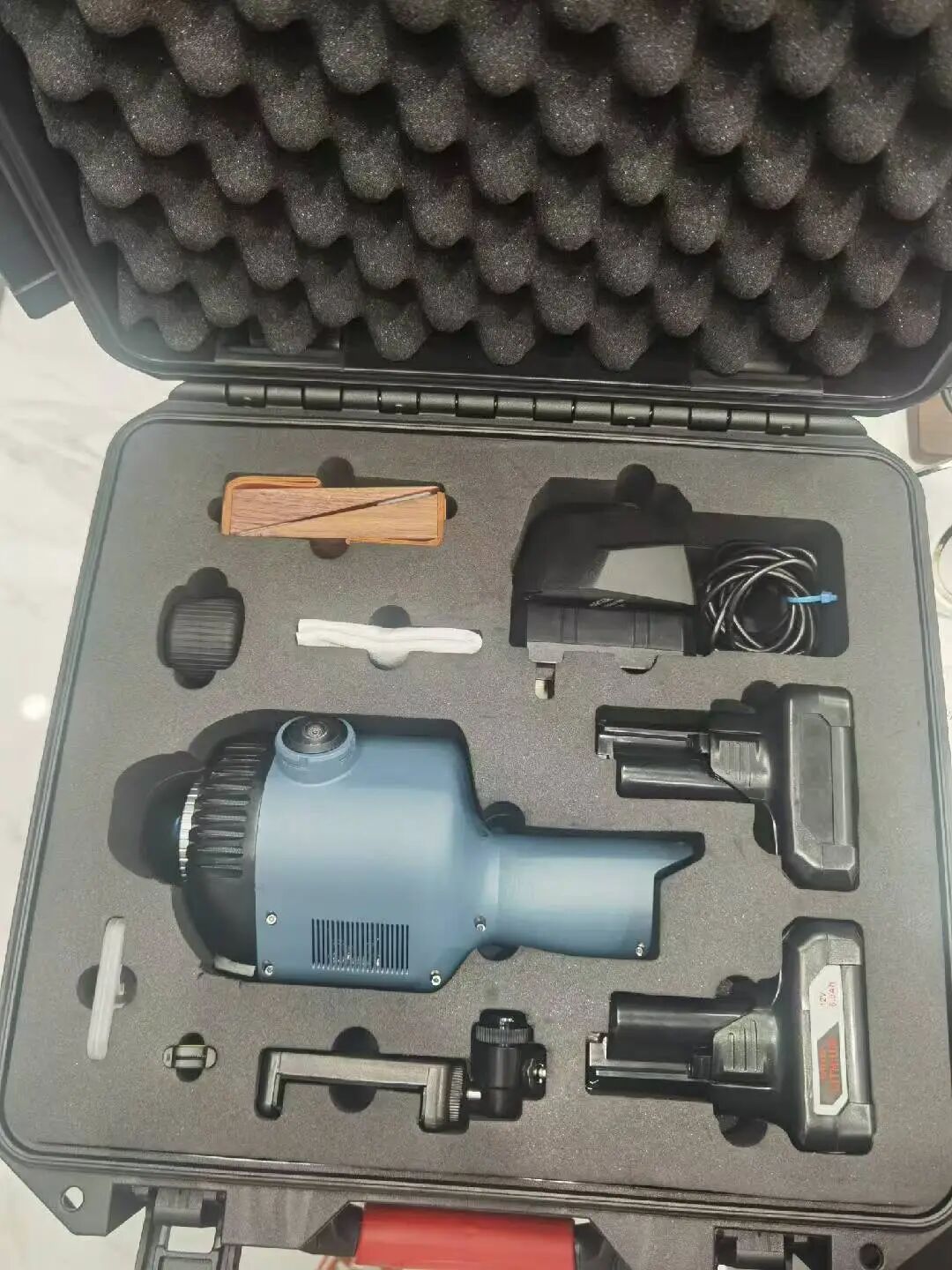
March 2023: Lixel established its R&D center in Shenzhen and launched its first-generation device
Xu Wei: I've seen plenty of teams where new members get assigned grunt work right away — calibration, synchronization, component selection. It's tedious, exhausting work. People want to switch to something else after a while, so the person who ends up doing it is usually someone with mediocre technical skills.
But there are exceptions. One team that really impressed me had great continuity. They had a "veteran" — still hadn't graduated by year six (laughs) — who kept at this work the whole time. He never wrote his experience down as a manual, but simply because he was there, the team's technical knowledge never got lost.
Yang Fan: A lot of our early customers were these small teams. Their pain points were very specific. Building a perception system isn't a one-person job — it takes several people collaborating, debugging,磨合-ing, sometimes for months or even a year. When our system reached them, it immediately brought their robots to life.
Q: What's your moat?
Yang Fan: In manufacturing, it ultimately comes down to overall performance. The full cycle from development and prototyping to mass production can take about a year. Our advantage is that we've refined every step of the process better.
This is a different rhythm from the rapid trial-and-error of consumer products. Manufacturing isn't a pangolin — you can't iterate quickly in round after round.
Take Intel's stereo vision system. Plenty of imitators on the market, but they can only produce versions with worse performance at lower prices. Or Sony's CMOS — everyone's trying to learn from it, but as long as budget allows, people still end up choosing Sony, choosing the best option.
With our second-generation product, Pocket, if you search for "handheld 3D scanner" now, you'll find maybe a dozen products, some even selling on Kickstarter at $1,699 with an early-bird discount.
That actually confirms we chose the right track. If this direction had no meaning, no real market demand, people wouldn't be rushing in to copy it.
Qin Youming: As the saying goes, "Imitation is the sincerest form of flattery."
This is actually a paradox startups often face: If no one's imitating what you're doing, you should be reflecting on whether you're on the right path. But once you actually start making money, especially in an environment like China where productive capacity is so abundant, you turn around and find a swarm of competitors has already descended.
Xu Wei: In manufacturing, there's no real moat — only fast, high-value products.
Yang Fan: This is still a long-term game.
Qin Youming: Right, that has to be the premise. Otherwise you easily get trapped in vicious competition, just racing to be cheaper and faster to ship.
But what we're actually building is a whole ecosystem, with a simulation system for robot training at its core — one that can replicate real-world operating scenarios as faithfully as possible.
If this system can actually run in real environments, it will be one of our most critical strategic directions over the next one to two years. We can continuously accumulate real data through our existing customers' usage, then feed that back to optimize the virtual data we generate, ultimately making our 3D data service system more complete.
At the end of the day, our users are our biggest moat.
Q: So product development starts from understanding demand?
Qin Youming: Exactly. In robotics scenarios, for instance, refresh rate can directly determine whether a flying device crashes. And if a sensor consumes too much of the main controller's compute, you need an external processor, which means adding cooling. Insufficient space creates a cascade of problems.
Our products can land in the market because we do extensive internal testing. Every parameter we refine is aimed at solving a real, systemic problem that actually exists.
Q: Algorithmic technology is your most important core capability.
Qin Youming: Lixel's initial barrier was algorithms. Our technology development has also kept expanding upstream — a lot of our hardware is custom-designed to support our algorithms. But now, I feel the technical advantage isn't just the algorithms themselves, but the synchronization of software and hardware. The fusion of both can become an optimal system.
This technology itself is a systems engineering problem. Like when we used to do academic research or competitions, especially at MaRS Lab — every paper was like a product iteration, gradually helping us develop user thinking.
In robotics, if you want to collect data and run experiments, you need at minimum a validation platform, preferably one purpose-built for experiments. Healthcare might get data through hospitals or labs, but for us to run models on data is a systemic industry problem.
Xu Wei: It's true — robotics hardware development teams tend to be less efficient because they need substantial funding and time to develop real systems. The problem isn't solvable by software or algorithms alone; it involves the entire systems engineering.
With the kind of highly complex product we're building, a single loose screw can cause problems. The nature of hardware products themselves also means long cycles — unlike software updates by the week, it might be by the month or even half-year. So we probably have a relatively long lead time.

Entrepreneurship Isn't a Prompted Essay, It's a Glorious Evolution
Q: Let's talk about motivation. After graduating from HKU, you could have gone to work at established platforms like DJI or Huawei. Why did you decide to start a company instead? Had you already figured this out while still in school?
Qin Youming: DJI has a very strong engineering culture. I deeply respect its corporate culture, and it's where I developed a lot of my working habits. But DJI's main thread is as an aerial photography company.
Through our research on robotics and unmanned systems, we gradually realized that a truly usable unmanned system needs "situational awareness" — a clear perception of its spatial environment. It needs to know where it is, what's changing in the environment, and how to respond. And this "awareness" is precisely the most critical yet most missing piece for drones to become truly ubiquitous. So when it came time to choose a direction, we didn't hesitate — we went with spatial intelligence.
I've loved building things with my hands since I was a kid, and my PhD topic happened to be robotics-related, which aligned with Professor Zhang's research direction. He was also one of the earliest people to encourage us to start a company.
HKU itself is very tolerant of entrepreneurship. During the PhD, you could finish all your coursework in one semester, and the school uses Pass/Fail grading, which reduces the pressure of grade inflation. This gave us time to engage with real customers, push research toward commercialization, gradually build a user perspective, and understand the business logic behind the technology.
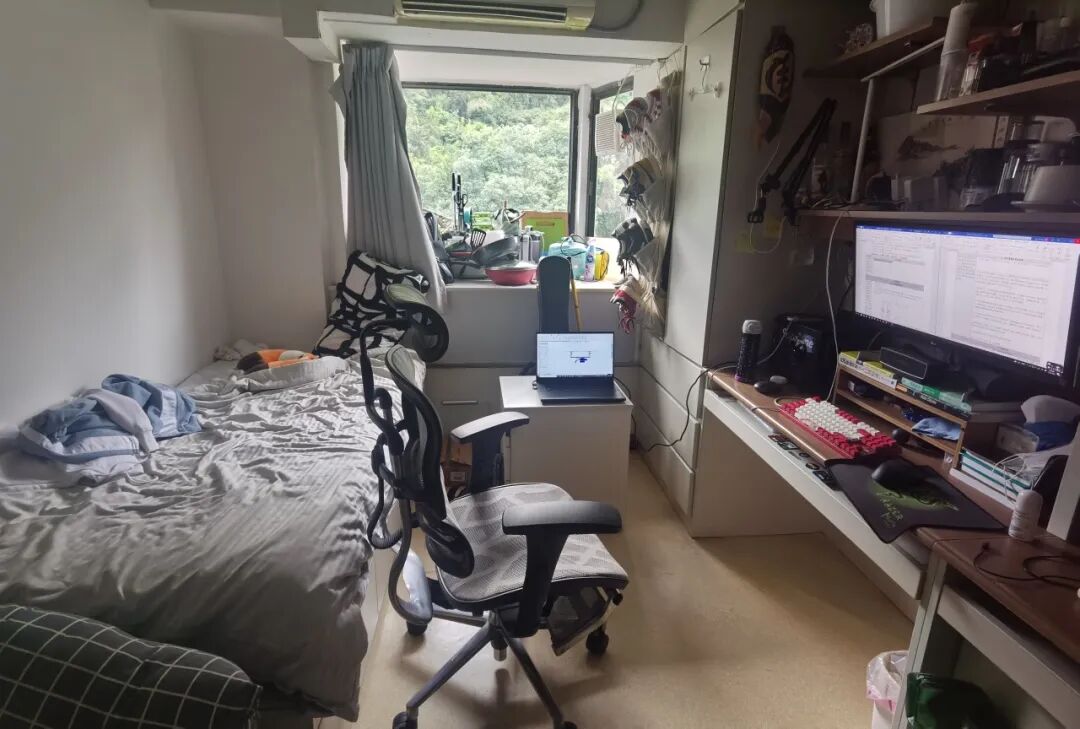
October 27, 2021: Where the dream began — Lixel was registered in Room 709, Lee Shau Kee Hall
Xu Wei: A lot of people think entrepreneurship means escaping the system, but not necessarily. Many alumni went to big companies and ended up building teams, running supply chains, pitching, securing resources — not that different from starting a company. And within the system, your mandate is often set for you, so you actually have less freedom.
Whether in a company or at school, your direction, resources, and pace are heavily constrained. It's stable and safe, but the room to actually execute is different from real entrepreneurship.
Qin Youming: Sometimes the difference between choosing entrepreneurship and going to a big company comes down to one ZhenFund.
We had just published several top robotics conference papers when ZhenFund reached out like talent scouts, and that became our first contact. They kept encouraging us to take this path.
At a big company, if you take its resources, you have to work on its directions. One project might have several teams working on it simultaneously, with the best one winning. That's fundamentally no different from startup competition.
And what you're working on might be quite marginal — like taking some open-source vision algorithm from seven or eight years ago and adapting it to automatically count "how many times a fish bit coral." We wanted to solve a problem we'd personally encountered in our work: there wasn't a good sensor for spatial intelligence yet. Every year, large numbers of robotics practitioners were getting stuck on the same problem, so we figured we might as well build it ourselves.
ZhenFund provided our first funding. Their starting point was that if the robotics industry is going to develop, the entire supply chain needs to keep up. Not chasing some competitor or hitting a specific performance target. Different sources of funding lead to completely different paths.
Q: After starting the company, what differed from your expectations? Ever wonder what your life would be like if you hadn't taken this path?
Xu Wei: Time only moves in one direction. Hypotheticals don't serve any purpose. What matters is whether what you've gained is what you wanted.
Yang Fan: Every industry is a fortress besieged — entrepreneurship included. None of my three ventures turned out the way I'd imagined. Life doesn't follow a script. We used to think there was a standard playbook: study abroad, return home, start a company, go public. But starting around 2020, the world suddenly changed. Our generation often can't even make sense of what's happening right now, let alone predict the future based on past experience.
I don't think entrepreneurship is for everyone, but it has genuinely expanded my understanding of myself. With each venture, I discovered I could handle roles I'd never considered — even came to enjoy work that was once unfamiliar. I'm not someone who believes in the concept of "stability." Compared to following the prescribed path at a big tech company, I'd rather embrace the creative space that uncertainty opens up. Even failures — my last startup lost quite a bit of money — taught me that I'm not just someone who can study. I realized that no matter which country, industry, or role I'm thrown into, I can make things work.
Q: If you were hiring, why would working at Luxiang be an irresistible offer?
Yang Fan: Measured in concrete terms, joining Luxiang would probably give you more than a master's or even a PhD program. Whether by headcount or revenue, our growth over the past two years has been extremely fast — basically exponential, tripling every year. Right now is the best window to join.
Qin Youming: Our most urgent needs are on the algorithm side, particularly in mapping and localization. This is a problem the entire world is trying to solve. Very few companies can actually crack it, and we're one of them.
Dr. Xu previously won world-class algorithm competitions, and he's still doing hands-on technical guidance. The chance to discuss problems with him and build things together is a rare opportunity for any technologist.
We want to contribute something meaningful to the development of robotics. Decades from now, you'll look back and feel proud — the work you did at Luxiang genuinely helped bring robots into human life. That's a once-in-a-generation challenge.
I posted something on Moments the other day. It sounds a bit cringeworthy, but I meant it sincerely: welcome to "join the glorious evolution together"!


The audio version of this episode is also available on the ZhenFund podcast Seriously Speaking — tune in!

Text | Cindy
Podcast | Jiamin
Editing | Wendi
Executive Producer | Qian