Born in the '90s, Built an AI Unicorn in Three Years: The Stubborn Teenager Behind the Windsurf Acquisition

A 50% win rate is more thrilling than a 100% success rate, because it means you're standing on the true frontier of technology.
On July 12, Google directly hired Windsurf CEO Varun Mohan, co-founder Douglas Chen, and dozens of core R&D employees for $2.4 billion, while securing a non-exclusive license to some of Windsurf's technology.
Two days later, Devin founder Scott Wu announced the formal acquisition of Windsurf, merging its engineering, product, and marketing teams. A month prior, OpenAI's acquisition talks with Windsurf had reached their final stages, only to fall through due to potential conflicts with GitHub Copilot.
Over its four-year history, Windsurf had established itself as one of the earliest companies to gain solid footing in AI-powered coding. Starting with nothing more than a pure code completion model, it quickly won developer acclaim, with ARR at one point surpassing $82 million. From founding to unicorn status, Varun's team took just three years.
But this mass exodus of core members left the company's future uncertain. Now acquired by Cognition, Windsurf is in the midst of rebuilding both team and direction.
Varun's move sparked considerable controversy. Some called it a communications breakdown; others accused him of abandoning his team. Yet when model providers like Anthropic began building their own IDE products, even a rapidly growing company like Windsurf had to reconsider: how to survive in the cracks between giants?
Whether in founding or growing a company, Varun has always been solving a hard problem.
Like that time in seventh grade at the Olympiad — two days, nine hours, six problems, 42 points possible, and he scored right at the median. But what truly captivated him was the process of wrestling with a single problem for hours. Entrepreneurship is the same. Compared to 100% certainty, a 50% win rate excites him more, because it means he's standing at the real frontier of technology.
From zero to one, Windsurf's product launch took less than 25 engineers and three months.
A parent of one of Varun's childhood classmates recalled on LinkedIn: they first met him at a sixth-grade math Olympiad, and the children had remained friends ever since. During the pandemic, Varun came to visit, mentioning he was starting a company. It wasn't until seeing the Windsurf acquisition news this May that they realized — this bright, focused, persistently determined boy had finally found his echo.
Let's step closer to this 28-year-old technical prodigy, return to the origin of this acquisition, and see how a boy raised on Olympiad competitions found his entrepreneurial path through tens of thousands of hours wrestling with hard problems, reaching unicorn status in three years to become a wave-maker in the AI surge.

A Young Man Obsessed with Hard Problems
Varun Mohan grew up in Sunnyvale, Silicon Valley, the child of Indian immigrants. During his time at the elite Harker School, he demonstrated exceptional mathematical talent. From elementary through high school, he competed in various computer science Olympiads, repeatedly crossing paths with future co-founders.
This May, Varun posted on X, marveling at AI's astonishing progress — the AIME to USAMO competitions he'd competed in as a child had been conquered by AI in mere months. AI chases scores, but what truly fascinated him was never the outcome; it was the hours spent wrestling with a hard problem.
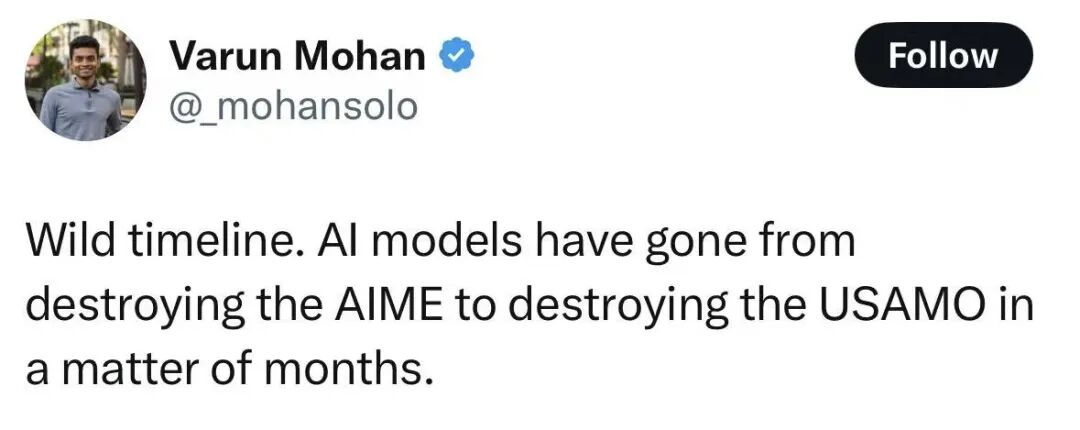
Varun posted that AI broke through USAMO within months
For him, mathematics' appeal lay in its absolute objectivity. In seventh grade, he competed in the USAMO — two days, nine hours, six problems, 42 points maximum. Many couldn't solve a single problem. His own score was merely median, but he always remembered the feeling of fighting alongside teammates, refusing to back down from a tough battle. "We never liked problems solvable in a minute — we loved the endless struggle with hard ones."
At Harker, he met Douglas Chen, equally obsessed with mathematics. This friendship forged through competition later became the starting point for their co-founding journey.
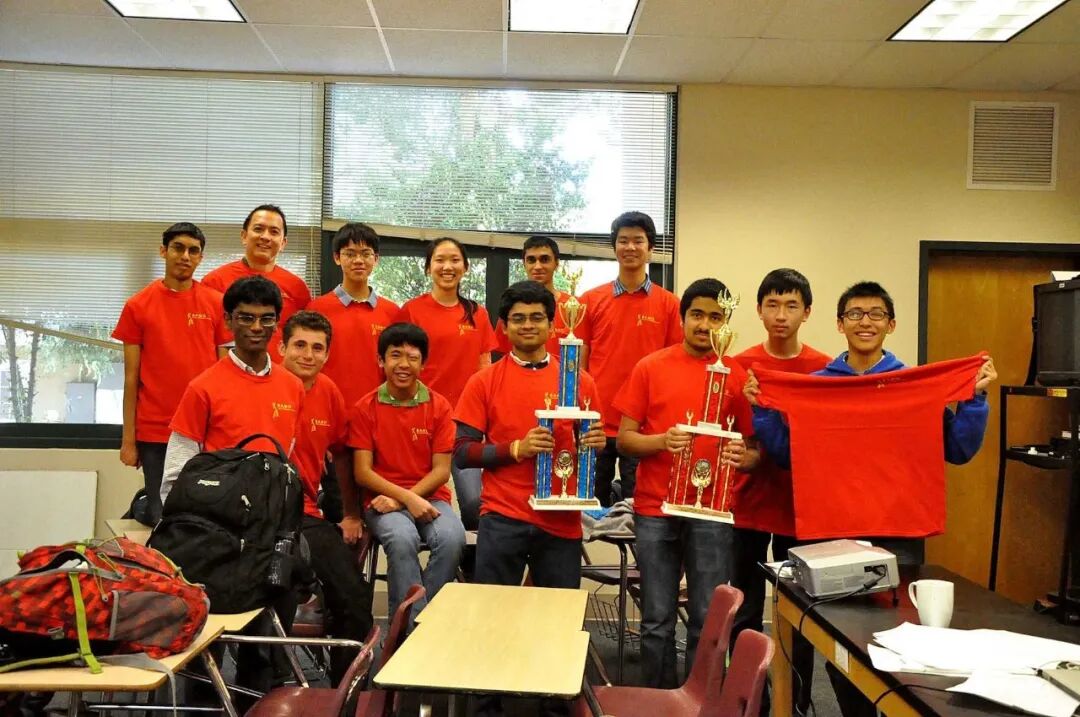
Varun (center) as a Harker School representative at AIME and USA(J)MO math competitions
Varun's drive to tackle hard problems in mathematics carried over to athletics. He completed multiple triathlons and once cycled from San Francisco to Los Angeles. He said he deeply enjoys this state of extreme focus — the same feeling as entering flow while debugging code.
From 2014 to 2017, Varun pursued dual degrees in electrical engineering and computer science at MIT, with a minor in mathematics, and went on to complete his master's in computer science. During this period, he met many future co-founders. Notably, his master's thesis with Douglas Chen focused on efficient parallel processing and fault tolerance in streaming systems, extending their collaboration beyond competitions.
Varun believes that MIT's greatest value wasn't specific skills learned, but learning how to decompose problems, view problems, and solve them in interesting ways.
His internships reflected this. Between 2015 and 2017, he completed multiple infrastructure and systems internships at LinkedIn, Cloudera, Quora, Cloudian, and Databricks. These experiences became his earliest industry foundation for his first startup.

Exafunction: A Non-Consensus but Correct Bet
Before founding Exafunction, Varun served as tech lead at autonomous driving company Nuro. As one of the first 15 engineers hired, he built large-scale deep learning offline infrastructure before gradually transitioning to management. Douglas, meanwhile, had worked at a robotics company and contributed to software development for VR headsets like Oculus Quest at Meta.
At Nuro, Varun experienced firsthand the long development cycles of autonomous driving technology. Though the work was full of possibilities, he gradually recognized a problem: this was a field where results might take a decade to materialize, and he craved building something that could create real value now, not just waiting for a distant future.
During that period, Varun began focusing on the most intractable problems in deep learning infrastructure. He discovered that even top technology companies struggled with GPU resource allocation and heterogeneous hardware scheduling.
Deep learning workloads across the industry were extremely diverse. Whether robotics, autonomous driving, or other verticals, each model had different memory and compute patterns, with completely different hardware requirements. Companies either absorbed crushing hardware costs or sacrificed performance — there was almost no solution.
These frontline observations ultimately led Varun and Douglas to co-found Exafunction. They focused on optimizing heterogeneous, customized workloads, attempting to use technology to unlock higher hardware utilization and greater flexibility.
Exafunction quickly found market traction. At peak, an 8-person team managed over 10,000 GPUs, accounting for nearly 20% of GPU compute across multiple Google Cloud Platform (GCP) data centers.

From Exafunction to Codeium: Restarting at the Breaking Point
In mid-2022, the AI infrastructure landscape shifted dramatically. Transformer became the undisputed mainstream. OpenAI released Text DaVinci and subsequent products, with GPT technology evolving explosively. Exafunction quickly realized this wave would fundamentally alter their survival logic.
For them, this was a suffocating moment. Exafunction's positioning — using GPU virtualization to support diverse compute workloads — grew increasingly untenable as technology unified. The team had been right about GPUs' importance (NVIDIA chips were flying off shelves), but they underestimated model architecture concentration: "We thought there would be a hundred flowers blooming. Instead, everyone chose Transformer."
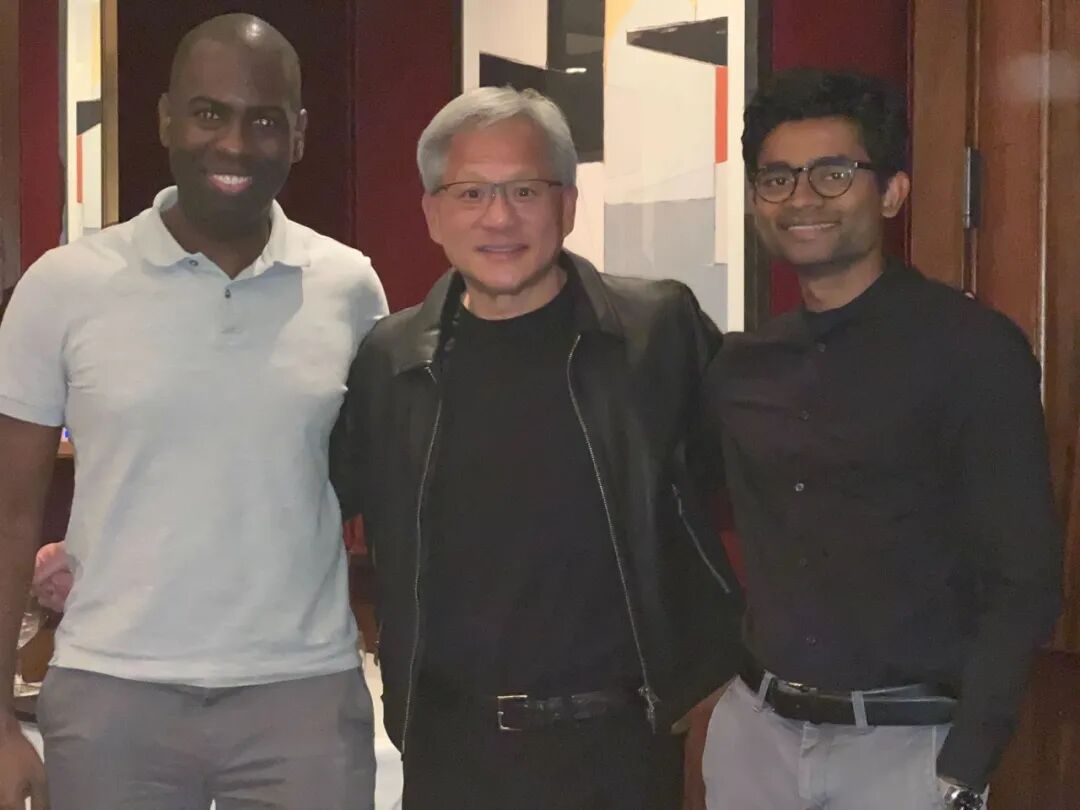
Varun (right) meeting with NVIDIA CEO Jensen Huang (center)
More immediate pressure came from customers. Exafunction's core clients — autonomous driving and AR/VR companies — were caught in a funding winter as the ZIRP (zero interest-rate policy) era ended.
Varun recalled sensing trouble, "but we still dragged our feet for three months before making the call." This experience made the team especially vigilant about any pivot they should have made but didn't.
The final pivot decision came over a weekend between Varun and Douglas. The company was just 18 months old, with 8 people, annual revenue already in the millions, and $28 million in the bank. Operationally, nothing was wrong. But they increasingly knew this path probably wouldn't last.
How to choose a new direction? Varun believed that if a direction seemed valuable but couldn't genuinely excite the team, failure would only come faster and more completely. So they returned to the team itself: This was a team of all developers, who had been using GitHub Copilot from its first day of internal testing in 2021, with an intuitive and deep understanding of AI coding tools' potential.
So they pivoted to developer tools — to build what they truly wanted to build.
Varun also knew developer tools were never an easy path. But at that moment, choosing a familiar, believed-in, all-in direction was the easiest decision. He said the pivot became a kind of relief: "We might still fail, but at least we'd be building something we truly believed in."

Codeium's High-Intensity Self-Iteration: Speed Is AI's Only Moat
Codeium was a VS Code-based coding assistance plugin. Development began roughly four months before ChatGPT's launch — a window that gave the team rare first-mover advantage. Their accumulated GPU virtualization experience also provided infrastructure support. Varun explained: "These AI coding assistance applications trigger trillions of cloud computations with every keystroke — an enormous compute scale that we happened to have the architecture to handle."
On how an 8-person team trained a code model from scratch in two months, Varun was candid: the team had no prior experience, but he always believed they had recruited smart, capable, success-hungry people.
With no retreat possible, they had to find a way — or fail.
After pivoting to Codeium, the team rapidly solved foundational challenges in data collection, model training, and code context. In October 2022, Codeium's first code model officially launched.
Market feedback was equally swift. Without a dedicated sales team, founding members personally handled pilot projects, landing benchmark clients like Dell and JPMorgan Chase within months. User growth was staggering: under 1,000 users in early 2023, surpassing 10,000 by March through pure word-of-mouth, maintaining 4-5% daily organic growth; by June 2024, developer users exceeded 600,000, processing over 100 billion tokens of code daily (roughly 10 billion lines).
Post-launch, Codeium maintained relentless self-iteration. Many directions were tried over the past year, mostly failing, but Varun saw failure as signal too. "When there's only a 50% win rate, I get more excited. Because if everything were 100% successful, it would mean we weren't trying hard enough, were overconfident, weren't standing at technology's frontier."
This rhythm ran through multiple attempts over the past year. For example, their code review product launched in early 2024 — the team tried various delivery methods including Chrome extensions and standalone web tools, but never achieved ideal experience. Only weeks ago, the team released a new version that finally struck balance between value and usability.
In the AI era, speed is a product's only moat. For Varun, getting there first matters. Only those who run out first can learn faster, and are more likely to become the dominant force in the next iteration. He always wants to see earlier which directions die fastest, which pitfalls have already been stepped in, which paths are worth persisting on.
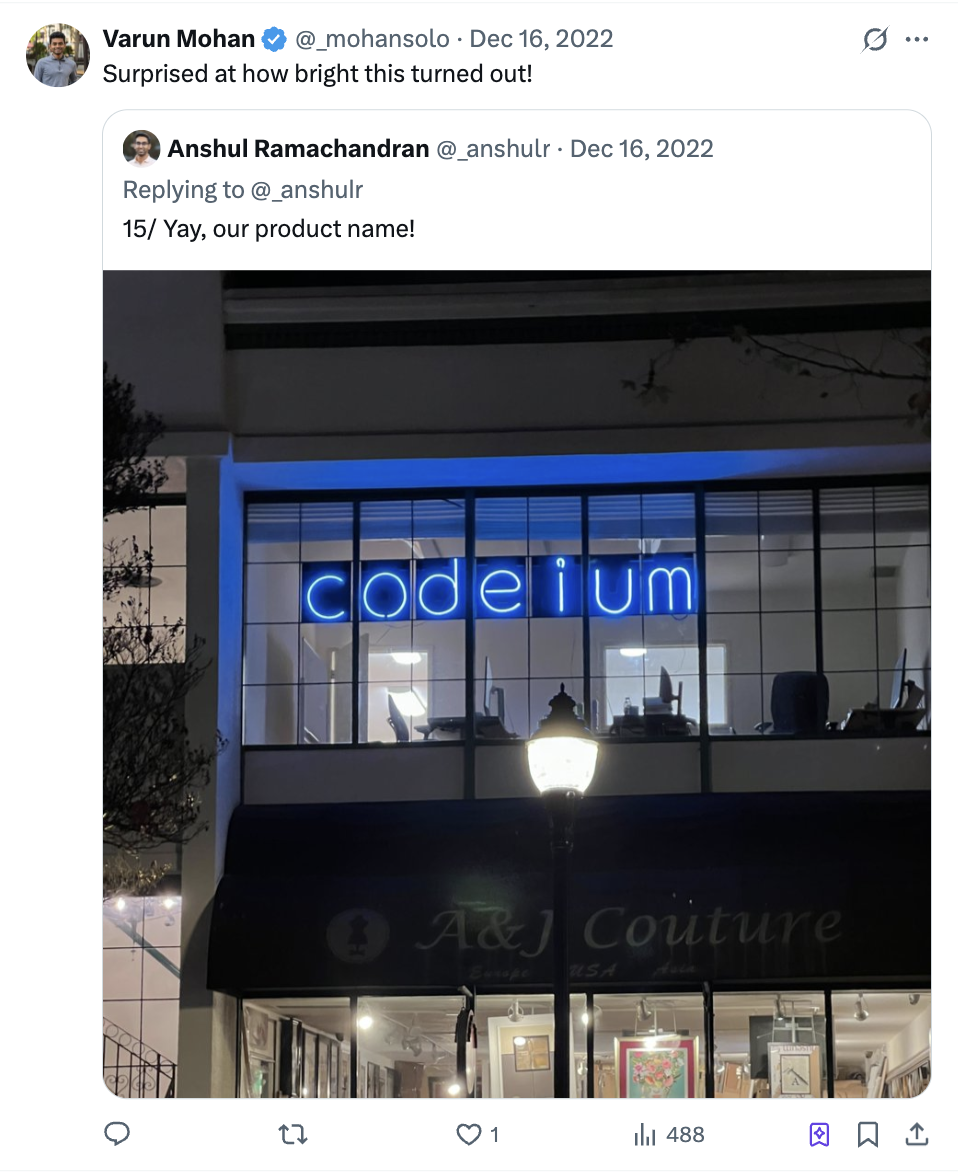
Codeium office building photographed after product launch in 2022
However, as agent capabilities matured, a new problem surfaced: VS Code's framework limitations were increasingly becoming a bottleneck for Codeium's growth.
Varun and his team keenly identified a trend: developers' core work would shift from "writing code" to "reviewing AI-generated content," demanding higher requirements for interaction fluidity, real-time feedback, and deep tool integration. Based on this, the team ultimately decided to break free from the VS Code ecosystem and embark on building their own Windsurf IDE.

Windsurf's Small-Team Rapid Experimentation: Product Iteration Driven by Minimalism
In November 2024, the Codeium team (later renamed Windsurf) released their new product, Windsurf. With an engineering team of under 25 people, it went from project initiation to launch in under three months.
In early stages, when direction remained unvalidated and product success uncertain, he preferred keeping teams small — one designer plus three or four engineers, rapidly experimenting. Because with more people come more opinions, and pushing forward without consensus only creates chaos.
How to judge whether a direction or product merits investment? The team agreed: if the direction is right, even a rough initial version will show surprising value and vitality. "For example, when we first built the Agent in Windsurf, the version was very unstable, but it could already accomplish things we hadn't achieved in eight or nine months."
In judging whether a product has reached "escape velocity," the team's most valued signal is organic user advocacy. Windsurf internally uses a single user metric: after using the product, does a user keep using it, recommend it to others, and integrate it into their workflow?
By mid-2025, the engineering team had expanded to nearly 160, with over 50 product-focused engineers, and 80 in sales and marketing. Surprisingly, there were no traditional product managers. Products were developer-driven.
In Varun's view, "We build tools for developers; the product should be shaped by their own hands."

Windsurf's High-Bar Hiring Philosophy
In building Windsurf, many of Varun's former colleagues chose to join him. These included co-founder Anshul Ramachandran and product engineering lead Kevin Hou. They too felt genuine pride in building tools for developers together.
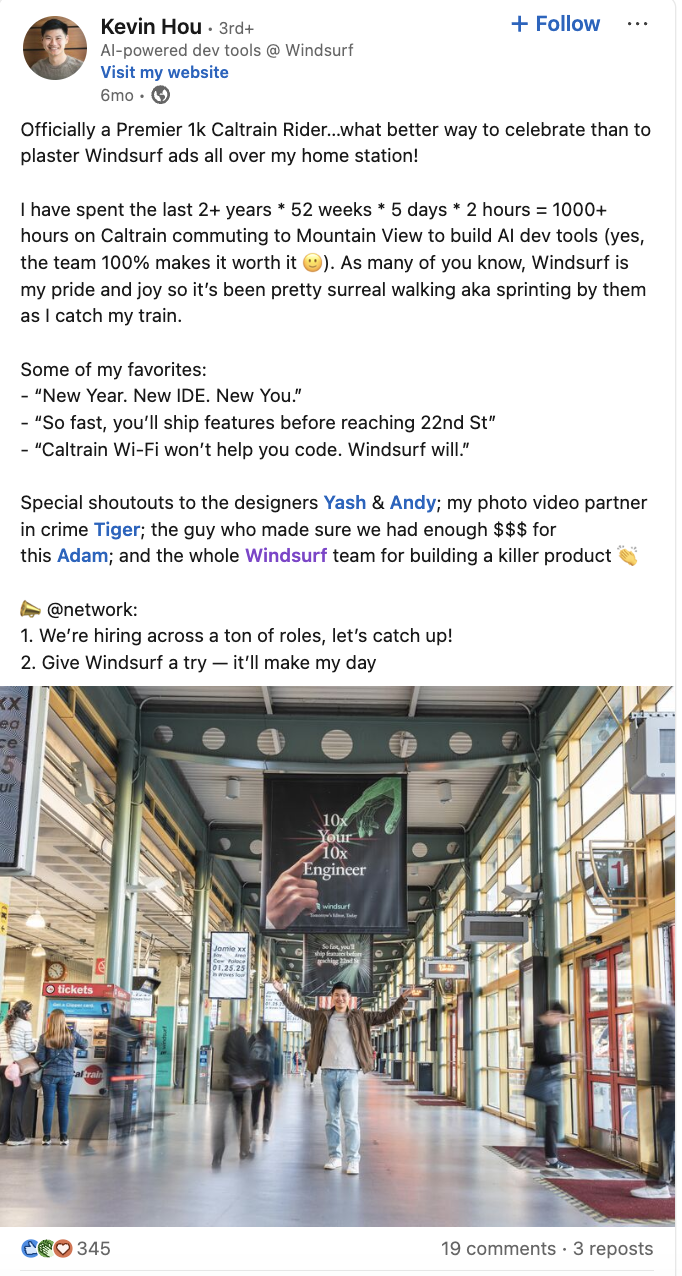
Windsurf product engineering lead Kevin's post hiring new employees
In one interview, Varun spoke about team hiring: "We don't try to make this place seem like a fun, easy environment."
They want engineers with strong initiative, willing to experiment actively amid uncertainty, and brave enough to admit mistakes. In Varun's view, startups don't usually fail because their technology isn't solid enough, but because the team never truly builds something valuable for users.
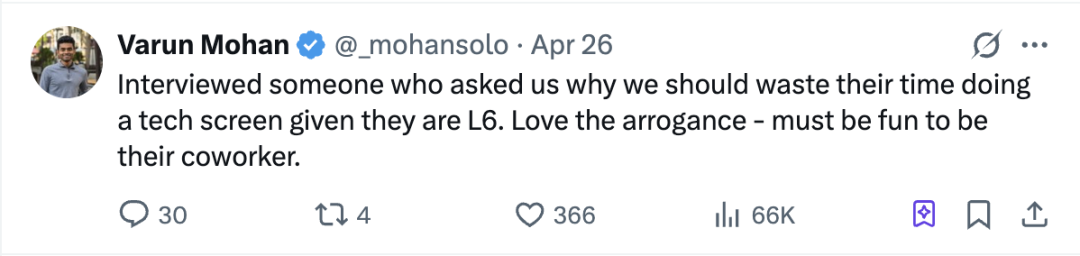
Varun's reflections after interviewing an L6-level engineer
Windsurf's hiring pace follows "dehydrated replenishment": they only hire when someone in a role is nearly overwhelmed, crushed by workload.
While hiring six months ahead sounds reasonable, it often backfires. "If you hire someone without clear tasks, they'll find things to do." The problem is, these self-created tasks dilute team focus and don't serve company goals.
Windsurf's hiring process is extremely rigorous. The take-home assessment alone eliminates over 90% of applicants; overall acceptance is under 0.6%.
During interviews, they design multiple scenarios: some allow AI tools, others explicitly prohibit them. The goal is assessing whether candidates can flexibly leverage tools to boost efficiency, while still demonstrating solid fundamentals and clear logical thinking when tools aren't available.
But mindset matters more than coding ability. Varun once shared a red flag he particularly watches for: when he asks candidates "how hard are you willing to work?" some answer: "I can work smart."
His response: "Our team already has plenty of people who are both smart and hardworking. What makes you different? Would you drag the team down?"
He sees companies as large collaborative systems. If someone is irresponsible, doesn't give their all, the problem isn't just their reduced individual output — it's that they're shifting the team's behavioral expectations. After all, when you're in a five-person group and see four others not caring about goals or taking responsibility, it's hard to persist alone.

The True Vitality of a Startup Team
For Varun, a true entrepreneur must simultaneously hold two seemingly contradictory beliefs in their head: irrational optimism, and uncompromising realism. Without the former, you never take the first step; without the latter, you don't get far.
Windsurf's three years are the best illustration of this.
From the initial code completion model to later product pivots, Varun and his team repeatedly asked themselves: "Are we still solving a genuinely important problem?" If the answer was no, they pivoted, started over.
He always remembers: "You don't get any credit for persisting in doing the wrong thing." What matters is continuously directing energy toward the right direction, giving the team and product genuine vitality.
ZhenFund has also been committed to discovering young entrepreneurs who dare to embrace change and break conventions. If you're also watching for innovation opportunities, feel free to reach out anytime.


By Hongling
Edited by Jingyi & Cindy