A '97-born founder's third pivot: building a Personal Agent that doesn't chase productivity

Like the earliest Apple Mac computers, we hope to realize the transformation of agents from productivity to everyday life.
The word "pivot" has defined Kaijie Chen's seven years since leaving Duke University.
Pivot — its original meaning is a fulcrum, a hub, the fixed point around which something turns. Born in 1997, Chen started his first company at age 20 and is now on his third. From smart home robots to gaming to MidReal, an AI interactive storytelling platform with 3 million users, each turn has been about finding the highest-leverage direction early, capturing the next bigger opportunity.
In every chapter, you can see Chen's focus on the individual. From MidReal's dream-worlds built for users to Macaron, the world's first Personal Agent, he doesn't want to build a productivity tool — he wants something that becomes a companion for living better.
In his view, the deepest way to connect with the world is through products that create genuine bonds with many people. To fulfill that vision, a product must succeed by conventional measures; the scale must be large enough. But even with all the money and resources in the world, if he couldn't build deep human relationships, it would still be painful.
Letting go is painful too. People get trapped in inertia, wondering if they should just hold on a little longer. Every pivot was a complete upheaval for Chen. Later he came to understand: even when one life has been lived as fully as possible, another life is born from it.
From products to life itself, they're like a musical composition — conflict keeps arising, and you keep resolving it. If all conflicts were resolved, life would essentially be over. As long as conflict remains, he has unfinished business.
In Bilibili comments, someone wrote that after every video from Coach_K, they feel like he's always exploring the optimal solution. That kind of feedback is deeply meaningful to Chen. Like building a product, it's a one-on-one, cross-temporal conversation with a user, mediated through UI — intensely personal. A hint, a line of copy, a reward — any of these might move someone.
When you go through life's transitions, you need both emotional support and tools to help you cross that threshold. Even if Macaron meets you for the first time at one of these inflection points, it can walk with you for a long road ahead — from a single point into the vastness of life.


Leaving School Was the Easy Choice
Liu Yuan (Partner, ZhenFund): Start by introducing yourself and your entrepreneurial journey.
Kaijie Chen: I started with physics competitions in high school, then went to Duke. After two years, I found school less interesting and took a leave of absence. That's when my first startup began — today it's my third. Along the way, I did smart home robots, reached 10 million RMB in revenue, and experimented with gaming AI agents.
In 2023, our FireAct research project spun out into an AI interactive storytelling platform called MidReal. It now has 3 million users, with over 300,000 monthly active.
Liu Yuan: Was dropping out a difficult decision at the time?
Kaijie Chen: Leaving school was actually a very easy choice. What was hard was going back after my first startup ended. The reason for leaving was simple: school didn't offer enough challenge or novelty. Freshman year was chaotic — I wanted to try everything. By the end of sophomore year, my grades were solid, and I'd joined a lab to work with a professor.
I also founded a club called Catalyst — Duke's first tech-themed fraternity, co-ed. We'd discuss a tech hot topic every week. The first year, only a dozen or so people joined. That summer, everyone interned at big tech companies, and when they returned, the club became a signal for landing those jobs. The second year, applications exploded — over 200 people. During Rush, every recruit had to deliver a 10-minute technical pitch.
By then, I felt I'd explored most of what school had to offer. I'd dated. I wanted to try a new life outside.
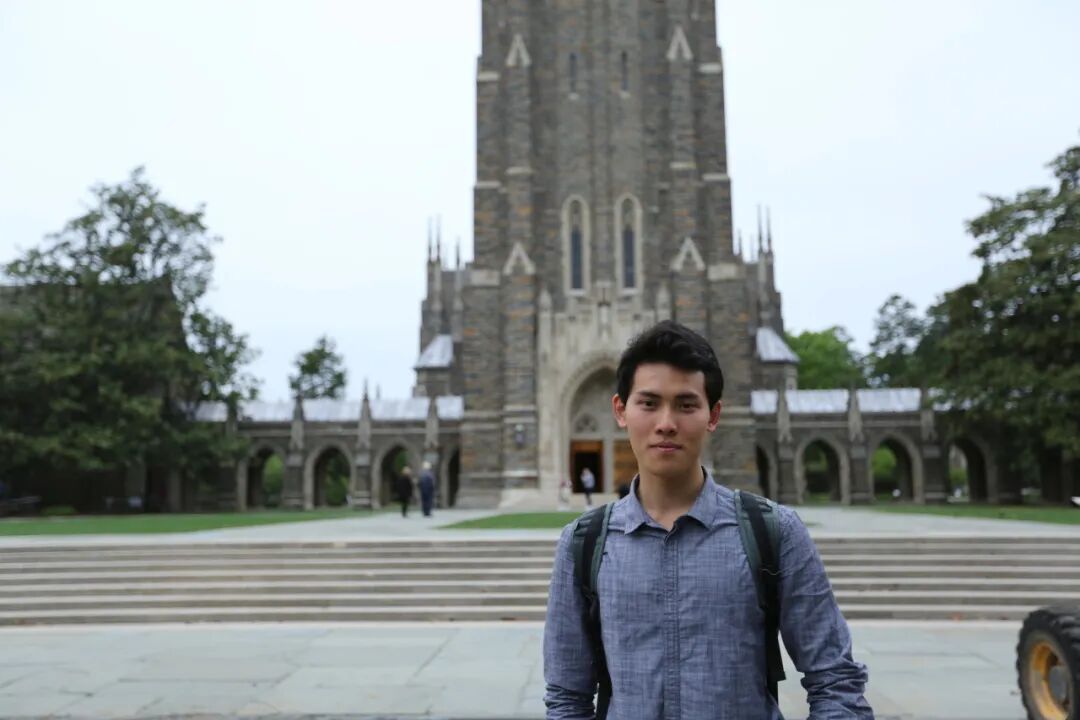
Chen during his time at Duke University
Liu Yuan: So you decided to leave school first, then figured out entrepreneurship?
Kaijie Chen: Yes, I just knew I had to go out and see something new.
I worked at Zhihu for a while, catching the knowledge-payment wave. Started as a WeChat official account editor. Then one day, by pure chance, I ran into Zhihu's CTO in the bathroom. In those 30 seconds, I pitched some product ideas. Unexpectedly, the next day the CTO said, "Come to a strategy meeting with us." The day after that, I was doing strategy and data analytics for Zhihu's knowledge marketplace. That was my first real-world experience right after leaving school.
Later, my professor had a startup idea. I saw it as my opening and jumped into smart home robots. These were home control hubs, not the humanoid robots you see today. Part embedded wall systems, part mobile interactive terminals in the home. Our concept was integrating smart systems directly into the renovation process, which made project cycles extremely long. After one project generated returns, I realized it probably wasn't the right business for young people, so I transferred it to a strategic partner.
In 2020 and 2021, the market was relatively quiet — big tech monopolies, nothing especially new to build. I explored at school for a while, came across GPT-2 and GPT-3, and built an open-world demo inspired by Westworld — pretty far ahead of its time. I was always two years early to market. This time, I'm hoping to time it more precisely.
In this 10-20 minute demo, NPCs could interact freely through text, with real-time hot topics woven in — after a SpaceX launch, you could chat with NPCs about it. But GPT's conversational ability was weak then. To make responses coherent, we spent enormous effort on engineering frameworks. Then GPT-3.5 dropped and instantly made it all obsolete.
Liu Yuan: And then came MidReal?
Kaijie Chen: Yes, MidReal is an AI interactive storytelling platform. Users input one sentence, a hundred sentences, and the AI unfolds it into a story. Two modes: tool mode, which generates content for you; and interactive mode, where an AI screenwriter writes line by line. Later we added character chat, phone calls, parallel universes threaded through a protagonist, and multimodal content.
MidReal's earliest inspiration was actually FireAct, a paper that enabled AIs to write longer stories and do longer reasoning — a watershed from prompt engineering to agents.
Our user base skews 20-35, with themes leaning toward web fiction. Many people immerse themselves in small private fantasies here — like returning to campus and meeting someone they once liked. We considered building it into a community, but progress on AI long-form writing has been slow, to the point where GPT-5 isn't better than 4.5. If this wave of AI entrepreneurship isn't riding the platform with the most dramatic technical improvement, a lot of the work won't show dramatic gains, and the product won't be the most transformative.
In early 2024, no one anticipated how difficult and slow writing improvement would be. Companion-chat products do have high user stickiness, but they're different from long-form stories. ChatGPT is natively trained for dialogue. Getting it to write 100,000 or 200,000-word novels with quality and excitement is hard to guarantee. Long-form story audiences have high expectations; companion-chat users mostly seek immediate interaction. The gap is significant.

Macaron Isn't Trying to Be a Productivity Tool
Liu Yuan: Introduce your new product, Macaron?
Kaijie Chen: Macaron is simple (https://macaron.im/) — a personal agent. It knows you deeply, and during conversation it can generate sub-agents for you, also called mini-apps or small tools.
A few characteristics. First, extremely strong memory. We used end-to-end reinforcement learning for our memory algorithm, so it doesn't forget your preferences, experiences, even desires — it can truly understand you.
Another feature: it writes complete, usable sub-agents, not just front-end but with back-end, sustainable functionality. We're focused on unlocking value in life scenarios.
Liu Yuan: How did the name Macaron come about?
Kaijie Chen: The codename "Macaron" started from "Mac." The original idea was that our agent could be like the original Macintosh — transforming from IBM's massive machines kept in companies to something you could carry home, the first Mac. That Mac had a translucent shell, came in colors. We wanted that shift from productivity to life, for Macaron to become a companion in your life, an agent that helps you live better.
So it started with Mac, but obviously you can't trademark "Mac." I kept flipping through the dictionary until I saw "Macaron." It has many colors, delicate and small, and it's sweet. I immediately thought: this fits our product perfectly.
Later we wondered, should it have a character? There's a detail I love in today's logo: in the UI, the macaron is standing upright, even angled like it's rushing forward.
At first we debated vertical or horizontal placement — if you held a macaron in your hand, how would you position it? After much discussion, standing up felt best. Because few things in nature stand upright like a coin, yet a macaron is man-made, it must have its own consciousness. We wanted it as a frame of "consciousness," so we made it stand, gave it eyes, made it look like it might topple at any moment. That instability is life in motion.
Liu Yuan: Why call it a personal agent? And why on mobile?
Chen Kaijie: Because we don't want to build a productivity tool. We want to build something that truly serves life.
During our beta, we recruited over 300 users. The most active ones have already built more than a dozen mini-apps; even the least active have one or two. Across thousands of cases, we saw scenarios we never anticipated. The largest category by far was trackers — calorie intake, workout plans, marathon training, mood logs, all kinds of life tracking. One user gives the agent a prompt every day, chats to unfold it, then generates a mood journal for that day. He's been doing this consistently. I think it's wonderful.
This showed me a new kind of radically personalized app experience — not the traditional broad-appeal app designed for the "lowest common denominator." Take fitness: we think of Keep, but it has so many features you don't know which to use, which becomes its own hassle. The calorie-tracking agent a user built in Macaron helps them snap photos for monitoring, pulls sensor data, integrates everything — it becomes a persistent, usable little tool.
What's interesting is, we initially thought simply helping users build sub-agents would be powerful enough. But we discovered that most people don't actually express their needs directly. More often, the need surfaces naturally in conversation — like chatting with a friend who suddenly gives you a great idea.
One user, who didn't even know sub-agents existed, mentioned offhandedly while chatting that he wished he wouldn't get distracted by his phone while reading. Macaron asked: Want me to make you a reading companion? Pomodoro timer on top, notes on the bottom? The user was moved — he hadn't expected Macaron to not just listen, but actually build him a tool.
There are many examples like this. Users don't arrive with a clear product concept. They chat, the agent senses a possible need, and casually builds something for them. This, I believe, is the fundamental difference between an AI personal agent and traditional apps. It's like a smart friend that catches context and customizes solutions for you. Recently I've been trying to lose weight, and Macaron will say: Want me to build you a calorie tracker to help control your intake? When I say yes, it doesn't jump straight to building — it first asks: Do you want to log each meal in detail, or should we just plan your daily diet and customize recipes for you?
Why is penetration so low for personal scenarios? The core missing piece is context. If you ask AI to make you recipes but it doesn't know what you like, how many people are in your household, what you're allergic to — it'll give you something correct but useless. You have to capture context first before you can serve personal life. This market is still wide open, which is why we define Macaron as a personal agent.
Liu Yuan: So how do you introduce Macaron to people?
Chen Kaijie: A life companion that really gets you, and can build mini-apps for you. A personal agent.
Making the Agent Understand You Better, Work Better for You
Liu Yuan: Your slogan is "the AI that instantly gets you." Technically, people might be curious about your model details. Can you share?
Chen Kaijie: We've accumulated quite a bit technically. We also co-founded a research center with Tsinghua University's Shenzhen Graduate School, where many students work with us on research. From MidReal until now, over a year of continuous iteration. We started training 70B parameter models; now we're doing end-to-end reinforcement learning directly on DeepSeek's 671B.
We have our own hundred-card cluster, roughly 100+ GPUs. Using LoRA, RL, and other methods, we first solidified the infrastructure, then trained toward two core objectives: understanding you better, and being more useful.
These two goals existed since the MidReal era. Back then, writing novels that followed user intent across hundreds of thousands of words required constant alignment. The signals we received were extremely limited — maybe the user edited a sentence, or indicated a plot direction. So we accumulated tens of millions of user data points, extracted 5% after de-identification for reinforcement learning, making the model better at capturing user intent.
Later this approach evolved into our current memory algorithm. We created something like a memory token — somewhat analogous to today's reasoning tokens. Before outputting, it writes a memory segment, autonomously deciding which memories to retrieve, what new content to store, whether to invoke deeper memory tools. This way memory isn't hard-coded with engineering rules; the model learns how to use it itself.
This approach may be relatively uncommon in the industry, but I don't think being unique means being right. It wasn't driven by technological innovation but forced by necessity. When writing novels, we discovered that what users wanted in memory varied wildly — sometimes plot preferences, sometimes foreshadowing, sometimes expansion style. Manually writing prompts was impossibly hard to control; using user feedback for training yielded the best reinforcement learning results. So the memory token solution emerged naturally.
Liu Yuan: Do user testing demands show strong head effects? Like search products, where the top 20 queries cover 80% of needs?
Chen Kaijie: Not quite. In beta we found that user scenarios converge somewhat — life tracking is one major category — but within a category, specific needs vary enormously, wildly. Yesterday I reviewed de-identified cases users shared in our backend and saw some interesting ones: someone built a free book reader, figuring there must be plenty of resources online and having Macaron find them for him. I definitely wouldn't have thought of that.
Someone else made a "little report" — a love commemorative between partners, turning months of experiences into an interactive H5 card for their significant other. Someone built a mini-game; I have no idea what it's for, but they have fun with it. The most absurd was someone making a robot vacuum cleaner game, controlling a robot sweeping back and forth in a room — probably evoking some childhood memory. They spent an unusually long time on that page.
These ideas are too scattered, too particular. It's not that existing products or technology couldn't do them — it's that no one would bother. More interestingly, these users didn't arrive with clear demands like they would with AI coding products. They discovered possible needs through chatting with Macaron, which then casually built something for them.
I've always felt: if AI is smart enough — smarter than most humans, even most product managers — why can't it help you distill your needs? But this is hard. It requires accurately understanding user intent, accurately constructing tool prototypes, and actually building something usable. The technical bar is very high.
With Macaron, I don't think we're early. We might even be slightly late. The turning point was seeing Claude Code's coding capabilities become powerful enough to actually build applications. Plus Zuckerberg said on Instagram in late July that he wants to build personal super intelligence — not just productivity, but caring for life. That resonated with our thinking.
Liu Yuan: What's the most polished user case you've seen?
Chen Kaijie: As long as the need isn't complex, completion rates are generally high. Take language learning: Macaron gives you 10 words and sentences daily, you write translations, get scored if correct, wrong answers go to a word bank for review the next day. I had a 750-day streak on Duolingo, but the day Macaron launched was the day I quit Duolingo — because I like learning technical vocabulary that Duolingo doesn't teach.
Liu Yuan: Will you do vertical scenarios?
Chen Kaijie: Verticals like parenting, education, plant care, pets — users have already built these. Snap a plant to analyze watering schedules, snap wine for pairing recommendations, snap a cat for health diagnosis. But I think AI's biggest opportunity may not lie in any specific vertical, but rather in life's various small needs. As AI capabilities improve, it can instantly cover more cases. Code becomes easier to write, the barrier to creating products keeps dropping, and we'll see explosive growth. Products and content will gradually merge — every user will be using tools that belong uniquely to them.
So I believe vertical agents represent a shrinking opportunity. Once we've磨合 out the first batch of scenarios with users, we'll add the most commonly used mini-app templates across verticals to help users launch quickly and input context.
But I generally don't call them mini-apps — I call them sub-agents, because they share memory and data, invoked by the main agent. We found users naturally want these things connected. If you built a fitness tracker first, then a diet tracker, you'd ask: "Why can't the diet tracker know I'm working out and recommend protein?" So we recently added functionality letting all sub-agents share memory, with the main agent invoking them during chat.
This way your chat becomes an extension of these little tools, and optimization needs for the little tools also come from your chat. Eventually, all apps on your phone feel like one big connected file — your life fully understood and served.
When users first onboard, they may not grasp this complex concept, so we don't use "sub-agent" externally. We use instantly understandable language, paired with persona-matched cases. For back-to-school season, freshmen returning to campus face chaos: course selection, club choices, lab selection, parties, new social situations — Macaron can help a lot. This kind of information spreads naturally.
Liu Yuan: When building Macaron, did you think about who it's for?
Chen Kaijie: Initially I felt it ultimately serves everyone. But many product people first imagine a typical user in their heads.
I first thought of people going through life changes. That moment when life shifts — you need emotional support and new tools to help you transition. Starting school, joining a company, switching jobs, moving, getting a pet, picking up a new hobby. We had one user build a swimming tutorial — a classic little sub-agent scenario.
These small changes are also inflection points in life. When people go through them, they typically turn to someone who understands them — to talk things through, to learn. If you use a sub-agent at that moment, because it already knows your life so well, it can help you navigate the new scenario better. Even if Macaron is meeting you for the first time at this turning point, it can continue to support you going forward.
These needs may be point-in-time — starting school doesn't happen repeatedly — but the relationship-management agent you build during that period could later help you manage many more connections.


Seven Years of Entrepreneurship, a Near-Death Pivot
Liu Yuan: You've managed to敏锐ly capture opportunities from technological trends and product shifts in every entrepreneurial chapter. Now in your seventh year, with so many pivots — how does it feel?
Chen Kaijie: I think I've gone through several stages where my personal growth wasn't fast enough, and those were probably my most confused periods. For example, when doing the B2C home robot, the project cycle was extremely long — every step required waiting forever, and it was easy to get stuck in idle spinning. With gaming too, no matter how much I polished the technology or optimized engineering, I couldn't achieve the kind of thinking I imagined AI capable of. That gap also brought confusion.
I started my first company at 20 in university, and I'm still in my 20s now, so it's relatively early — I don't feel too defeated. Though I do get confused, the more I see and interact with the market, the closer I feel to the right answer.
Each venture brings more support. Starting from MidReal this time, I had the whole team working together. The platform is different — I can exchange with more founders, often attend sharing events, and see what people who eventually succeeded actually did along the way. Though it's hard to distill standard methodologies, you can observe certain patterns.
The so-called right answer is making a product I find remarkable. Success doesn't require doing too many things — just identifying the right few, and打磨ing a few循环 capabilities until they're solid.
Liu Yuan: As long as you haven't given up, it doesn't count as failure. Many great projects came through near-death pivots.
Chen Kaijie: Right, Manus pivoted four or five times too. I remember once visiting the Manus office — that was my hardest time, figuring out direction and searching for answers, and you gave me a lot of support then.
Liu Yuan: What help did ZhenFund bring you?
Chen Kaijie: We first met at a coffee shop, and you were very interested after our chat. The second time we met at your office, and you gave us a term sheet on the spot. Looking back, this was very different from investors I'd met before. You didn't treat founders as lower-dimensional beings to be tested — often when I asked questions, you'd say "I haven't thought about that," and we'd discuss together.
You felt like a macaron to me — a strong, excellent partner. When I have problems, I can come to you with confidence, without worry.

From Technology-Driven to Demand-Driven
Liu Yuan: For a product this difficult that also requires strong tech, how do you build the team?
Chen Kaijie: Our team culture is quite unusual, and we're distributed. Andrew is someone I met during my university robotics days — we've worked together since 2018, seven years now. He took leave from MIT, I came out of Duke, and we connected to work on the home robot project together.
Our collaboration style was also gradually polished. We're both very open — when we encounter disagreements, we lay our opinions on the table and weight them together. I have less weight on technology, he has less on product; conversely, each person's strengths carry more weight. This way when making decisions, we don't get hung up on whose idea it is — we look at which direction all the evidence stacks toward, and go with that. Over time, this became our paradigm for discussion, and the foundation for long-term cooperation.
Liu Yuan: How did you two meet when you both took leave?
Chen Kaijie: Duke and MIT aren't in the same state, but there aren't many students on leave in the US, so everyone wanted to gather. There was a leave-takers group chat, and a friend brought us together. Later we each started our own things, then came back together.
Andrew is extremely strong technically. For example, the R&D center we established at Tsinghua University's Shenzhen Research Institute — he's leading the PhD team doing much of the research. Many partners helped us a lot in the early FireAct days; this research group has over 15,000 total citations on Google Scholar. Our development lead has a master's from the Chinese Academy of Sciences' Institute of Computing Technology, then worked at Tencent and Alibaba — we poached him from Tencent. Our model training partner previously did AI algorithms at AWS. Our product manager is from Tsinghua University's Academy of Arts & Design, with substantial product experience. Our team is very different now from before.
Everyone understands technical boundaries and tries to push past them. When we first started MidReal, it had a very research-heavy flavor — doing FireAct to change model capabilities, doing post-training, all felt cool. But the last six months have seen a major shift. Before it was bottom-up: what can technology do, then figure out how to push it to users. Now it's top-down: the growth team first engages with users, identifies pain points and needs, then hands to product, and the business and model teams break down and iterate to support.
Liu Yuan: Why choose distributed work?
Chen Kaijie: On one hand, Andrew and I did our undergrads in the US, and many previous projects were cross-school collaborations, so this model is familiar. On the other hand, this time it was about people. Many veteran partners we've been through battles with are spread across the world — core team members have worked together over five years, not just known each other.
When recruiting core team members, we require having worked with at least one or two existing members, because the hardest part of remote work is trust. I trust everyone, but everyone also needs to trust me. This model suits small teams, but if the product explodes — say, ten million DAU — we can't maintain such a small scale.
I think the opportunity now is huge. The personal agent market on mobile is still wide open — everyone's agents are still stuck on PC, while the mobile scenario remains unexplored. Yet so many life needs happen on phones. And technology maturity is at just the right point — the next two years are like riding an elevator of steady growth, early enough. Combined with a well-磨合ed team and resources in place, I think we have the necessary conditions to make a great product.
Liu Yuan: In seven years of entrepreneurship, what was the hardest moment?
Chen Kaijie: Every time I gave up was the hardest. You always wonder if you should persist a bit longer, but sometimes persistence is actually laziness — just trapped in inertia, making micro-adjustments while the optimization space shrinks.
At that point you have to be brutally honest with yourself: this direction isn't working. The hard part is denying your past self, then rebooting from there — telling the team "we were wrong, but it's fine, we learned something, let's go do a new segment." That process is quite difficult.
A Large-Scale Social Observation of Life
Liu Yuan: I remember when we first met, I happened to see your reading list on the computer — incredibly diverse categories. Talk about how you became the founder you are today?
Chen Kaijie: You could probably tell from my reading list — philosophy, biology, history, very serious academic works, but right next to them Douluo Dalu and Battle Through the Heavens, with no organizing principle. I read these before deciding to do novels.
For me, a few interesting small experiences had outsized impact. One was after the robotics venture ended, when someone invited me on the show Challenge the Space. It was a奇妙 experience — my first time experiencing astronaut life, participating in simulated astronaut training, riding a zero-gravity plane floating in the air. The show itself was nothing special, but it changed how people around me saw me.
This was probably my first large-scale social observation in life. People who make products sometimes care how others see them, and also reflect on how they see others. The feeling at the time was that strangers would start recognizing you, sending lots of goodwill, but people close to you would反而 produce some negative evaluations. Being on the show gave me a new冲击 about human nature. It wasn't something I deliberately sought — more like an entrepreneurial experience. But from then on, I thought more carefully about human motivations and behaviors. Whether managing organizations or making products, I start from motivation.
Another important principle came from engineering. I often use the airplane example — even today, people haven't fully figured out why airplanes can fly upside down. Back then someone just tried it, found it flew fine, and kept it. Many engineering things don't require knowing "why" before doing them. Sometimes knowing "why" isn't to satisfy curiosity, but to more stably reproduce results. The key is defining your objective function at the right level, asking why and how to reproduce at that level, rather than infinitely iterating technology or drilling into details.
Liu Yuan: You mentioned earlier that good product people observe others. Product serves others, so is observational ability actually more important than expressive ability?
Chen Kaijie: When walking in a group, I'm always at the back. A friend later pointed this out, and I realized it was probably subconscious — because this way I can see everyone, and analyze how their relationships change. I prefer being the observer at gatherings; it's inherently interesting. Maybe that's why I enjoy observation-based reality shows like Terrace House — six people in a house filmed for a year, until everyone drops their masks.
Liu Yuan: Would you call this your superpower?
Chen Kaijie: I think there are two. First is noticing details others miss, being able to stay ahead of the curve, seeing product trends early, having预判 about what's coming next.
Second is in team management — I can communicate with people as equals, get everyone aligned on shared goals, or at least openly exchange ideas, then pull together. This probably connects to observational ability too, because in conversation I can relatively quickly grasp what the other person wants, then respond.
Liu Yuan: What do you think is the most important change in yourself as a founder now?
Chen Kaijie: First, a more stable mentality. But this stability isn't "things are just like this" — it's realizing that success is just these elements, executing them well, then accepting that some parts are beyond your control. Grip tightly what you can control; for the uncontrollable, try to collide with good timing — luck is also a form of ability.
Then you have to keep trying, and know that you'll fail. Once you realize this, your mindset gets much better — you'll feel like there's always a solution, and that success will come. If it still doesn't work out after all that, then either I'm a complete idiot, or the world operates on some other set of rules.
Liu Yuan: Have you ever thought about working at a big company? Will you keep founding startups forever?
Chen Kaijie: Not necessarily. I'm not completely ruling out the option of working somewhere — if you asked me to go work on Doubao, I'd be thrilled. But for me, what matters most is passion: being willing to pour your life into doing something remarkable, and wanting to make it truly exceptional.
That's how I've approached every startup. When I was building robots, making games, working on AI-generated novels — I felt each one was worth dedicating my life to. Not sacrificing my life, but investing the most important time of my life in it.
And that feeling has only grown stronger. During my first startup, it was more like "this is awesome, I really want to do something" — but I couldn't quite articulate why. By the time I got to MidReal, it was crystal clear: this is something I'm willing to spend my life on. It feels deeply meaningful, even enough to die without regrets. It's just that every time I abandon a product, it's a painful upheaval and shock to myself. But even when one life reaches its end, another one is born from the same place.
Liu Yuan: What do product, content, and music have in common for you?
Chen Kaijie: I play violin and piano. What's interesting about music for me is that at first it was just performing — interpreting a piece. Then I became concertmaster in an orchestra, which became a management role: leading everyone to study a work with one rhythm, one feeling. Finally I shifted toward arranging and composing as a hobby.
Chen Kaijie performing with an orchestra
For me, music is a process of discovering patterns, and the most fundamental pattern is conflict and resolution. How to create conflict, how to resolve it — there's both mathematics and art in it. Product is the same: first discover the pain point, then deliver the solution.
Take Beethoven's Symphony No. 5: "So - So - So - Mi" is the conflict, a tense chord; "Fa - Fa - Fa - Re" is the resolution. The entire piece keeps building bigger conflicts, then delivering bigger resolutions.
Why do you know when to applaud during a symphony, even if you've never heard it before? Because you feel that all the preceding conflicts have been resolved — not just because of the pause. The pause matters, but what's more essential is the satisfaction that comes from that resolution.
So I think that whether it's something as small as a product or as large as life itself, it's all a piece of music — constant conflict, constant resolution. I used to wonder why life always has difficulties, why you always have to persevere. Now I see it as the conflict in music. If all conflicts were resolved, life would probably be over.
I actually hope there are always some conflicts remaining, so there's always a product to build, always something to do.
Liu Yuan: Like that Bruce Lee quote — not wishing for a smooth life, but hoping you have the courage to overcome difficulties. In one of your Bilibili videos you also mentioned: what do you want success for?
Chen Kaijie: I think it's because of people. Ultimately I want deep connections with the world, especially with other people. Close friends, family — these intimate relationships are one part of it. The other part is realizing that the best way to connect with many people is through product.
If you gave me all the money and resources in the world but I couldn't build deep relationships with people, that would be too painful for me. So I want to use product to build a relationship with the world. To fulfill my vision, it has to be successful in a conventional sense — it needs scale. It doesn't have to be highly profitable, though making money is better, because it means the connection runs deeper and people are willing to pay for it.
I'm not someone who enjoys social occasions — I'm not great at making conversation at dinners. In those settings I can't really see who the person across from me is, I can't observe, I can't build genuine interaction. For me, product is actually something very personal.
When you're not building a community but building a product, you're essentially having a one-on-one, cross-time dialogue with your user. A small prompt you design, a line of copy, a macaron animation, a little reward — any of these might move someone. I think this is the meaning of my life and my work as a founder.
Text | Cindy Podcast | Xin & Neya