A Stroke of Genius: How to Pursue Excellence in Everything

Why do so few scientists make major contributions, while most are forgotten?
Dr. Richard Hamming was a mathematician and computer scientist from the United States.
His most famous contribution was the invention of Hamming Code in 1950. Early computers were notoriously unreliable — data was frequently corrupted during storage and transmission. Hamming proposed adding extra parity bits so that machines could not only detect errors but automatically correct them. He received the Turing Award in 1968.
Before this, Hamming had worked on the Manhattan Project. In 1946, he joined Bell Labs, where he would spend the next three decades.
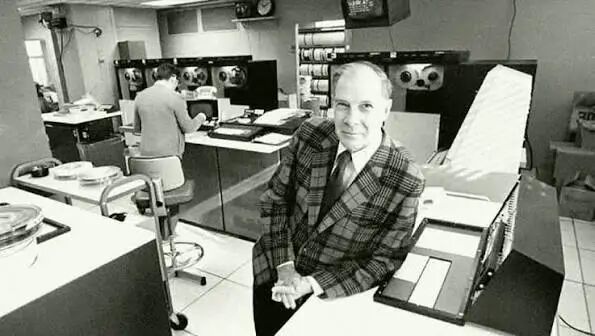
Bell Labs was one of the most storied innovation organizations of the twentieth century. The telephone, the transistor, information theory, Unix, the C language — a vast array of breakthroughs emerged from this system. And Hamming found himself surrounded by a cohort of people who would go on to genuinely change the world.
This gave him a rare observational sample: equally brilliant, in the same place, with similar resources — so why did their ultimate achievements diverge so dramatically?
He studied Claude Shannon, Richard Feynman, John von Neumann, and others. He reflected on his own research experience. Eventually, he reached a conclusion: what truly separates people is not intelligence, resources, or luck.
To do important work, you must work on the right problem, in the right way, at the right time.
What resonates isn't just how Hamming defined excellence — it's his unguarded seriousness when talking about it. In an era of restlessness and noise, where everyone chases speed, he spoke plainly about greatness, importance, and success. He believed a person should think carefully about what deserves a lifetime of their effort.
You and Your Research was not originally an essay — it was a lecture.
On March 7, 1986, a decade after leaving Bell Labs, Hamming returned to Bellcore — born from the breakup of the Bell System — and delivered this talk to roughly two hundred researchers and guests. The room was packed.
For the entire lecture, he wanted to answer just one question:
Why do so few scientists make significant contributions, while most are eventually forgotten?

The Flash of Insight
Few people discuss how to manage their own research, and even fewer talk about how to avoid letting others dominate it. But in fact, you have far more control over your research than you imagine.
We're talking here about great research — work that gains wide recognition, perhaps even wins a Nobel Prize.
Most people know that an ordinary paper is read only by its authors and referees, while a classic paper is read by thousands. What we care about is research that truly matters, that stands the test of time, that doesn't merely end up as a historical footnote.
To do important work, you must work on the right problem, in the right way, at the right time.
Miss any one of these, and you may still produce decent results — but you will almost certainly miss true greatness.
Greatness is a style.
Like learning to paint: after mastering the basics, you apprentice yourself to a master. During that time, you listen carefully to his critiques of your work. But you also know that to truly become a master yourself, you must eventually find your own style.
A style that succeeds in one era might not work in another. Cubism, had it emerged during the height of realism, would likely have made little impact.
Similarly, there is no simple formula for great scientific research.
This matters because, as far as the evidence shows, each of us has only one life. Given that, rather than living it out in mediocrity, you might as well do something you genuinely believe is important. There is no need to spend your life on things that won't even merit a historical footnote.

Choosing the Problem
Let me start with the choice of problem.
Most scientists spend all their time on problems that even they admit are unimportant and unlikely to lead to significant results. Thus, they are almost guaranteed not to do truly important work.
Note that an answer may be very important without the question itself being worth studying.
I worked at Bell Telephone Laboratories for thirty years. Before its breakup, nobody there studied time travel, teleportation, or antigravity.
Why? Because no one had any idea how to approach them.
One important criterion for whether a problem is worth studying: Do you have a reasonable line of attack, a suitable starting point, or at least a plausible idea of how to begin?
My experience at Bell Labs illustrates this.
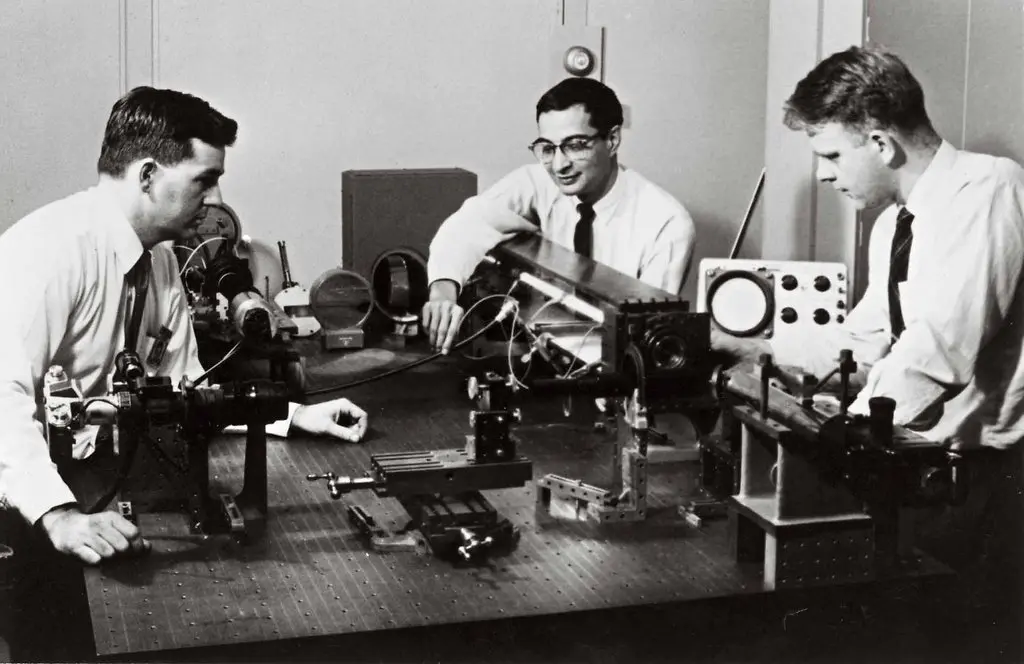
In 1961, Donald Herriot, Ali Javan, and William Bennett posed with one of Bell Labs' earliest lasers.
In my early years, I often had lunch with the mathematicians. But I soon found they seemed more interested in amusement and games than in serious work, so I moved to the physicists' table.
I sat there for many years. Eventually, Nobel Prizes, promotions, and offers from other companies removed most of the interesting people from that table. So I moved to the chemists' table, because I had a friend there.
At first, I would ask them: What are the important problems in chemistry? What are you working on? What problems might lead to important results?
One day, I asked them: "If what you're doing is not important and is unlikely to lead to important results, why are you doing it?"
After that, I had to go eat with the engineers.
About four months later, that friend stopped me in the hallway. He said my question had haunted him. He had spent the entire summer thinking about what was truly important in his field. Though he didn't change his research direction as a result, he felt the reflection was immensely valuable.
I thanked him and continued on my way.
A few weeks later, I found he had been appointed head of his department. Many years later, he became a member of the National Academy of Engineering.
Of that entire group, he was the only one who truly took the question to heart, and he went on to do important things. The others, as far as I know, produced nothing that warranted public attention.
The world is not short of right problems. What it lacks are people who seriously search for them.
Most people simply drift with the current, doing whatever comes their way, taking the easiest path toward tomorrow.
Great scientists spend enormous time and energy examining what is truly important in their field. Many keep a mental list of ten to twenty potentially important problems, for which they have not yet found a suitable way in.
Thus, when they encounter some new clue they hadn't known before, one that might connect to one of these problems, they can pivot quickly, begin working on it, and reach the result first.
Some people work with their doors open, so anyone passing by can see; others keep their doors tightly shut, avoiding all interruption.
Those with open doors may accomplish less each day. But those with closed doors often don't know what they should really be working on, and they rarely happen to hear the clue that would fill in a missing piece for one of the problems on their list.
I cannot prove whether open doors lead to open minds, or open minds lead to open doors. I can only say that the two are clearly correlated. An open door is far more likely to lead you to important problems than a closed one.
Hard work is a trait shared by most great scientists.
Edison said genius is one percent inspiration and ninety-nine percent perspiration. Newton said that if others worked as hard as he did, they could achieve similar results.
Hard work is necessary, but not sufficient.
Most people don't work as hard as they could have. But many work very hard yet study the wrong problem, in the wrong way, at the wrong time — and end up with almost nothing to show for it.
We often see more than one person begin working on the same problem at roughly the same time.
In biology, Darwin and Wallace proposed evolution nearly simultaneously; in special relativity, besides Einstein, many including Poincaré were working on similar problems.
But Einstein studied it in the right way.
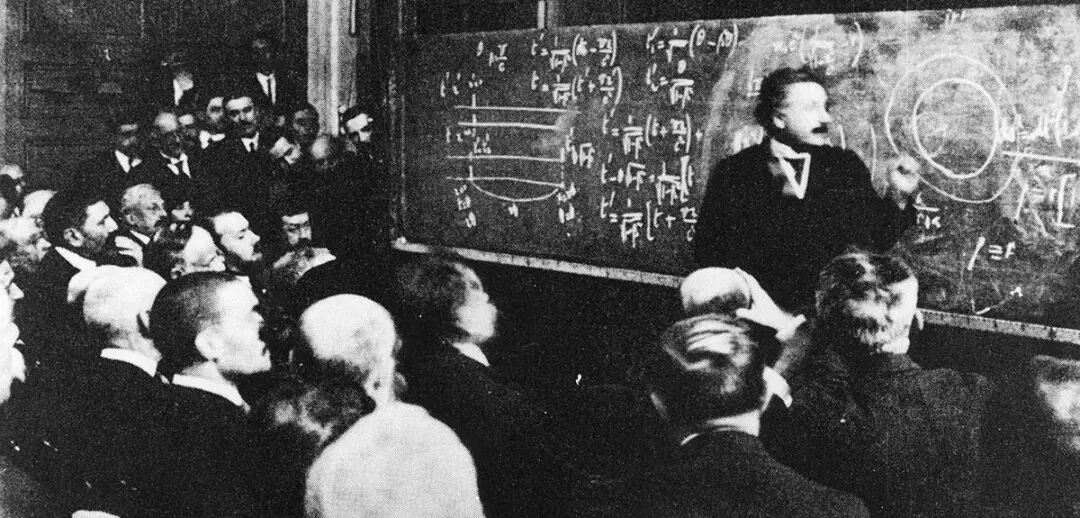
In 1922, Einstein lectured at the Collège de France. That same year, he received the 1921 Nobel Prize in Physics.
Usually, the first person to produce results gets nearly all the credit; the second is quickly forgotten. Working on a problem at the right time is crucial.
Einstein spent much of his later life searching for a unified theory. Until he was hospitalized, near the end of his life, he was still working on it — yet never achieved significant results.
He may have started too early, or worked on the wrong problem.
When you believe you are working on the right problem at the right time, you typically make one of two errors: giving up too soon, or refusing to give up while producing no results whatsoever. The latter is quite common.
If you choose the wrong problem and refuse to abandon it, you are almost destined to waste the rest of your life. Einstein's late work is an example.
Knowing when to persist is not easy. If you are wrong, people will call you stubborn; if you turn out to be right, they will call you determined.
Now, let me address the excuses people most commonly use for not working on important problems.
People always say success depends on luck. But as Pasteur said: "Chance favors the prepared mind."
Extensive personal experience, indirect experience gained from asking others, and wide reading have all convinced me of this.
If success were merely random, it would not happen repeatedly to the same people.
When I first met Feynman at Los Alamos during World War II, I believed he would someday win a Nobel Prize. His energy, style, and ability all indicated he would do many things, and at least one of them would be very important.
At age twelve, Einstein asked himself: If a person traveled at the speed of light, what would light waves look like to him?
He knew Maxwell's theory could not accommodate a stationary local wave crest. Yet if the theory was correct, that seemed to be exactly what he would see. It was no surprise that he later proposed special relativity. The question had been germinating in his mind for years.
Often, when you speak with someone who has just made an important discovery, he will tell you how he arrived at the final answer step by step. That path is usually built on things he did years before, or problems he had thought deeply about.
You succeed because you completed the necessary preparation years earlier. At the time, you didn't know that step would eventually become indispensable.

Personal Traits
The following traits are not all indispensable, but they appear in most people who achieve great scientific accomplishments.
First, successful people usually have more drive and energy than ordinary people.
They see more, work harder, and think longer than others.
Knowledge and ability are much like compound interest. The more you do, the more you are capable of doing; and the more you can do, the more opportunities open to you.
It was Feynman's abundant energy and his habit of constantly trying new things that made one believe he would eventually succeed.
But this requires emotional commitment.
I once observed a mathematician at close range, perhaps one of the most gifted people I have ever known. Yet he never seemed truly committed to the problems he was working on.
He produced a great deal of first-rate work, but never reached the highest level.
To achieve real success, there seems to be no substitute for deep emotional involvement in a problem. It keeps you thinking about the same thing from morning till night, and this often proves sufficient to overcome mere talent.
After the war, while still at Los Alamos, I thought seriously about the famous Buffon's needle problem: if you throw a needle randomly onto a set of equally spaced parallel lines, you can calculate the probability that it crosses one of them.
I began asking: Does the needle have to be a straight line segment? What if multiple crossings are allowed? The answer was no.
Do the parallel lines have to be straight? No.
Must they be equally spaced? Or is what really important merely the average density of these lines in the plane?

Scientists conducting nuclear test-related work at Los Alamos National Laboratory.
Several years later, while working at Bell Labs, some metallurgists asked me how to measure the total length of grain boundaries in a micrograph. I immediately said: "Draw a random line of fixed length on the picture and count how many times it crosses a boundary."
What was surprising about that? I could think of this method precisely because I had previously thought deeply about that interesting probability problem, which I had considered important.
The result was not great, but it illustrates well how preparation and emotional commitment work.
This story also exemplifies what I call "going the extra mile."
I didn't stop at the minimum requirements. I went further, trying to understand the essence of the problem. This habit of not being satisfied with surfaces, of persistently understanding a little more, will let you see new uses for knowledge in the future, even when the application is only slightly similar to the original problem.
With a problem like Buffon's needle, if you study it deeply enough, you will someday stumble upon an important application.
Courage is another trait common among those who do great things.
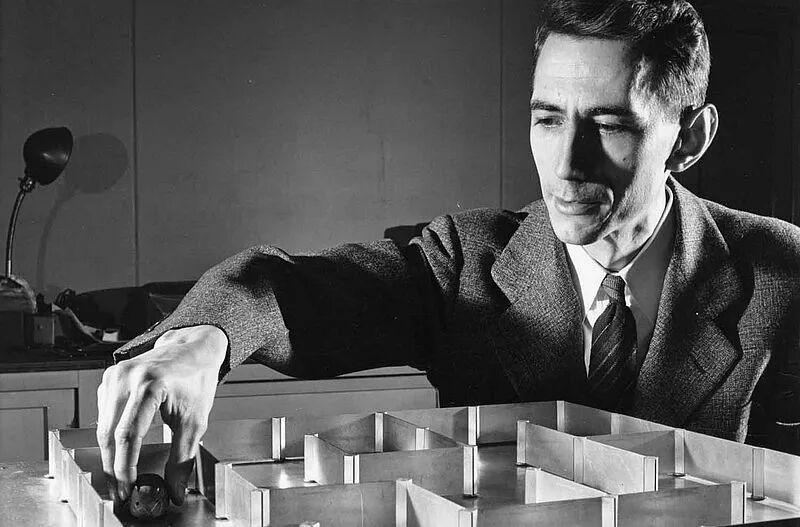
Shannon is an excellent example.
For a period, he would come to work around ten in the morning, play chess until two in the afternoon, then go home. When his pieces were under attack, he almost never defended — he immediately counterattacked. Before long, the board would become a tangled, mutually constraining mess.
Then he would pause to think, advance his queen, and say: "I ain't scared of nothing."
It took me a while to realize that this was precisely why he could prove the existence of good coding methods.
Who else but Shannon would think of averaging over all random codes and expecting that average to be close to ideal?
Later, when I was stuck on a problem, I learned to say the same thing to myself. Several times, this very approach led me to important results.
Without courage, it is hard to keep attacking truly important problems, and thus hard to do important things.
Courage brings confidence, and confidence is indispensable for completing difficult tasks. But it can also slide into arrogance, which becomes a hindrance.
There is another trait that took me years to notice: the ability to tolerate ambiguity and uncertainty.
Most people want to believe that what they have learned is the truth; a few others are skeptical of everything.
But if you believe too much, it becomes hard to find the fresh perspective that could transform an entire field; if you doubt too much, you cannot move forward at all.
You must find a delicate balance between belief and doubt.
Truly major breakthroughs usually mean stepping outside the standard viewpoint of a field and seeing the problem anew.
When learning something, you need to keep thinking about it, examine it from different angles, and connect it in as many ways as possible to what you already know. Only then, when you find yourself in an unusual situation, can you retrieve it.
It took me a long time to realize that for everything I learned, I should attach some "hooks."
This is another side of "going the extra mile": learning more deeply, going a little further than others. It seems to be a habit shared by great scientists.
Considerable evidence shows that breakthroughs that change a field often come from outsiders.
Carbon dating in archaeology came from physics; the first airplane was built by the Wright brothers, who knew bicycles intimately.
As an expert in a field, you face a dilemma: the outside seems full of cranks and crazy ideas, yet the next truly major breakthrough may well come from one of them.
If you spend too much time listening to them, you cannot get your own work done; if you ignore them completely, you may miss the most important opportunity of your life.
I have no simple answer to this. I can only say: don't dismiss an outsider as quickly as most insiders do.
Having a clever mind is certainly good, but the top graduate students do not necessarily end up contributing more than those who were not initially ranked as highly.
There are many forms of cleverness.
Experimental physicists do not think the same way as theoretical physicists. Some experimental scientists seem to think with their hands: they can only think clearly by constantly manipulating equipment.
It also took me years to realize that even someone who doesn't know much mathematics can still make important contributions. His inability to solve a quadratic equation in his head does not mean I should ignore him.
When someone's cleverness is of a different type than yours, this may mean precisely that you should listen to them more carefully.

Vision
You need a vision of who you are and where your field is going.
A fitting metaphor is the drunk sailor. He takes one step left, one step right, each step random and independent. After n steps, his average distance from the starting point is only about √n.
But if someone he cares about stands in the distance, his steps will unconsciously drift in that direction, and his net progress will be proportional to n.
In the countless large and small choices of life, the gap between √n and n is enormous. This is the difference between having no vision and having one.
As for what the vision specifically is, that matters less. There is more than one path to success. What matters is knowing who you might become, where you want to go, and roughly how to get there.
Without vision, it is hard to do great work; with vision, you have a chance to go far enough.

The first transistor computer built by Bell Labs in 1954.
Another topic: age.
Historically, mathematicians, theoretical physicists, and astrophysicians tend to achieve early; in music, politics, and literature, a person's later works are often more treasured. Other fields fall somewhere in between.
You must know your field. In some fields, it is best to move early.
People often complain that working conditions are not ideal, yet many great results have emerged from decidedly non-ideal environments.
What people imagine to be their optimal working conditions may not actually suit them. In my view, the Institute for Advanced Study at Princeton University has probably destroyed more good people than it has helped. A comparison of their work before and after joining makes this not hard to see.
There are exceptions, of course. But overall, so-called ideal working conditions may actually destroy creativity.
Another obvious trait of great people: they complete their work in a way that lets later generations continue building upon it.
Newton said: "If I have seen further, it is by standing on the shoulders of giants."
Too many people care more about guarding their results than letting others build upon them. Don't let the same thing have to be started over from scratch next time, by you or by someone else.
What you do should truly move everything one step forward.

Selling
Now I must address a somewhat unpleasant topic: selling your ideas.
Too many scientists consider this beneath their dignity, as if the whole world is waiting for their great results.
But the fact is, other researchers are busy with their own work. You must present your results in a way that makes them willing to stop what they are doing and turn to listen.
There are three main forms of presenting results: published papers, formal presentations, and informal exchanges.
You must master all three.
Much excellent work has been buried because of poor presentation, only to be rediscovered later. If you cannot present your results clearly, you may not receive the recognition you deserve.
I have seen too many such cases: the discoverer was unwilling to make the effort to explain things clearly, and ultimately his results had virtually no impact on society.
Finally, I must address one question: Is greatness worth such enormous effort?
Those who have truly done great things usually say, in private, that the feeling surpasses all wine, love, and song.
The moment of realizing "I did it" is overwhelming.
Of course, I have only asked those who actually achieved great things; I dare not ask those who did not. They might give a different answer.
But as people often say, the real reward comes from the struggle, not from success itself.
Some say that in striving to do great things, you become a better person. Compared to this, success or failure matters less.
I believe this.
No one ever told me what I have just told you. I had to figure it all out for myself.
But now I have told you how to succeed, so you have no excuse not to try, not to do truly great work in whatever field you choose.

If you too are working on an important problem, striving to do great work, we would love to hear your story: dream@zhenfund.com