A Team, an Email, and Thirteen Years of Zhaogang's Startup Journey

Crank the sensitivity up. For entrepreneurship, crank it even higher.
For 24 years after graduation, "Liu the Electric Engineer" — Liu Cixin — never changed employers, writing The Three-Body Problem on his office computer between shifts. Wang Dong, who spent nearly a decade as a university lecturer, took a different path: he "played" his way into entrepreneurship, eventually building China's largest steel e-commerce platform, Zhaogang Group.
On March 10, Zhaogang Group successfully listed on the Hong Kong Stock Exchange, marking the first steel e-commerce company to debut on the Hong Kong main board in nearly three years.
The evening the interview ended, Wang posted a photo to his WeChat Moments, asking DeepSeek: "Why does a late-night bowl of lamb soup and a lamb testicle taste better than any Michelin meal I've ever had?" DeepSeek replied: "The right time + the right food + the right emotion — it's an instinctive rebellion."
From the stability of academia into the steel industry as a professional manager, then from Zhengzhou to Shanghai to start a business — Wang Dong's life trajectory traces a series of "desertions," each one a search for a new path.
When he founded the Home esports team in his early twenties, he was a curiosity-driven Sichuan University student frequently reprimanded by professors for being "disorganized and undisciplined." In 2000, the esports market barely existed; getting online required dial-up modems. StarCraft drew a cohort of university students to Battle.net. They played in English, endured 6.4k lag, and studied tactics without replays. Wang, who once placed second nationally, recalls: "StarCraft was the first time I saw the internet."
In 2011, the Shanghai steel trade crisis erupted, leaving a massive market void. China's traditional industries stood at a transformation inflection point, and a wave of B2B companies emerged. Old teammates urged Wang to come to Shanghai — and the steel professional, who watched Win in China daily, was moved. He understood: this was an unmissable opportunity.
In 2012, he gathered several old teammates. Eleven people, eleven fish. Zhaogang was born. At the company's founding, Wang sent an email to ZhenFund's Dream Center inbox. Bob Xu, ZhenFund's founder, saw it and invited Wang to meet. Over xiaolongbao, they finalized the first investment.
Come out or not? Start up or not, in Shanghai? Like the sci-fi novel Dark Matter, everyone has perhaps fantasized about an alternate life path. If he had chosen differently fourteen years ago, what would his other version look like? But when asked "What if you hadn't come to Shanghai that year?" Wang cut in before the question finished: "No." He wasn't rejecting another road — he simply never left himself a way back.
"Every emerging entrepreneur is someone with no way back."
Wang Dong is 49 this year. As the saying goes, "at fifty one knows the mandate of heaven." Having taken many detours, he and the Zhaogang people have finally reached the company's IPO. Everything fell into place naturally, but only those who lived it can recount the details and review this "hell mode" game. And he remains like that "fat cat" figurine on his desk — smiling, his conversation radiating fierce curiosity, traces of his twenty-something self still visible. Perhaps from his optimism, perhaps from his proud "good skin."
At an age of accepting destiny, Wang faces uncertainty with growing equanimity. He often says to Wang Changhui, Zhaogang Group's co-founder who is eight years his junior and took over the team at 20: "When heaven bestows, not taking it brings punishment" — divine opportunity must not be missed.
Zhaogang Group is his doing the right thing at the right time, and another "instinctive rebellion."
Below is the full interview.

The text message Bob Xu sent Wang Dong after their first meeting in 2011
01
The First Time I Saw the Internet
Q: What year did you come to Shanghai?
Wang Dong: 2011. I was 35, and decided to start a business.
Before 2008, I had been a university lecturer the whole time. Initially in the physics department, later transferred to the network center to oversee campus network construction.
Q: Even today, many people are unfamiliar with the steel industry. Can you explain how you first came to focus on this sector?
Wang Dong: No matter how powerful the virtual world becomes, this world is ultimately made of matter. The building we're in — every square meter contains 80 kilograms of steel. Buying a car might consume one ton of steel; five years later when it's scrapped and replaced, that's roughly 200 kilograms of steel consumed per year. Even replacing a phone requires a few grams of steel. From weaving clothes to paving roads — food, housing, transportation, daily use — nearly all human activity depends on steel.
Per capita steel consumption is a crucial metric.
For millennia, humanity has never been able to do without steel. From steel's earliest replacement of bronze, through both peace and war, steel was always in short supply.
In early 2009, through a chance connection, I joined a steel internet company. Like Qunar or Baidu, it focused on search — behind it lay a market of four to five trillion yuan. I saw opportunity, so I started as operations director, gradually shifted to sales, and finally took full responsibility. Three full years.
I didn't start a business on impulse. It was based on my understanding of the steel industry. Otherwise Bob wouldn't have invested in me. How would someone coming out of academia end up in the steel business?
Before founding the company, I read Wu Jun's At the Peak of the Tides. The book analyzed Silicon Valley and every historical story of seizing era-defining opportunities. This gave me my first real grasp of "era opportunity." When the steel trade crisis erupted, I understood: I had found my era's opportunity. China is the world's largest steel producer — of 1.7 billion tons of global annual output, China produces 1.1 billion. Moreover, steel's connected industries are innumerable; this was genuine combat experience.
The night I finished that book in 2011, I was too excited to sleep.
Q: How did you build your team?
Wang Dong: Mainly through my esports network.
In 2000, I founded an amateur esports team called Home.
I met Wang Changhui here when he was just 15. We both graduated from Henan Experimental Middle School.
At the time, the esports market didn't exist yet; Tencent and other major players hadn't entered. In 2000, we even got Cisco as a sponsor for tournaments — not easy.
This team was purely interest-driven. I played StarCraft. The predecessor of today's Honor of Kings is League of Legends; League of Legends' predecessor is Dota; Dota's predecessor is Warcraft; and Warcraft traces back to StarCraft.
The earliest StarCraft players were almost all highly educated — you needed to know English, and know how to modify IP addresses and registry settings to get online. Back then, computer lab fees were 3 yuan per hour, while internet was 15 yuan per hour. Everyone pooled money and took turns going online. Sounds boring, but in retrospect, first-generation players at home had only 6.4k "cats" [modems]. That we could play StarCraft at that speed — incredible.
StarCraft was the first time I saw the internet.
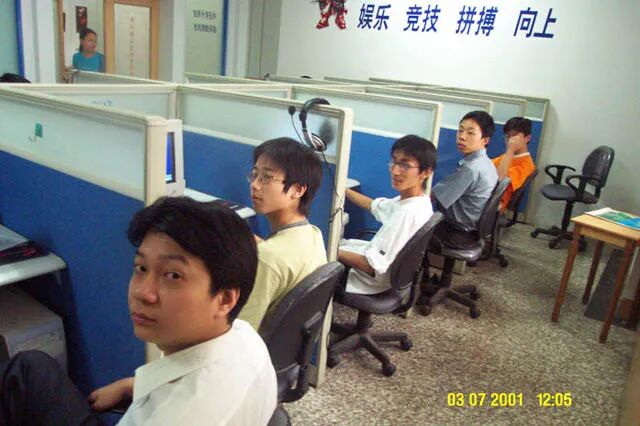
A 2001 photo of Wang Dong (far left) training with Team Home
Q: When did you first believe your judgment about the steel industry was correct?
Wang Dong: 2011, when the Shanghai steel trade crisis erupted.
Before this, China's manufacturing, infrastructure, and real estate were developing rapidly; steel had been a scarce commodity in short supply. The industry was saturated, but hadn't truly developed demand for internet-based services and transactions.
But with the steel trade crisis, the industry shifted from supply shortage to overcapacity. By 2012, as China's economy entered the new normal, sellers went from "not worrying about sales" to "worried about sales" — and internet entrepreneurs finally had their opening. Just as Zhejiang's surplus of small commodities created opportunity for Taobao, and Guangdong-Fujian's backed-up apparel and footwear made Vipshop possible.
From 2012 to 2015, the steel trade crisis first exploded in Shanghai, spread to East China, and finally swept the nation. Those three years, we followed the crisis's footsteps. Where there's crisis, there's opportunity. The steel trade crisis was the era opportunity I "found."
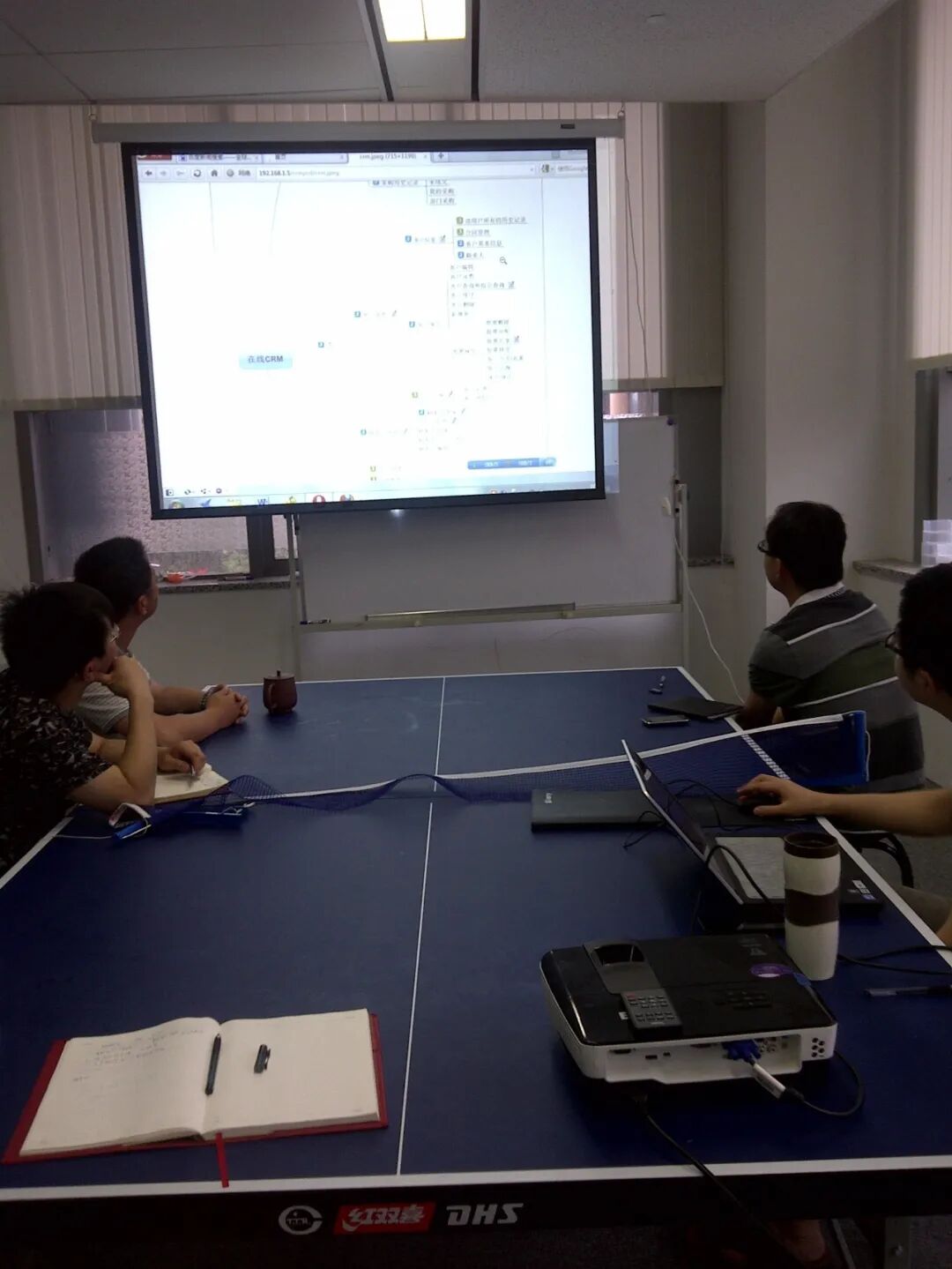
Zhaogang's first conference table was a ping-pong table; after work, everyone could play to decompress
Q: Zhaogang launched in 2012, and by 2015 there were already 31 various "Zhao" ["find"] companies. What do you think of this "Zhao generation" that Zhaogang initiated?
Wang Dong: I don't really buy into this "Zhao generation" concept.
"Finding" only makes sense when an industry has massive SKU variety and frequent price fluctuations across regions. Buyers have to constantly "find" to discover optimal purchasing strategies. But many industries don't actually need "finding." Only industries like steel, electronic components, and others where the internet can enable "finding" can truly benefit.
Steel has two advantages: first, production quality is regulated by the General Administration of Quality Supervision; second, invoices are managed by the State Taxation Administration. Steel production quality is strictly state-controlled — it determines whether buildings collapse, whether roads fail. This makes it very suitable for internet entrepreneurship.
But some industries, without standardization, can't support platform models — you can't manage individual peddlers one by one. Non-standardized industries that imitate Zhaogang are doomed.
Q: When you started Zhaogang in 2012, how did your teaching background influence team-building and your read on people and situations?
Wang Dong: A teaching background is particularly well-suited to B2B.
One major difference between B2B and B2C lies in financial statement composition. B2C entrepreneurs' core task is traffic control — acquiring traffic, converting it, driving growth. B2B companies that blindly imitate B2C mostly fail.
B2B's essence is a human resources company. At Zhaogang, for example, 80% of costs are human capital. We acquire order flow by providing free pre-sales inquiry and quoting services, then pursue conversion — we don't rely on traffic.
I place great importance on the process from new hire to seasoned veteran, on achieving "1 + 1 > 2" results. This is my advantage as a teacher. Like running a school, I focus on recruitment, probation management, and designing promotion paths for every employee — analogous to progressing from first grade to third grade.
Q: Did you take a different path from what your parents expected?
Wang Dong: I took a path that belonged to me.
My parents certainly hoped I'd progress from lecturer to associate professor to administrator at school, but I didn't like living by the schedule. Gaming changed me. Kingsoft's first game, Zhongguancun Tycoon, also made Kingsoft — the earliest entrepreneur stories are almost inseparable from gaming.
Games are the most direct way to experience the magic of technology. StarCraft was only 183 megabytes, written in C, with a structure that was elegant and precise. Some people played the game; others looked through it and saw how intelligent and advanced the internet could be — they saw the future.
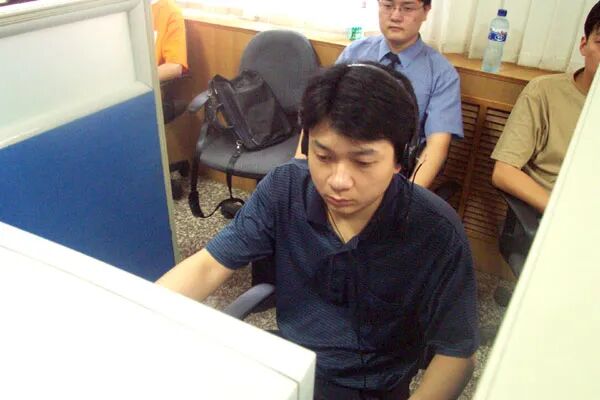
Wang Dong with Team Home, 2001
02
An Email to Dream Center
Q: What impact did gaming have on your career as a whole?
Wang Dong: StarCraft was how I first learned about the internet.
It started with esports — I got to know a whole circle of players. My hometown is Zhengzhou, Henan, where information flow lagged behind Beijing, Shanghai, and Guangzhou. But one teammate kept pushing me to come to Shanghai in 2011, and he even explained how venture capital worked. Without meeting him, I probably never would have come. He always believed I was suited to start a business in Shanghai, not to stay back home. It all felt predestined.
Around that time I was also watching Win in China, soaking up entrepreneurial stories. Combined with my teammate's encouragement, I started trying to email investors. I sent over 100 emails. Two or three people replied. One of them was ZhenFund.
Q: Why reach out to investors by email?
Wang Dong: First, we didn't know any investors — we were starting from zero. Second, Weibo was the hottest platform then, and many entrepreneurs connected with investors there. After we left a comment, an assistant would give us an email address to send our pitch deck to.
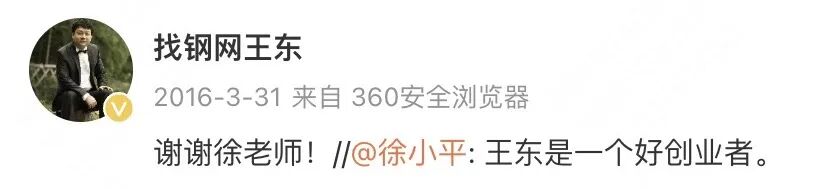
Wang Dong and Bob Xu frequently interacted on Weibo in the early days
Q: What was it like meeting Bob Xu?
Wang Dong: The email reply was brief — let's meet and chat. At first I met with Bob Xu's advisor, and only later met Bob himself.
The meeting lasted less than half an hour. What stuck with me most was that Bob's chef was from Yangzhou, and the lamb xiaolongbao he made were incredibly good. We talked over buns, finalized the investment terms, and had a great time.
As we were parting, Bob said something: "Wang Dong, make Zhaogang the JD.com of steel."
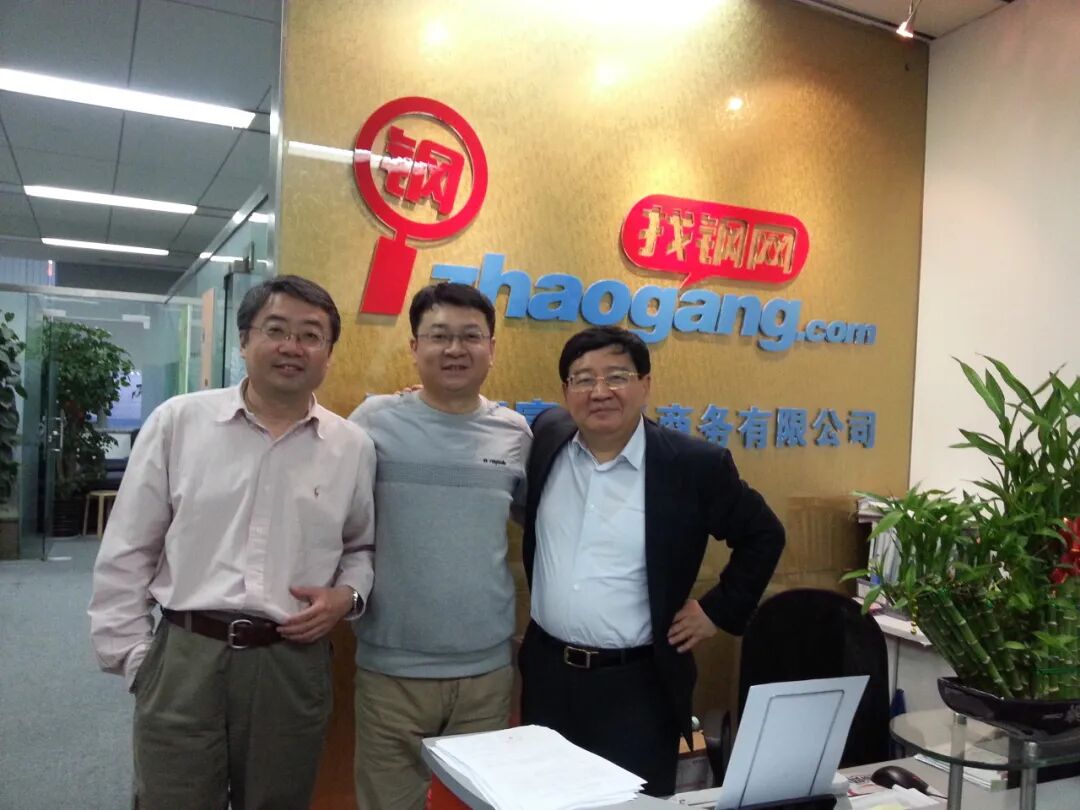
Wang Qiang (left), Wang Dong (center), and Bob Xu (right)
He said it with real excitement. At the time, there was a lot of debate about how B2B would develop in China. One path was self-operated, like JD.com. Another was copying the B2C Taobao-Tmall model. There were also state-owned enterprise-led supply chain management approaches, and pure trading models.
Q: In 2011, mobile internet was still the hottest space for investors. Zhaogang wasn't the most attractive sector on paper. How did you convince people this was worth doing? Did your gaming experience play a role? Shopify founder Tobias Lütke once said that managing a gaming guild might be more valuable than a college degree when starting a company.
Wang Dong: China's restaurant industry is a 5-trillion-yuan market. Steel was roughly the same size. I believed steel had that kind of potential.
But angel investors aren't necessarily betting on the business model — they're betting on the person. At the time, the most impressive entrepreneurs were almost all gamers or game makers.
I didn't start out as a general manager in the steel industry either. I went from managing 20 people step by step to over 200.
In fact, when I was just over 20, I once managed an organization of nearly 1,000 people. Team Home peaked at 963 members. We didn't even pay salaries — it was purely for the love of it. The team had different departments and hierarchies. Every tournament required coordinating across departments to pull off. Wang Changhui and I were both willing to do it because that passion was our biggest driver back then.
We were extremely optimistic. I was already a professional manager, and Wang Changhui was sharp — we ran the team with ease. As long as you had a solid pitch deck, decent background, and a strong team, the success rate for angel investment was high.
03
People Can't Change the Environment, Only Adapt to It
Q: What have been the key turning points in your years of entrepreneurship?
Wang Dong: 2018 was a critical turning point. By the end of that year, we fully realized that B2B had to be platform-based, not self-operated.
Many things that look like detours are actually necessary paths. From 2015 to 2018, we did take a wrong turn, but we became the largest self-operated company in the country. By 2019, we faced another fork in the road — this time, we had to cut off our own arm and abandon self-operation.
If we had kept going with self-operation, the financial pressure would have been enormous. The company would have had to manage massive inventory, deal with various risks and price fluctuations, and eventually fall into an unsustainable situation.
Although Zhaogang was profitable in 2017, the business model wasn't stable enough. The company once had over 1,300 employees, with inventory reaching 800,000 tons. Today we're around 1,100 people, but our overall business scale far exceeds what it was then.
Self-operation wasn't a viable long-term direction. Only after becoming the largest self-operated company at the time did we realize — we climbed the mountain, but what we found at the summit wasn't what we wanted.
So we turned around and started climbing a different mountain.
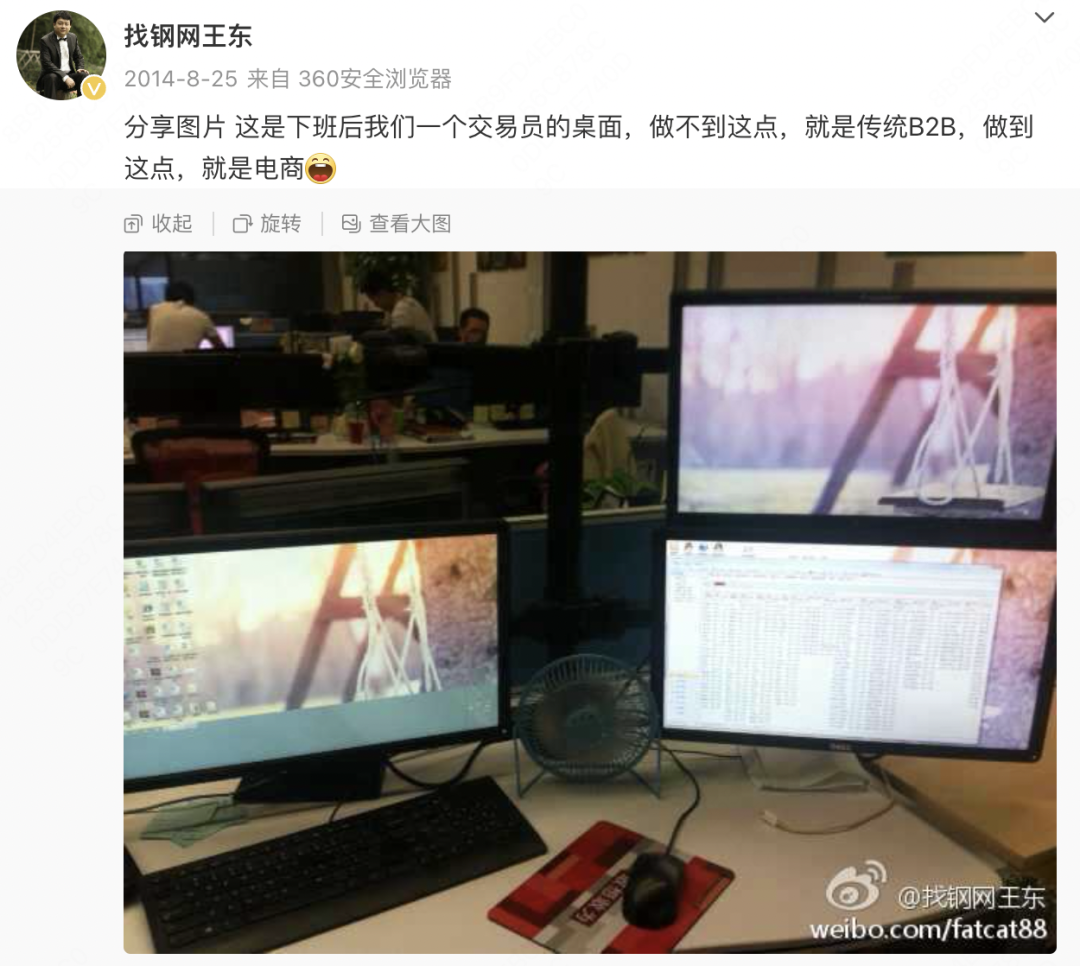
A photo Wang Dong shared on Weibo in 2014 of an employee's desk
Q: What signals made you feel self-operation wasn't the right path?
Wang Dong: A company has to get big before it can get strong.
In China, a company's future is shaped by four forces pulling together, like a tug-of-war. First, policy — your business has to align with policy and ride the momentum of the times.
Second, users — only when users see Zhaogang growing bigger and their own profits growing alongside it will they support you.
Third, team — of course the team wants the company to do better, but actually achieving that is quite hard.
Fourth, capital — especially after going public, both old and new shareholders expect returns.
Only when these four forces combine can they support a company's growth. Many companies fail to achieve this.
When we were self-operated, we were often blocked internally by profit and capital pressure, and constrained externally because we were taking others' lunch. Only when we began transforming into a platform did I discover that the forces supporting us grew more numerous and moved in a healthier direction. Zhaogang belongs to producer services — every city where we expand our business promotes local trade development, which is also a national priority. Once the direction was right, these forces actually wanted Zhaogang to grow even more than we did.
Customers were willing to grow with us. At the time, I was shocked by some of the numbers I saw. One logistics company, for example, started with 5 trucks and has now grown to over 100. Growing around the platform ecosystem, their revenue increased more than a hundredfold.
Once these forces multiply and your internal capabilities are solidified, you can build powerful momentum to push the company forward.
Q: How did you get the flywheel turning when shifting from self-operation to platform?
Wang Dong: We were China's number one steel self-operated company at the time. The brand was established. By offering free price inquiry services, we slowly started the snowball rolling. We had only one or two hundred suppliers when self-operated; now we have over 3,000. We gave up our inventory, and traders came to support us. They were skeptical at first, but as they watched us continuously cut our agreements with steel mills, they gradually joined in.
When you've reached the peak of self-operation, looking at the platform becomes simple. That four-year detour, in hindsight, wasn't wasted.
Q: Leaving your university job to start a business, and cutting a profitable self-operation model — these were both decisions to step outside your comfort zone.
Wang Dong: So-called "comfort zones" only offer temporary comfort. After the comfort comes real discomfort. We were profitable in 2017, but started losing money in 2018. Profit and loss fluctuate.
In 2017, I judged inventory to be around four or five hundred thousand tons — within my comfort zone, something I could control. But by 2018, inventory grew to seven or eight hundred thousand tons, beyond my management capacity. No one in all of China could use that much inventory. And I was facing pressure for future growth — I couldn't just keep accumulating stock.
My days in academia were comfortable too, but that comfort was fleeting. Before 26, earning a bit each month, not worrying about family, I was happy. But when you reach a certain stage and have to plan for your future, you realize that so-called "comfort" is just a temporary illusion. You have to make choices.
For me, leaving the comfort zone was forced. Each time, I was pushed out by time's pressure, and then had to quickly adapt to the new environment.
Q: What's Zhaogang's next goal?
Wang Dong: I'm a very curious person. I'm especially curious: how big can I actually make Zhaogang? We're at 50 or 60 million tons now — can we reach 100 million? 200 million? Though we don't have any real competitors domestically anymore, I still have many hypothetical future rivals.
Going overseas, one challenge we face is India's OfBusiness. It's the Indian version of Zhaogang. Though not yet public, its valuation has already exceeded $5 billion — much higher than ours. Its market is smaller than ours, but India's total steel production is only around 100 million tons.
As for the US, it has supply chain steel companies founded during WWII, like Reliance Steel & Aluminum, with a market cap of $16 billion. Japan has companies like Itochu Marubeni, which grew alongside Japanese manufacturing's global expansion, though their supply chain services are mainly concentrated in developed countries.
We're growing alongside Chinese manufacturing's global expansion. The world's manufacturing center is in China. As Chinese manufacturing goes overseas, that's a massive opportunity for us.
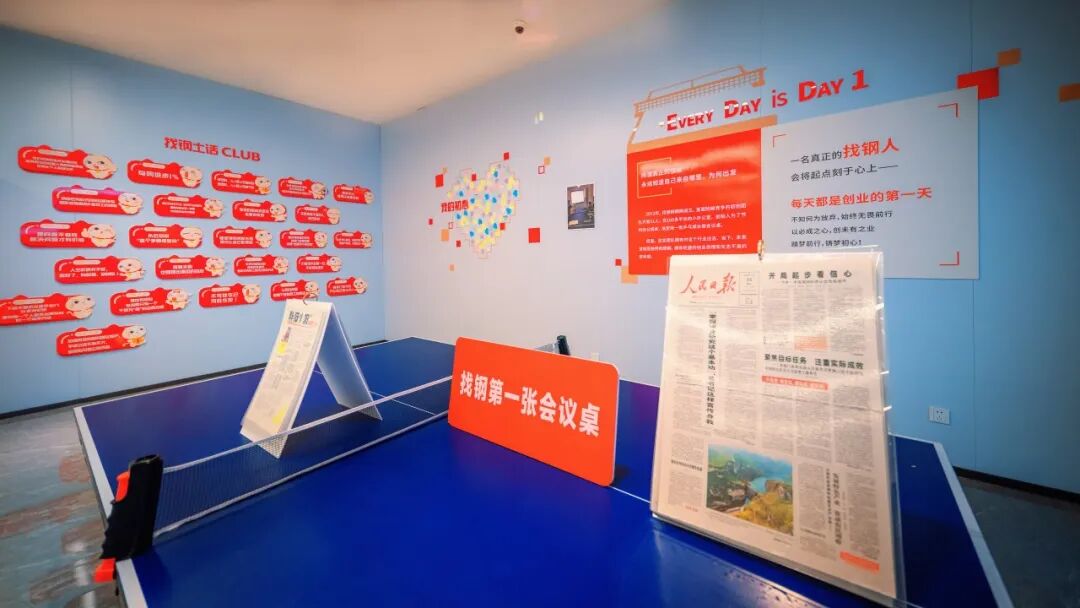
Zhaogang's first conference table, still displayed in the company showroom
04
Turn Your APM to High Sensitivity — Entrepreneurship Needs It Even Higher
Q: What has Zhaogang done right?
Wang Dong: This industry is full of temptations. There are many ways to make quick money, but Zhaogang has always stayed committed to the internet and the platform model.
You could build a "small but beautiful" company — say, doing supply-chain finance, pulling in 100 or 200 million RMB in annual net profit. But then you're just distributing dividends; you can't access the capital markets. Plenty of people in this industry do supply-chain finance. They don't need you for that. What the market actually lacks is an industrial internet platform.
We've always stuck to what we believe is the hard but right path.
Domain cognition determines success or failure. Zhaogang's insight was to stay firmly focused on the pre-sales process and allow users to negotiate prices. Other companies tried to build their platforms the B2C way — locking in product prices like items on Tmall. That goes against the nature of this industry. It's like buying vegetables at a supermarket: the price is fixed, no haggling. But at a wet market, you'll ask them to knock off the change. Two completely different worlds.
Many entrepreneurs trial-and-error repeatedly and end up as "small but beautiful." Like us, they have a gambler's instinct too. But once they bet wrong, that's it.
Q: Compared to ten years ago, what's your new understanding of entrepreneurship today?
Wang Dong: Turn up the company's frequency.
We used to hold all-hands meetings once a month. Now it's weekly. Everyone writes daily work logs and submits weekly reports. Like esports — players need to set their hand speed to high sensitivity to handle sudden situations. All competitive activities work this way. Watch how soccer players warm up before a match — the point is to get their bodies moving fast.
Entrepreneurs need to crank the frequency even higher to handle high-frequency management and operations. Otherwise, they'll likely get eliminated.
Chinese entrepreneurs have it tough today, especially with AI now in the mix. You need to find breakthroughs while operating at high frequency. Every successful startup I know is "high-frequency." If a company's operations don't have this rhythm, no matter how successful or massive it once was, it's declining. If its foundation is solid, maybe it can adjust. But if not, it'll face catastrophic failure.
Q: You once said, "As long as this planet still uses steel, it will need Zhaogang."
Wang Dong: That's still our mission.
People sometimes misunderstand steel, thinking it's crude and heavy. But we're not involved in production — we mainly handle trading. Real traders are extremely sharp. It involves many portfolio strategies; plenty of people with math backgrounds are in this trading game.
As long as this planet still uses steel, trading will be necessary. In most cases, production can't directly correspond to consumption. It needs a platform to facilitate trading services.
Q: How is AI changing the steel industry?
Wang Dong: AI's greatest value in steel is handling pre-sales information matching. It sounds a bit mysterious, but essentially, it's "chatting." Zhaogang has fully integrated DeepSeek.
The steel trading flow goes like this: The buyer asks, "Do you have this model?" If yes, then "How much? Can you go cheaper?" Once settled, the buyer confirms, the deal closes, and the system automatically locks the inventory and places the order. It's a simple chat — same questions, over and over.
Currently, 10% of our transactions are handled by AI responses. AI can negotiate prices too. That proportion will only grow.
05
A Laid-Back First Job Isn't Necessarily Bad for Young People
Q: What advice would you give young people today?
Wang Dong: Things are definitely getting more competitive now. I'd call this the "high-frequency" state. There's no way around it — you have to adapt to this era of intense competition until you reach a point where you're so fully adapted that it feels comfortable.
There are actually more entrepreneurial opportunities in the future, but everyone needs to maintain a moderately high-frequency thinking and working state. If you don't do this, someone else will. Especially with DeepSeek emerging — it'll make the entire industry even higher-frequency. In the future, we probably won't need everyone to be employed. It depends on how each person adjusts their mindset.
Q: You graduated from Sichuan University with a science and engineering degree, but you also have excellent writing skills. You even published articles in Guangming Daily.
Wang Dong: I published in Guangming Daily at 26 — it caused quite a stir at our university. I also spent a year as a columnist for PopSoft and wrote science fiction, published in the ninth issue of Science Fiction World in 2000. I actually predicted the existence of smog back then. The story was about someone who breathed smog every day, drank chemically contaminated water, ate genetically modified crops, and eventually mutated into someone adapted to an acid rain environment.
I quite enjoy writing. Writing makes you more expressive. ToB business itself requires massive communication — convincing people every day.
Q: In your upbringing, what experiences still influence you today?
Wang Dong: I was interested in astronomy as a child and even made a star-viewing box from a cardboard carton. The stars are there all year round. If you place the box at a fixed corner of your balcony, you'll discover that stars actually move from one grid to another. It's magical.
In junior high, the early 1990s, reading Asimov's The Stars, Like Dust also shocked me. I had no idea people could have such imagination. All of this got me interested in science and engineering.
In college, teachers often criticized me for being "disorganized and undisciplined." Sichuan University is an inclusive school. The more inclusive it is, the more "weird" people emerge. If I had gone somewhere with fewer opportunities to explore, I probably would've just studied obediently. Whether playing games or writing articles, I approached everything with a "play" mentality — wanting to challenge myself. I wanted to try Guangming Daily, and it got accepted on my first submission.
When I started working, as a teacher 20 years ago, I only had two classes per week with no office hours. The rest of my time was free.
I think a laid-back first job isn't necessarily bad for young people.
If your first job is relaxed, you have plenty of time to fully engage with society. Of course, if your first job is fast-paced, you'll grow quickly too. But a relaxed first job is also fine. What you should fear is the job that's neither here nor there — not quite busy, not quite idle. That's devastating for young people; it's a waste of time.
Either go somewhere extremely busy and grow fast, or go somewhere extremely relaxed where you can freely engage with society and do what you want. At twenty, you still have time. The pressure only gradually builds as you approach thirty. Youth is precious.
Q: Going from employee to rule-maker at your company. When you encounter so-called undisciplined young people in this process, how do you balance and handle it?
Wang Dong: One of our corporate values is "self-driven, proactive growth." Every manager must clearly communicate expectations and see if you like this position or not.
It's the same with gaming. There was a hugely popular game called Legend that I just couldn't understand. What's the point of grinding monsters to level up? How could kids stay up for days on end, mindlessly chopping away at monsters? Later I understood: different strokes for different folks.
Every industry is different; achieving expertise in any field isn't easy. If you have a hobby that reaches top-tier level, you can deeply understand how different each position is — the water runs deep between trades.
I started with esports. Because of esports, I met Sky Li Xiaofeng — two-time world champion — in my clan, back when he went by Home.Sky. Wang Changhui and I met him when he was just 15. He placed third nationally with Home Clan before going pro. In 2003, he traveled alone from Zhengzhou to Wuhan for a competition. I gave him the money at the train station.
You could tell he loved gaming — different from others. He could train 16 hours a day. Who does that? If it were me, I'd vomit from watching match replays.
Any field can reach a highly professional level. Whatever the position, only after understanding it professionally can you generate genuine curiosity and start wondering: How specialized can this thing get? How big can it scale? Can it provide more value?
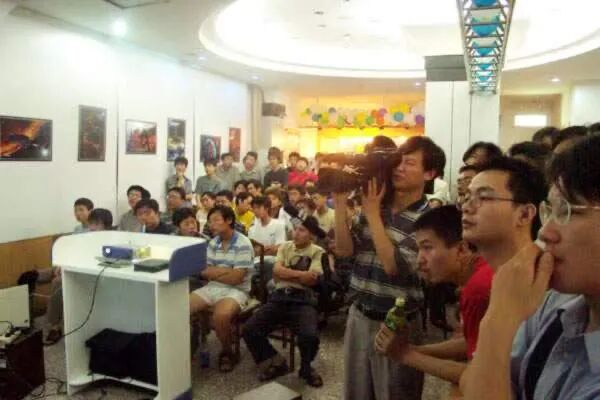
The Home Clan watching match replays together
Q: How did the clan come together?
Wang Dong: Forming a clan is simple.
First, you need someone who's really good. I had placed second nationally, so when I rallied people, they came. Back then matches had no replay function, so if people wanted to see how someone played, they'd have to watch the match live. The most direct way to understand someone was to find an opportunity to play me.
Top skill makes organizing a clan easy.
By 2000, I was 24 — didn't have that much time anymore, and my reactions couldn't keep up. Sky's APM (Actions Per Minute) was 380; mine was 260. The gap in operations per minute was obvious.
I still game to this day, but I don't spend too much time on it. Look at me playing Honor of Kings — I only know one hero, but I solo-queued to 25 stars in King tier. If that hero gets banned or my team doesn't cooperate, I lose.
06
There Are Chasms Between People
Q: Do you have other hobbies?
Wang Dong: I'm decent at Go, but far from professional.
Go is something that makes you realize you're "not that smart." I'm roughly 6-dan on Foxwq. Even just facing amateur experts, you can viscerally feel the gap in computational ability. Understanding this makes you humble.
I've developed a habit over the years — when I'm sleepy, a game of Go works better than coffee. It's like your brain learns to instantly switch modes. When I reached 6-dan on Foxwq, it got exhausting. My peak was only 7-dan. Usually at 6-dan, I'll intentionally lose, drop to 5-dan, and then it's easy again.
Some things simply have chasms. I know that beyond 7-dan isn't something my IQ can handle. There's a book in the Go world called Hatsuyoron. It's the chasm that separates amateurs from professionals. Being able to understand the life-and-death problems inside means you have the potential to go pro.
Q: Whether in career or hobby, how does one become a master in a field?
Wang Dong: Why do I say there are chasms between people? Curiosity is crucial — it keeps you digging, thinking: "Hey, why did he play this move?"
To study game tactics, I once took a 3 AM train to an internet café in Beijing's Wudaokou.
The best players back then were Korean. Korean students would be the first to pick up tactics from Korean pros. We wanted to see how they played, so we just went — 3 AM train from Zhengzhou. It was winter, so cold your lungs froze when you breathed.
I often tell this story later: "To master a skill, would you also brave the northern wind at 3 AM and travel eight or nine hundred kilometers?" It's easy to tell whether someone has this spirit.
Another story. There was an arcade game called 1943 back in the day. A junior high classmate and I often played it. Usually everyone would play a few rounds after school and go home for dinner. But that day we played late, who knows what time, until my classmate suddenly yelled "Whoa!" I turned around — the arcade panel was covered in blood. Then I saw his hand — there was a nail sticking out of the panel, and as he played, it had worn through his skin. Blood was dripping nonstop. He had been so absorbed in gaming that he didn't feel himself bleeding until game over, when he discovered his hand was mangled by the nail.
You say you work with total focus — but have you ever been so focused that you wouldn't even feel a needle prick? This guy didn't just get pricked; he bled all over the place. People are different. Investing means backing a lot of strange people. If there were a sector called "total focus" with the highest PE multiples, my classmate would absolutely be worth the investment. He was so absorbed in thinking that he simply didn't feel the pain.
07
The Seven Steps of a Sales Master
Q: You had sales experience before founding your company?
Wang Dong: Bargaining is crucial.
Sales is just selling stuff. Not hard. I train people all the time — I tell them selling steel is the easiest thing in the world. People just ask: how much for this steel plate? 3,500, I'll knock off 10, want it? Done. That's the simplest kind of sales there is.
Selling something intangible is the hardest. Honestly, convincing Mr. Xu to invest in me was the toughest sale. You aim at a dream, and he puts money in. I also used to sell a formaldehyde-removing photocatalyst. The principle was: spray it on the wall, let it dry, and when it touched sunlight, the enzymes would break down airborne molecules and remove harmful gases. It's mature technology now — basically every home in Japan uses it — but back then it was novel and hard to sell. It was expensive, and after spraying you couldn't see anything. Even if it worked, you couldn't detect it. Very much like "the emperor's new clothes." What you were selling was belief.
If you can sell photocatalysts, you can sell steel.
Consumer psychology has seven steps: capture attention, generate interest, create association, stimulate desire, compare, decide, purchase. Every step must be meticulously designed. When I look at any packaging, I instinctively think: how did it get on the shelf, how was the poster designed, how did it catch my eye? There's also left-brain/right-brain selling. Facing a prospect, you quickly judge whether they're left-brain or right-brain dominant. Left brain calculates precisely; right brain runs on emotion. If they're left-brain, you attack with right-brain appeal, and vice versa. You have to train this daily. Only then can you truly become a sales master.
If they're right-brain, they'll want to drink with you — no drink, no deal. So you start by running the numbers with them, figure out their bottom line, then finally bring in the emotional appeal, alternating left and right. Otherwise you could drink a whole jin with them and they'd still feel it's not enough.
Wang Changhui entered the steel business before me. His WeChat handle is literally "Sales Master."
Back then steel was in short supply. If you had steel, you could sell it. Steel brokers just needed to secure bank loans, get mills to sell them goods, then sit back and mark up prices. You didn't actually need professional sales skills.
Q: What's the secret to winning customer trust?
Wang Dong: Steel is a traditional industry. You have to win over customers one by one. Sometimes, honestly, you have to drink with them one by one.
The clients who come to Zhaogang's annual conference are the real deal — they either own factories or run logistics, with annual revenues in the hundreds of millions year after year. Everyone trusts Zhaogang.
Sales is about making customers trust us. We collect payment upfront — hundreds of thousands in one transfer. Clients have to believe I won't run off with their money. In the beginning, winning them over one person, one truck at a time wasn't easy.
Some business models win through connections — getting more inventory, more capital to do financial services. But we did it properly, conquering territory through real sales ability one by one. Our ultimate goal is service, and the prerequisite for service is that they're willing to trust you.
There's a saying: "Sales is making someone believe what you want them to believe." That's the essence.
08
Emerging Entrepreneurs Have No Retreat
Q: When you were going through "hell mode," how did you relieve stress and build mental resilience?
Wang Dong: There's nothing to build. You just endure silently. Founders heading toward IPO all need to prepare for this.
Q: At peak pressure, did you ever think about what failure would look like?
Wang Dong: The peak pressure was 2019. The decision to cut existing, mature profitable projects was huge. It wasn't painless. But once you've decided, you just move forward. It's like esports — you have to make adjustments constantly, even if that means deciding to sacrifice a unit. Sacrifice it and move on. Don't think about failure. If you think about failure, you can't transform.
Just firmly believe it's right and keep going. Game theory is high-frequency and often requires burning your boats, and you have to learn selective amnesia about these things.
Life has too many forced choices. The more you experience, the richer your experience, the more courage you have to face burning your boats.
Q: What if you hadn't gone to Shanghai?
Wang Dong: No, that wouldn't work. It had to be Shanghai.
Shanghai is the country's largest steel distribution hub, with obvious advantages in talent and logistics. It turned out that among hundreds of steel internet platforms fighting it out, the final survivors were all in Shanghai.
Q: If Zhaogang hadn't worked out, what was your fallback?
Wang Dong: Mr. Xu has real investment wisdom. He saw that we had no retreat. B2B platforms were just starting then. Even if I wanted to retreat, there was nowhere to go — none of the big companies were doing B2B. You can't just quit entrepreneurship and go collect a salary somewhere.
Every emerging industry starts with no retreat, especially for founders. It's like the Battle of Red Cliffs — Zhang Zhao and the others all urged Sun Quan to surrender to Cao Cao, but only Lu Su urged resistance, saying: "My lord, we can all surrender, but you cannot."
Sun Quan didn't understand. Lu Su explained: "Look, if Wu surrenders, I, Lu Su, can still get an official post. What would you, Sun Quan, become?"
If a founder is just an imitator, they have a retreat. But emerging domains rarely offer one. For investment, I don't think you should put money where there's an obvious retreat. Think about it — where could the earliest people who made it with Jack Ma retreat to? They had no retreat, because they created that domain. Same with Tencent. Though chat was imitating ICQ, domestically there was no retreat.
Q: After all these years of entrepreneurship, how has your mentality changed?
Wang Dong: 49, almost knowing heaven's mandate.
Heaven gave me this mandate, so I must do it well. I used to often tell Changhui: "When heaven bestows, refuse at your peril."
At the time everyone was hesitating — should we leave, should we come to Shanghai to start a business? At 35 you have a lot to worry about. But I said: when heaven gives you opportunity, you must seize it, or you'll suffer for refusing.
I'm in a good mental state. Standing next to Wang Changhui, he's 8 years younger, but people think we're the same age.
Q: Because you're curious?
Wang Dong: Mainly looks. My skin is better than his.
Q: In 2012, Zhaogang started with 11 people and 11 fish. What about now?
Wang Dong: All 11 fish are still here.
This episode's audio is also available on ZhenFund's podcast "Seriously Speaking" — welcome to listen!
If you also believe technology changes the world, and love practice and creation, welcome to contact ZhenFund Dream Center: dream@zhenfund.com
Recommended Reading
](https://mp.weixin.qq.com/s?__biz=MjM5NDk5MTA0MQ==&mid=2652323748&idx=1&sn=130aa8a4e5ee95b8c4fc89add8617793&token=970142135&lang=zh_CN&scene=21#wechat_redirect)[
 ](https://mp.weixin.qq.com/s?__biz=MjM5NDk5MTA0MQ==&mid=2652324383&idx=1&sn=2d82670215f19e852680546fce002c8f&scene=21#wechat_redirect)