After Designing a Chip with AI in Three Days, a Tsinghua PhD Decides to Go "Open-Book"

Let more people start from a score of 80.
In three days, Tuoken Zhang used AI to design a chip.
He wrote up the entire process — from zero to tape-out — in an article titled "From Zero to Tape-Out in Three Days: AI Guided Me Through Designing an Attention Compute Chip", which quickly went viral.
With compute support from ZhenFund's Token Grant, he pushed his open-source exploration further, launching an "open-book chip" initiative. Zhang holds a PhD from the Department of Electronic Engineering, Tsinghua University, and is currently a postdoctoral researcher at ETH Zurich.
Over the past year, he has kept plugging agents into real chip design workflows. Virtuoso-Bridge-lite, which connects agents to commercial EDA software, has racked up over 40,000 views and 17,000 downloads on GitHub. Analog Canvas, a schematic drawing board for analog circuits built via vibe coding, surpassed 10,000 users within two weeks of launch.
In his view, one of an engineer's highest dreams is building a product or technology that people actually use.
Beyond putting agents to work, Zhang is also constantly "setting exams" for them. As an outstanding teaching assistant at Tsinghua University, he believes training models is fundamentally a form of teaching. He builds benchmarks for chip design, hoping to show people what models can actually do — and which tasks have already fallen below the models' kill line.
What he wants is to let more people skip starting from zero, saving their time for the part that truly creates value.

Build Without Restraint
Q: Please briefly introduce yourself and what you're working on now.
Tuoken Zhang: I'm Tuoken Zhang — "Tuoken" means to lift up and affirm. In 2026, I earned my PhD from the Department of Electronic Engineering, Tsinghua University, and I'm now a postdoc at the Integrated Systems Laboratory and the AI Center at ETH Zurich in Switzerland.
I'm currently working on an "open-book chip initiative."
A chip usually needs to score above 99 out of 100 to have real commercial value, but training chip engineers is extremely slow, and the industry has long suffered a shortage of talent. Limited human effort is still being massively consumed in the journey from 0 to 80 points.
The chip industry often gives off an impression of being highly closed off. But in reality, a huge amount of foundational content can be opened up.
"Open-book" carries both meanings — reading is beneficial, and open-book exams: organizing textbook-level knowledge, experience, and capability into shared public infrastructure, so that large models can be trained on it, agents can call on it, and every chip designer can use it.
That way, everyone can start directly from 60 points, or even 80, and save their energy for the final stretch that truly creates value.
Q: How many tokens did you spend today?
Tuoken Zhang: In the past 24 hours, I used up 30% of the tokens on both Claude Max 20 and GPT Pro 20.
The project consuming the most tokens is Analog Canvas, the analog circuit drawing board — I'm still refining the user experience. If I'm going to build something, I want it to be the best schematic drawing board in the world.
This is also my own pain point. For many people, doing analog circuit design directly through programming is painful, and the efficiency isn't great either. Is there a way to draw a schematic and convert it straight into a netlist, turning this step — traditionally heavily dependent on closed-source commercial tools — into something AI-native?
But existing tools are either hard to use or ugly. I have fairly high aesthetic standards, so I decided to start from scratch.
Within two weeks of launch, Analog Canvas surpassed 10,000 users worldwide, with over 39,000 page views. I believe it will spawn a lot of future work beyond what people can imagine today.
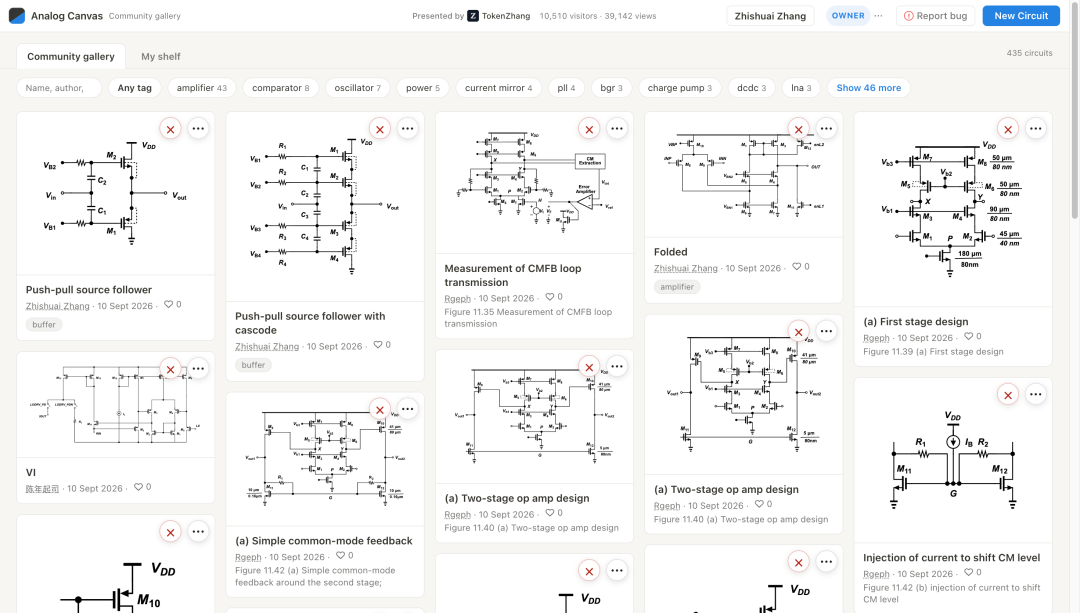
Over 400 different users have uploaded circuit diagrams to the site so far
Q: How do you get a project to meet your standards?
Tuoken Zhang: Developing with agents is a hundred times faster than traditional development. In traditional development, any code change involves a very long process, and you constantly have to look over your shoulder — the cost of compromises made for compatibility is huge. But the cost of having an agent rewrite everything is tiny; whenever you find a problem, you just rewrite. That's how we stay in peak condition, traveling light.
Q: Roughly how many times has the circuit drawing board project been rewritten?
Tuoken Zhang: Every part, every module gets rewritten constantly — it just costs a few more tokens. And since ZhenFund happened to provide token funding, I've been even more liberal about it, having the newest, strongest models do the rewrites directly.
Q: What prompted you to apply for the Token Grant in the first place? What moment moved you the most?
Tuoken Zhang: This March, after my WeChat blog "Tuoken Zhang Uses AI" blew up, quite a few investors reached out, hoping to fund a startup for me.
But I had already committed to my current advisor to do a postdoc in Switzerland, and I'd made my personal career plans. I take commitments I've made very seriously, so I turned down those offers. Right at that moment, ZhenFund offered a Token Grant with no startup prerequisite attached.
What moved me most was the vision and sincerity of the program itself. It doesn't require any upfront binding commitments — it just gives you the funding directly. I think that's a decision that takes real vision and boldness. I deeply appreciate that.
Q: What was the first thing you did after receiving the Token Grant?
Tuoken Zhang: The first thing was reimbursing token costs for my collaborators. They're all friends of mine, and all excellent vibe coders who were initially drawn in by me and the project itself, vibe coding for me almost for free.
With the Token Grant, neither I nor the people working with me have to hesitate over API costs anymore — we can build without restraint.
Q: Things have been changing fast lately. From your first exposure to AI until now, compared with more traditional ways of working, how does it feel different?
Tuoken Zhang: Amazement and awe — I'm constantly stunned by AI's capabilities. Early last year, basically everything was manual clicking, and moving things between files had to be done by hand. But as agents have become widespread, all this work can be delegated to far more intelligent methods. The burden has been lifted from my mind.
Q: When did you most recently feel "these tokens were so worth it"?
Tuoken Zhang: One time, I connected Codex to my test instruments. I was chatting with Codex on the screen, and the indicator lights in front of me lit up in response — the test platform was generating real voltages and currents.
I uploaded the whole process to Bilibili, titled "Heard You're Still Hand-Tweaking Your LDO? I'm Using AI to Control Chip Test Power Supplies and Reference Sources." In that moment, the intelligence agents bring became tangible.
Those tokens were so worth it.

When AI Enters Chip Design
Q: What prompted specialized application scenarios like this one?
Tuoken Zhang: Because I genuinely use it myself — I need this equipment to test my chips.
Everyone's end-stage needs are actually highly fragmented. Before agents, third parties solved our needs for us and sold us products. But products can only satisfy consensus needs — it's hard to satisfy everyone. We have countless last-mile problems.
Now, everyone can use agents to complete their own last mile.
Q: Your first Bilibili video said agents could replace 30% of the work in a pipeline. Is that 30% the fragmented last-mile needs?
Tuoken Zhang: It's both.
My PhD focused mainly on mixed-signal chip design — analog-centric, but with plenty of mixed chips assisted by digital circuits. Analog is the core; digital is auxiliary. But once digital and analog are mixed together, there are tons of interface issues in between that easily go wrong, plus the verification part on top.
Across these three major parts, agents have different degrees of penetration. By the end of last year, I found that virtually not a single line of the digital circuit code was handwritten — it was all written by agents. The penetration level there is extremely high.
Analog design is significantly lower — I gave it about 10%. On the verification side, a lot of debugging still relies on manual judgment built on years of experience from my PhD, but much of the tedious, large-scale cognitive labor and data processing is done by agents.
Weighted all together, it came out to around 30%, which I think is fairly objective and reasonable.
Q: Has that ratio changed now?
Tuoken Zhang: I believe it can go higher.
The ratio also varies with the characteristics of different chips. For pure digital chips, it can already reach 80–90% or more. For analog chips, it's a more gradual process — from 10% to 20%, then 30%, and it may eventually saturate at 40–50%.
Any overall chip system definitely has digital parts and analog parts. How far agents can ultimately penetrate depends on how the system is defined and designed.
Q: You previously mentioned that digital chip design is one of the best scenarios for AI adoption. Why?
Tuoken Zhang: Digital circuits are the first to land for both technical and commercial reasons.
First, the technical side. Digital circuits have a mature toolchain and well-established CLI interfaces, with clearly defined task boundaries and verification standards. From simulation, synthesis, and place-and-route to timing and physical verification, every step comes with rigorous feedback — run it once and you can see the results.
Chip design constitutes a relatively closed, complete environment. You could call it a "victory of the closed world" — and an excellent training ground for agents.
Second, the commercial side. The market for digital chips is vast enough, with enormous customized demand on the horizon, which means huge market value. Chips are also a high-value industry with real, clearly defined willingness to pay for productivity tools. The efficiency gains agents bring can quickly convert into commercial value.
Analog and mixed-signal circuits are equally high-value scenarios. Full 100% end-to-end automation is still a considerable distance away, but agents can already step in for certain parts, pushing intelligence forward step by step.
Q: When it comes to using AI for chip design, how does it differ most from the everyday tasks where we call on agents — writing code, making reports?
Tuoken Zhang: Much of the time it's quite similar, but chip design is more complex overall, and more mysterious to most people.
If we break the process down piece by piece, there are at least three categories of tasks where agents can currently step in: extracting and processing large-scale information; writing code, scripts, and executing command-line tasks; and modeling, analysis, and numerical computation.
General-purpose AI already has sufficient capability and generalization to make meaningful contributions on these tasks. The overall approach here is also similar to office scenarios — the difference lies in which tools are connected.
The more important difference shows up in verification. Chip design demands greater diversity and comprehensiveness in verification, which means more test rounds, more tool calls, and more interaction rounds. From a commercial standpoint, this is good news. Once agents reach mass adoption in the chip field, token consumption will be astronomical.
Q: You once spent three days using AI to design an Attention computation chip. Can you walk us through the process?
Tuoken Zhang: I documented the specific workflow on my WeChat public account in a piece titled Three Days from Zero to Tape-Out: AI Led Me Through Designing an Attention Computation Chip.
The two most important words in that title are "led me." It wouldn't be accurate to say I used AI — it was almost AI taking me along for the ride.
At the time, our research group was doing a shared MPW chip, and one area of it was left empty. If nobody used that space, it would be wasted. So it was an emergency assignment — I got the task three days before the deadline.
I previously didn't know much about hardware implementation of Attention chips. Every detail came from ongoing communication with AI, figuring out how to verify things, and once verified, porting them onto the chip — stacking it up step by step until it reached a state where it could be sent for tape-out.

The Attention demo chip Tuoken Zhang designed with AI. Left: a photo of the physical chip; right: the chip's internal structure
I only offered some vague directions — the specific knowledge was all taught to me by AI, hand over hand. It connected the entire EDA toolchain and handled different EDA tools from several companies with ease.
I got the feeling of "being the boss."
This is also my hope for the future of AI for chip design: I don't need to understand every domain. I just need some basic knowledge and a sense of direction — and with AI's augmentation, it can significantly expand the boundaries of my capabilities.
Q: What can AI currently do independently?
Tuoken Zhang: I'm even skeptical about whether AI can program "independently," let alone independently complete complex engineering tasks.
So far, no piece of software, webpage, or small tool I'm satisfied with has been produced in one click. Engineering deserves respect. It still requires substantial human involvement — adjusting direction, handling endless details, and verifying over and over.
It's like human society. Even if a company hires an extremely capable employee, it's hard to give them one sentence and expect them to work in silence for two months with zero communication and finish everything.
Judging "what AI can do" requires constant recalibration of expectations based on objective reality and our evolving understanding of things.
Q: So one-click generation isn't realistic — is that because of missing context and the fact that much tacit experience hasn't been absorbed?
Tuoken Zhang: One is context; two is that human requirements keep changing.
Every chip design ends up looking very different from where it started. Many design specs and internal decisions get revised in the middle of meetings.
What AI can currently do independently is mainly subtasks with clear boundaries, mature interfaces, and well-defined standards.
Compared with last year and earlier, AI has already amplified human capability enormously. My judgment has always been that AI will bring tremendous empowerment. Humans still need to be the driver — constantly gauging its capability boundaries, assigning appropriate tasks, doing proper verification, and taking responsibility for the final outcome.
Q: Over your long stretch of collaborating with AI, how has your role as a human changed?
Tuoken Zhang: I feel like I got promoted — from AI's "+1" to its "+2."
Back when I was using Claude Sonnet 4.6, I still had to micromanage some details. This year, there's less and less micromanaging. I'll dispatch other agents to review intermediate steps, and I only need to look at the delivered results.
I believe everyone will get promoted in the future.
The bigger the company, the more important a person's leadership and organizational skills become. The same holds for agents — you need to be able to communicate requirements and guidance to agents effectively.
Q: You created and open-sourced Virtuoso-Bridge-Lite. Can you introduce what it is and what it can be used for?
Tuoken Zhang: Virtuoso-Bridge-Lite is a project I open-sourced this April, aimed at connecting agents with commercial EDA software. I've iterated on it several hundred times. Its value can be summed up in one sentence: it gives AI a pair of hands that can reach into industrial chip design environments — connect it, and agents can perform much better.
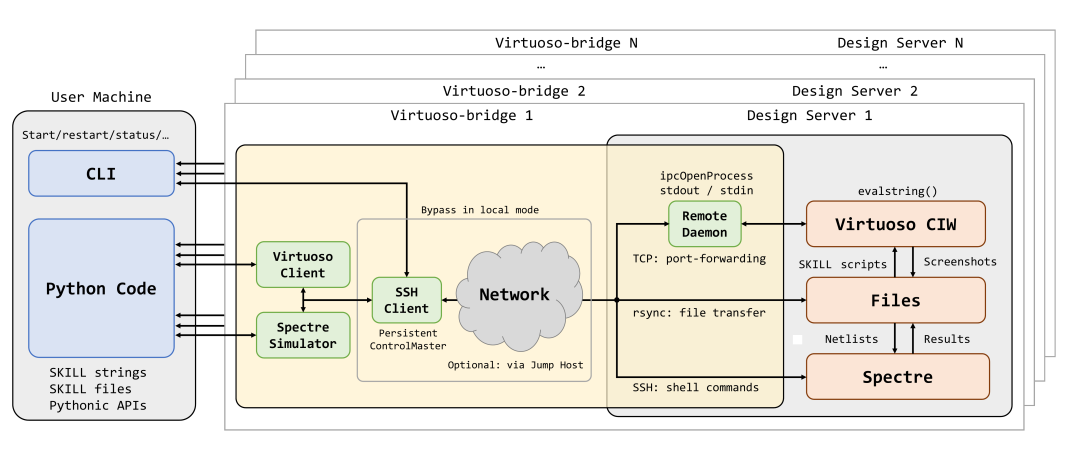
The connection architecture between agents and EDA
Q: Since open-sourcing the project, have you received any memorable feedback?
Tuoken Zhang: Two kinds stand out.
One is the numbers. The project has over 40,000 GitHub views, more than 17,000 downloads, over 150 forks, and more than 10 projects that explicitly state they've built secondary development on top of it.
The other is spontaneous feedback from all corners of social media. One Bilibili follower even wrote me and the project into the acknowledgments of their undergraduate thesis.
Several companies have also told me they've modified the tool — some connected it to RAG, to knowledge bases, optimization algorithms, layout design, and so on — and deployed it in production and intranet environments.
Every engineer's ultimate dream is for the product or technology they built to actually get used — especially commercially.

Does AI Really Understand Chips?
Q: We noticed you've been continuously building professional evaluation sets like Razavi-Bench and Analog Design Bench. Why did you want to build a benchmark specifically for analog circuits?
Tuoken Zhang: Razavi-Bench leans more toward circuit understanding and reasoning, while Analog Design Bench goes further into long-horizon, tool-calling, simulation-verified real design tasks. Analog circuits especially need this kind of benchmark, because models can easily sound like experts while the circuit may not actually work when it runs.
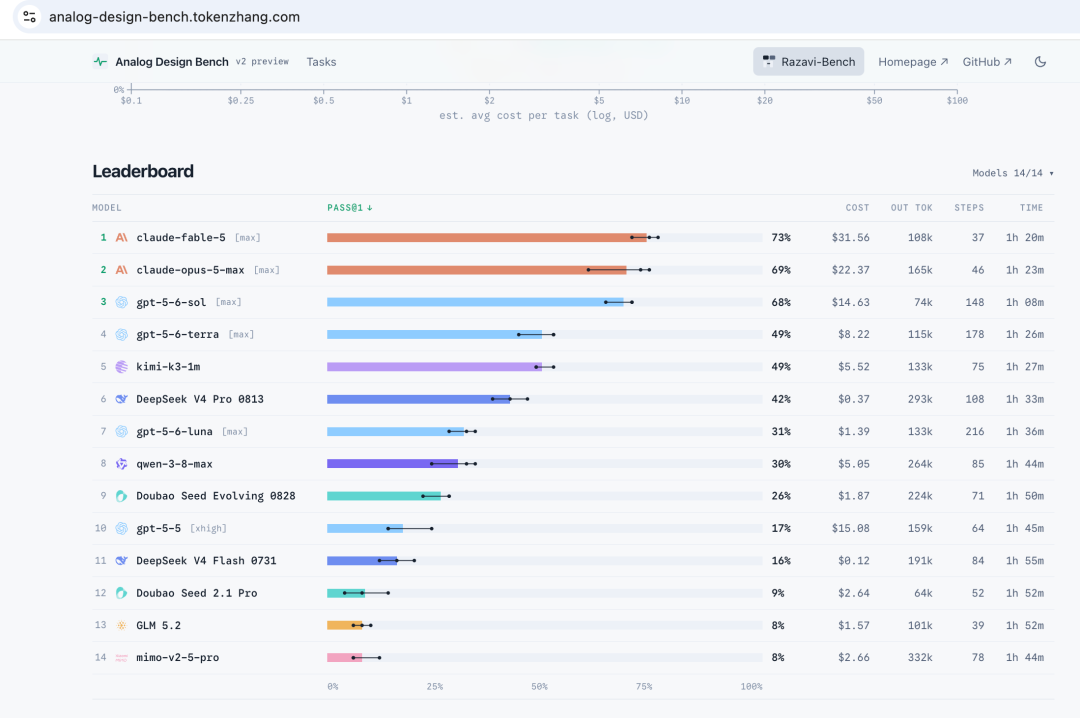
I believe a benchmark's significance lies in providing two rulers.
The first is a ruler for relative comparison. Through benchmarks, we can compare capability differences between different models.
The second is a ruler for absolute capability calibration. This is also my core motivation for building these two benchmarks. I want to tell everyone: what level has model capability actually reached? Which tasks are already below the model's kill line?
Relative comparison tells us which model is stronger; absolute calibration tells us what models can actually do. With these two rulers, we can form accurate expectations of AI's capabilities and assign tasks sensibly.
It's very much like education.
When we say someone "knows how to make chips," that "knows how" varies enormously. Is it an undergraduate level, a master's student level, a fresh master's graduate hire, or someone one year into the job? An engineer with three years of experience is a completely different capability mark from five years or ten years.
What grade is AI in now? How far has it developed? Honestly, few people know specifically. Everyone says "I can do it really well," but I don't think that's very objective. I want to produce an absolute calibration to tell everyone.
Q: What conclusions have you drawn from the evaluations?
Tuoken Zhang: The most intuitive conclusion is that AI's current capabilities have exceeded what many people imagine — especially in the chip industry.
Razavi Bench has 50 analog circuit Q&A questions. GPT-4o, released the year before last, performed terribly on this test — practically unusable. But models released after June this year have reached a level no worse than an above-average graduate student. It's been a very steep upward curve.
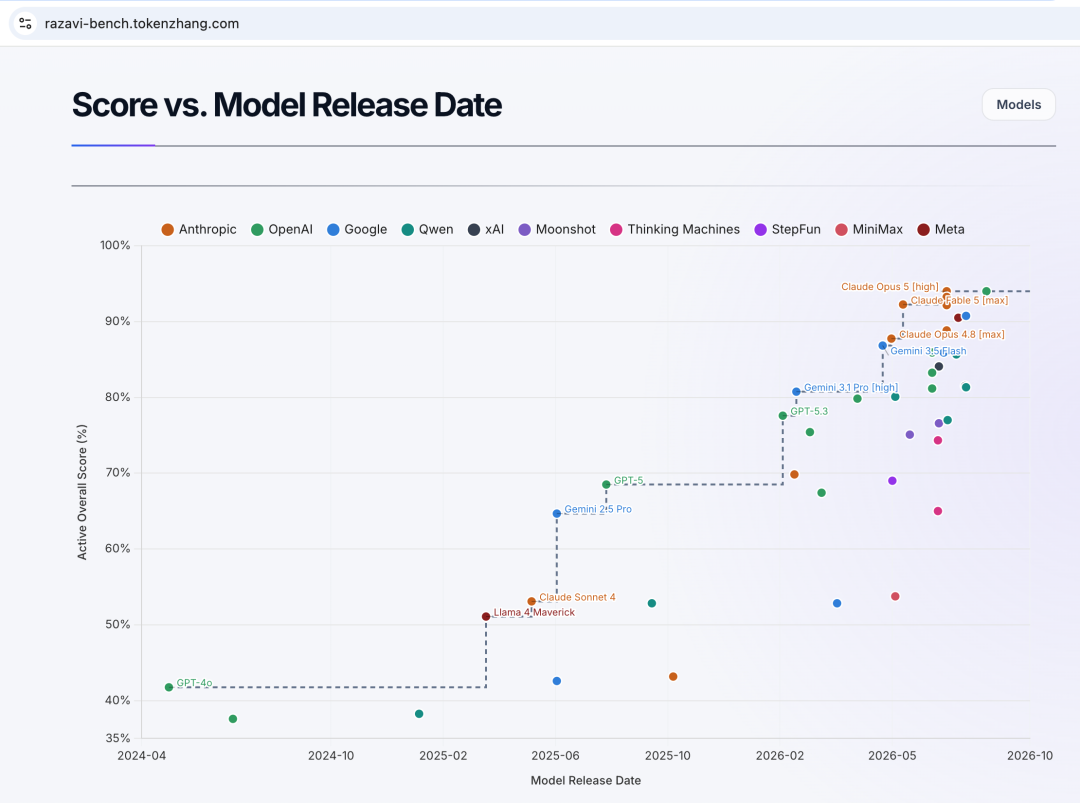
Evaluation results for 42 models on Razavi-bench
Another finding: for the evaluation itself — especially agentic tasks — test-time scaling is extremely important and extremely effective.
The base model's capability has a far greater impact on the final result than the harness does. Take the same model and swap in five different harnesses, run the same 50 questions three times, and the scores come out roughly the same. But swap in different models — say GPT 5.6's Sol, Terra, and Luna — and the scores are clearly separated.
Q: Models also update very quickly. How do you avoid a benchmark becoming obsolete right after it's released? And what about model vendors gaming the scores?
Tuoken Zhang: A benchmark should be a continuously updated testing system.
On one hand, it needs versioning: keep a fixed set of core questions to ensure longitudinal comparability, while adding harder tasks drawn from new failures in real projects, so the leaderboard doesn't saturate.
On the other hand, it needs layering: a public development set for research, plus hidden test sets and rotating tasks for formal evaluation, to reduce training contamination and targeted test-prep.
I also keep the models' raw outputs, tool-call trajectories, costs, runtimes, and repeated-run results. Reporting only a single best score is easy to optimize for; publishing the full chain of evidence is what lets you distinguish stable capability from lucky hits. Ultimately, a benchmark should focus on reproducible engineering ability, so that familiarity with the question bank doesn't become an advantage.
There's a flip side to this too. If a benchmark becomes obsolete, it also tells everyone that these problems have been slain by large models, and that less human effort needs to go into them from now on. The more problems models slay, the better it is for the chip industry.
On the other hand, as I keep building out the benchmark, I'm confident I can stay ahead of model capabilities for the next two to three years.
There's no ceiling to the difficulty of chip design. Right now we're deliberately going easy — babysitting, really.
It's like going through school: every grade has its own exams. As a teacher with a PhD, I can write first- or second-grade problems for AI, middle school entrance exam problems, all the way up to undergraduate or near-master's level.
Only when the problems we write can no longer stump most foundation models will AI for chip design have reached a truly high level.
Q: So how do you think about "training models" now?
Tuoken Zhang: I think training a model is fundamentally a form of education.
Pre-training is like basic education — compulsory education, well-rounded education — while post-training is like the specialized and vocational education that comes after undergrad. We have to decide what to teach, how to drill it, how to test it, and observe where it fails on real tasks.
Before this year, my dream and long-term vision was always to teach and educate people. Now I've realized that teaching students directly is one way — but teaching AI and letting it diffuse that knowledge and capability outward is also teaching, at a much larger scale.
I was once named an outstanding teaching assistant at Tsinghua University, and I've written many tutorials online and taught a lot of complete beginners. One tutorial I wrote was "A Beginner's Journey for Mixed-Signal Circuit Designers." The driving force behind that course was that too many people kept asking me extremely basic questions — it was painful.
Back in 2024, I felt that in such a developed modern era, having to learn all this from scratch wasted the time and energy of so many talented people. Better to have organized knowledge that everyone could absorb in the most digestible form possible.
That course sold over 500 copies, which showed me the real demand for education — and also the limits of individual teaching in terms of reach. Now I want to extend that same educational spirit to AI.
Q: How do you better transfer this kind of experience to AI?
Tuoken Zhang: The core bottleneck for all models right now is data.
That's normal. Humans also have a pre-training phase — from compulsory education to the college entrance exam, from choosing a major in undergrad to graduate-level projects and research, accumulating ever finer-grained experience step by step.
Every step forward comes with a shortage of data and information.
People get their data and information through senior schoolmates, advisors, or internships. For a student starting from zero all the way to a successful career, the biggest variable is which projects they've worked on and how good those projects were.
Work on good projects with good guidance, and you're more likely to succeed. Look closely at the differences between schools, and much of it comes down to differences in the projects each student gets to take on. Internships are the same — different people intern at different companies and grow differently afterward; the key lies in the projects they participated in.
So the tasks themselves and the environment matter enormously. All of this transfers very well to training models: we teach models through similar project-based "internships" — which is what everyone calls post-training.

One year ago, one year later
Q: What do you think is the most underestimated capability in the AI era?
Tuoken Zhang: I'd say it's Agent "driving skills."
A lot of people have become AI relay stations, expecting that with AI, they can finish their work with one click. But I believe that no matter how AI develops, the human's ability to drive an Agent remains extremely important.
Agents are like an endless stream of new cars, with models and tools updating generation after generation. Cars have been around for many years and have profoundly changed the world, yet different people's driving skills still vary enormously.
The same goes for Agents: the car's performance sets the ceiling, but the driver determines whether it reaches the destination safely and reliably.
Agent driving skills include defining the problem, breaking down the task, providing sufficient context, choosing tools, establishing verification standards, and recognizing false successes. The stronger AI gets, the more valuable these skills become. Today's truly AI-native generation is actually relatively weak in this regard.
The Vibe Coders I respect most are all people who came up through the manual era. Once these people start using Agents, they're more familiar with the "car's temperament" — they know under what conditions the car behaves abnormally and when it can run at high speed. They drive fast but can still brake in time, effectively getting people or cargo to their destination.
If you've never done anything by hand and jump straight into using Agents, things easily spin out of control. Then there's another type of person who completely rejects Agents and stays fully manual — that's not advisable either. You need both hands on deck.
Q: In the next three to five years, will people spend less time driving Agents?
Tuoken Zhang: Definitely. It used to be all manual or automatic transmission, and now many cars already have a high degree of self-driving — maybe 90% of the driving is done by the car itself. This is bound to happen.
Q: What's the biggest change you've felt?
Tuoken Zhang: We're very lucky to be living in the middle of an enormous new wave of our era.
AI is gradually opening up knowledge and capabilities once held by a small number of people and organizations to far more ordinary individuals. It's a democratization — an equalization — of capability.
A year ago, I might still have been asking, "Can AI help me complete a certain step in chip design?" Now, Claude can already connect to a Synopsys EDA server and directly attempt the full flow of a chip module based on a 5 nm PDK.
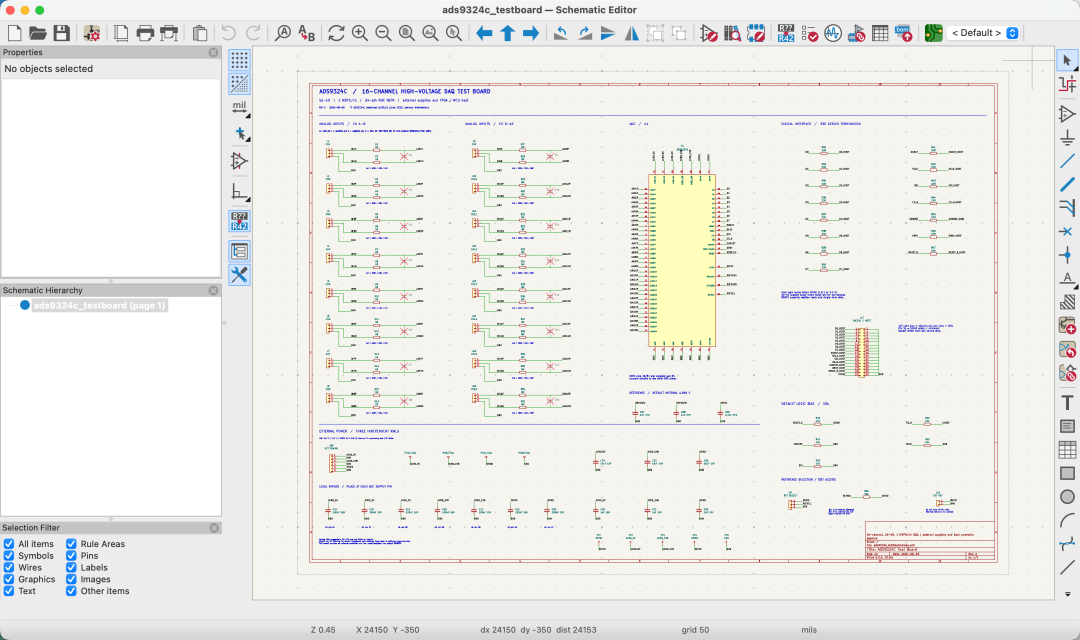
A chip test board schematic Tuoken Zhang completed in 30 minutes using GPT-6 Astra
The biggest change is that our judgments about "what AI can't do" have shorter and shorter shelf lives. That's why I now prefer to make fewer static conclusions and instead build more tools, verifiers, and benchmarks — letting real results continuously tell us where the capability boundaries are.
Q: To build an Agent that truly understands chip design, what do you think matters most?
Tuoken Zhang: Infrastructure, above all. I give talks everywhere now, online and offline, and my basic thesis can be condensed into one formula: general foundation model + general Agent + scenario-specific capabilities.
On the engineering ground, it comes down to four things: provide sufficient context, connect to design tools, define task boundaries, and establish checking standards.
Q: If you had unlimited tokens, what would you do?
Tuoken Zhang: Build data, build infrastructure — scale up the fuel for training models. I'll gladly be an ox with my head bowed, serving the cause.
Q: What changes do you hope to see in yourself one year from now?
Tuoken Zhang: A year from now, I hope to have genuinely pushed model capabilities forward in chip design. Through a closed loop of data, benchmarks, skills, and tools, I want models to learn more chip tasks and complete real verification more reliably.
I also hope to keep evangelizing, so that more engineers, students, labs, and companies recognize what Agents can do in chip design — and actually put them to use. For me, the change a year from now means doing both well: capability building and industry-wide diffusion.
Q: What needs to be overcome first for the technology to spread across the industry and reach commercial adoption in companies?
Tuoken Zhang: The capability of the foundation models.
One thing that clearly distinguishes chip companies from others is how seriously they take information security. It's virtually impossible for us to obtain large amounts of real data from chipmakers — we can only find ways to synthesize it.
Given this basic reality, acceptance of cloud models is very low. If these tools are going to be used inside chip companies, what everyone wants most is local models. But developing affordable local models will take some time.
Q: One sentence for developers who just received a Token Grant?
Tuoken Zhang: Actions speak louder than words; seek truth and be pragmatic. I hope everyone turns their tokens into action and builds something no one has seen before. Even if you only push the boundary forward a little, you're expanding humanity's collective field of vision.

The audio version of this episode is now live on ZhenFund's podcast Ci Hua Dang Zhen. Give it a listen!