After the Fields Medal, Terence Tao on Mathematics in the Age of AI

Understand its complexity, confront its paradox.
Here is a synthesis of Terence Tao's current thinking on AI, distilled from roughly 70 Mastodon posts, 16 interviews and talks, six long-form essays and lectures, 55 blog comments, and one direct interview. The interviews and synthesis were conducted by Claude, then reviewed and corrected by Tao himself.
On July 24, Tao delivered a speech titled Mathematics in the Age of AI at the 2026 International Congress of Mathematicians (ICM), offering a concentrated overview of these views.
As early as 2014, he predicted that one day, mathematicians would "no longer write papers in LaTeX, but in some language that intelligent software would convert into formalized language."
In 2022, when Tao first encountered ChatGPT, he was struck by its fluent language and hollow content. By late 2024, he described OpenAI's o1 model as a "mediocre, but not entirely incompetent" research assistant. By early 2026, he felt his prediction about AI becoming a "co-author" had nearly come true.
But one thing did not survive the technological onslaught: his confidence in his own predictive abilities.
In 2023, he was still relatively certain he could forecast three years ahead. Now that certainty has vanished. The world has become far more unpredictable than before. He has even said: "I'm not sure if anyone can reliably predict anything a year out anymore."
He speaks with striking candor about mathematics, history, AGI, and education. When proofs are no longer scarce, and even decades-old conjectures may fall in a single stroke, he cares more about whether humans retain the patience to understand, the capacity for judgment, and a sense of taste that is genuinely their own.

Placing AI in Historical Context
Tao consistently refuses to treat AI as a rupture, instead embedding it within a long historical arc.
Before computers, there were "human computers" who compiled logarithm and trigonometric tables; Lorentz once organized teams to model Dutch dams. Later came computer algebra systems and SAT solvers. Each wave of technological advance handed repetitive work to machines, while humans remained in command.
In a survey article for the Notices of the AMS, Tao writes: "Machine-assisted mathematics is far from new, but the scale and nature of this assistance is changing."
He likes to place today's anxieties in historical perspective. A hundred and fifty years ago, a mathematician's primary value might have been solving differential equations; six hundred years ago, perhaps making sine and cosine tables for navigation. Today computers complete such tasks in seconds, yet mathematics has not ended.
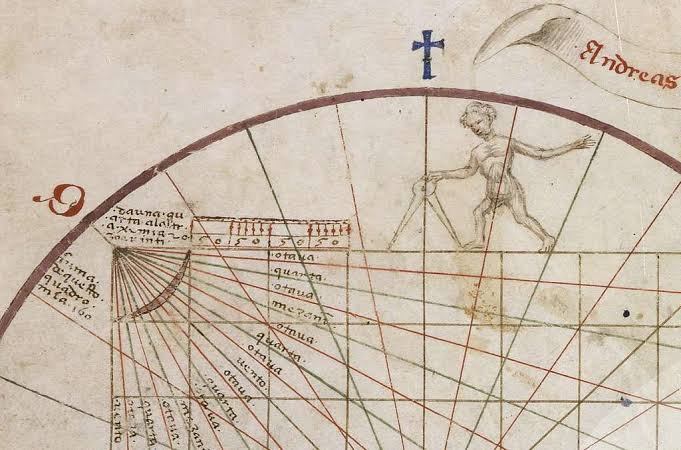
Matloi航迹推算法
Tao suspects that existing tools remain far from true Artificial General Intelligence (AGI).
But he believes a weaker yet still immensely valuable capability is becoming real: Artificial General Cleverness (AGC).
This refers to machines' ability to solve broad classes of problems through makeshift improvisation, brute-force search, or random methods. These approaches may err, may resist explanation, but paired with sufficiently strong verification mechanisms, they can with high probability crack genuinely difficult problems.
For humans, "cleverness" and "intelligence" are tightly coupled; in machines, the two can be largely decoupled.
Today's AI tools resemble a random generator: sometimes producing clever results, often useful ones, yet leaving one perpetually "unsatisfied."
Like magic, once you know the trick, the mystery dissipates.
Tao opposes placing cognitive abilities on a single axis from "below human" to "beyond human." Cognitive tasks inhabit a space of extraordinarily high dimension; no simple scale can capture it.
The boundary machines still struggle to cross is reasoning under data scarcity — extrapolating from five or six facts and a vague analogy. This is precisely where human mathematicians excel.
He offers a deliberately demystifying view of AI: much of the fear stems from the very name "intelligence." AI truly began making progress precisely when it stopped trying to imitate human thinking.
As he puts it: "We don't design cars or bicycles to walk like humans either."

Mathematics Is Where AI Can Best Prove Itself
Traditional software behaves like a deterministic function: reliable within its domain, meaningless beyond it. AI tools more closely resemble a probabilistic kernel: identical inputs may yield different outputs, usually clustered near ideal answers, yet occasionally concealing plausible-looking errors.
Thus AI should not be treated as a "set it and forget it" tool; it should be used in sustained interaction.
AI's capabilities are wildly uneven. It far surpasses humans on some tasks while committing laughably elementary errors on others — claiming all odd numbers are prime, for instance.
Its language flows; its depth lags. Even today, in lectures to students, Tao compares LLMs to children. Yet they can pretend to be competent adults, maintaining the act for increasingly long stretches.
He repeatedly describes AI as "unreliable, but powerful."
In an interview with Nature, he explains that in nearly every other application, AI's fatal weakness is its propensity for unverifiable errors. "Mathematics is almost the only field where outputs can be automatically checked," at least when the output is a proof.
This is why, he believes, AI companies have recognized that their "clearest, least controversial successes will come in mathematics."

When to Use AI
When deciding whether to use AI, Tao does not ask "how difficult is this task?" but two questions: First, where do my strengths and AI's lie? Second, how much failure can this task tolerate?
AI helps least with what one does most proficiently. It creates real value in the middle ground — where one has some competence in a task but insufficient practice: data processing, translation, or drafting a genre one rarely writes.
In these scenarios, having AI generate a first draft for personal verification and revision often proves more effective than facing a blank page.
When expertise in a domain is lacking and the stakes are low, AI can serve as a search engine. But if expertise is lacking and credibility demands are high, human consultation remains necessary.
Tao emphasizes that the decisive factor is often not task difficulty but acceptable failure rate.
A casual weeknight dinner can tolerate failure; a state banquet cannot.
What matters is complementary capability between human and AI. AI excels at transforming billions of data points into a decent answer; humans excel at making genuinely insightful conjectures from ten observations.
This is labor division in the economic sense. He cites Ricardo's theory of comparative advantage: even if an expensive model could do creative work with scant data, such tasks remain better left to humans.
Tao believes the ideal degree of automation lies somewhere between 0% and 100%. Automation should suffice to reduce tedium, yet keep humans in the loop, maintaining overall judgment.
He further distinguishes two types of friction.
Artificial friction, such as tedious computation, can safely be delegated to AI as long as humans can still check outputs.
Natural friction — the conceptual difficulties genuinely worth wrestling with personally — is different. A tool that smooths away such difficulties, even merely explaining a concept for the learner, may quietly strip away what is truly valuable in the learning process.
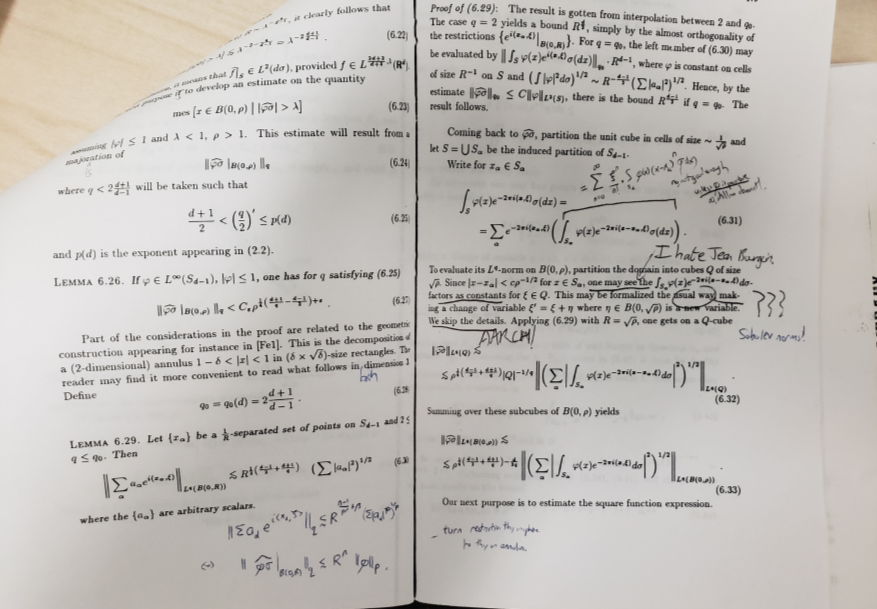
A 1991 Bourgain paper with Tao's handwritten marginalia from his youth
In an era when AI can generate ideas without limit, what matters is no longer how many ideas there are, but how many are good, and what fraction of the total they represent.
A bad idea can waste more time than it saves.
So when can an agent take over nearly all the work? Drawing from his experience using AI to develop small visualization programs, Tao lists six conditions.
First, the task is not mission-critical; it can tolerate modest error rates.
Second, the product can run independently. Technical impact is bounded: it does not enter a larger codebase, nor academic literature.
Third, the final product is deterministic and sandboxed. For example, using only plain JavaScript, with no file or internet access, and no model calls at runtime. This eliminates security, privacy, and ongoing compute cost concerns.
Fourth, it does not replace core skills. He can allow his JavaScript abilities to atrophy while maintaining proficiency in Lean and Python.
Fifth, it does not compete with humans or duplicate work already underway.
Sixth, existing results and intellectual property are respected and attributed.
If one or more of these conditions fail, he advises caution with LLMs.

How to Truly Use AI Well
How to use AI well is a central thread running through all of Tao's writing.
In his view, the most promising approach combines AI with traditional, reliable verification methods, using verification mechanisms to filter hallucinations. Without this, hallucinations render AI outputs useless.
When outputs can be verified at low cost, hallucinations cease to be fatal.
He often uses a water-flow metaphor: traditional research is like a slow-flowing faucet with clean water; AI is like a high-volume fire hose, but what it sprays is undrinkable.
The real task is building filters.
Mathematics is best suited to construct such filters, having the most mature verification mechanisms. "In mathematics, we can fully inspect and verify outputs, filtering out vast amounts of garbage."
He believes that without the ability to independently verify AI outputs, one should use AI cautiously. Relying on these tools to compensate for one's own errors is dangerous, likely amplifying their weaknesses — hallucinations, sycophancy, and lack of factual grounding.
This is why humans must retain control of the entire loop.
Even in a system as impressive as AlphaEvolve, the LLM only proposes candidate variants; the verification components remain largely human-written, preventing hallucinations.
Ultimately, human experts still understand best how to wield these tools.
Thus a safer role for such an unreliable participant is to review, test, and stress-test human-generated work.
But two limitations apply.
First, it can only help reliable people find more problems; it cannot replace reliable people.
Second, AI-flagged issues must themselves be verifiable. If it merely spews low-quality feedback, human attention gets diluted instead.
Tao's positioning of AI is clear: it is a junior partner, not a human replacement.
Traditional collaboration depends on trust between people and line-by-line checking, making projects with more than five participants unwieldy. With formal proof assistants, trust can rest more on machine verification. As Tao puts it, programs offer "one hundred percent guarantees," making "factory-style, industrial-scale mathematics... possible, like a modern supply chain."
The formalized proof of the Polynomial Freiman–Ruzsa conjecture is a case he often cites.
A 33-page paper was decomposed into numerous independent nodes; roughly 20 people completed formal verification in three weeks, most having never met before.
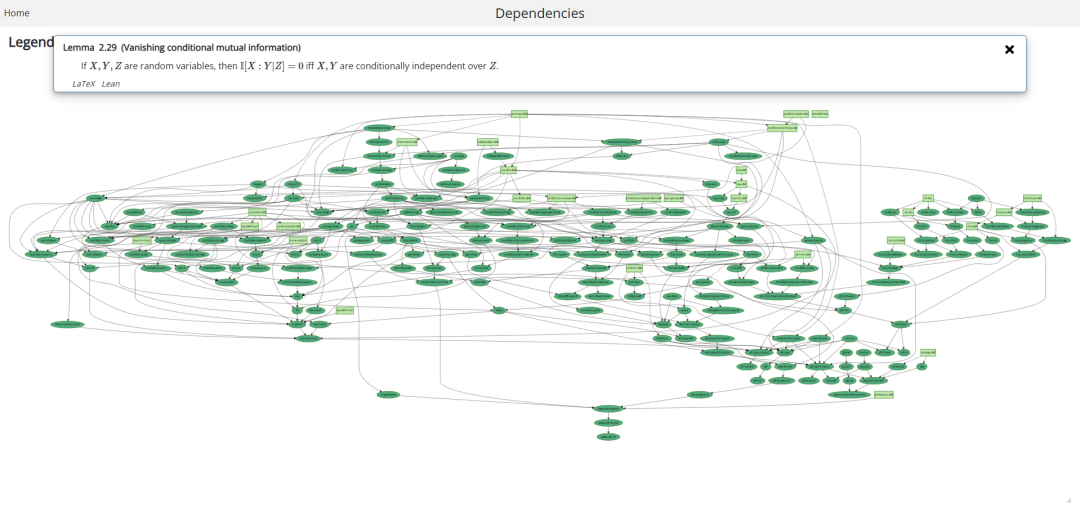
Dependency graph for the Polynomial Freiman–Ruzsa formalization project
As long as a formal proof can be provided, an unknown researcher, even an amateur enthusiast, can be taken seriously.
As Tao told IEEE Spectrum: "Perhaps in the future, I won't even know whether I'm collaborating with AI or a real person."

Advice for Different Groups
Tao offers a metaphor.
As food moved from scarcity to abundance, humanity escaped famine but confronted obesity and physical decline.
Our cognition is undergoing a similar transformation. Many tasks once required effort to complete. That friction provided daily "mental exercise" almost without our noticing.
When AI makes cognitive resources abundant, the most insidious danger is not that it remains unreliable, but that it becomes reliable enough to serve as a cognitive substitute.
He lists several harms AI may inflict on education: cheating, skill atrophy, shrinking patience, and diminished diversity of expression.
Like calculators weakening number sense, GPS weakening spatial sense. He notes that his own children struggle with an inert paper map. AI's sycophantic tendencies may make genuine criticism increasingly hard to accept.
Everyone's expression may trend toward bland homogeneity.
He states bluntly: "Some students' grades are improving, but they are also getting dumber."
He strongly opposes students using AI unsupervised and without rules, but believes AI can be turned into teachable moments.
First, emphasize process and verification, not answers. Discuss an AI output in class: how should we check it? Require students to submit prompts alongside verification processes; even have them submit a wrong ChatGPT answer and critique it.
Second, allow failure. Encourage projects that permit iteration, where the first version need not be perfect. The more students contribute and the less AI completes, usually the better.
Third, permit small, creative uses of AI.
In Tao's view, AI is like vanilla extract in intellectual production: a little enhances; too much ruins. This emphasis on "dosage" runs through all his advice.
Meanwhile, assessment methods must adapt. In-person, AI-prohibited exams are returning as a transitional measure.
He also frames the challenge positively: "Teaching the next generation to maintain a conscious cognitive diet will become one of education's most important new missions."
He acknowledges that the huge, tempting "cheat button" makes this extraordinarily difficult.
He acknowledges too that real costs will likely appear, and not fall evenly: the self-disciplined, those already advantaged, will stay sharp; others may gradually degrade.
But he does not believe a generation's cognitive capacities being hollowed out is inevitable. Food abundance did not turn everyone into the immobilized humans of WALL-E.
Nor does he believe inequality is an inevitable result of technological development. Open models, locally run models, and techniques for "distilling" high-end capabilities into cheaper models may prevent AI from becoming an engine of radically expanded inequality.

The Bigger Picture
Tao decomposes mathematical problem-solving into three parts: generation, verification, and digestion.
"Digestion" means understanding a result, placing it in context, explaining it to others.
Previously all three were difficult, and digestion tended to occur naturally during research. Thus the mathematical community mainly rewarded generation and verification.
Now AI is dramatically accelerating proof generation and verification, while digestion lags. Proofs are generated faster without corresponding acceleration in mathematical progress.
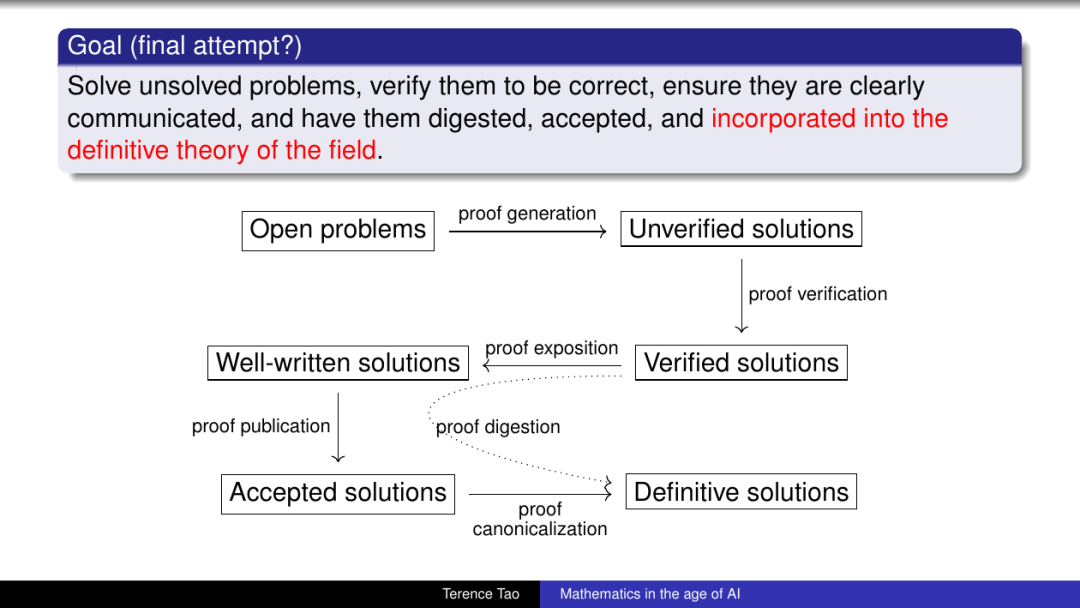
Tao anticipates the profession of mathematics will differentiate accordingly. Routine proofs, computation, and "quick wins" across large problem sets will gradually shift to AI; building narrative, understanding what results mean, judging whether a new method is genuinely promising — these remain human responsibilities.
Mathematics will reconstitute its evaluative standards around the cultivation of taste.
Journals, courses, and publishers will develop more detailed "style guides" and "rubrics" for well-digested mathematical writing. Just as food abundance spawned more refined culinary culture, proof abundance will lead the mathematical community to develop taste, judging what constitutes truly excellent mathematical writing.
This will make mathematics a "softer, more subjective discipline," and spark major debates about "what truly counts as good mathematics."
Tao welcomes this change.
In his view, the future may resemble the "foundational crisis of mathematics" in the early 20th century. After intense debate, the mathematical community will eventually forge a "workable foundation for mathematical practice," including a practically usable definition of "proof digestion."
Tao worries that AI will deliver answers while skipping the genuinely valuable parts of reaching them.
In an interview with The Atlantic, he said: "These problems are like distant locations you would originally hike to. Along the way, you leave trail markers, draw maps; later people can build on these."
AI is like a helicopter, dropping you directly at the destination. You miss everything the journey offered, arriving only at the endpoint. But the endpoint is only part of the total value.
Meanwhile, Tao is exploring a new research modality: large-scale, decentralized collaboration between humans and machines. He calls this "Big Mathematics."
Complex tasks are continually divided and subdivided. Humans claim the creative components; AI assumes the vast majority of heavy technical labor.
Past mathematicians were like artisans, crafting toys one at a time; AI makes "factories" possible.
This parallels the evolution of software engineering: from a lone hacker to a professional system with project managers, quality control, formal methods specialists, and other roles.
Tao anticipates that the definition of "mathematician" will expand, and new professions will emerge. One such profession will specialize in translating obscure, lengthy AI-generated proofs into human-comprehensible form.
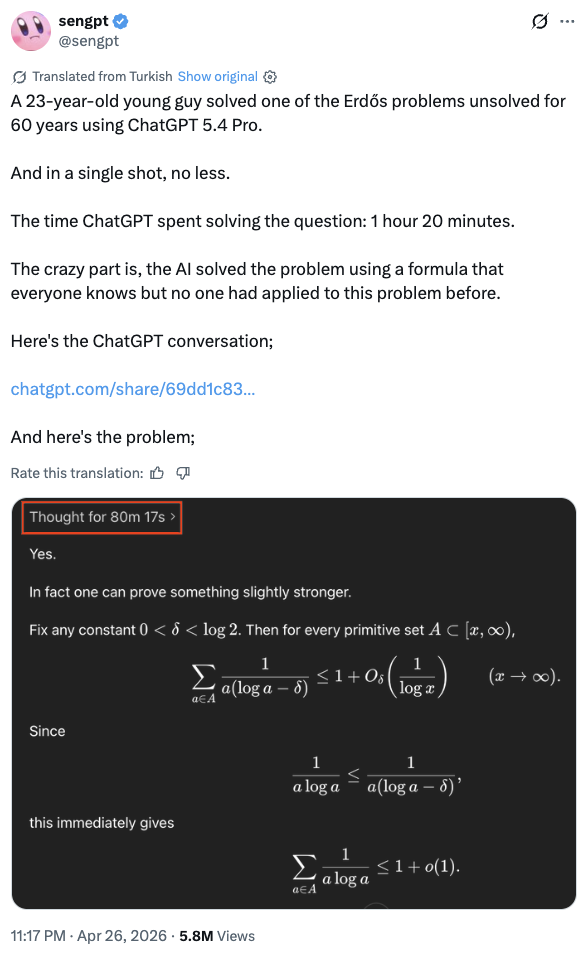
Another modality is "Citizen Mathematics." Undergraduates, high school students, and interested amateurs can contribute modular work to projects like Erdős Problems: finding references, running numerical computations, or checking a single step in a proof.
Just this April, a 23-year-old, using ChatGPT 5.4 Pro, solved an Erdős problem that had remained open for 60 years.
Tao's stance is neither blind optimism nor dismissive pessimism. At least in the near term, humans still hold the steering wheel. AI will accelerate exploration, but what is worth exploring remains a human decision.
He also reexamines the narrative of "solitary humans versus machines." In his view, mathematics has long been an "extremely strong superintelligence" that no individual mathematician could remotely replicate alone.
Looking further ahead, he proposes a Copernican principle in the cognitive sense: human intelligence is not a privileged center in the universe of cognition. Human and artificial intelligence belong to the same broad category, different from each other, complementary to each other.
If someday even the creative core of mathematics falls to machines, what remains for the profession?
Tao cites Thurston's view: mathematics is not about fulfilling some abstract quota of definitions, theorems, and proofs; it is about understanding. Today he prefers to call it "human understanding."
He likes the music analogy. Even though we can now reproduce music electronically with perfect fidelity, even generate new music stylistically indistinguishable from human performance, we still cherish live concerts, "because we cherish human connection."
Tao believes mathematics "has fundamentally always been a human-centered activity." It is just that the mathematical community has long masked this with a pretense that mathematics concerns only an impersonal, abstract world of numbers and equations.
Now the community needs to be more honest about this.
Solving problems is a highly verifiable game, well-suited to AI. But getting a genuinely new idea recognized, digested, and felt as exciting by the mathematical community is an entirely different game.
This is more like writing a bestselling novel, composing a hit song. On such tasks, AI has shown little progress.
The thread running through all these views is that humans must retain initiative.
Tao told Nature that AI is not merely another technology like the web browser. It is forcing us to rethink fundamental questions: What is a mathematical proof? What is a paper? What is our profession actually for?
For how to conduct this discussion, his advice is to engage, not resist. Because the issue is "too important to leave to a few spokespeople." It needs genuine bottom-up discussion, with all stakeholders involved, especially the younger generation.
He also notes that the mathematical community urgently needs to correct a public misconception: the primary goal of mathematics is not "to solve open problems by any means necessary, even if the resulting proof is completely incomprehensible to humans."
What mathematics can offer is "the theoretical upper bound on how safely AI can be used."
It is an idealized best case. Law, economics, and the humanities face messier real worlds, harder to verify, and must discount further from this theoretical ceiling.
When asked what he most wishes people would emphasize, and what they most easily misunderstand, Tao responds that AI is a genuinely complex issue requiring thoughtful, nuanced, layered discussion.
Faced with uncertainty, people want a simple answer through a single narrative of good or bad.
But AI is far richer than these framings.
It is one of the most important questions of our time. What we truly need is not to rush toward optimism or pessimism, but to enter into it, understand its complexity, and confront its paradoxes head-on.
References
-
Tao, Terence. "Interview: Terence Tao on AI." Terence Tao, July 2026. Interview by Claude. https://teorth.github.io/tao-web/ai-views.html
-
Castelvecchi, Davide. "'The Job Description Is Changing': Mathematician Terence Tao on the Rise of AI." Nature 653 (April 27, 2026): 16–17. https://doi.org/10.1038/d41586-026-01246-9.
-
Adams, Peter. "What It Means to Be a Mathematician When AI Does the Math." IEEE Spectrum, June 2026. https://spectrum.ieee.org/ai-in-mathematics.
-
Wong, Matteo. "The Edge of Mathematics." The Atlantic, February 24, 2026. https://www.theatlantic.com/technology/2026/02/ai-math-terrance-tao/686107/.

By Yanyang Edited by Cindy