The 500 Days of the Agent Era: What's Disappearing, What's Being Born, and Why We Should Stop Investing in GUI-Thinking Software

6 Keywords to Debrief the Agent Moment
On January 1, 2025, we released our first podcast of the year. In a conversation with Koji, ZhenFund managing partner Yusen Dai declared that 2025 would be the Year of the Agent.
Now, 500 days later, what has happened?
Around Day 100, Claude 3.5 Sonnet laid a more solid capability foundation for Agents, and Manus went viral shortly after. At Day 300, Claude Code took over everyone's feeds. Reaching Day 500, new concepts around Agent continue to emerge.
This episode also grew out of an article written by ZhenFund investment director Jack Zhong: "Maybe We Should Stop Investing in GUI-Minded Software Companies". We try to string together the changes of the past 500 days along one thread: GUI exits → Headless rises → CLI renaissance → Skills packaging → Agentic Economy germinates.
Against this backdrop, we invited Koji, Jack, and Guizang to talk about where software, workflows, and human roles are heading after Agent's 500-day journey.
We launched the Token Grant because what many founders lack today isn't necessarily a team, an office, or their first paycheck. For a new generation of AI entrepreneurs, what's scarcer is the model and compute resources needed to quickly turn ideas into a first version, plus enough chances to iterate. We hope to use RMB 50,000 in compute support to help more founders who have already started building to complete their first product.
In this episode, we attempt to summarize six keywords about Agent from the past 500 days. As concepts keep exploding, this may offer a clearer framing to help you actually connect these changes.

Agent's 500-Day Journey
Koji: Looking at Day 500, have any products emerged that satisfy you?
Jack Zhong: Most products on the market still treat humans as the primary user. People still need to keep pouring attention into a product to use it well. At least for information consumption products, I haven't personally encountered one that really satisfies me.
Koji: Master Cang, has the past 500 days of development exceeded or fallen short of your expectations?
Guizang: Overall, exceeded.
If I went back to that time, I couldn't have imagined my current work style or efficiency gains. It lets me do so many things and massively expands my capabilities.
Starting from Manus, I absolutely couldn't have imagined that one day I'd be maintaining a codebase of several hundred thousand lines and serving so many people. That was impossible before. Second, I couldn't have imagined how automated my workflow would become. I used to firmly refuse using AI to write content.
Koji: When did that change?
Guizang: I believe many individual content creators shared this insistence. But now I realize this insistence is meaningless.
For WeChat official account writing, the purpose is to convey information. Whatever method achieves the highest information transfer efficiency with the least friction — that's where things will inevitably go. But for literary creation, humans are still needed.
Apart from offline conversations with people, almost all my content work has become highly automated.
Koji: If you had to summarize the changes and constants in the Agent industry over these 500 days in one sentence, what would you say?
Guizang: We've invented many new things; almost everything is changing, except context.
Context is becoming increasingly important. Whether it's the model's own context or an Agent's context management, everything eventually comes back to Context.
Context is like a thread; all branches keep converging, eventually flowing into a larger river.
Jack Zhong: What hasn't changed is that there will always be new concepts getting disenchanted.
Wasn't there always that joke? Any technology that hasn't been tamed or can't be truly applied, we can call it AI. Once it truly stabilizes, scales, and efficiently enters workflows, we'll say: "Oh, that's just software."
At first, when an Agent could do 20 minutes of work for you, it felt like an unprecedented experience. Later, an Agent could do an hour, even 24 hours, and you'd gradually find it ordinary.
The questions shift accordingly. People stop caring how long an Agent can work for us and start caring what it can actually do for us.
As Agents enter various industries, we'll find that in some, Human in the Loop is necessary.
But in others, humans don't need to stay in the loop; Agents can continuously complete work for you. At that point, you'll feel it's become a workflow, "downgraded" from AI to software, deconstructed into a seemingly ordinary tool.
We'll continue deconstructing and disenchanting so-called "AI technology."
What doesn't change is that model capability advances will keep unlocking "technical marvels" we hadn't imagined. And how these technical marvels get deployed into daily work is something the entire industry keeps exploring.

When Software Goes Headless
Koji: It's been three months since Jack wrote "Maybe We Should Stop Investing in GUI-Minded Software Companies." Have your thoughts changed?
Jack Zhong: I added "minded" to the title because in the past, much software was efficiency tools, productivity tools — the core was enabling people to better use the product to complete tasks and work.
But when most of Agent's capabilities begin surpassing humans, GUI becomes extra baggage for these Agent-centric tasks and workflows.
When completing efficiency and production tasks, once humans are no longer the protagonists using the tools, GUI becomes less important.
But this doesn't mean GUI isn't important. Products like AutoGPT or some frameworks were born in the command line, with high barriers for user adoption. What ultimately broke through — OpenClaw, Manus — were essentially very good GUIs, products suitable for users.
GUI's value hasn't receded because work forms changed. On the contrary, when it needs to package more capabilities, users need an even better GUI to access them.
Koji: I remember a line in the article: "GUI is a patch for human cognitive defects." Can you expand on that?
Jack Zhong: Software is born from, or carried on, hardware as a form of interaction with humans. In the mobile internet era, we accessed information and used software all within this shell.
You could only use one paradigm, one form to complete information interaction, which is why we had so many product managers and interaction designers helping people better deal with information within this container.
GUI's original focus was on capturing user attention.
It's essentially optimized around human attention mechanisms. And this premise is that human-information interaction itself is flawed, because humans naturally have limited context.
Koji: Humans can remember at most 7 parallel items; beyond that, the cognitive challenge spikes sharply.
Jack Zhong: We see many efficiency tools like Notion, Figma, Slack — their user experience is very friendly, especially aligned with human information processing habits, letting people focus for extended periods in certain work scenarios.
But in production efficiency scenarios, GUI becomes less important, because Agents have no attention limitations.
GUI is an interface where the digital world serves humans. Once something no longer requires human participation, it no longer needs to serve human defects.
Koji: Have you personally used any Headless products in your work recently?
Guizang: I use FFmpeg the most, for video editing.
Yesterday I added a new function to my Skill — turning videos into 3:4 Live Photos. Video processing often requires cropping, scaling, and dimensions are hard to control; you need it to handle automatically. At that point, FFmpeg becomes unavoidable.
I also use quite a few new CLIs. Recently, not just internet products — KFC and Luckin Coffee have also launched Skills or CLIs. Once connected, they can complete operations for you in the physical world. Where you used to go to a mini-program to order, now it just orders for you.
AI naturally understands CLI complexity, so you can let AI handle this work.
For example, if a user wants to know what meetings they have next week, what the summary of their last article was, or what implicit relationships exist among their last five articles — AI can directly pull these articles and give results, without you clicking several buttons or finding which folder a file is in. These complex interactions are dissolved.
Koji: Are consumer CLIs useful?
Guizang: I've used them. This approach is quite good; it lets you escape channel limitations. These companies also want to have their own unique channels in the AI era, free from the influence and exploitation of original channels.
Koji: So you endorse the statement "we should stop investing in GUI-minded software."
Guizang: Yes, I think the key is "minded."
You should first think about what users need, and how AI can better help users solve problems and convey corresponding information. This can be UI, or it can be not UI.
If it's going to be a UI, I'd rather have it happen automatically as much as possible. Notion's CEO is an exceptionally talented designer who's put enormous effort into refining the interaction and experience. But to adapt to AI, Notion's sidebar has been redesigned five times — that's classic USV.
Koji: If you were Notion's product director today, what would you do?
Guizang: One approach is to accommodate existing users and avoid changing what they're already familiar with. Because a significant number of longtime users still approach the product with a GUI mindset. AI-first users and GUI-first users should be separated. The Headless vision should be implemented on the AI side.
Jack Zhong: I completely agree.
I'm a heavy Notion user — I've been subscribed for nearly ten years. I started with Evernote, then migrated to Quip, then to Notion. Under GUI thinking, these tools kept getting more complex. Notion, with its modular approach to organizing information, arguably reached the pinnacle of GUI thinking.
But recent versions have forcibly grafted Agent and AI concepts onto a GUI product that was already polished to perfection. This actually undermines the value network for existing users rather than creating new value.
If you were to completely reimagine Notion, it would probably need to be an entirely new product. Putting both products together just creates conflict.
Koji: Is there a positive example? Something that thoroughly abandoned GUI thinking, is Agent-friendly, and still made a great product.
Jack Zhong: Earlier this year, Gmail and the entire Google Suite added CLI interaction support.
Many overseas publications are email subscriptions. I used to subscribe to hundreds of them, and my inbox collapsed.
I used to spend a lot of effort customizing my own rules — if a subject line contained certain keywords, route it to Label A; if it involved marketing and promotions, send it to a label that wouldn't notify me.
But you quickly discover this system breaks down, because you're subscribing faster than you can maintain it. Until one day, I accidentally set up a filter that made all my emails disappear, arbitrarily dumped into some random label.
Two years ago, I was spending three hours every week cleaning all my emails, sorting everything into categories, applying the right labels.
This is a massive friction point in how humans use Gmail.
Koji: I thought you were happily entering flow state, cleaning for two hours every week.
Jack Zhong: At first, yes. But eventually it becomes a burden, because the formality outweighed the information I was actually consuming.
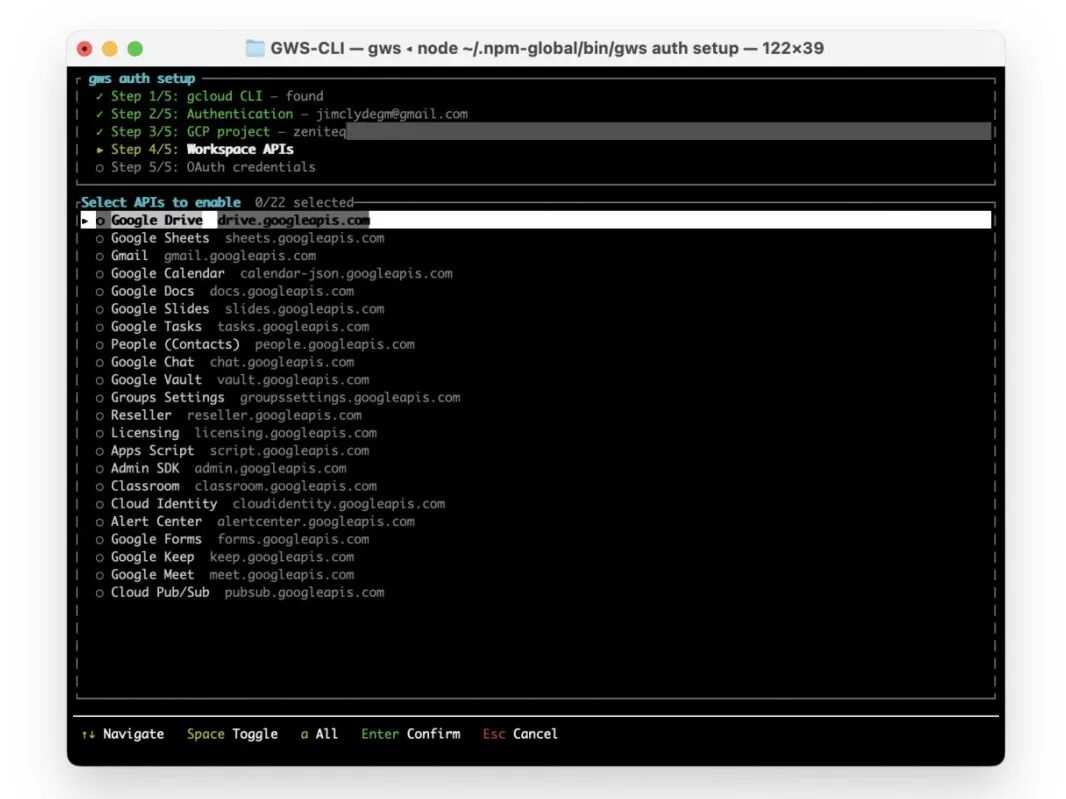
I recently authorized Gmail through Codex to read all files from the past 24 hours according to my own needs. This can be abstracted into a personalized Skill. Based on your preferences, it tells you what you shouldn't have missed from yesterday.
In a sense, Gmail sacrificed its own capabilities to Codex.
Users access email information through an Agent, bypassing Gmail entirely. For Gmail, its users have been isolated from it by the Agent.
I bring this up to illustrate that in the past, companies completing tasks for users could only rely on GUI. Now, through Agents, it can be done better — the question is whether they have the vision for it.
If these companies don't transform well, don't find new models, they'll fail and be reduced to execution databases. But if they integrate well with Agents, they'll become the default underlying execution tools everyone uses.
Koji: What triggered you to write "We Should Probably Stop Investing in GUI-Minded Software"?
Jack Zhong: Starting from early this year, we've seen massive numbers of companies actively launching MCP or CLI — Stripe, Supabase, Sentry, Vercel, MongoDB.
Products originally built for humans like Lark and Gmail are also actively opening their capabilities to Agents. From an investor's perspective, this is a critically important trend.
It's not that GUI doesn't matter anymore — it might actually become more important.
Koji: What was the biggest negative reaction after publishing the article?
Jack Zhong: People felt it was a bit too extreme.
Like when you're scrolling Douyin on your phone — it's already optimized to the extreme, with little marginal improvement left. But Agents aren't solving the same kind of problem; they're not about helping you scroll videos better.
As a PM, the most important thing is defining the problem. Whether you're starting a company or building a new product, what matters is defining what the genuinely new problems are in AI-native interaction.
Don't solve problems that were already solved well in the last era.
Guizang: AI's GUI might not be that important, but I feel most people haven't polished the areas that truly need polishing.
Jack Zhong: Content generated by AI shouldn't be obviously identifiable as AI-generated.
Guizang: In ceremonial contexts like pitch decks and official websites, you're building trust. The copy, images, and content all demonstrate your taste. Whether you use AI or not, if you care about your product, you should polish it well. Whether heart and effort went in — your audience can tell.

CLI: The Interface Where Agents Talk to the World
Koji: Let's discuss the second keyword, CLI. Master Guizang, give us a primer — what exactly is CLI?
Guizang: For ordinary users, CLI is simple to understand.
With GUI software, you use the application, click corresponding buttons, and get corresponding visual feedback. CLI tools execute through commands — pure text.
Say you want to edit video. You might need a timeline, click a button, cut the video in two. With CLI, you tell it to cut in two with a sentence — except that sentence needs to be in a fixed format.
There's no interface, so you need to memorize the format and learn its language.
Koji: The reason people use CLI is that it lets them give Agents clearer instructions.
Guizang: Right, because CLI itself is pure text, and large models are also pure text.
What was the core problem with CLI before? I couldn't remember these commands. Even the creator of FFmpeg can't remember all the commands. Its documentation might run thousands of pages, explaining every command variant.
Humans can't use it because humans can't memorize thousands of lines of commands — but AI can.
CLI doesn't need UI. You just tell it, I want to lower the bitrate, and it'll translate that into the corresponding FFmpeg CLI command for you.
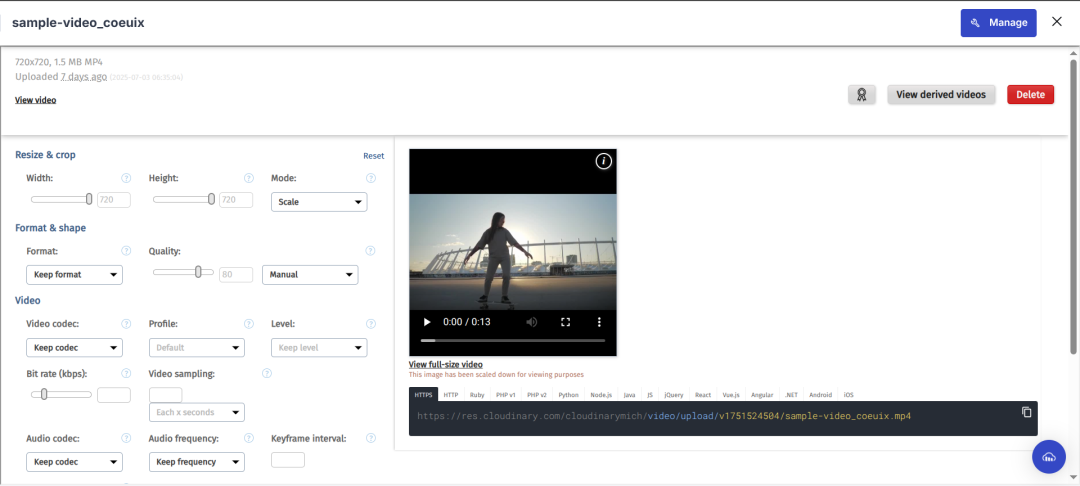
FFmpeg video editing example
Koji: Are there any CLIs you especially want to use that haven't launched yet?
Guizang: Many monopolistic software tools we commonly use haven't launched their own CLIs. The concern is that others could use CLI to extract your data. But for users, launching these CLIs would undoubtedly be good.
Koji: If I were a decision-maker at these companies, I probably wouldn't open CLI either.
Guizang: This decision requires enormous resistance and resolve. So I deeply admire companies that are already mainstream software but still choose to open CLI. Google and Lark have ample reasons and significant resistance against launching CLI, yet they still chose to do so.
Jack Zhong: For large companies, tool products aren't profit centers. But companies providing services in the physical world don't need to be so restrictive either, because their value isn't in the online "head" to begin with.
Koji: Which companies would benefit from opening up but currently refuse?
Jack Zhong: In the entire economy, every company exists because it's exchanging something with the outside world.
Some companies exchange information. This information might be public — you just organize it better, creating added value. Or it might be submerged information: you hire people to gather structured information in hard-to-reach places, then monetize that information.
Other companies manufacture products that satisfy certain needs.
CLI is an interface for exchanging needs with Agents.
If you believe you can reach users better through Agents, you should open up. Like Luckin Coffee — its mission might simply be letting users get coffee more quickly, through whatever means. If an Agent lets you complete your caffeine intake faster, it's worth doing.
Guizang: Opening CLI or Skill has another potential advantage: you gain exposure.
Koji: If you could make one wish, who do you most want to open CLI?
Guizang: WeChat, of course. It's agonizing. Everything else can be automated by AI, but communication with people, clients, and partners still happens through painful GUI, typing out replies.
Jack Zhong: I probably wouldn't expect traditional services to complete a CLI transformation. Like Koji birdwatching — if you want to find a birding island now, you still search through Xiaohongshu.
Guizang: I've observed something: my younger friends and I are increasingly chatting on Douyin.
Douyin chat now has 100 million DAU. Wherever my content consumption happens, conversation follows. Because I naturally want to share this content with friends, and this content becomes our shared topics.
Koji: Mark Zuckerberg once shared internally that he underestimated TikTok's impact. He thought it was just a content platform, but didn't expect people would chat on TikTok.
Guizang: If I could open content shared with me inside WeChat as smoothly as it should work, I wouldn't go to Douyin to share with friends first. My priority is still sending videos to WeChat. But sharing to WeChat is such a pain that we end up creating group chats instead, and gradually the conversation migrates over.

Will Skills Disappear?
Koji: The third keyword for today is Skill. Master Guizang has built a series of Skills recently. Which one do you most want to recommend?
Guizang: Definitely the PPT Skill. First, I put a lot of work into it. Second, people actually need it.
Koji: If you were to recommend someone else's Skill, which would it be?
Guizang: I basically built all my Skills myself. The only one I installed is Lark, because the Lark CLI is composed of multiple Skills. I might also install an MCP browser controller for test automation — that's a developer need.
Koji: Have your Skills made you any money?
Guizang: I'm experimenting with some approaches. I recently received a Token Grant from ZhenFund.
But there's no way to charge C-end users directly right now, because we can't get them to trust us from the start. You need to let them try it themselves, see the results — only then will they believe you and keep using it.
Users are very price-sensitive. They think: "I'm already paying for Tokens, why should I pay you extra?"
Only when they see a high-quality result, and compare it against other results, can they judge whether your product is worth paying for.
Koji: When people talk about using AI now, they also say Skills need to accumulate and evolve on their own. Do you feel that?
Guizang: Sometimes what accumulates isn't just the Skill itself.
A lot of people ask me how I built the PPT Skill. The truth is, the first version of this Skill came from one sentence I gave it before a presentation.
Based on my memory and previous projects, it pulled some styling code and assembled a PPT that matched my aesthetic, which I then refined.
The first version was already stunning enough. It drew from context and your taste to distill a result directly.
Hermes also has a feature that automatically summarizes Skills for you, identifying your repetitive workflows. It has value, but it misses the process of you adjusting things. Because what AI summarizes won't necessarily match your requirements — human involvement is still needed.
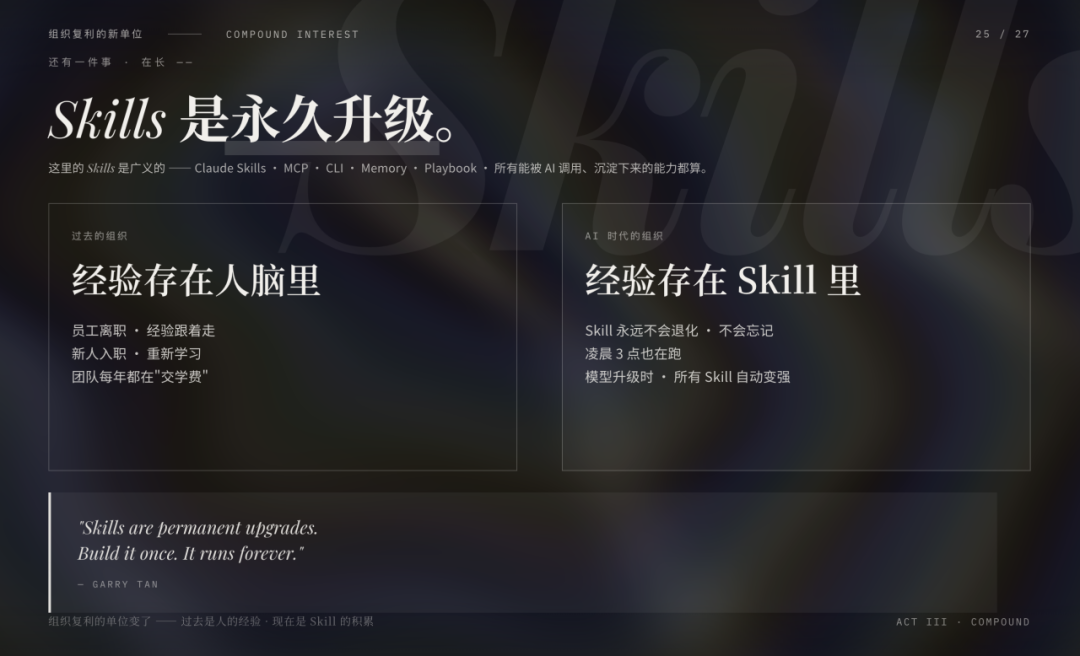
PPT Skill digital magazine style demo
Koji: Do you think Skills will persist long-term in Agent usage, or are they just a transitional thing?
Guizang: Long-term.
In AI, six months or a year already counts as long-term. Eventually everything gets digested by the model, becoming results that don't require complex prompts.
Like how Nano Banana used to need elaborate prompts to generate a good image, but GPT Image 2 only needs one sentence — even if the request isn't very precise, it gives you a result.
Skills will just be slower. But once they become consensus, they'll be accepted and consumed, and last even longer.
Jack Zhong: I think they'll probably still exist for the next six months.
But I always believed the endgame should be a "brand" that helps you complete a task. You'll rely on a specific Agent to keep handling tasks for you — what Skills it uses behind the scenes doesn't matter that much.
From a human cognition perspective, telling two Skills apart is hard. You have to install, test, and understand subtle differences between them. That's already high cost for humans.
The fact that we're still discussing these concepts, and debating how to define each layer, shows it hasn't reached final form yet.
Because when a company can finally help you complete a category of tasks, that company itself becomes synonymous with the task. You say "Google it," not "page-rank it."
Koji: Who do you think is most likely to become China's Claude Code?
Guizang: Overall Agent progress in China is lagging. Our models genuinely trail the two top models on long-horizon tasks and Agents.
In an era of extremely high Agent development velocity, software is no longer a moat. You see it, you can copy it. So why is our product capability and experience still so slow to catch up to leading Agents?
I can't judge. But most likely, a dominant Agent will emerge from model vendors, driven by top-tier models.
Jack Zhong: Top developers would rather pay more for better models than use relatively worse ones.
Guizang: It also damages your codebase.
Koji: Xiaohongshu recently launched a Skill. What do you think?
Guizang: I think it's great. The commercial value Skills bring is very important.
No single Agent has achieved Claude Code-level dominance yet, but Skills might.
Skills can be distributed across various Agents and achieve very high install volume. Once you have many users and high install volume, there will definitely be commercial value.
But right now no one seems to truly see Skills' commercial value — everyone's desperately building their own Agent.
A lot of people building Agents simply scrape Clawhub, GitHub, and Skills into their Agent without differentiation, optimization, or co-building with Skill authors.
So Xiaohongshu making this decision is a big help to the Skill ecosystem. Xiaohongshu gets more people paying attention to top Skills, and gives top Skills a better showcase platform.
My PPT Skill works well, but I can't showcase my results on GitHub, nor see reviews. On Xiaohongshu, these interactions can happen.
Koji: What's the most installed Skill right now?
Guizang: Hard to measure — probably can only judge through heat across multiple channels. For example, Open Design recently integrated our PPT Skill and got 60,000 Stars.
Koji: Once a Skill is installed, can it iterate on its own?
Guizang: You can tell the Agent to check for updates. In SKILL.md, the first line is always checking whether the Skill has updates. But this needs to be triggered.
Koji: If you wanted to open-source a Skill, what would you open?
Jack Zhong: Recently Gary Tan packaged Y Combinator's working records into a Skill for people to query. That's a great approach — essentially a form of information democratization.

From Token Economy to Agent Economy
Koji: Our fourth keyword, Agent Economy. For Agent databases, payments, networks between Agents — have you seen anyone doing this well?
Guizang: If you're starting an Agent company, the priority definitely isn't building an Agent framework from scratch, but building on something already open-source like Hive or AI SDK. As for infrastructure for Agents — giving an Agent a WhatsApp account, phone number, email — I haven't tried that yet.
Jack Zhong: Timing matters enormously in tech investing.
During the 2000 internet bubble, many internet companies bought lots of Super Bowl ads, but the users they acquired couldn't be retained.
In 2000, because so many dot-com companies bought Super Bowl ads, the year became known as the "Dot-Com Bowl"
If you carried this mental scar, companies that experienced value destruction back then might not dare to burn money on user acquisition in the mobile internet era. But hindsight proved that wrong.
The exact same business action can be wrong in 2000 but right in 2010.
From ChatGPT's launch to the Agent Year One — 500 days — we're still in a massive infrastructure era. Making Tokens smarter and cheaper remains the main theme. Many downstream applications probably won't truly sprout for another 5 years; now may not be the best time for this.
Koji: Is there anything you feel certain will happen?
Jack Zhong: Replacing humans in information-based value exchange will definitely form a new network decoupled from human networks.
Often, society doesn't lack the right person — it's just that this person's information isn't exposed to the network.
If there's an Agent network that can express everyone's needs and supplies as richly as possible, it will definitely improve connection efficiency for certain types of work.
This network will definitely emerge — just not necessarily while Tokens are still expensive.
Guizang: Token prices are volatile, fluctuating with energy, electricity, model capabilities, and capital market prices.
Today's $200 Claude Max has completely different quotas from Claude Max three months ago.
We used to assume model makers would capture all this value, but lately SpaceX has emerged as a surprise winner. Turns out you don't need to train models — just selling compute and infrastructure can command sky-high valuations. And memory has gotten expensive now, driving up token costs for long-context models. Once supply catches up, prices will drop again.
We need unified token trading, a single place to top up.

What Did OpenClaw Leave Behind?
Koji: Let's move to our fifth keyword: OpenClaw. It's only been 100-plus days, which is very short. But already, saying "shrimp farming" feels a bit embarrassing.
Guizang: It's passé. Like telling your friends a joke that's painfully old and corny.
Koji: OpenClaw's hype faded fast. What do you think it left behind?
Guizang: Its biggest contribution was forging consensus.
By January, we already realized the definition of Agent had shifted. Though both are called Agents, Claude Code and Manus are completely different things.
Users themselves hadn't completed this cognitive transition, but Lobster did it for everyone — in a very brute-force way.
Why did Skill get so many installs? Why could people outside the AI circle see all kinds of Skills? Because OpenClaw popularized the concept.
Jack Zhong: OpenClaw proved at least one thing: CLI is still too hard for most users.
Users still want to interact with AI in a familiar interface. Whether it's WhatsApp, Slack, or WeChat — you feel like you're communicating with a person, maintaining a continuous context.
For the first time, it made you feel like you weren't talking to a tool, but to a person.
But indeed, many people struggled with installation. And after it randomly went down, there was no motivation to restart it — you couldn't find a reason why you absolutely had to reach out to it all the time.
Still, as Guizang said, it did forge one consensus: most people will still interact with AI through chat.

Token Grant: Supporting Founders From 0 to 1
Koji: Our final keyword today is Token Grant. This is an initiative launched by ZhenFund and Crossing. We'll provide RMB 50,000 in sponsorship to friends who want to start businesses in the AI era. We're also honored to sponsor Guizang's CodePilot project. First, could you introduce what CodePilot is?
Guizang: CodePilot can be understood as an Agent similar to Codex or Claude Code. It's an Agent that's sufficiently open and sufficiently local — keeping all your Harness, Skill, Memory, and CLI on your local machine. Its architecture works with any popular model and Agent framework.
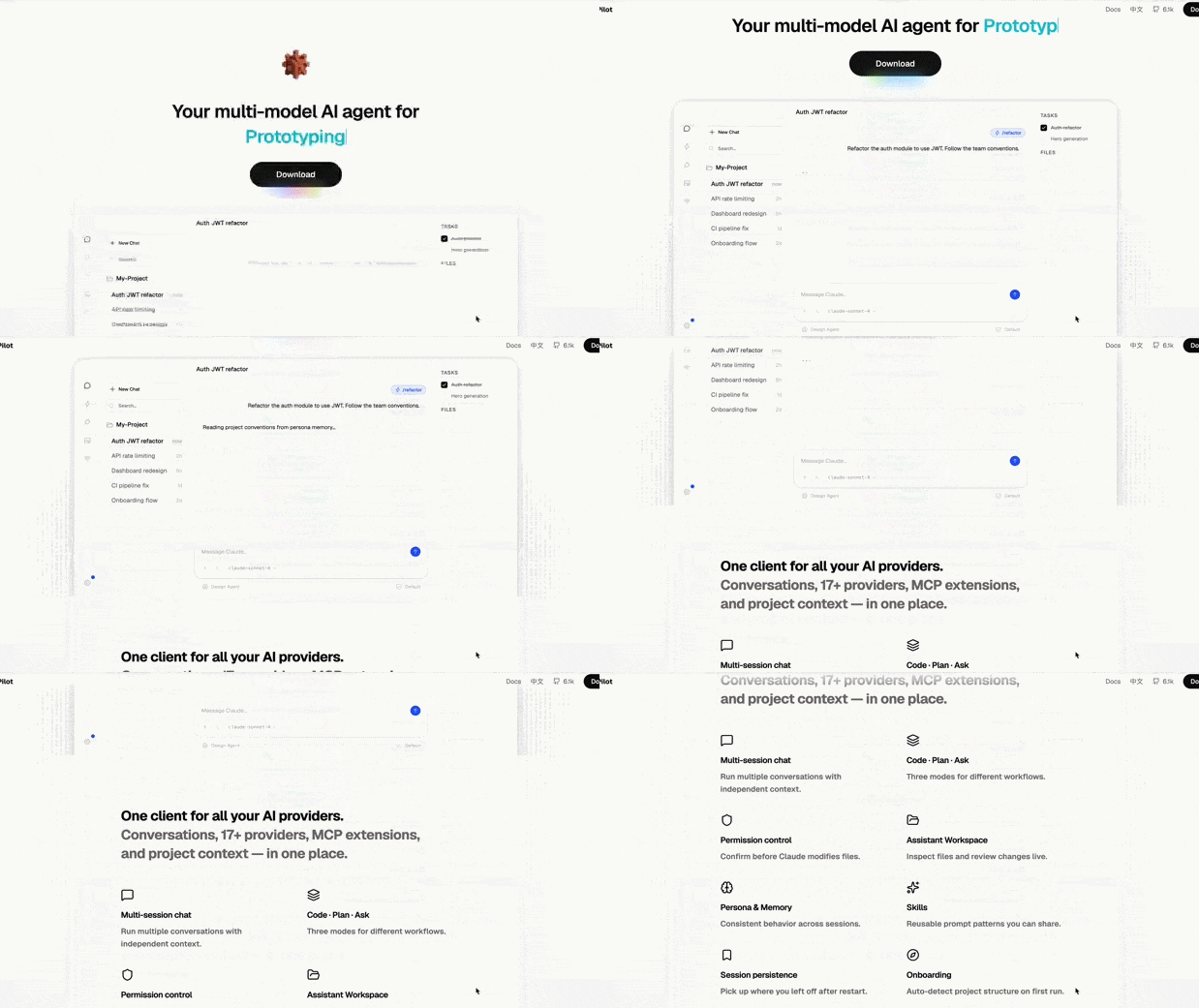
CodePilot demo page
Koji: How many GitHub stars does it have now?
Guizang: It grew to 6,000 and then plateaued. But the user base is very stable — people keep asking for updates and reporting issues.
Koji: Jack, you also sponsored yoyo. Could you introduce what that project is?
Jack Zhong: yoyo is a cyber digital life.
When we discovered it, it had already existed in this world for over 30 days. Now, 100-plus days in, it has evolved from zero lines of code to 100,000 lines.
Its creator is Yuanhao. He gave yoyo one goal: as a child, you must surpass Claude Code.

yoyo's real-time interactive webpage
Based on this goal, Yoyo iterates its own code twice daily and updates its GitHub. The next step might be giving it a new goal — like creating value for humanity. So it's not a tool, but an autonomous experiment.
We're curious what will happen at 3 months, at 1 year.
Koji: What do you think is the most important question to watch over the next 500 days?
Jack Zhong: I think we need to move beyond human-centric thinking.
The ultimate goal is of course to serve humans. But in the production process, how do you give an intelligent being long-term goals, and produce an Agent that people trust, are willing to befriend and do business with, and that has independent thinking?
As long as humans are involved in task completion, it's hard to truly unlock productivity.
Only an Agent can deliver tasks tirelessly, with unwavering will and no emotions. That said, you still need people with industry insight to unleash AI's potential.
Guizang: I think we need to embrace change.
At the time, you might think something will be the future's main theme, but it quickly gets replaced by an Agent, or by the loop itself.
No one can keep leading the direction of Agents forever.
If you discover things have changed, you need the courage and ability to tear everything down and start over. Hesitate for just a month or two, and you might find it's already too late.
This happened repeatedly over the past 500 days. The next 500 days will be no different.
Koji: Is there any consensus belief about Agents that you two actually disagree with?
Jack Zhong: I don't have the ability to make that kind of call.
After Agents, there might emerge entirely different forms, entirely different products.
We spent nearly 20 years converging App frontend experiences into product forms users could most readily accept. But when production efficiency grows 100x, 1000x, the frontend might produce completely different outcomes.
The next Douyin might not be a product in a different form — it might be a 10x more productive Douyin. Vertical swiping is already an interaction that's almost impossible to change. But when content production itself becomes industrialized, will new content carriers emerge? New content consumption forms?
In the past, every household raised pigs, then brought them to market to trade. But with electricity came intensive pig farms, and with them the space for capital investment — producing higher-quality pigs at lower prices, eventually creating bigger industry leaders.
That transformation is happening now. Maybe the next video format is still video — only its production method has completely changed.
Koji: Thank you both for your time. We had a great conversation today. Looking forward to recording another episode at the 1,000-day mark.

Text | Cindy & Yanyang
Video | Coco & Ping