Angry Miao Li Nan's Unfiltered Take on "AI Glasses": Stop Kidding Yourself About Tech, Cash In on the Hype While It Lasts | Z Talk

The payoff on this smart glasses wave could come far faster than anything we've seen before.
Z Talk is ZhenFund's column for sharing insights.
Li Nan, founder of Angry Miao, has spent the past few years building from a niche mechanical keyboard product toward a broader portfolio of consumer tech gadgets.
As former VP of Meizu, Li has been searching for a unique path targeting geeks and trendsetters through his thinking on design aesthetics and product philosophy. In 2019, Angry Miao launched its first product, "Cyberboard" — a mechanical keyboard with an LED matrix display that quickly became a star in tech circles and attracted a devoted following of enthusiast users. ZhenFund previously invested in Angry Miao at its angel+ round.
In 2024, as AI glasses have already kicked up massive waves, Li sees enormous potential in the category. Compared to the scaled innovation of tech giants, he believes small, elite teams can pry open new futures for the industry.
This article is republished from GeekPark. The full text follows:
Author | Yong Zhang
Editor | Jing Yu
At GeekPark's "IF 2025 Innovation Conference," Li Nan took the stage as a speaker and delivered some unvarnished truths about AI glasses entrepreneurship, along with his views on how hardware startups can go "from 1 to 100":
- "In this era, thinking costs more than doing wrong";
- "The AI glasses market will grow 10x within 12 months";
- "For a new category to succeed, both giants and Huaqiangbei must jump in together";
- "There will be more tickets to the final destination in AI glasses — 10 to 15 brands will ultimately survive and make money";
- "Don't lie to yourself about having core technology. Within these 12 months, no startup team has reliable core technology."

Li Nan speaking at GeekPark's IF 2025 Innovation Conference
Image source: GeekPark
01
The uncertainty before growth is the product's "touchstone"
I'd like to start by asking: has anyone here ever used a Meizu M-series phone?
We know that in the last major tech cycle, Meizu was one of the players. We have experience with trillion-dollar markets. Today we've discovered a new track: AI glasses. We suspect it might have 100x growth potential over three years. What happens next? We can look at our previous experience to see which history rhymes and which goes off the rails. Hopefully this won't waste your time and will help you seize the opportunities of the next three years.
The title is "AI Glasses: A New Track with 100x Potential in Three Years — Where History Rhymes, Where It Goes Off the Rails."
Faced with this kind of growth, uncertainty is high, so treat this as a story for now.
Let's look at the consumer electronics industry. We've always had a question: will the next trillion-dollar product with annual global sales over 1 billion units appear? When?
Every year we hear about something new, but from 2007 until now, nothing has actually emerged. Why? Because in observing all these products rise and fall, we've distilled one insight: when a new trillion-dollar consumer product appears, it must satisfy three conditions. We call them the three touchstones of a trillion-dollar track.
What are these touchstones? Actually very simple — three lines:
One: Single model sales break one million. Only products with single-model sales breaking one million can become new trillion-dollar tracks.
Two: Both leading brands and Huaqiangbei must jump in. Having only Huaqiangbei or only leading brands isn't enough.
Three: The product that ultimately confirms a trillion-dollar track with annual sales over 1 billion units will see single-model sales break 100 million.
These are the three touchstones.
Let's review 2007 — did it qualify?
First, the iPhone 2G sold 700,000 to 1.4 million units total. Single model broke one million.
Second, both Huaqiangbei and leading brands went all in. Remember the shanzhai phones? Huaqiangbei went all in alongside Apple — a very strong signal.
Third, the single model that broke 100 million appeared in 2010: the iPhone 4. So when you see these three signals, folks, a new tech wave is coming. There will definitely be a hundred-billion-dollar market with hundred-fold growth.
If you've identified these three signals, timing your entry becomes crucial. Let's look at history again.
The most successful "pig in the wind" of the last wave — Xiaomi. When did they enter? Their first phone launched in August 2011. But we're in hardware, so we need lead time, because product development cycles take 8-12 months. Xiaomi was actually founded in April 2010, before the iPhone 4 launched. So timing is critical — we can't wait until the third signal appears to act; by then it's too late. We believe you can move when two signals are satisfied. It could really be 100x growth and a trillion-dollar market.
Let's see how many conditions AI glasses currently meet:
First, single-model sales breaking one million happened this year. Meta's AI glasses have already crossed one million, nearly two million in sales.
Second, leading brand entry. Meta counts as a leading brand. Has Huaqiangbei entered? Folks, Huaqiangbei has gone crazy. Dozens of solution providers are working on it, with solutions dropping from $100 to $20.
As for the single model breaking 100 million, we expect that within three years.
Under these circumstances, here's our "hot take": Right now, at the end of 2024, this market will grow 10x within 12 months. We believe this is already decided.
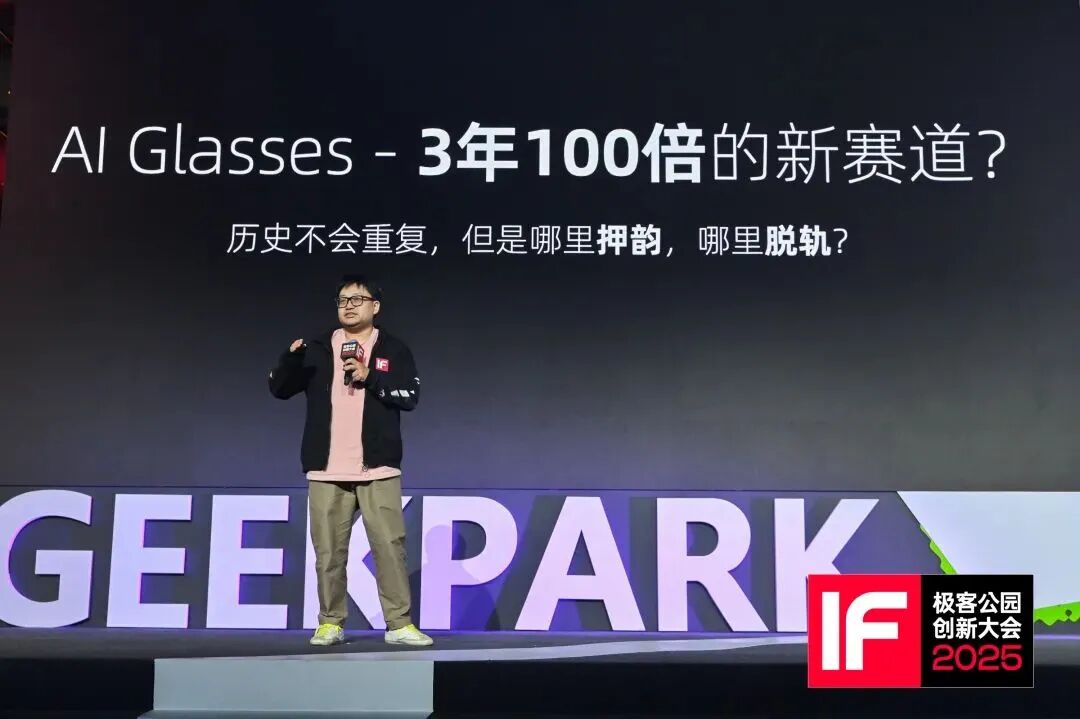
Li Nan speaking at GeekPark's IF 2025 Innovation Conference
Image source: GeekPark
Some will ask, what makes you so sure about 10x? Because we've already confirmed a massive number of launches. This is just a sample — everyone is lined up to release AI glasses nonstop from November onward. You might say these don't look like very strong players. Who will drive 100x in three years?
First, Xiaomi. Xiaomi will release a very competitive AI glasses product either in Q1 or Q3 next year. Let's do a countdown for the price — shout it out. 999 yuan? Given Xiaomi's relationship with Qualcomm, it'll be cheap. I estimate around 1,500 yuan. But ByteDance will also enter.
Meta will update too. And OpenAI and Apple are preparing — OpenAI is hiring. So for 100x in three years, beyond Huaqiangbei and those brands, you also have Xiaomi, Apple, Meta, and OpenAI. All the giants are jumping in. Huawei probably will too. In 2023, Huawei's glasses already sold 700,000 units domestically, so there's potential for one million in the China market. Breaking 10 million in a year, we believe, is highly certain. Whether we can break 100 million in three years — that depends on these players.
We know 10x growth in the next 12 months is highly certain, and 100x in three years is possible because of their entry. What will the market penetration progress look like? Again, we look at history. It's simple: how long did each tech wave take to exceed 50% penetration in the US market? PCs took 20 years. The internet took 12 years. Smartphones took just 6 years. See the trend?
Each massive tech wave has accelerated its penetration to 50% in the US market. So if AI glasses is real, if it's really 100x in three years, it won't need six years — just three, even faster. If we start counting from 2025, this battle ends in 2028.
To summarize: we believe two of the three signals for a trillion-dollar track have already appeared, and you can't wait for the third to act. When two appear, it's time to move. And the speed of payoff will exceed previous waves. We don't have six years, maybe only three. Finally, risks can't be denied, because the third signal hasn't appeared yet. This is why there's 10x opportunity within 12 months and potentially 100x within three years. This is distilled from historical experience.
02
The rise of independent brands in the digital age
What else has changed?
First, looking from 2024 back to the 2007 iPhone launch, brands are completely different. Brands are long-tailing.
What does brand long-tailing mean? In 2007, big brands dominated the market. Today we have more independent brands, more D2C brands (editor's note: Direct-to-Consumer), more small brands — and they're doing well, while big brands are struggling. This isn't empty talk. Look at this data: in the US market in 2023, compare Amazon's and Shopify's sales scale.
Shopify is the backend used by many D2C and independent brand stores, so Shopify's sales volume reached half of Amazon's. This means the sales scale of those D2C brands, independent brands, and personal brands has reached half that of big brands.
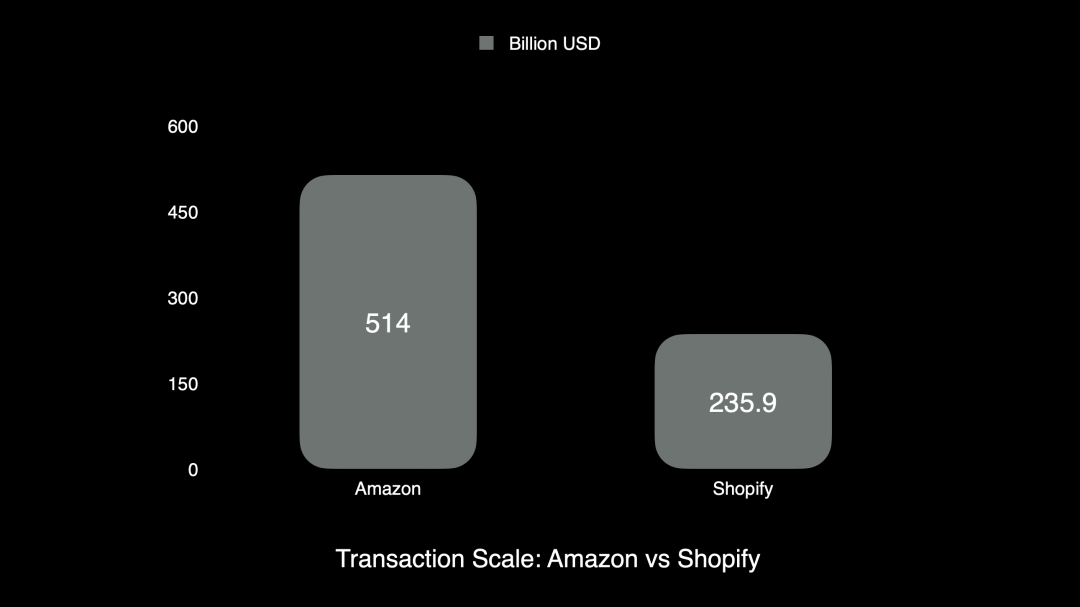
2023 Amazon vs. Shopify sales scale comparison
Image source: Angry Miao
Shopify's growth rate is several times Amazon's. You might see Pinduoduo dominating in China — China doesn't have Shopify. But US consumers are clearly telling us: we want more personal brands, more independent brands, more D2C brands.
Our summary of 2024 versus 2007: 2007 was ruled by shelf e-commerce, everyone selecting and comparing prices. Today it's different. Today independent brands are exploding in growth, while shelf e-commerce is declining. Though Pinduoduo is strong, all that haggling and price-cutting ultimately isn't a virtuous cycle.
Where's the opportunity in this second trend of brand long-tailing? Lower barriers to brand breakout.
Some of you might think I'm talking nonsense. Traffic is increasingly expensive — how can barriers be lower? It's true that internet traffic acquisition红利 has disappeared, costs are rising. But correspondingly, individual传播 data is exploding in growth.
Second, big teams are shrinking. Microsoft once had over 100,000 people, but Discord has only about 500. Midjourney has just over a dozen people, several of them part-time. Teams are getting smaller. So we believe small brands have opportunity.
Why is individual transmission data exploding? The most famous example: Joe Rogan's three-hour podcast interview with Trump hit 26 million views in 24 hours, ultimately settling at 60-70 million. One person, one three-hour podcast, 60-70 million views. What does that mean? Total US election voters this cycle: 140 million. One person influenced half the voting population. So we believe brand long-tailing, the opportunity for independent and personal brands, is rapidly arriving — whether you look at Shopify's data or individual传播 data.
Unlike back then, we now see strong polarization in brands. I don't know how much money those of you who invested in or bought "affordable luxury" lost, but you'll notice no one says "affordable luxury" anymore. Affordable luxury brands have collapsed. In the future, you either make the cheapest thing or the most expensive thing.
After梳理ing these two demand-side characteristics, let's look at the supply side.
The supply side is fully digitizing: digital design, digital user research, Kickstarter is rapidly rising. In production, CNC machines — China's overcapacity has pushed CNC adoption to 40% or higher. So today it's easy to access CNC for any product. And 3D printing is continuously普及ing. Supply digitization brings supply flexibility.
Most of you probably haven't made phones. Back then if you wanted to make a phone and approached the supply chain, their first question was always: how many units do you want? If you said 10,000, they'd say: sorry, exit's that way. Back then, to actually bring a phone to market, your minimum order had to be 100K, 100,000 units.
Today, guess what order size the supply chain accepts? Someone said 5,000. Correct. Today's supply chain has overcapacity. With no orders, they'll make a glasses product for 5,000 units. The entire supply chain is rapidly flexibilizing.
What do these changes lead to? On the demand side, consumers genuinely want more independent brands — we fundamentally want to buy good things that are uniquely ours, not撞车 or撞衫 with others. On the supply side, true small-batch flexible iteration is supported, because we've digitized and flexibilized. So we believe there will be a major difference from the phone industry.
We know in the last wave, after brutal competition among 100+ brands, only 5 truly profitable brands remained. This wave, we think there will be more tickets to the final destination, because demand is fragmenting while supply is flexibilizing. Possibly 10 or 15 brands will ultimately survive and make money. This is a better era.
Under these circumstances, brand positioning, design, quality, and D2C capability become more important.
03
The long-tail effect of the new era
Let's get more concrete — how to successfully define this product and build this brand.
First is the core of the brand side. Core brand capabilities have changed; they're different from the last generation. I believe first is cultural expression — you must capture the generational culture of new consumers, or their subcultural capacity, and design products that only their generation owns. Because glasses are more external-facing, they more represent one's aesthetic, taste, and identity.
This is our paisley keyboard. But many of you don't know what paisley is — young people see paisley and immediately think street.

Angry Miao's CYBERBOARD R4 keyboard with "paisley" theme
Image source: Angry Miao
This is our product. We also don't understand why young people would combine keyboards with donuts and food, but they'll tell us through the community: this is dope, even though we don't see it. Two examples of cultural leadership.
Second is returning to初心. Because today's传播 and communication are tighter, faster, more real-time. Telling the truth matters vastly more than before. If you watch Joe Rogan's podcast, or his Trump interview — three hours, no script whatsoever. Joe Rogan just asks, Trump just answers. Everyone who listened to that three-hour interview believes Trump is telling the truth, because he has no capacity to fabricate.
So what product you make is deeply connected to who the product's主理人 is. Only such a person making such a product is credible. Here's a photo of me when I was thinner; now it's somewhat less credible.
Third is continuous interaction. You really need to be online, really be on X, TikTok, Discord, podcasts, constantly communicating with your consumers. When communicating, really don't put on airs. Just tell the truth — this product turned out poorly, sorry.
So having a community to support your brand, guide your brand communication, guide your product — this is truly important.
People say brand stuff is all vague. Can you give us real product-side advice? Next I'll say some truths that may feel like暴击 to some product people or investor friends. But it's fine, maybe it'll be启发ing.
First, during 100x growth over three years, don't obsess over scenarios. Don't talk to me about core scenarios, I'm sick of hearing it. Why not obsess? Because in 100x growth over three years, you cannot predict scenarios. So anyone claiming core scenarios will be this or that during such a wave — they're frauds.
Why am I confident saying this? Jobs once gave an interview where he debated core scenarios. He put Mac in the center and pushed all phones to the side — he believed the core user scenario was using his computer at the desk. Even Jobs couldn't predict core scenarios at the start of the smartphone wave. What makes you think you can!
So don't predict core scenarios, don't discuss it, it's a waste of time. Really, I don't want to hear "core scenario" anymore. What matters? Getting the MVP out matters. Actually make the product, give it to consumers, let them flame you — that matters. I believe one important reason Jobs was ultimately persuaded to return to making iPhone was that real smartphones already existed in the market. Only with real products can you grasp core products, grasp feedback. So making samples is crucial.
Second, don't talk to me about killer features anymore, I'm really sick of it. Today thinking any killer feature is amazing — Photoshop built up amazing image editing over so many years, but could be秒杀ed by OpenAI the next second. OpenAI has already killed translation software. Google Gemini 2.0 released a couple days ago, killed Photoshop again.
So there's really no point假设ing what our killer feature is. When you're halfway through development, OpenAI迭代s a version and you're finished! What to do? First find 1,000 users who love this brand and continuously interact with them — this matters most. This isn't me saying this, it's Altman. Altman once said: Having 1 million people know you doesn't matter, but having 1,000 people who truly love you — this matters enormously.
Third, don't lie to yourself about having core technology. You can lie to investors, you can lie to your users, but don't lie to yourself, okay? In a trillion-dollar wind, with Huaqiangbei fighting to a pulp today, are we using Android, RTOS, or Linux? Qualcomm or UNISOC? So many AI solution providers, so many ISP solution providers, including those from security cameras — they're constantly fighting, working until 11 or 12 daily, constantly integrating and iterating their solutions. Can you claim to have any core technology?
Before the phone industry competition reached its final stage, no brand had true exclusive killer core technology. The competition and reintegration among them still has 12 months before it shakes out. So within these 12 months, no software person has any reliable core technology.
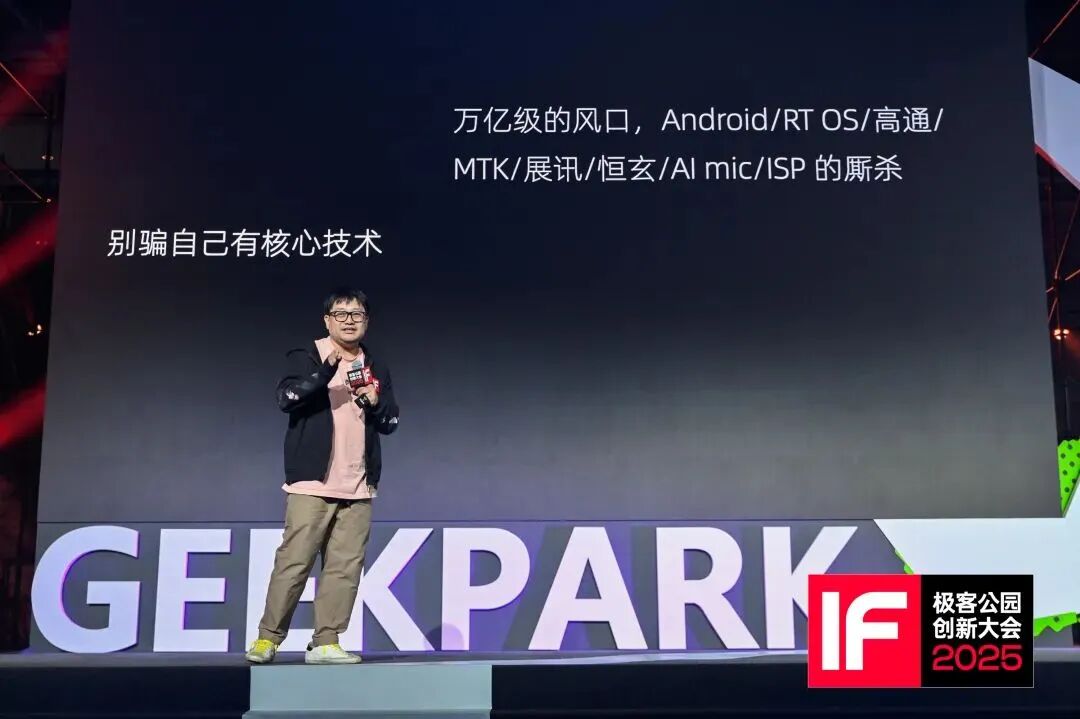
Li Nan delivering some "unvarnished truths" to AI glasses entrepreneurs
Image source: GeekPark
What to do? Let's review history. In the phone industry, everyone's core technology was vertically integrated after they first captured the market. As a brand, don't solve core technology supplier problems, don't solve production-side problems. Brands first need to solve the "last mile" problem. Once you've captured the market, have stable profit sources, you'll naturally have resources to discover and develop the core technology you should vertically integrate.
04
"Thinking" costs more than "doing wrong"
Three truths delivered, let me close with two bowls of鸡汤: At this moment, I believe thinking costs more than doing wrong.
Simply put: just do it, stop thinking. Don't discuss core functions, core scenarios, killer apps with me — it's truly wasting time, and time is something no amount of money can buy.
Finally, if the vision of 100x in three years is real, we'll have very uncertain high-speed growth. In this kind of growth, I think the most important thing is not to make too many predictions. What's the better state? Be a nomadic people.
What does nomadic people mean? Let me give an example. We know Li Auto initially sold refrigerator, TV, big sofa — sold well. Then Huawei's intelligent driving came along. No problem, we hire people to write rules, we compete on智驾. Then Tesla FSD V12 released, end-to-end AI智驾 appeared. No problem, we buy GPUs to train. After Li Auto released true end-to-end AI智驾, what did they do? They fired all the rule-writers, then found out: can't work, cut too deep, hire a few back.

Li Nan believes the correct organizational form for the future is "nomadic people"
Image source: GeekPark
Looking at 2023 China brand TOP50, those born in the 60s aren't good at this, and not many born in the 80s can handle it either. So stop delivering 60-point products at half the price. It'll get you market share, it'll get you more shipments than Apple, but Apple captures 80% of profits. Use double the price to deliver 90-point products.
The future is no longer a battle for share. Your era is no longer a battle for share. The share battle was solved by those born in the 60s. The future is a battle for mindshare. And the battle for mindshare will bring greater returns than today's share battles. You can look at Xiaomi's valuation on Hong Kong stock exchange, then look at Apple's valuation on A-shares. You have the opportunity to capture 80% of industry profits as a头部 enterprise.
So everyone, the returns are sufficient, they're enormous. So Chinese brands — it's up to all of you!
Recommended Reading