ZhenFund Angel Project Yuan Ce Future Releases Robot Whole-Body Control Framework Anchor 1

Providing a control foundation for complex whole-body manipulation.
French philosopher Maurice Merleau-Ponty once said, "To understand is to experience the harmony between what we aim at and what is given, between our intentions and the execution — and the body is our anchorage in the world."
A good brain needs a capable body and cerebellum.
A strategy that "knows what to do" requires an execution system that "can reliably do it."
Yuan Ce Future's exploration of Whole-Body Intelligence (WBI) targets general-purpose physical intelligence.
On November 5, Yuan Ce officially released its whole-body control model, Anchor 1, with the goal of enabling robots to bridge the morphological gap between humans and machines while preserving the action structures that tasks actually depend on — precisely and stably anchoring themselves in the physical world.

More Accurate Motion and Whole-Body Control
In humanoid robot operations, whether the hand reaches its target is not sufficient to fully measure the quality of an action's completion.
Take retrieving an object from a low position: the robot needs to adjust its body height, bend its knees, alter its torso posture, and maintain stable foot-ground contact throughout.
If foot slippage, unintended stepping, or body drift occurs during the motion, even if the arm is near the target, subsequent operations may be compromised.
This means humanoid robots must simultaneously handle two interrelated problems: on one hand, precisely tracking motion targets for the hands, pelvis, and other key body parts; on the other, coordinating whole-body joints to execute movement based on their own structure and real-time state.
Human motion capture provides an important data source for robot learning, but differences in body proportions, joint structure, and range of motion between humans and robots mean human movements cannot be directly copied onto robots.
Traditional methods typically rely on joint-space retargeting to convert human motion into robot joint trajectories.
However, the intermediate solving process may introduce reference errors or motion discontinuities, affecting the precision and stability of robot execution.
To address these challenges, Anchor 1 designs around three aspects: motion reference representation, control policy training, and real-time feedback mechanisms — exploring more direct motion mapping and more stable whole-body control.

Building Precise, Stable Whole-Body Control
Control precision must be considered across the full pipeline. Errors may arise during robot execution, or may already be introduced when human motion is converted into control commands.
Anchor 1's design follows this chain: preserve task-relevant motion intent, leave room for whole-body coordination, guide behavior through training data, and continuously correct deviations during execution.
Preserving Key Motion Targets, Leaving Room for Whole-Body Coordination
Humans and robots differ in body proportions and joint structure, so motion transfer must adapt to the robot's body while preserving task-relevant trajectory structure and spatial relationships.
Online joint-space retargeting, if solved poorly, may introduce deviations or abrupt changes before the controller even receives commands.
Anchor 1 uses geometric calibration to scale human motion to the robot's body dimensions, then extracts target poses for the pelvis, both wrists, and both ankles as sparse motion references.
At deployment, these references feed directly into the controller with no online joint-space retargeting.
This design aims to establish more predictable human-robot motion correspondences, making teleoperation more intuitive and supporting natural, fluid post-training demonstration collection.
Sparse input also represents a trade-off between complete motion reproduction and coordination flexibility: preserving motion targets for key body parts while relaxing individual constraints on remaining joints.
The controller can thus leverage coordination space across the torso and limbs to adjust whole-body posture and more accurately achieve these targets.
The research demonstrates examples with operators of different body types and various motion capture and VR devices controlling the system, showing this interface's adaptability to different input modalities.
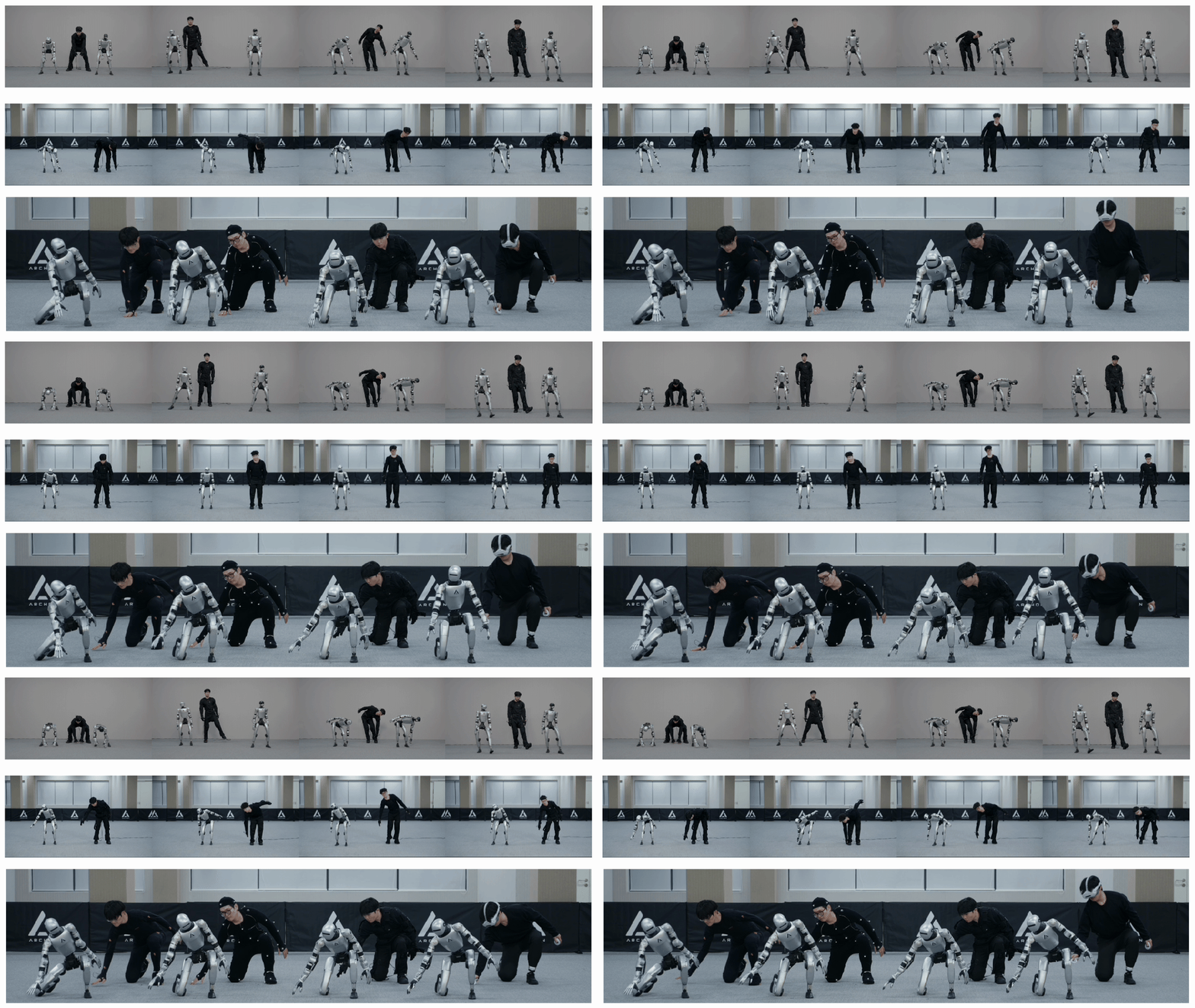
Operators of different body types and multiple motion capture devices
Guiding Whole-Body Coordination with Quality Motion Data
Sparse targets typically correspond to multiple whole-body movements. After preserving coordination space, the controller still needs guidance on how to use these degrees of freedom to form stable, expected behaviors.
Anchor 1 pairs calibrated human motion with robot references obtained through offline retargeting of the same actions: the former provides sparse commands, the latter provides training guidance for whole-body movement.
The team organizes training data around the postures, support, and coordination patterns needed for whole-body manipulation, then shapes the training distribution toward stable, reasonable behavior through quality checks, filtering, and manual analysis.
Thus, the sparse interface and data distribution work together: key targets clarify which motions need accurate realization, while filtered robot motions guide how the rest of the body should cooperate. The online control's whole-body coordination is learned by the policy.
Decoupling Motion Expression from Execution Correction, Balancing Precision and Upper-Level Interfaces
During execution, explicit tracking errors can provide the controller with direct correction signals.
But the same target action may produce different errors under different execution states.
If these errors are encoded together into motion representations (Motion Tokens), the representation of desired behavior becomes contaminated by transient execution deviations, increasing the difficulty for upper-level policies to learn, predict, and reuse this representation.
Anchor 1 separates explicit error feedback from motion encoding: a motion encoder extracts reference action representations, while tracking errors enter the control decoder separately, combining with robot state to generate actions.
This architecture preserves the precision benefits of explicit feedback while supporting flexible upper-level control interfaces.
When an upper-level policy directly outputs motion representations, a reconstruction module recovers the corresponding target poses to provide references for error calculation.
Thus, the same controller can receive either sparse motion references or motion representations, performing execution correction under both interfaces.
Ablation experiments further validate the feedback mechanism's role: in MuJoCo's In-House Track, compared to versions without explicit error feedback, feeding errors into the control decoder improved Anchor 1's global action success rate from 70.9% to 88.7%, and local success rate from 61.7% to 88.4%.
This result indicates that, in this experimental setup, explicit feedback and its input location have significant impact on sustained tracking precision.
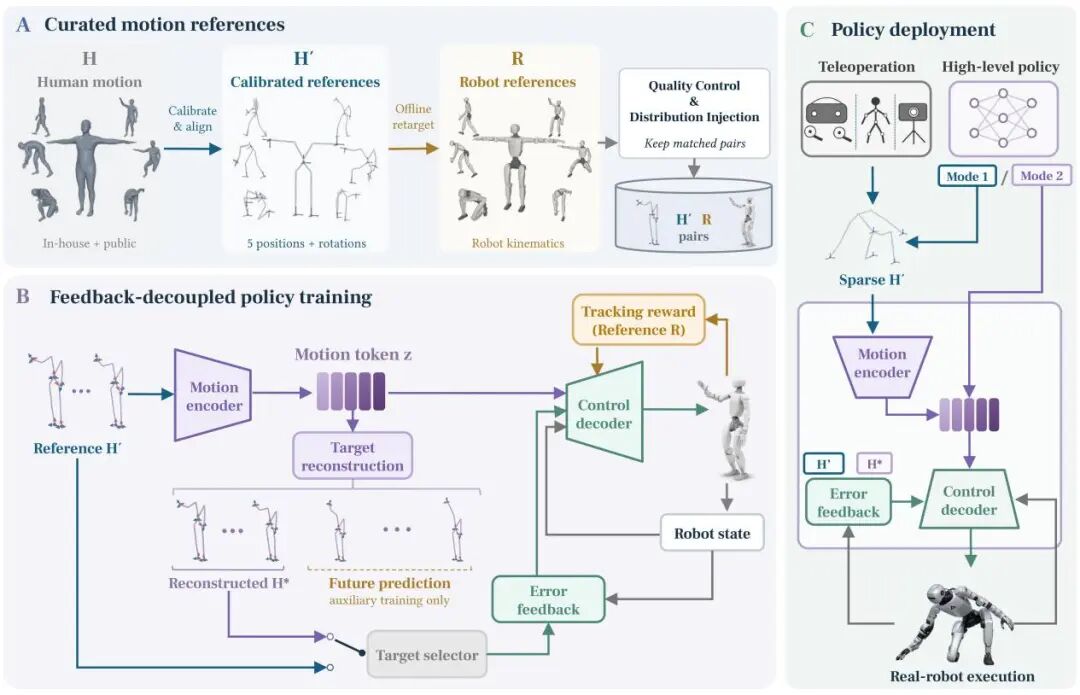
Anchor 1 control architecture diagram

Multi-Dimensional Experimental Validation: From Motion Tracking to Stable Support
These designs require evaluation oriented toward operational demands.
Whether a robot can accurately reach targets, sustain precision throughout an action, and stably complete movements under different postures and support conditions are three interrelated questions.
To this end, the team built a Benchmark covering precision, sustained execution stability, and reachability — systematically characterizing the controller's capabilities and boundaries through In-House Track, Public Track, and Reachability Track.
The three test sets involve over 20,000 action and target samples combined:
- In-House Track: 15,342 internal actions, focusing on evaluating whole-body motion tracking and coordination capability.
- Public Track: 2,230 publicly sourced actions, evaluating control performance across different motion sources.
- Reachability Track: 3,210 reference targets, testing target reachability and stable support under different postures.
In In-House Track testing, Anchor 1 achieved 88.7% global action success rate and 88.4% local action success rate.
This result demonstrates Anchor 1's control capability in whole-body action tracking and coordination.
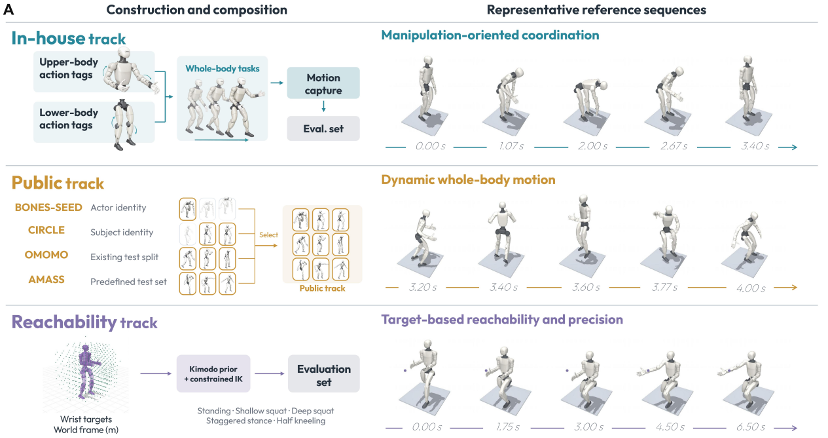
Three complementary test tracks
Global tracking primarily measures whether the robot accurately reaches targets in space; local tracking focuses on whether body parts move relative to the pelvis in accordance with references. Both metrics together reflect whole-body control execution quality.
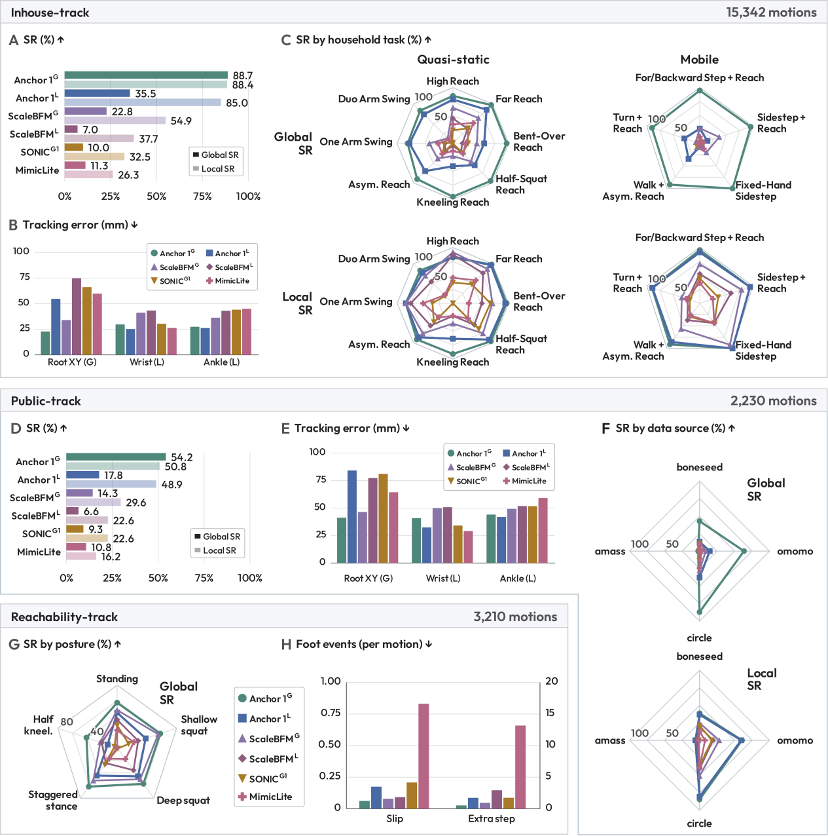
Benchmark results across three tracks: action success rates and tracking errors
For operational tasks requiring sustained body posture changes, stability is also an important evaluation dimension.
In Reachability Track, the research sets up different support conditions — standing, shallow squat, deep squat, staggered stance, half-kneel — testing robot performance when completing reaching targets, and recording foot slippage, extra steps, and other events.
Experimental results show that Anchor 1 can complete target tracking with relatively few foot anomalies in relevant tests, demonstrating the control framework's capability in coordinating action precision with body support.
Beyond simulation, the research team also conducted real robot experiments.
Using optical motion capture and robot joint kinematics to recover whole-body motion, the team compared different control methods on the same robot platform under similar test conditions.
Results show that, on the tested action subset, Anchor 1 achieved lower global tracking error and maintained high overall action success rates across different position error tolerances.
In the real robot Reachability subset's 51 standing reaching actions, Anchor 1's global wrist position average error was 44.58 mm, with both ankle positions averaging 35.70 mm; the lowest-error comparison method in this subset, MimicLite v1.1, correspondingly recorded 53.59 mm and 50.40 mm.
Meanwhile, Anchor 1 uses a 0.06-second future action reference window and requires no online joint-space retargeting; MimicLite uses a 0.08-second reference window and requires online retargeting of real-time human input. These results apply only to the real robot test conditions described in the paper.
Combining simulation benchmarks with real robot experiments allows the research to extend from large-scale action testing to execution validation under real mechanical structures, sensing measurements, and ground contact conditions.
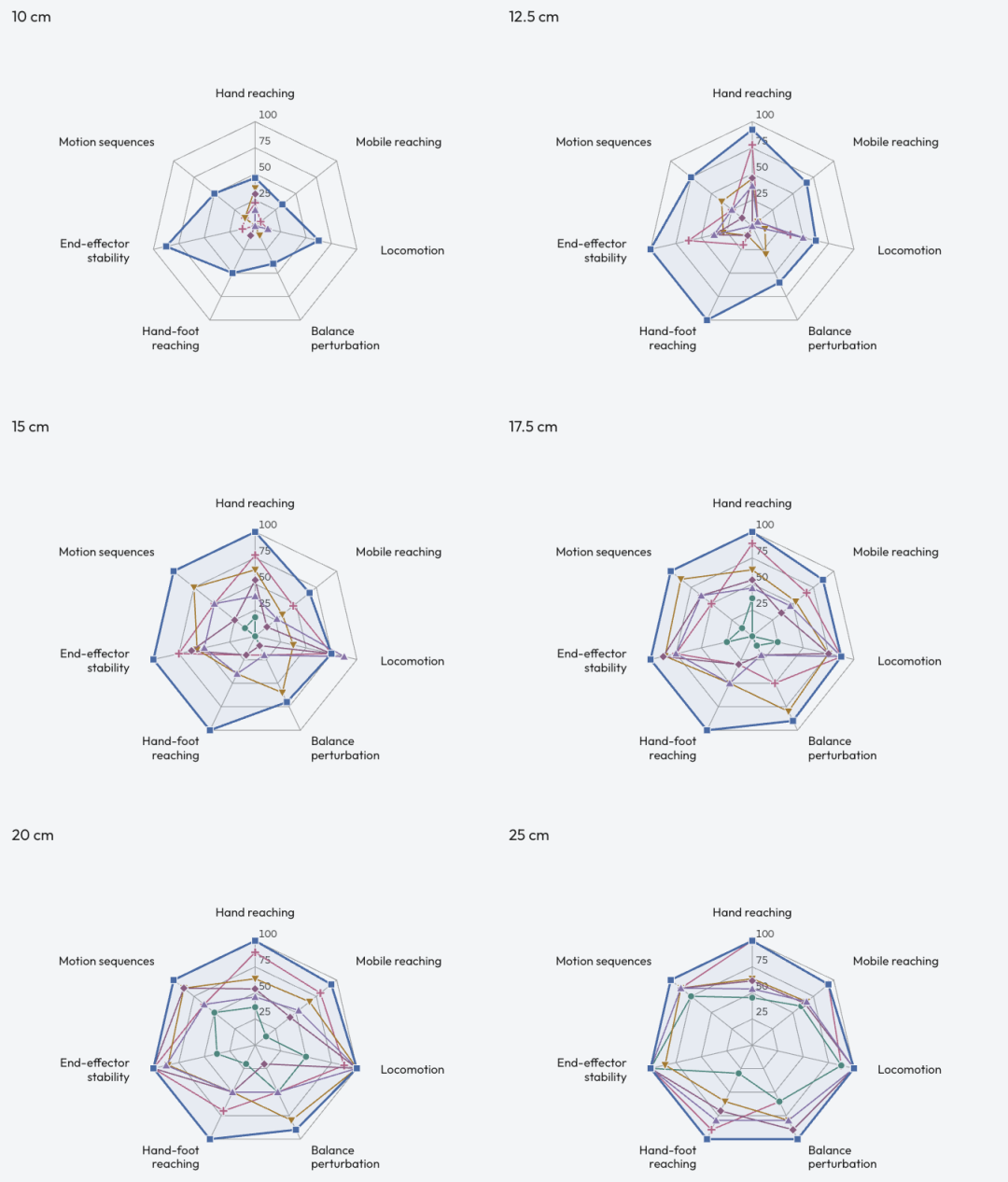
Real robot task success rates under different error tolerances

From Teleoperation to Autonomous Execution
Connecting Motion Control with Upper-Level Intelligence
The value of whole-body control capability lies not only in whether robots can accurately follow motions, but also in whether they can support data collection and autonomous execution in real tasks.
In teleoperation scenarios, operators need to guide robots through motion demonstrations to complete specific tasks.
If robots frequently exhibit tracking deviations, instability, or extra adjustments, the same task may require repeated demonstrations, affecting the efficiency of effective training data collection.
The research team validated Anchor 1's practical application capability through two task types: one involving kicking a cardboard box in a target direction, the other retrieving slippers from a low shelf and completing transport and placement.
These tasks involve robot locomotion, body posture changes, and object contact, posing comprehensive requirements for whole-body coordination and stable execution.
Experiments further evaluated different control methods' impact on data collection workflow using successful demonstrations per hour and demonstration success rate as metrics.
Results show that Anchor 1 achieved high successful demonstration proportions in tested tasks, demonstrating the value of more accurate, stable action execution for teleoperation-based data collection.
Specifically, in the box-kicking task, Anchor 1 collected 43 successful demonstrations per hour with 98.03% success rate; the comparison method SONIC v1.1 (SMPL) achieved 9 and 37.50% respectively.
In the slipper retrieval-and-placement task, Anchor 1 collected 62 successful demonstrations per hour with 97.37% success rate; SONIC correspondingly achieved 41 and 68.33%.
This set of experiments reflects changes in both collection efficiency and successful demonstration proportion; results are limited to the two task types defined in the paper.
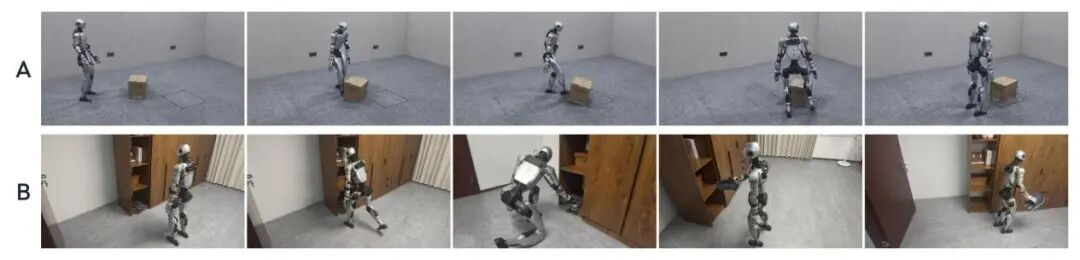
VLA autonomous execution process for box-kicking and slipper retrieval-and-placement
Building on this, the research team further used collected data to train Vision-Language-Action (VLA) policies and conducted autonomous task execution experiments.
In this process, the upper-level policy generates motion commands based on environmental observation and task goals, while Anchor 1 receives commands through sparse pose or Motion Token interfaces, responsible for the robot's whole-body coordination and execution correction.
The research validates how different control interfaces and feedback designs affect autonomous execution performance through comparisons of task success rates, task scores, and other metrics.
This experiment connects low-level motion control with upper-level task strategy: the upper-level model generates task-relevant motion targets, while the low-level controller transforms them into body actions the robot can actually execute.
Precise action tracking and stable body control are important foundations for humanoid robots to perform complex manipulation.
From sparse pose input to Motion Token representation, to explicit error feedback, Anchor 1 establishes a complete control framework around action precision, whole-body coordination, and stable support, validated through multi-level experiments in simulation, real robots, and tasks.
Going forward, Anchor 1 will also upgrade to richer scene terrains, continuously expanding the boundaries of whole-body manipulation.
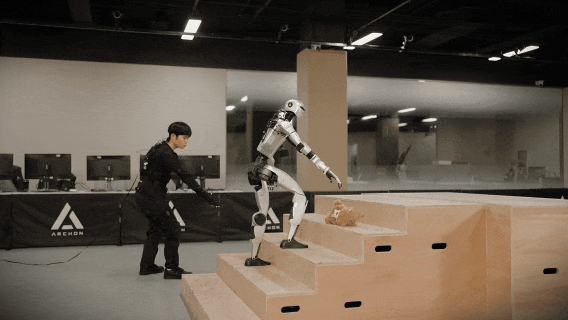
Anchor 1's model weights, deployment code, teleoperation data collection solution, and user guide are expected to be released by end of 2026.
Click "Read Original" to access the technical paper and project details:
https://www.archon.tech/research/anchor1