Taking a Leave from Columbia to Build a Startup: Don't Ask ChatGPT, Ask Hyperknow 3.0

We want to serve everyone who stays curious about knowledge.
At Columbia, Yilin Zhao and Ruohan Jiang, both still fresh arrivals, signed up for a quantum-physics hackathon. The lectures ran from logic gates to code implementation, and the two beginners struggled to keep up. On one side sat impenetrable textbooks; on the other, ChatGPT's quick but shallow answers. Only when they tore the core concepts apart themselves did they realize the material wasn't nearly as daunting as it seemed. That was the moment it clicked: the knowledge itself wasn't hard — what was hard was finding someone who could actually explain it.
They refused to settle for surface-level answers.
Yilin and Ruohan share a drive that borders on agentic — they call it "the ability to grow outside the structure." Not pulled along by predetermined paths, not merely checking off assigned tasks, but moving forward with their own judgment. They attended classes by day and built their company by night. When they met, the greeting was never "How was your day?" but "What problem are you stuck on?"
From last September to now, Hyperknow has cycled through five major versions and hundreds of minor ones.
Back in high school, Yilin often wondered: What would it feel like to have someone beside him who truly understood his thinking, his pace, his entire background? Over time, he became that person himself — someone who could make hard things simple. Eventually, he realized what everyone was really missing was a Hyperknow: a companion that grasped your learning context and answered every question you had.
In November 2025, Hyperknow, a general learning agent, officially launched, built around real learning scenarios with personalized dedicated models. Three months later, Hyperknow 3.0 went live. It began to think and plan proactively, anticipating your next step before you took it.
The future keeps throwing one question after another. Fortunately, twenty-year-old confidence and hope still run deep — enough to carry them forward again and again.

Serving Everyone Curious About Knowledge
Q: Could you both briefly introduce yourselves?
Yilin Zhao: Hi everyone, I'm Yilin Zhao. I'm a junior at Columbia University, currently on leave to start Hyperknow, which I founded.
Ruohan Jiang: Hi, I'm Ruohan Jiang, a sophomore at Columbia, also on leave right now.
Q: Tell us about the Hyperknow product.
Ruohan Jiang: What we're building is a "general learning agent" platform. It started from the difficulties we ran into in our own studies, and we later realized everyone's pain point boiled down to this: there's no good enough channel that can actually explain all kinds of knowledge clearly.
We have classrooms, YouTube, ChatGPT — but none of them manage to be "deep yet accessible, while truly fitting each person's learning needs." In the past, learners were constantly trapped by information noise that slowed down real understanding.
What we want is for AI to absorb that noise, so learners can focus on understanding itself.
Q: What made you decide to take a gap year and start a company in your first two years of college?
Yilin Zhao: I had a close friend at Columbia who I did research with, working on AI for Science. We'd been gradually getting the tech to work since early 2024, but then Sakana AI beat us to the punch, credited as the first AI Scientist capable of completing the full scientific research process independently.
That friend used to tell me something repeatedly: "Yilin, you're someone with real ideas. You should look at what problems you actually encounter in your own life, and think about whether you could turn one into a company."
He grilled me on this. I'd push back: "Didn't I come here to do research with you?" But those words lodged in my mind. I spent two months unable to figure it out, growing more frustrated.
Then Ruohan arrived at Columbia, and we signed up for that quantum physics hackathon. And right there, something clicked.
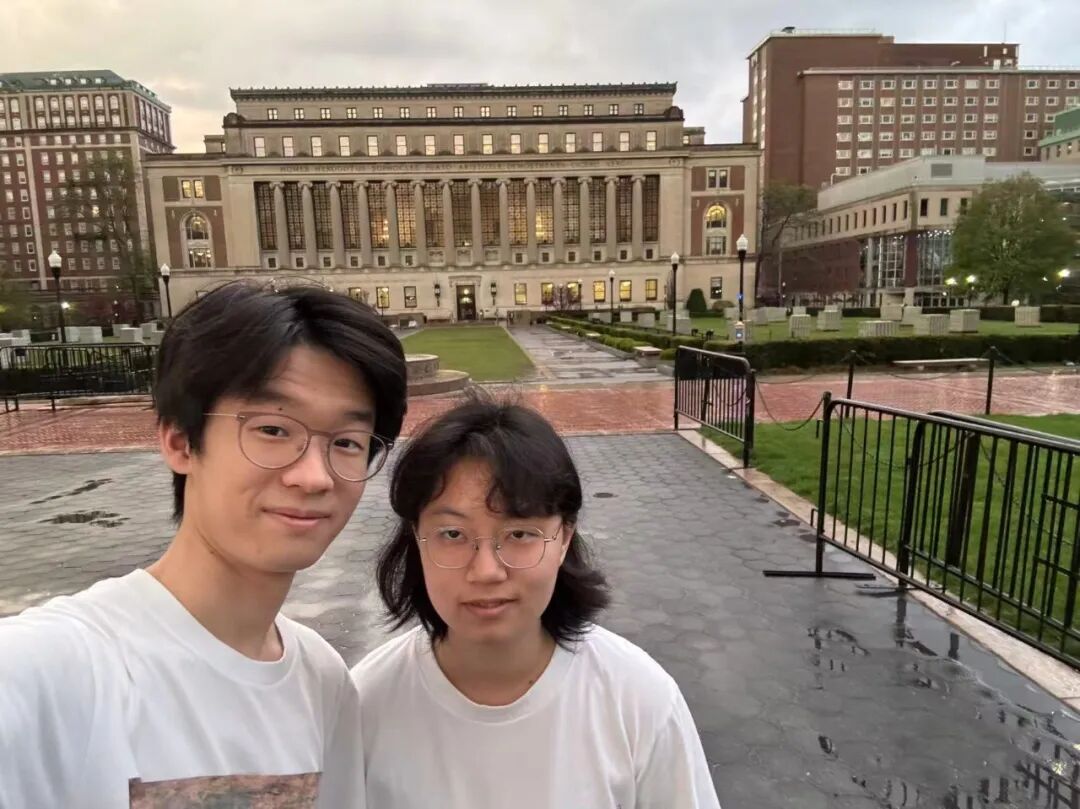
Yilin Zhao (left) and Ruohan Jiang (right) during their time at Columbia
Before the hackathon, there was a series of lectures on how logic gates and code implementation actually worked. We were complete beginners and suffered through them. We skipped so many meals with friends just to attend.
The textbooks the instructor gave were too abstruse; ChatGPT couldn't explain it either. In the end, we figured it out ourselves, bit by bit. We discovered the core concept was actually incredibly simple: quantum "gates" are like circuit gates, just inverted in one spot.
That sudden strangeness hit me: why is the knowledge itself so simple, yet no one can explain it clearly?
We were building a platform that makes problems clear — rigorous yet accessible. For the first time, I could see our problem with full clarity.
Q: You already had the product idea last year. How many versions have you iterated through this past year?
Yilin Zhao: One evening, our team was meeting for the agent's first complete internal unveiling. I pulled out all the frontend code I'd written and ran through every version, only to discover that from our official start last September to now, we've iterated through at least five major versions, with probably hundreds of minor ones internally.
I screenshotted all those pages and dropped them in our group chat. Everyone marveled at how fast things had changed. Our team has always operated in "move fast, break things" mode, iterating intensely.
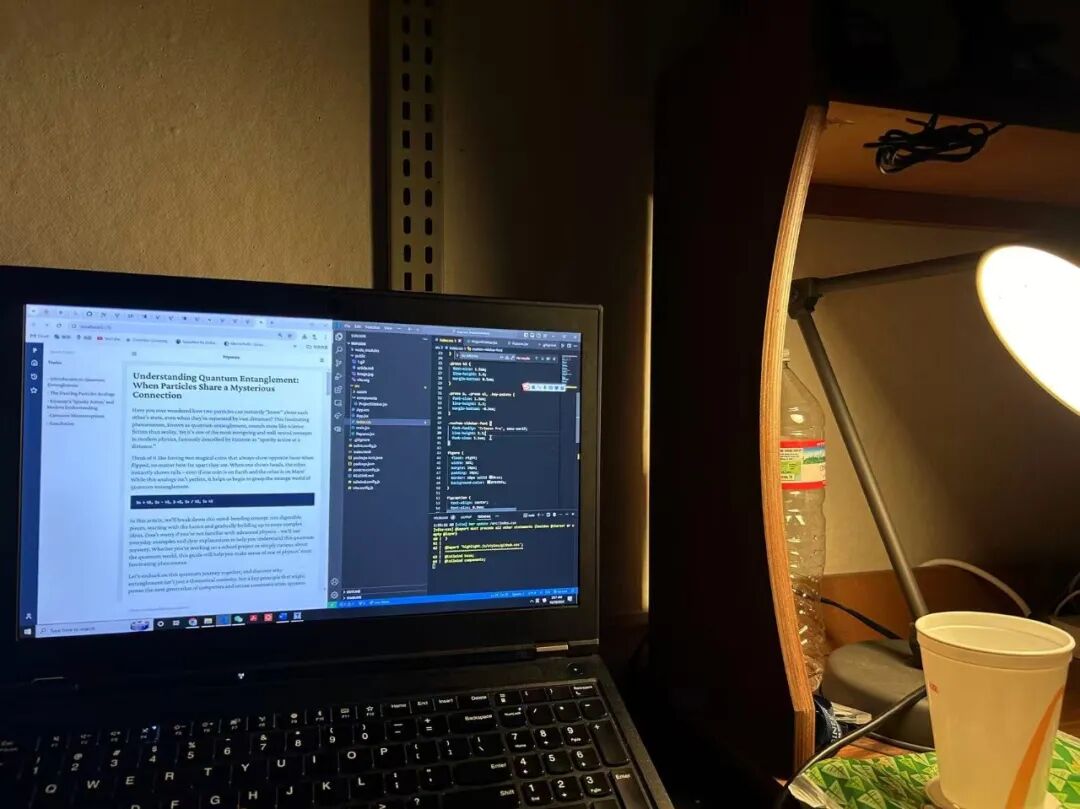
Building the first version of the Hyperknow Agent in the dorm
Our first product, AI Workspace, was simply meant to help students understand knowledge better. Back in October 2024, it may have been the first platform that truly helped students do deep academic search and explanation. The "Deep Research" concept didn't even exist yet.
Q: What's the focus of this Hyperknow 3.0 update?
Ruohan Jiang: Hyperknow 3.0 was conceived last October. While staying focused on providing sufficiently clear and accessible explanations, we also re-examined the overall form of AI-assisted learning.
We found that often, the impulse to learn gets stuck at "not knowing what to ask."
So we designed an "All-Round Learning Assistant." It connects to learning management systems like Canvas LMS, and also supports users building their own course knowledge bases. The agent actively tracks course progress changes and anticipates your likely next moves.
Before you even ask a question, it's already preparing in the background all the materials needed to complete your learning task. When the moment comes, the content is right at hand.
The problem is solved before the question even arises.
In Hyperknow 3.0, we also launched "Deep Learn Sessions." This is a structured chapter-based learning space, proactively guided by AI rather than waiting for student questions — more like one-click creation of your own personalized course. Many learners don't know what specific content falls under a subject or topic, or how knowledge points connect. Fragmented learning struggles to build systematic knowledge structures.
In Deep Learn Sessions, AI guides layer by layer, teaching progressively, and combines videos, interactive animations, and other materials to help learners understand entire courses more systematically and deeply.
We already have beta users using this mode to prepare for competitions and to study for finals with almost no class attendance — and they've gotten good results.
Q: Quite a few users have said they like Hyperknow's proactive questioning feature.
Yilin Zhao: "Proactive questioning" came to me suddenly around 1 a.m., while I was walking along a road near home.
I was thinking: In what situations are we genuinely better than GPT? Or when would someone actually prefer to use us?
When we first launched, a classmate of mine was working on his own project but had never tried Hyperknow. He asked me: "Hey, how is your knowledge search any different from GPT?"
I told him: "Just try it, and you'll know."
First, he saw our complete agent thinking process on display, followed by Web Search. Typical models search about 10 web pages; we search 50 at a time.
Once those 50 pages come back, Hyperknow reads through each one before generating an answer. Every segment is source-tagged — you click the tag to see which page it came from and what the core content was.
That feeling provides an extra hit of dopamine in learning.
Q: What can you do that ChatGPT struggles with?
Yilin Zhao: One feature we find pretty interesting ourselves is the "cheatsheet" we just mentioned. Many foreign courses have common semi-open-book exams with Cheatsheets — professors let you bring in one double-sided A4 sheet of notes compiled from the slides.
This is an extremely time-consuming process. If you use ChatGPT to generate a PDF, you'll find it doesn't really understand what a cheatsheet should look like. The output is text-heavy, poorly laid out, looks crude.
But our design starts from the real student perspective. Most students making cheatsheets divide the page into four columns, with tiny margins and font sizes. For STEM subjects, we also extract all formulas and annotate what every variable means.
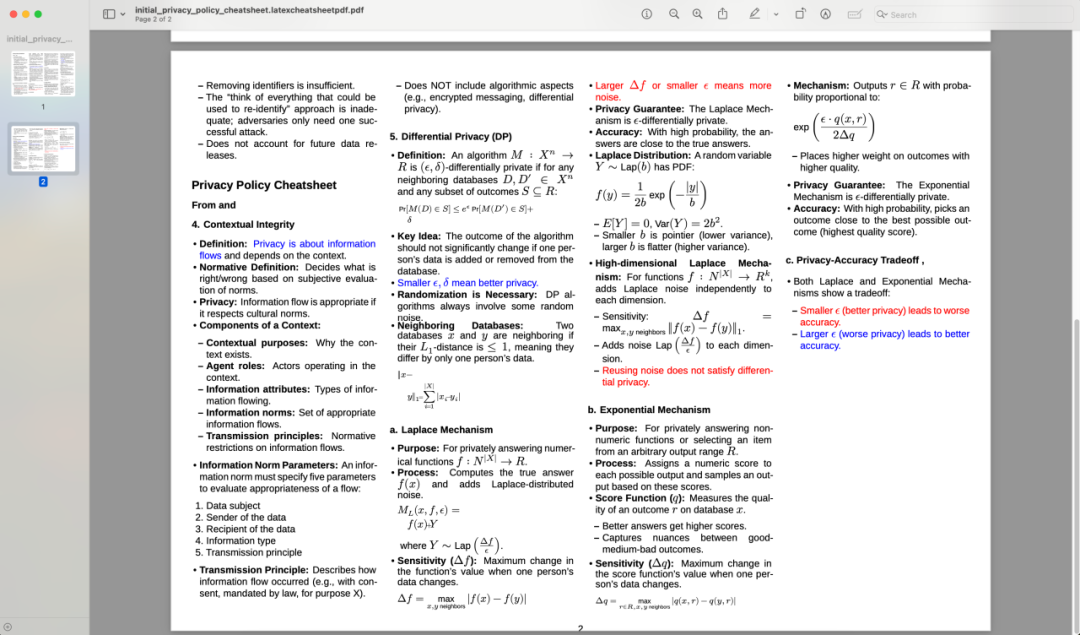
A cheatsheet generated by Hyperknow
If you upload a 500-page book to ChatGPT, it doesn't actually read the whole thing. Due to computational load or context-window limits, it often compresses the content, or even just "guesses" what the book says based on publicly available information.
But we read every file you upload, completely. Right now we can handle documents up to a thousand pages — like a student's entire semester of PowerPoints.
Q: If you had to describe Hyperknow in one sentence, what would it be?
Yilin Zhao: A lot of people have probably used Zuoyebang when studying. Snap a photo of a problem, you get it in the moment, but forget it the next day. Three days later when the teacher asks again, you're thinking: "Wait, how did you solve this?"
That's chasing an answer, not understanding a process.
It's the same in the AI era. I ask ChatGPT: what is a neural network? It gives me an answer, and I get this illusion of "oh, I get it." But the whole thing happens way too fast.
Real understanding means not just knowing the definition of a term, but grasping how it works, seeing examples, even calculating or simulating it yourself — that's when you truly understand how a neural network operates.
Although roughly sixty or seventy percent of our users are currently college students, we've also received a lot of feedback from Xiaohongshu from all kinds of voices. One parent asked: "I'm a mom of a middle schooler, can my child use this?"
We want to serve anyone who stays curious about knowledge.
Q: What do you hope to bring users?
Yilin Zhao: In this era of information explosion, where information is also so easily accessed at a shallow level, we don't really want users to just settle for that "I kind of get it" feeling that ChatGPT gives you.
We want users to see that there's actually a better mode of AI explanation out there. And once they experience it, they'll discover that this deeper understanding brings genuine pleasure. Over time, they'll be more willing to go deep, rather than staying stuck in that fragmented, surface-level understanding.

Build in Public
Q: Your first Xiaohongshu post got over 1,000 likes and drew tons of product feedback. How did you get started on Xiaohongshu in the first place?
Ruohan Jiang: This result really surprised us. Because our on-campus network was pretty limited, the main goal of building our first version was simply to reach more students from different backgrounds.
Xiaohongshu just happened to be a platform that lots of students use now, so we posted our first piece there.
After posting, we started thinking about how to better collect everyone's suggestions. So we created our first user group on Xiaohongshu, and quickly a few hundred people joined. The product had just launched at that point, and there were plenty of issues with database and system stability — it crashed a lot. Users in the group were giving us suggestions while sticking with us through fixing all kinds of bugs.
The pressure was definitely intense, but it was also really joyful. We were talking to users every day, iterating the product while seeing the most authentic feedback.
Another thing left a deep impression on me. When planning the next version, we invited a batch of users to an online workshop. It was a weekend morning in Beijing, and a few dozen people showed up. A medical student mentioned needing to read large volumes of literature, and users studying life sciences and law brought up features like flashcards. Many suggestions from those interviews directly became parts of the product today.
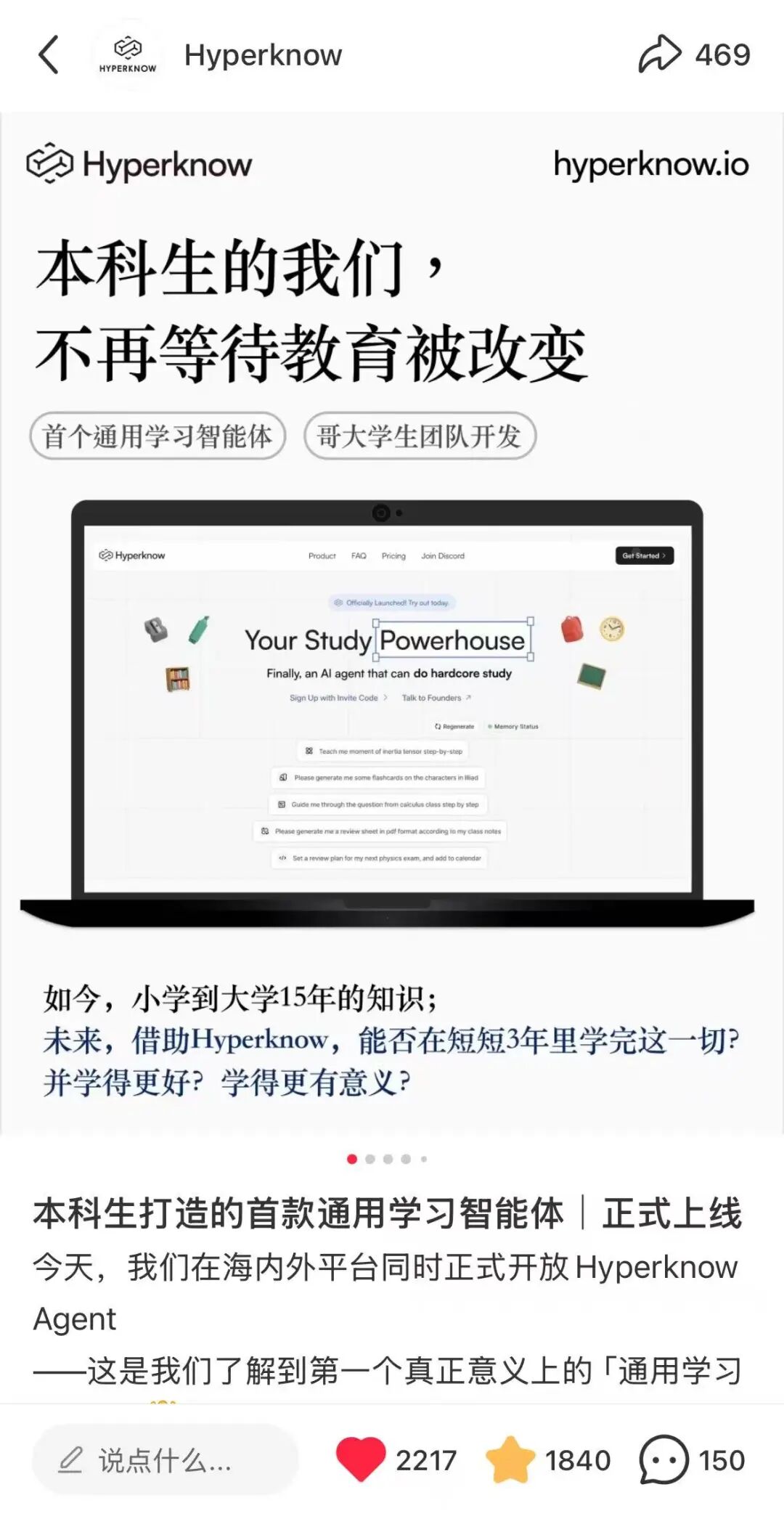
Q: Have you received any feedback that caught you off guard?
Yilin Zhao: Just a few days ago we got some interesting feedback. A user gave Hyperknow this prompt: "I'm an 80-year-old grandma. Please teach me how to make graphs in R, using simple language."
Hyperknow gave a response that even we found pretty delightful. It went something like: "Hello Grandma, you're doing great! Let's use a kitchen as an analogy. First you need to install a compiler that can run R, that's like your knife and stove."
The user then said something even funnier. She said: "Thank you, my granddaughter already helped me set up the environment."
She was probably partly being genuine about not knowing how to operate things, and partly stress-testing our system's limits. But seeing Hyperknow explain R language to an 80-year-old grandma through chopping vegetables and cooking — we found that pretty remarkable.
Q: What kind of feedback have you gotten on overseas platforms?
Ruohan Jiang: Discord has had a lot of feedback that's deeply encouraging. When we promoted overseas, we attracted quite a few paying users from different universities.
Several early users have been quietly following us, actively asking how the company is doing, even offering to help recommend our product in various school newsletters.
They don't just recognize the product — they identify with what we're trying to do. That means a tremendous amount to us.
We were also worried whether learning habits differ dramatically between domestic and overseas users, so we hoped to use Discord to better understand how overseas students study, and see whether Hyperknow could truly adapt.
After observing for a year, despite different cultural backgrounds, everyone still takes exams, still goes to school — the core pain points in learning are remarkably consistent.
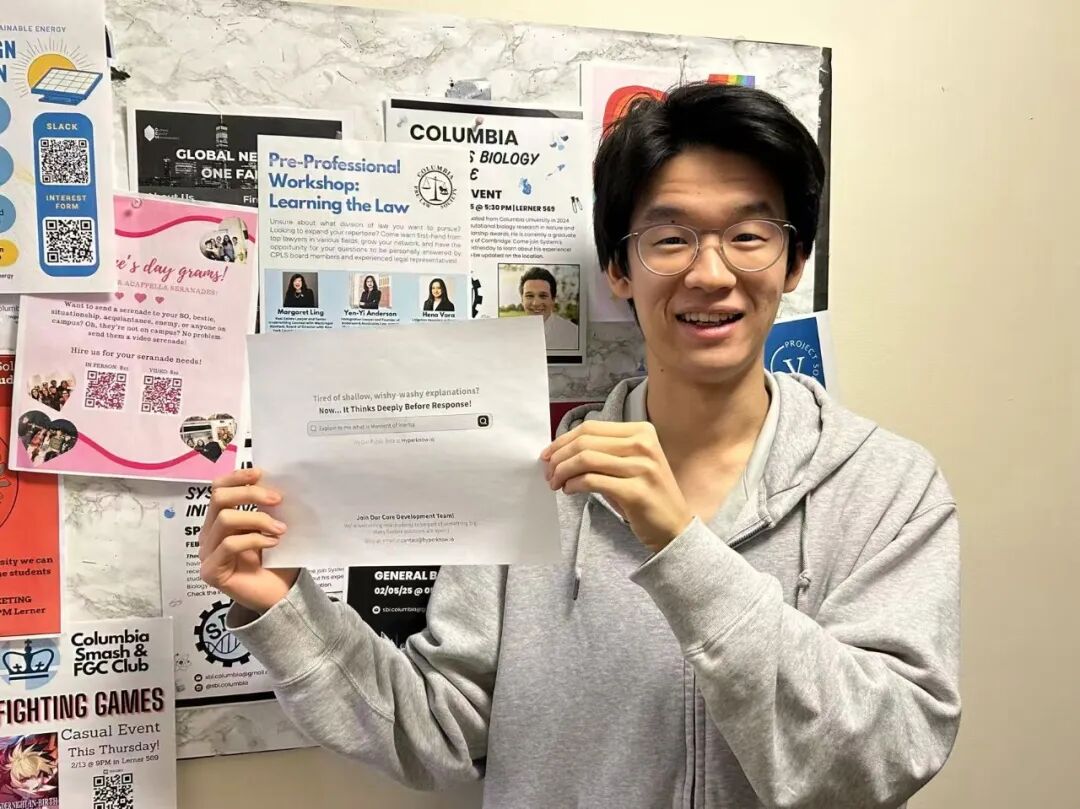
Hyperknow's early days promoting on Columbia's campus
Q: What are your hopes for the product's future?
Ruohan Jiang: We want to strengthen the model's proactivity.
Back in September last year when we were discussing product form, we were already thinking about this. Jarvis from Iron Man has always been my vision for "the future form of AI." It doesn't wait for you to speak — it actively observes what you're doing, judges what you need, then steps in to help you get things done.
We hope Hyperknow can more fully grasp the context of learning in the future — things like a student's course information, pain points, knowledge level. With this information, the Agent can more accurately judge what you actually need right now, whether exams are coming up, whether it's time to start reviewing, and then proactively prepare the relevant study materials for you.
We've talked to many users, and everyone mentioned a very real problem: when you use general-purpose models like GPT, you often don't have enough time or mental energy to craft your prompt with sufficient precision.
Most AI products still require users to walk up to the input box first, think through their question clearly, and then the AI responds passively. But we hope that in the future, you won't even need to think about what to do today — the AI has already planned it for you.
In other words, evolving from a tool into a true companion for your learning.
Q: AI might finally make learning truly personalized.
Yilin Zhao: We see in Xiaohongshu comments that people really resonate with "self-directed learning."
Right now using AI has actually become a bit passive. Usually you only turn to ChatGPT when you hit something you don't understand in class. But the "dopamine" in learning isn't just tossing a problem to it and being done — it's when it can explain a genuinely difficult concept clearly. In that moment, you suddenly feel: "Hey, I actually get this."
We hope this "dopamine" can create an experience where learning with Hyperknow is simply joyful.
Q: Many users on Xiaohongshu say they're already subscribed to ChatGPT. Compared to general-purpose models, what's Hyperknow's advantage? Why should I pay for this too?
Ruohan Jiang: Although ChatGPT has strong memory, it's still a general-purpose model — all your various memories get mixed together. And its memory window is so long that it's hard for it to consistently and accurately recognize who you are right now and what learning context you're in.
But our personalization is built entirely around student learning scenarios.
All your learning-related content gets recorded and organized within our memory system. It builds a learner profile for each user, continuously providing more tailored responses.
Going forward we'll also integrate more data sources from learning scenarios, including school learning management systems and classroom recordings. So from the very first question you ask it, it starts personalizing and building a dedicated learning model just for you.

Past, Present, and Future Agent
Q: How do you understand Agent?
Yilin Zhao: Going back to before we started in 2023, I was actually pretty averse to the word "Agent" at first.
In Chinese it's translated as "zhinengti" (intelligent entity). But looking at the English, Agent means "agent" — like a travel agent, a ticket agent. I found it vague, abstract, even a bit annoying at first.
But I gradually came to feel that from the earliest products to now, people's definition of Agent has been converging, becoming clearer and clearer.
The earliest Agents used that very typical LangChain approach, which was essentially one workflow library or framework after another. That Columbia friend I mentioned earlier demonstrated an Agent for us at a coffee shop: you could see its thinking logic, and when it called tools, it would display a line of green text in the terminal saying "I'm using xxx library to do something" — one line spins, one task completes. I found it pretty stunning at the time.
Past Agents were more like a workflow or pipeline. An Agent claiming it could automatically plan your trip was actually a designed process, a fixed script.
The reason Agent can continue evolving forward has a lot to do with the underlying model's own capabilities improving. When reasoning ability, generalization ability, and tool-calling ability get stronger, you no longer need to design complete workflows for it — you can just hand it the goal and let it plan and complete it itself.
Another fascinating development is the emergence of tools. Once a large model gains access to tools, it's like growing many extra tentacles — a real connection to the outside world.
Take Manus, which completes tasks through browser operations; behind that browser is API control. Or consider Python tools that can search the web, evaluate information sources, filter result quantities, generate files, create charts, produce scientific figures, even solve certain complex problems. All of these are tools that give the model more "tentacles."
It's no longer just giving you a text response. In the future it could be images, flashcards, practice problems, videos, PowerPoints — outputs in all different forms. I think Agents are already pretty captivating as they stand now.
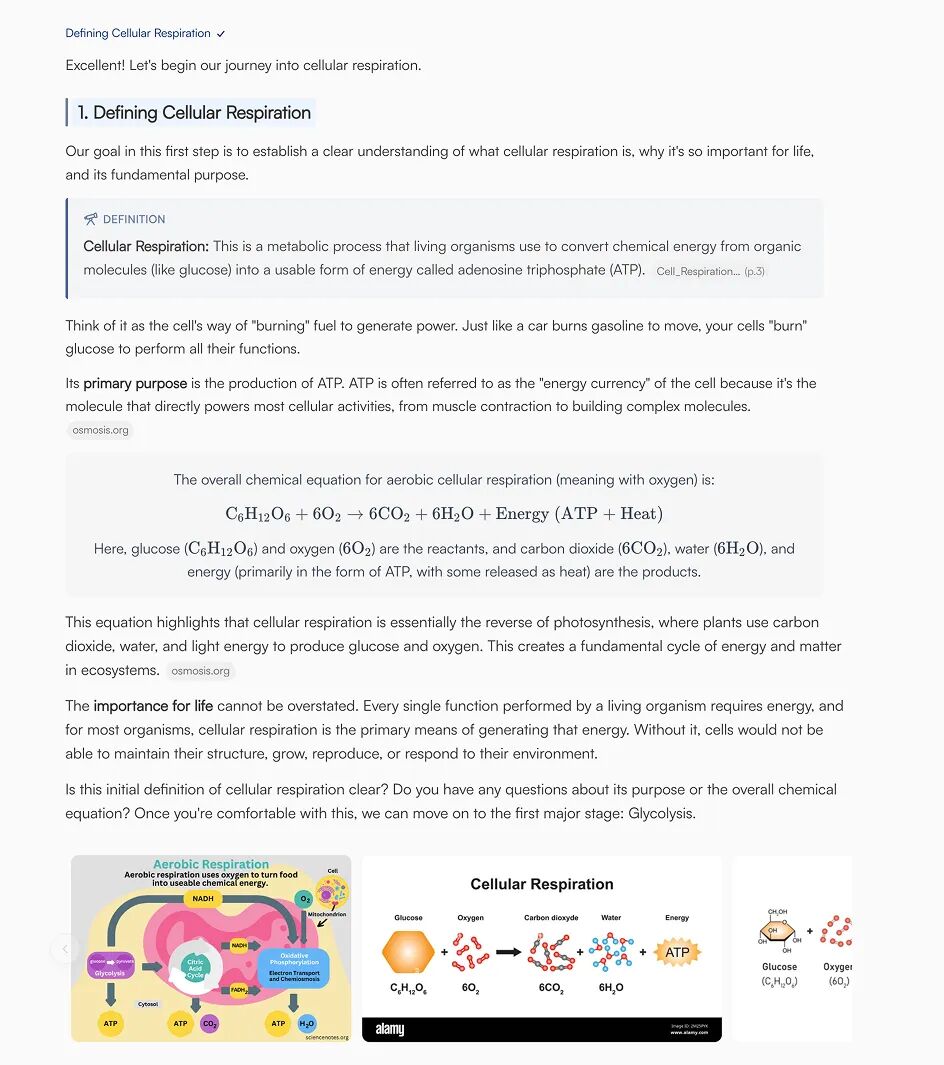
A concept explanation generated by Hyperknow
Q: Hyperknow is the first "general-purpose learning agent" I've come across. What exactly does "general-purpose" mean here?
Zhao Yilin: Our "general-purpose" has two dimensions. One is generality of use case, the other is generality of the model's own capabilities.
Like the computer science and physics we studied in undergrad — a classic question is: what is a neural network? Ask ChatGPT and you might get a relatively superficial explanation. But look it up on Wikipedia and you're hit with a wall of formulas, very difficult to read.
What Hyperknow aims to deliver is an explanation that goes deep yet remains accessible. It has textbook-level rigor, while also customizing the difficulty and scope based on your learning background.
Our problem-solving doesn't just hand over answers either — it guides you step by step: what's the first theorem this problem uses? Do you understand that theorem? Then it walks you through the derivation piece by piece. It's more like accompanying you through the entire thought process, rather than telling you the result.
Compared to ordinary models, Hyperknow also has stronger reasoning and generalization capabilities, plus more tools.
It can use web search tools, planning tools, memory tools, and more. When explaining a concept, it not only has our internally tuned complete explanation logic, but can also connect to external information sources — pulling online materials, academic browser content, even combining with a user's past questions, preferences, and knowledge level.
Our Agent can also read study files with user authorization. Like how many schools abroad use Canvas and other learning management systems where professors put all course materials, Hyperknow can directly provide explanations more closely tied to the classroom based on lecture notes.
Q: What are your outlooks on the underlying model going forward, and how might they enable Hyperknow to perform better?
Zhao Yilin: Context window is a critically important capability.
Whether it's handwritten notes or PowerPoint diagrams, our ability to read thousand-page documents and do visual reading all depends on improvements in model context length.
The hot technology in 2023-24 was RAG (Retrieval-Augmented Generation) vector search. The idea was to put massive amounts of information into a database, find the most relevant parts through semantic retrieval, rather than stuffing everything into the model.
But lately people mention RAG less frequently. Because in the past, models had very small context windows — every token was precious, so you had to filter. But as context windows have grown, we can now put more or even all information directly in, no longer needing such complex filtering workflows.
Ruohan Jiang: Context windows aren't just helpful for reading long documents — they're equally important for us to achieve finer-grained personalization. More context means the model understands a learner more comprehensively.

Growth Beyond Structure
Q: What do you imagine learning will look like in the future?
Ruohan Jiang: We saw a comment on Xiaohongshu the other day where a user said, "self-directed learning" will likely take up an increasingly large share in the future.
In schools, students might rely more on personalized approaches to decide what to study, at what pace, in what way suits them best — not necessarily strictly following the school's predetermined uniform progress.
Everyone will have their own rhythm, truly achieving individualized instruction. For schools, if students acquiring and understanding knowledge can already be accomplished through more efficient, individually-paced methods, then schools might be able to focus more energy on practical content closer to society, more oriented toward education in "how to be and how to do."
Q: You each have hobbies you've stuck with for a long time. Yilin, you're a train enthusiast; Ruohan, you're interested in theater. How did these hobbies form? Did they influence your later product work?
Zhao Yilin: I'm a train enthusiast. My mom and grandpa both worked in the railway system, so I watched trains a lot as a kid.
I really picked the hobby back up in middle school. That period was pretty stressful, and I'd often go to the Ming City Wall Ruins Park next to Beijing Railway Station to watch trains pass by, where I also met many friends.
If I just took photos and looked at them myself, it felt a bit wasteful. I once submitted photos to a train website I really liked, but they were never accepted. I thought, why not start my own platform? So I built a website where people could upload train photos they'd taken and share stories related to trains.
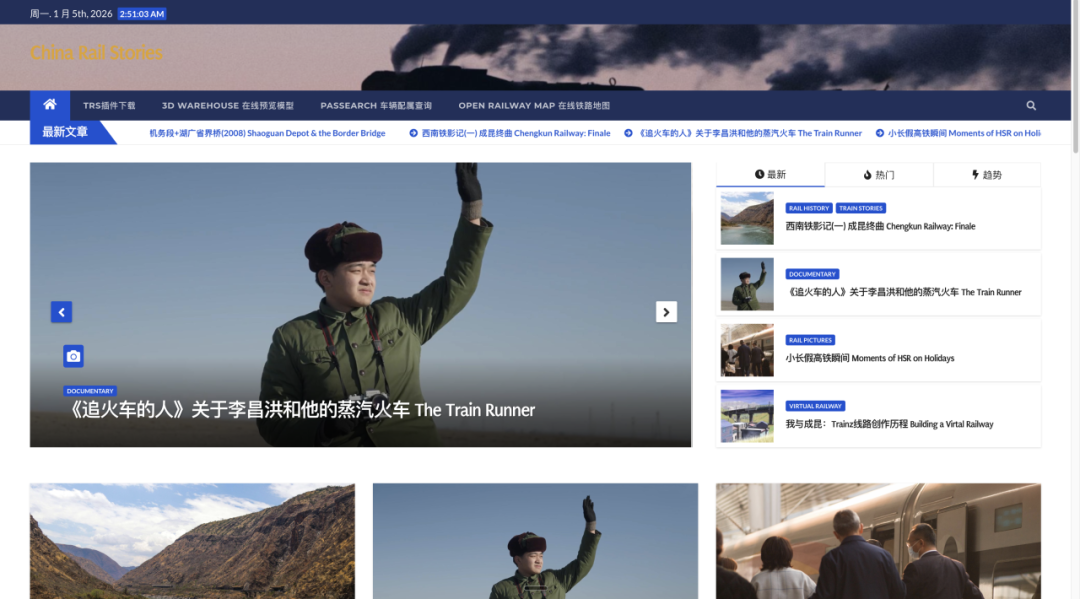
Screenshot of the train website Zhao Yilin created
I gradually realized that photos were just the surface — what truly drew me in were the stories trains carry. People online often say you should take the train to Lhasa before you turn 18. Why the train? Because the train represents a process, an experience — it brings strong emotional and visual impact.
I also particularly love watching trains travel from small places to big cities like Beijing and Shanghai, where you can see very grounded, authentic scenes of daily life — these moved me deeply. Later I went to Guangzhou, Sichuan, Tibet, Xinjiang, interviewing many fellow enthusiasts, drivers, and passengers.
Even now, I occasionally come across people reposting content from our website on Xiaohongshu. That moment always touches me.
Ruohan Jiang: I first encountered Shakespeare in a middle school activity, watching a scene from Hamlet, and soon pulled together a small theater group in my class to bring the play to the grade-level stage.
No matter what people around me are doing, no matter what's happening in studies or life, there's always a period of time when I can walk into a theater, completely immerse myself, and seriously feel and think.
Theater taught me a kind of deep-thinking ability that sets aside utilitarian concerns. I find this ability quite scarce in today's era of information overload. What we're fundamentally trying to do with Hyperknow is return this capacity for "deep understanding" to people.
Theater creation and product work share one important similarity: before you truly push something out to the masses, you go through a long period of uncertain struggle.
You keep asking yourself: is this story clear? Can the audience understand it? Will they resonate? Product work is the same. The process of repeatedly reflecting and constantly adjusting amid uncertainty is itself important.

Photo of Ruohan Jiang's theater performance
Q: What insights or experiences do you have about learning itself? How do these get distilled?
Zhao Yilin: You only truly learn something when you can explain it clearly to someone else.
I'm a year above Ruohan, and sometimes we'd take the same course in college. Before exams I'd walk her through the PowerPoints and key content. Often, in the process of explaining to her, I'd discover where my own understanding wasn't quite complete, then go back and work through the book again. Then explain again, and through explaining, really get it.
Q: What's been your most unforgettable experience over the past year?
Zhao Yilin: The previous version of our product, AI Workspace, made us seriously doubt what we were doing. Not that the direction was wrong, but the user experience had problems. It was like the dashboard of an old aircraft — you had to flip this switch, click that button, go through three or four steps before reaching anything with real "aha moment" value.
Later we realized we might have buried the good stuff too deep. So we decided to decouple, putting what matters most to users directly up front. This also aligned with our habits as developers — we ourselves don't really like using overly complex tools.
The current Hyperknow carries forward some missions that Workspace left unfinished. The original workspace functions can all be achieved by the Agent, and more naturally. But this was no small challenge for the team. With every iteration we ask ourselves: is this the version we'll be committed to long-term?
Our office is on a hutong alley; when we need to think things through, we often walk back and forth on the nearby main street. Many times at three or four in the morning, I'd step out for a walk, discussing these questions as I went.
Later, as the semester was starting, we set the previous version aside first, not rushing to scale promotion. We built a smaller prototype for testing with classmates and old users, getting the minimum closed loop working and seeing the feedback. Results were good, so we continued down this path.
Q: If Hyperknow had existed when you were just starting high school or college, what would have been different?
Zhao Yilin: Ruohan wouldn't have needed me to walk her through entire courses (laughs).
When it came to self-study, we'd spend massive amounts of time finding source materials, really having to search and read papers one by one. But if we'd had a tool like Hyperknow back then, one that meets the needs of research-oriented learners, it could have read all the literature completely through, with clear explanations for every line.
Many AI reading tools essentially just move information to you, without caring whether you actually understand it — they don't truly intervene at the level of comprehension and thinking.
A friend studying life sciences gave feedback on Hyperknow that left a deep impression on me. He said Hyperknow doesn't just annotate sources line by line — it truly digests the entire paper.
What we hope to do is transform complex documents into a state that a person can actually read and absorb.
Ruohan Jiang: Hyperknow resonates strongly with humanities students too.
Columbia's core curriculum often demands 200 to 300 pages of reading in just two or three days. But many tools, ChatGPT included, can't actually read through these documents in full. They typically compress the 200 pages, skimming the beginning and end and sampling a few paragraphs in between. So we constantly find inaccuracies, or the tool can't tell you which page a conclusion came from, or it simply hallucinates.
With Hyperknow's document summaries, every fact maps back to a specific location in the original text — down to the exact page and sentence.
If Hyperknow had been available for this kind of intensive reading, much of the work that used to take hours of grinding through material repeatedly might not have to be shouldered alone so painfully.

The Best Products Are Built Alongside Learners
Q: How would you describe the team's overall dynamic?
Yilin Zhao: It feels very much like a co-building process. Most of our team comes from universities in North America and China. They saw what we were posting on social media, became genuinely interested in the product, were moved by it, and reached out to us proactively. Sometimes during interviews I'll say, "No rush to decide — try our product first, see how it feels."
Q: The users who go deepest with a product often have the most authentic, nuanced understanding — they can help co-create something better.
Ruohan Jiang: Our whole team is college students, so we have strong firsthand experience with learning.
Many members converted from users. When we choose collaborators, we look for one thing in particular: are you genuinely interested in entrepreneurship? Have you done personal projects, open-source work, or hackathons in the past?
We want everyone on the team to share one trait: agency, a strong sense of initiative. Everyone truly treats it as their own product and wants to make it better together.
The whole team works with real commitment, and our iteration pace is fairly fast. We hold ourselves to reviewing the current version completely within a week, rebuilding it if necessary. Any new feature or breakthrough, we want to push forward in half-week increments.
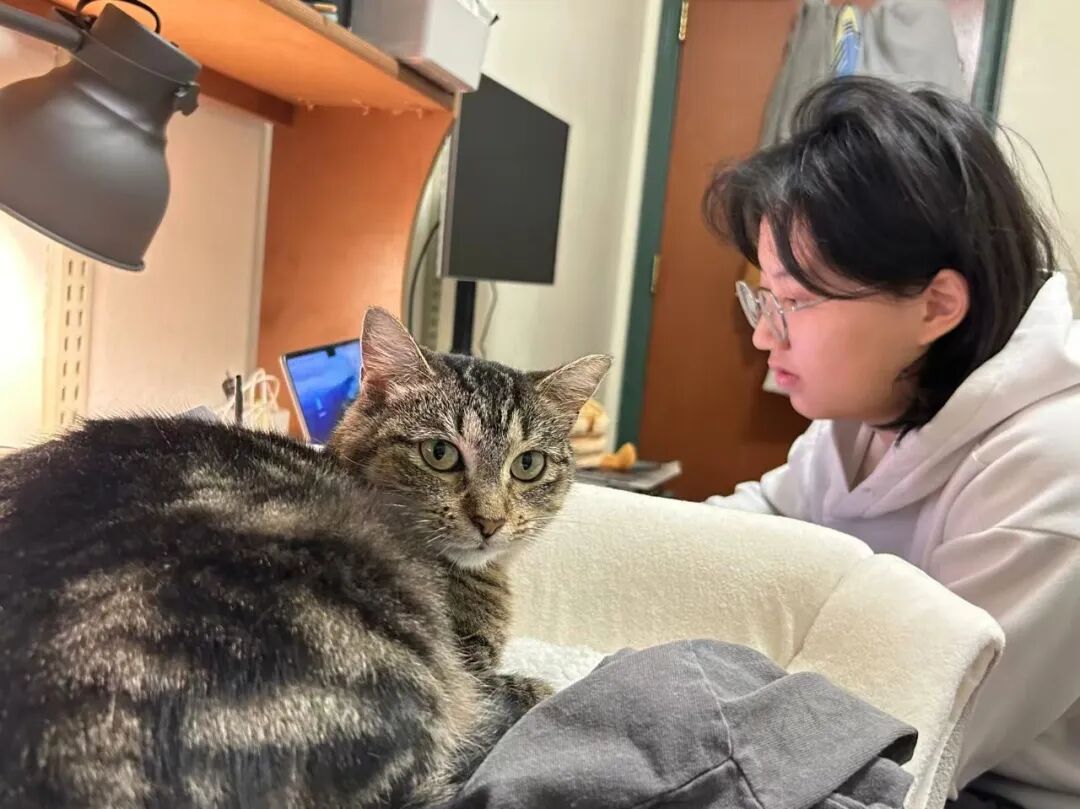
A photo from Hyperknow's entrepreneurial journey
Q: What's your ultimate vision for the future?
Ruohan Jiang: From elementary school through college, the current education system typically takes 16 years. But we've found that acquiring the knowledge you actually need doesn't necessarily take that long.
Since starting college, sometimes entrepreneurship gets exhausting — staying up late, not having much energy for classes the next day. I'd spend finals week learning the entire semester's material my own way, and my grades turned out fine.
This made me realize: it's not that the knowledge itself is too difficult, or that understanding it inherently requires so much time. For a long stretch, we're mostly adapting to the rules of a system. But exams and assignments — these rules don't necessarily suit every individual's learning rhythm.
We hope Hyperknow can make self-directed learning better in the future. A process that originally might have taken 16 years could, with Hyperknow's help, perhaps be accomplished in three to five.
Q: What do you hope to deliver to users in the coming year?
Ruohan Jiang: We want to fully realize our current product vision and bring it to market before this semester ends. We also hope to build real presence on campuses in North America and China. One day you're walking across campus and overhear a classmate saying, "I'm using Hyperknow, and it helped me with..."
Q: What's your superpower?
Yilin Zhao: I'm pretty impatient by nature. I might take after my grandmother. She had an intense grip on time — if I had to be up at 6:30, she'd wake me at 6:20, and breakfast was ready by 6:10.
I'm probably the team's grandmother, pushing the overall pace forward. Ruohan sometimes leans toward delivering things with high quality and steady rhythm. But I'm more likely to say, can we go a bit faster? Don't sleep tonight, let's just get this done?
Ruohan Jiang: Which is why I mainly do frontend and he does backend.
Q: What do you want users to search for when they think of Hyperknow?
Ruohan Jiang: We want it to be any concept at all.
Right now if you search a concept, you might get a PowerPoint, a webpage. In the future, we want there to be a Hyperknow entry. It's as clear as a PowerPoint, more accessible than Wikipedia, yet retains sufficient professional depth — and it's highly personalized.
So not Ask Google, not Ask Wikipedia — Ask Hyperknow.
Q: Are you currently hiring?
Ruohan Jiang: We're mainly recruiting frontend and backend technical talent, and we also welcome people with ideas for marketing and operations. We want you to proactively spot gaps in a product or market and think about how to fill them, rather than passively completing assigned tasks. If you'd like to reach out, you can leave a message through ZhenFund's platform or email us directly at contact@hyperknow.io
Q: Are agency and curiosity innate abilities?
Yilin Zhao: I think agency comes from a kind of "growth outside the structure."
You don't just do tasks others assign you — you're willing to come up with an idea yourself and make it happen. From elementary through high school, I always had side projects that others might have seen as a waste of time, but they meant a lot to me and brought me real joy.
You worry — what if family doesn't support it? What if it doesn't work out? But I later realized success or failure matters less. Even failing is itself a form of learning.
Many truly creative outcomes don't come from assigned tasks. They come from someone actively saying, "Nobody asked me to do this, but I just find it interesting."
I often think of that little owl from Duolingo. This definitely wasn't the CEO saying, "Design me a green owl, and make it sick with a runny nose." It must have come from a creator's sustained thinking and intuition — constantly mulling it over, then one day a flash of insight: "This feels right."
We're all still young. Much of what we're saying today may not look entirely correct in ten years. But that uncertainty itself constantly reminds us to stay more open, more willing to learn.
This kind of exploration outside the structure takes courage in itself.

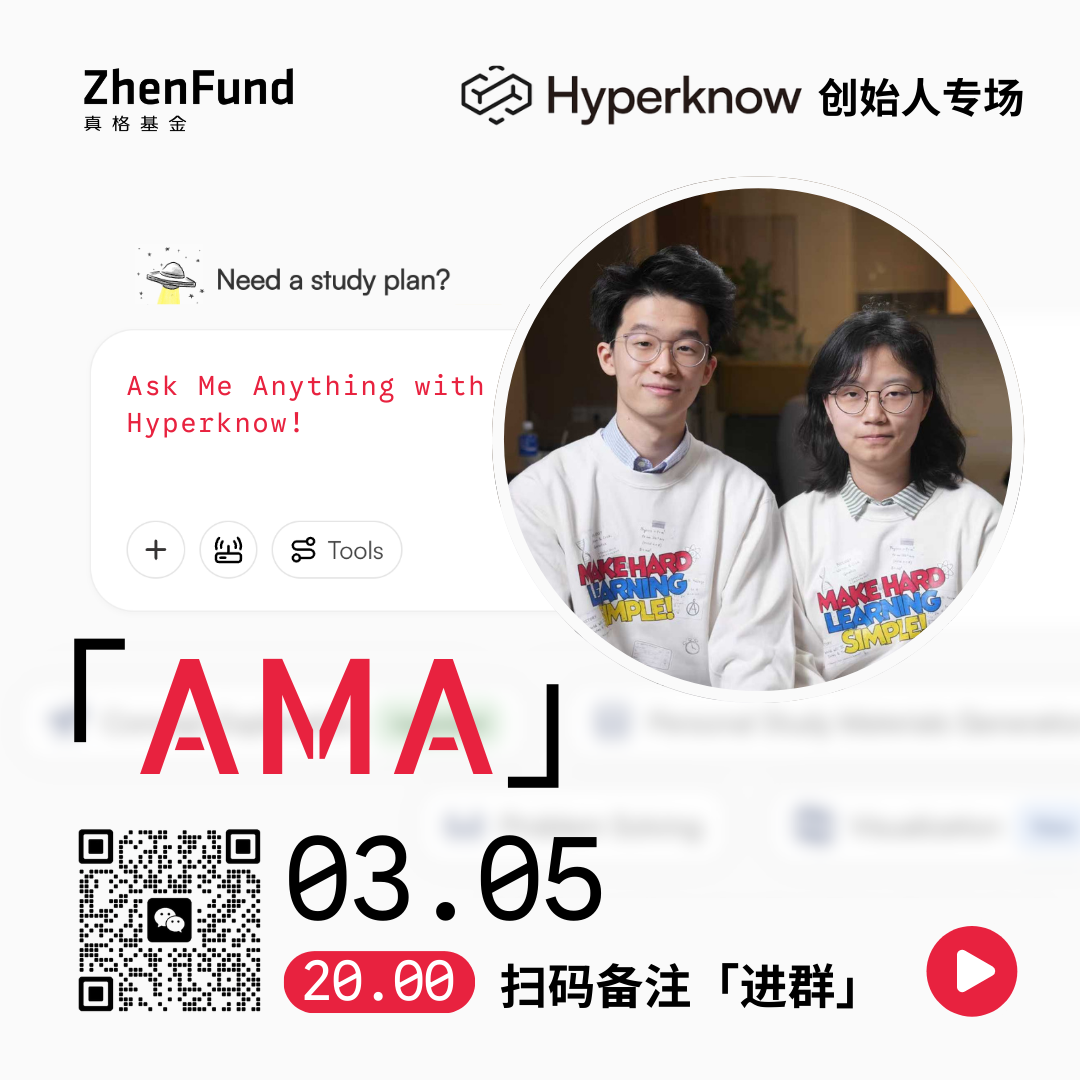
Want to share your thoughts? Hear the founders tell the real stories behind it all? ZhenFund will host its inaugural AMA in the "This Is True" podcast community, featuring Hyperknow founders Yilin Zhao and Ruohan Jiang. Scan the QR code to add the ZhenFund assistant, note "join group," and see you Thursday.
Text | Cindy Video | Cindy, Menmen, Nuohan, Coco