A Conversation with Wang Yi, CEO of Butter Elephant: Three National No. 1s in Five Years, Champion Breakfasts Crafted for Kids — How Butter Elephant Is Reshaping Breakfast Habits

For every 10 frozen scallion pancakes sold online, four are from Little Yellow Elephant.
Wang Yi, founder and CEO of Xiao Huang Xiang (Little Yellow Elephant), carries two distinct kinds of "muscle memory." One comes from over a decade of grinding through serial entrepreneurship in the food industry. The other comes from leading Huazhong University of Science and Technology's first-ever CUBA men's basketball team to the national Final Four. These two memories shaped both Xiao Huang Xiang and the man himself.
Five years ago, Wang Yi founded Xiao Huang Xiang, landing an angel investment from ZhenFund with just a PowerPoint deck. The story he told Yuan Liu was simple: a father who wanted to make a healthy breakfast for his child.
From a single cereal product to selling over 100 million scallion pancakes a year, Xiao Huang Xiang has hit the accelerator. Since launching products in 2021, the company has maintained annual growth of 200-300%, with a GMV target of breaking one billion RMB this year.
Behind this sustained growth is a team with "athlete DNA." At Xiao Huang Xiang, daily fitness check-ins are mandatory — even the boss pays fines when he forgets. Wang Yi always says, "At the end of the day, entrepreneurship is a physical contest." The ups and downs along the way? To him, they're just "scrapes short of life and death." Whenever he feels stuck or uncertain, he plays a game of basketball, works up a sweat, and the problems tend to sort themselves out.
June 1st marks Xiao Huang Xiang's fifth anniversary. We invited Wang Yi and Yuan Liu to sit down together — to talk about the company's past five years, and the next five ahead.

From Eating Bitterness to Eating Well: A Father's Reunderstanding of Growth
Yuan Liu: Our first meeting was in late October 2020 — nearly five years ago now. Many listeners might be meeting you for the first time. Want to introduce yourself and Xiao Huang Xiang?
Wang Yi: Hi everyone, I'm Wang Yi, founder and CEO of Xiao Huang Xiang. In college I was a professional basketball player — competed in CUBA and the Universiade, won a national championship.
Basketball training taught me that good health comes from what you eat. People grow through cycles of breakdown and repair. Entrepreneurship works the same way — constant setbacks, constant reflection, constant growth — and nutrition is the foundation of everything.
Now Chinese families are moving faster and faster. Young parents need to take care of themselves in the morning, take care of their kids, and prepare a breakfast that can sustain four hours of learning — it has to taste good, be nutritious, and be fast. Xiao Huang Xiang was born to solve this pain point. I remember we had just made a sample product, went to you with a PowerPoint, and ZhenFund became our lead angel investor. Really grateful for that.
Yuan Liu: You studied economics as an undergrad, but then entered the food industry and found your mission — that's actually a pretty winding road.
Wang Yi: Athletes of my generation trained by the "three froms and one big" principle — from height, from strength, from strictness. Eat bitterness to become human above humans. I thought I could endure hardship as a kid, then realized Chinese people are pretty good at enduring hardship — but hardship doesn't necessarily produce results.
Yuan Liu: Without scale, there's no 10x scale, right? Ten times the bitterness doesn't necessarily bring ten times the good.
Wang Yi: Exactly. I later realized that recovery after training matters more than training itself. But by the time I understood this, I was already badly injured, lying in a hospital bed.
Later when the internet took off, people gradually learned that you can't improve just by grinding — you can't eat a bowl of rice noodles for breakfast. Without adequate nutrition, all that training is just burning the candle at both ends. Athletes have critical growth windows too. If a child doesn't learn to speak before age five, they may never speak well; if they don't get enough energy during development, they may never reach their physical potential.
I personally benefited from many sports brands. Growing up watching the Dream Team, watching Jordan — when I played CUBA, FILA even sponsored me. I felt firsthand how a once-glorious Italian brand was revived by a Chinese company. That planted an idea in my mind: someday I would build a Chinese brand related to food.
After college, I gave up grad school and joined an excellent company, starting food from zero. This year marks my 20th in the industry.
In recent years, Ronaldo's nutrition plate, LeBron spending a million dollars a year on ingredients, Curry's breakfast club — these have helped more young people understand nutrition's role. Many people, like me, have become fathers, hoping their children can eat healthier and grow stronger within the limits of their natural gifts.
What I'm good at is making healthy things taste good. China's supply chain is so strong, yet food brands trying to go global keep getting stuck on food safety and health perception. I believe Chinese flavors plus modern nutrition concepts can absolutely produce great products, making our breakfast tables more abundant.
Yuan Liu: Your son must be quite a persuasive little spokesperson now? Does he eat Xiao Huang Xiang regularly?
Wang Yi: He's 1.98 meters now — I have to look up at him. He's become quite particular about food. His daily diet emphasizes dietary fiber, protein, fast and slow carb combinations. He eats deep-sea fish for fats, tries to eat several colors daily, and doesn't repeat weekly. Especially when training gets hard, he feels like he needs to eat properly to recover.

Wang Yi with his son, who is chasing his own basketball dreams
Yuan Liu: The kid's grown a lot, and so has Xiao Huang Xiang. How are things lately? Five years is a moment for good news?
Wang Yi: Thanks to ZhenFund and the team for their support. We're now number one in most of our categories. For example, with our butter scallion pancakes, four out of every ten sold online are Xiao Huang Xiang.
Others sell pancakes for one RMB, we sell for three. I called us an extreme value-for-money brand, and you asked how I could say that with a straight face. I said the ingredient costs are right there — the math is clear.
This year we're basically paying over 10 million RMB in taxes per quarter, and for the full year we expect to exceed 50 million. A company that started from a PowerPoint now employs several hundred people, serves three to four million families, and contributes tax revenue to the country.
Since our 2021 launch, we've maintained 200-300% annual growth, and this year is no exception. We're still growing nearly 300% year-over-year. The target is to reach over one billion RMB in GMV this year, serve 6 million families, and keep moving toward our goal of serving 100 million families.

No More SKU Stacking: Xiao Huang Xiang Reshapes Breakfast Categories with "Scene Thinking"
Yuan Liu: Xiao Huang Xiang has been focused on breakfast from day one. You started with cereal and later became number one in that category too. How did Xiao Huang Xiang navigate category exploration step by step?
Wang Yi: I've always believed that so-called "categories" are shelf logic formed over decades in physical supermarkets — a classification system embedded in people's minds. Whether investors, industry professionals, or even consumers, when retrieving products people often unconsciously follow this "grains and oils section," "fresh produce section" kind of thinking.
Yuan Liu: This is an outdated logic?
Wang Yi: Xiao Huang Xiang doesn't see it this way. When users have material abundance and shopping becomes increasingly convenient, thinking shifts from "category thinking" to "scene thinking." People no longer follow shelves; they search actively based on their needs. And the internet, fundamentally, is built on search.
So when we expand products internally, we never let category boundaries constrain us. Others ask us: you're number one in cereal, why are you doing frozen foods now? The logic is actually very clear — we're always solving needs within the "breakfast" scene.
The essence of breakfast is tight time, heavy responsibility. For many parents, there's also an unspoken requirement: "no repeats." Kids get bored easily — adults too, actually.
Of course adults can make do, but kids can't. If it doesn't taste good, they won't eat. And if they don't eat, where do four hours of nutrition and energy at school come from?
Yuan Liu: Then why, among so many breakfast options, did scallion pancakes become the breakout hit?
Wang Yi: If you look at our quarterly reports now, chicken cutlets are also near the top, and we have new products every quarter. Many people ask me: why does every product you make become a hit? What's the logic behind it?
I think when people say "hit product," their first reaction might be high GMV, large market share. But these are because we've already accumulated a large base of loyal users. Scallion pancake users, for example, are largely people who got tired of cereal. They needed a "wrapping vehicle" that kids could eat on the way to school.
We wanted to do wraps from the start — wrapping vegetables, for instance. But our current fulfillment capabilities, brand strength, and cold chain aren't there yet, so we shelved it temporarily. But we knew parents genuinely want fresh vegetables and quality protein in breakfast, and these do need to be "wrapped" to eat.
So what can wrap things? Mexico has tacos, Italy has piadina, China has flatbreads. Flatbreads wrap everything.
We ultimately decided on scallion pancakes, but needed to solve three problems: tasty, safe, healthy.
First, tasty. Many pancakes cut costs with low-quality oil. But parents actually care a lot about fats, so we led with "zero trans fatty acids." It's not that kids can't have any trans fats at all, but we needed to tell parents we're not using recycled oil — we're using the best fats available.
We use butter. Dairy itself is a nutrient source that Chinese people under-consume, and many are lactose intolerant, so milk isn't suitable. But butter can supplement fat-soluble nutrients like vitamin D. And Chinese kids don't get much sun, often confined to classrooms, so these supplements matter even more.
This is actually a Chinese-Western fusion product. We use New Zealand butter from the Southern Hemisphere plus wheat from the Northern Hemisphere to make a tasty, safe scallion pancake. By then users already trusted us, and some of our cereal customers migrated over. Plus there happened to be some oil safety incidents in the market that actually helped us.
Yuan Liu: Where does product inspiration come from? Do you get a lot of inspiration traveling and studying around the world?
Wang Yi: Every product has a story behind it. For example, our black highland barley scallion pancake came from a detail I noticed while watching the English Channel crossing competition. Athletes facing cold, turbulent waters need to withstand low temperatures and sustain energy for several hours, without eating too much.
This is very similar to what Chinese kids need in the morning: just waking up to face four or five hours of intense mental activity, plus running laps. Too much food is uncomfortable, too little won't sustain them. What can achieve this? The crossing athletes eat black highland barley with butter.
Yuan Liu: You've always emphasized ingredient quality, but tasty and healthy are often in tension. How do you achieve both?
Wang Yi: Health and taste aren't at odds. It's just that healthy food used to be defined by Western athletic diets. Salads taste bland? Maybe they just haven't met a good Chinese cold-dressing sauce. With the seasoning and cooking techniques we're good at, even those "white people meals" on Xiaohongshu can be delicious.
Yuan Liu: Any new categories you're researching or about to launch?
Wang Yi: Yes, we just launched a xiaolongbao made with black pork from our fully traceable, antibiotic-free supply chain. Steamed items are very consistent in timing and technique, so we'll do more of those.
Then there's congee. Many people still cook plain white rice porridge, but its glycemic index is actually extremely high — it spikes blood sugar faster than drinking sugar water. Multigrain congee is too much trouble to make at home. So our previous baby pumpkin congee was very popular. We just have limited R&D capacity, so its siblings haven't had their turn yet.
Actually, there are many great ingredients in China and globally that can be developed along the directions of low GI, stable blood sugar, and rich nutrition.
We also talked about cheese before. The product manager who worked on our butter shaobing was originally from our cheese team. Though the cheese project didn't work out, it made us realize: without endgame capabilities, it's hard to quickly enter a mature, competitive market where leading players have already accumulated advantages.
Yuan Liu: In recent years everyone's talking about consumption downgrading, about making things cheaper. But you're going the opposite direction: taking things that were originally cheap and making them better.
Wang Yi: We have an unwritten internal consensus: products should be good enough that you'd feed them to your own children. Don't cite national standards or world standards — ask whether you'd let your own kid eat this. Our employees' kids all eat our products; some even model for us.
Yuan Liu: What's the kids' favorite product?
Wang Yi: The kids are very familiar with our products. The shaobing is like an "ingredient base" for them — they'll add their own chicken cutlets, eggs, things like that. Very creative.
Our sausages were also very popular before, but we proactively discontinued them because we couldn't achieve fully antibiotic-free pork for that batch. Even though that product line was generating several million RMB in GMV monthly with profit, we felt it wasn't safe enough — we wouldn't feed it to our own children. Once we get the antibiotic-free pork supply chain ready, we'll bring it back. The good thing about consumer products is that as long as you're iterating, you don't have to rush to be everything on day one.
Yuan Liu: The first time we met, you told me the origin of the Xiaohuangxiang name. You said "xiao" represents children, "huang" is a national feeling, and "xiang" symbolizes health, strength, and gentleness.
Wang Yi: The first step in choosing this name was of course figuring out how to make a brand survive. Human memory for animals is the strongest, and "xiang" is an animal — an auspicious one. We're making food for Chinese families, so having an auspicious image is inherently good.
For colors, red, yellow, and blue are the easiest for people to remember. We're yellow people; "huang" is a very stable memory anchor. And "xiao" tells everyone we're making food for children. For communication efficiency and brand recognition, this combination lets users remember us without effort. People's lives are already hard enough — remembering a health brand shouldn't cost them more mental energy.
Of course there's some personal sentiment too. We eat food grown on yellow earth. I'm from Henan; Henan's abbreviation is "Yu," which has "wo" (I) and an elephant in the character. And the elephant also represents what we hope children grow into: strong, gentle, powerful, not easily bullying others but not easily bullied either.
Another inspiration actually came from the Shang Dynasty tomb of Fu Hao. Fu Hao was a female general who campaigned all the way to Persia, and her seal for commanding the world was a small yellow elephant.

Because You Believe, You See: How Five Years of Brand Building Changed Everything
Yuan Liu: You've actually been an entrepreneur far longer than five years — it's just the brand-building that's been five years. You'd already founded companies for many years before this. As a founder, what's been your biggest change during these years?
Wang Yi: These five years have made me more grateful. I used to have a quick temper; now I've learned to see things more calmly. And because of entrepreneurship, I've had more topics to talk about with my children.
But building a brand is completely different from before. Previously I was doing B2B, where the core was supply chain — as long as clients were satisfied, there was revenue. Chinese people are naturally good at this; for example, many global chip giants now have Chinese CEOs, and that's no coincidence. But with B2C brands, you have to build user mindshare — this is much harder than cracking B2B.
You have to make users understand "what is a healthy breakfast," get them to try and repurchase, while simultaneously building out the supply chain. From raising chickens, central kitchens, and dim sum factories, to channel construction, team building, and brand expression — none of it is easy.
Only in these past five years did I truly feel the weight of the word "entrepreneurship." Honestly, the previous decade-plus was just running factories, doing some business.
Yuan Liu: When we first met, although this was your first time building a brand, you'd already served many international big names. Many were long-established brands with extremely strict quality standards. Though you were doing B2B services, helping them control food safety and quality, you were already benchmarking against the highest standards.
Wang Yi: Yes. I already had many product ideas then, and wanted to communicate with these international brands, but cross-cultural exchange really isn't easy.
Yuan Liu: Any memorable examples?
Wang Yi: For instance, we once supplied powdered sugar to an international brand. I repeatedly explained to their R&D team that Chinese acceptance of sweetness is very low — "lightly sweet" is enough. But the final product was still cloyingly sweet. This also explains why a Korean brand later did so well in China with its sugar-free, tooth-friendly gum. There are many such examples.
I've always believed there are opportunities for new brands in ingredient selection and innovation. International brands have mature systems but limited room for innovation. We have the chance to make breakthroughs with fresh thinking.
Yuan Liu: After starting your own brand, have you encountered problems you'd never faced before?
Wang Yi: Many challenges. Previously serving big brands, they had money, their payment terms could be discounted, risks were low. But doing your own brand, you have to carry many things yourself.
There was a period when we'd received part of our investment, but the rest hadn't arrived, and cash flow was extremely tight. In the end, the team pooled their own money to build the Changsha factory. So on the day the Changsha factory opened, when you specially flew over, we were truly grateful.
Less than three years after launching products, we had our own factory, and it was at full capacity from day one — expanding from 4 lines to 6 lines, running three shifts at full load. It wasn't easy.
Yuan Liu: You mentioned that operational complexity will only keep increasing. But it should be more familiar to you, given you managed factories for over a decade — you know the processes and details well, right?
Wang Yi: Right, the more automated things get, the more you see the value of "people." Especially for good taste — no matter how smart the machine, it can't judge texture and aroma. This human-controlled part can't be cut.
China has many excellent food enterprises with capacity, OEM capability, and export ability, but they're not good at building brands. We hope to cooperate with these companies, for example through joint ventures where Xiaohuangxiang holds controlling stake. They have stable teams, skilled workers, and mature management; we contribute brand, product innovation, and sales, solving their problem of "daring not to use good ingredients, afraid they won't sell."
Yuan Liu: Any non-consensus decisions? For example, on whether to build your own factory — some might think it's too heavy, while others see it as key to building moats.
Wang Yi: Building the factory was definitely a major decision. The market was cold, capital was retreating, but we still decided to build it — and built it with the team's own money.
We've always believed: believe, and then you shall see.
There were also times when people were poached, when team members left to start their own thing. But I've always felt that organizational growth matters most. Without a healthy organization and culture, you can't sustainably produce good products. Building the factory was another process of organizational cohesion.
I personally never hesitated; I always had confidence. You know, entrepreneurs are somewhat blindly optimistic, otherwise they wouldn't do such "foolish" things. But what moved me was that the team shared this belief and carried it through together.
Another non-consensus decision was sponsoring youth sports teams instead of investing in celebrity livestreams. Many people didn't understand — if you have money, why not go for big exposure? But we insisted on not doing it. We've consistently sponsored youth basketball teams, ice hockey teams, and programs like that.
Yuan Liu: Sponsoring athletes seems like a choice between commercial sponsorship and philanthropy — quite special.
Wang Yi: Yes, we've always had a team sports culture, and we believe in the long-term health value of sports for children.
And we want our words and actions to be consistent, advocating a lifestyle of healthy eating and healthy exercise. Users want to see children who are sunny and healthy, and eating well is the foundation.
For example, the youth ice hockey team we sponsor has very good results. Ice hockey is highly confrontational and requires team coordination — in popular perception, yellow people aren't good at these things. But these kids play very well, with solid training.
We can't only say "1.4 billion people can't pick 11" every time the national football team loses. We should support, encourage, and invest from childhood. We've just done what we can within our capacity.
Yuan Liu: The team is also worth discussing. You started from zero and got to today — how did these people come together? Many team members are your longtime friends, and some even live in your house.
Wang Yi: Entrepreneurship is hard; what I'm most grateful for is my family and my partners' families. Wanting to build a global brand is a huge challenge.
At that time many of us directly moved to the United States. I remember when Xiao Xin first arrived in the US, he stayed at my place. Soon after, the pandemic hit, and everyone was trapped together, discussing products and direction every day. It's hard to imagine — a group of men in their thirties and forties, trying to do something, still living crammed together like a student dorm.
But this group of people is really reliable. Like our Chief Brand Officer Liu Qun, who previously built a top-tier public account, worked on cases for top real estate and dairy brands, and still lives at my place.
We trust each other. Early hiring was actually quite difficult — the brand had no reputation, and many excellent people wouldn't even look at us. But we did everything we could, asked friends, sought out seniors, cashed in decades of personal connections, just to find a few people willing to believe and willing to work together.
Entrepreneurship is a total explosion of your lifetime network.

Going Global: How Xiaohuangxiang Plans to Build a US Factory
Yuan Liu: I heard you're already preparing to build a Xiaohuangxiang factory in the US. Recently we've indeed seen many brands going overseas, everyone trying things out. But directly building a factory in the US like you are — there don't seem to be many doing that. How are you thinking about this?
Wang Yi: This month-plus in the US has given me new understanding of global supply chains, the American consumer market, and overseas opportunities.
The Chinese consumer market is growing. But trying to move the entire supply chain to the US and operate outside the global system — that's practically impossible. We all know Berkshire Hathaway started as a textile company, but could you really make it go back to textiles today?
I noticed the inflation as soon as I arrived in the US. Many places are undersupplied, yet consumer spending remains strong. America should focus on what it's good at — sports, culture, soft power. NBA broadcast rights are still worth serious money in China. Eighty percent of US GDP comes from the tertiary sector; agriculture and manufacturing aren't major components. But its tolerance for innovation, its embrace of diverse cultures — that's what makes it a country where every niche market is a massive market.
Coming to America, I don't need to educate the market. They already have a health consciousness. They're even willing to pay 40% more for organic products at places like Whole Foods. So the requirement for brands becomes singular: stable supply.
This happens to be exactly what I learned from my OEM days. Supplying Nestlé, Mars, KFC, McDonald's — stability was everything. So when I started talking to North American supply chain partners, that was their first question.
Yuan Liu: Even with China's sophisticated supply chain system, many domestic brands never chose to go overseas, especially in food, where localization is so critical. Why do you think that is?
Wang Yi: The number one leader didn't come. If you just send professional managers overseas, it often doesn't work.
Japan and Korea did it differently. When they entered the US market, the founders typically came personally. The number one has to adopt a restart-up mindset. Going overseas, you'll hit legal pitfalls, hiring pitfalls, production pitfalls — every single pit, you have to step into yourself, and you have to be able to climb out fast.
A brand going overseas is really a culture going overseas. Chinese food culture has global appeal at its core, but consumers often have question marks about food safety. So we build to quality standards far above US testing requirements. Only then does a brand have a real shot at going global.
Yuan Liu: And your products overseas will be somewhat different, right?
Wang Yi: We'll make adjustments. Every product gets flavor-tuned, but product innovation has always been our strength. Succeeding in the US market can also feed back into China. For instance, cheese and butter prices are rising domestically now — even McDonald's has switched to vegetable oil.
If you want to build a truly great consumer brand, you can't avoid globalization. Whether it's P&G, Nestlé, or Coca-Cola — they all operate globally. It's only a matter of time.
Today we happen to see an opportunity: the US has short-term supply shortages but stable demand. Consumers already buy into the healthy food concept. You just make it delicious, no need to explain much, and there's a market. Validation here will also make Chinese consumers trust Xiaohuangxiang more.
Better to advance in one thought than to pause in one thought.
Yuan Liu: You mentioned wanting to build a global brand. What are you thinking for the next five years?
Wang Yi: In the next five years, I hope Xiaohuangxiang becomes a true global brand. At minimum, stable market presence in North America. We're also expanding in Asian countries like Japan.
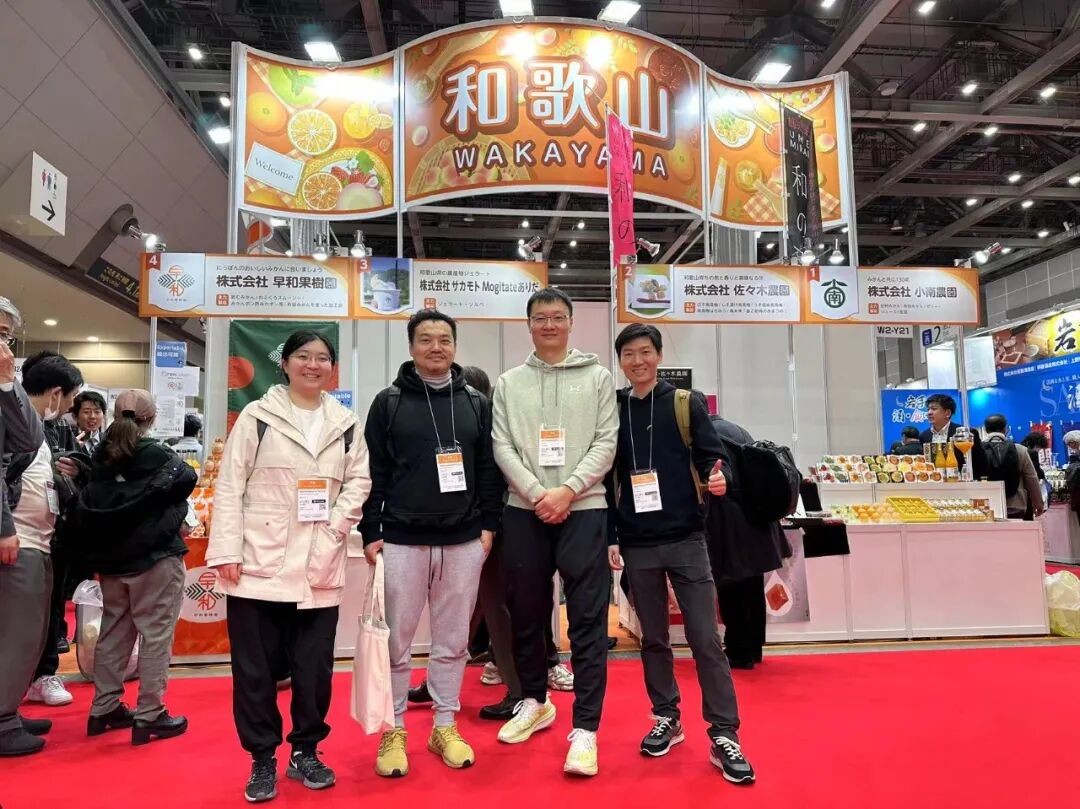
Wang Yi (second from right) and his team make a point of traveling to Tokyo every year to attend FOODEX JAPAN and learn
The health concepts here in the US evolve fast, feedback is immediate — that helps us make better products and feed improvements back to China. And Chinese food culture is globally recognized for its taste. We hope more companies go out and bring Chinese flavors to the world.
Our unchanged founding mission is to accompany the next generation's growth with healthy food. In the coming five years, we hope to have the opportunity to serve children globally.
Yuan Liu: Will you go to Europe?
Wang Yi: We're considering it.
Yuan Liu: People used to say overseas regulation is strict, but you've always been quite confident, right? Because your quality standards were already far above requirements.
Wang Yi: Right, we were already operating above standard. So strict regulation actually works in our favor. It keeps many unprepared competitors out.
Yuan Liu: You'll also be building factories in the US?
Wang Yi: Yes, and we're not ruling out acquiring local facilities either.
Yuan Liu: So this overseas expansion — will it be another round of localization challenges? Operations, team, product, probably figuring everything out from scratch again?
Wang Yi: Yes, we'll have to go through all of that sooner or later. But if now is a good window, I'd rather test early and stumble early. After all, failing early is always better than failing late.
Like in tech — though we're in breakfast, our self-imposed quality standards are far above any country's regulatory requirements. Talking straight business can itself become a form of connection. The ideal state would be like the Olympics, halting conflict. If the Ming Dynasty and the Later Jin had opened trade earlier, perhaps many later problems wouldn't have happened.

Drawing on Historical Military Strategy to Build a High-Energy Startup Team
Yuan Liu: You've always liked finding inspiration in history, right? I remember you said that after your previous startup, you took some time off and spent it reading — a lot of history.
Wang Yi: I love history. At its core, entrepreneurship is business warfare, and business warfare is very much like military strategy. A lot of strategy comes down to "seeking victory from the momentum, not blaming individuals."
Once you re-enter the arena, reading history feels visceral — many scenes seem to unfold before your eyes. How did they build organizations back then? In difficult circumstances, how did they recruit teams and lead people into battle? Many things, if you haven't seen them yourself, you wouldn't even believe.
At one annual meeting, I gave the team an example: we're small now, like when Nurhaci raised his army with just thirteen suits of armor. If someone had told him that the Great Ming, with its four hundred million people, would one day become his territory, that the Yin Mountains would become a scenic spot within his borders, that regions like Tibet and Xinjiang — which the Song Dynasty didn't dare touch — would fall under his control, who would have believed it?
The rise and fall of many organizations — the details are all written in history books.
Yuan Liu: So you found a lot of help for organization-building from history.
Wang Yi: Yes, many ideas from military texts I later came to understand through basketball. For example, when promoting people — do you elevate the strongest performer, the most aggressive in business, or the strongest manager? In basketball there's "locker room culture." The team leader isn't necessarily the scoring champion; it's the person with the most leadership.
So leadership in an organization is essentially a form of service — achieving yourself by enabling others. Xiaohuangxiang's core members number maybe sixty-something, but they're the spark of our culture, the template for what the organization will become.
As organizations scale, many entrepreneurs can't avoid the "entropy increase" phenomenon — instead of developing talent internally, they acquire people through M&A. Many large American companies lose their innovative edge and end up buying external teams.
But we're building a new team-sports culture internally. The structure is very flat; everyone's contribution is visible. Trial and error is encouraged. Like in war, "the best fighters have no glorious achievements." Every battle we fight is prepared, paced — waged according to Sun Tzu's concept of "calculation." So every new product launch, we run simulations, prepare, and organize internal coordination.
Yuan Liu: So you've drawn entrepreneurial inspiration from history, military texts, and sports.
Wang Yi: Yes, especially when facing strong competitors — those frameworks are particularly useful. What do you do when rivals offer your key people triple salaries to poach them? When they copy your product exactly, price lower, and are willing to lose money to undercut you? When they cut off your retreat and encircle you from all sides? These scenarios have played out repeatedly throughout history — just in different forms.
Yuan Liu: Any history books you'd especially recommend, particularly for entrepreneurs?
Wang Yi: I quite recommend The Fall of the Three Capitals (Huī Sān Dū), about the Jin Dynasty. It doesn't just chronicle its rise and fall — it writes about the fusion and conflict between north and south, nomadic and agrarian cultures.
How organizations collapse, and how they revive from the ruins — from the Jurchens to the Qing, you can see an organization climb out of a valley and grow strong again. It's very moving.
Yuan Liu: You've been talking about organization. On hiring — what do you particularly look for? Any questions you ask regularly?
Wang Yi: The first thing I check is whether they love team sports. Basketball, soccer, hockey — anything. Because they know how to fight alongside people they don't necessarily like, in order to win. These people tend to have less ego, and they're more direct and effective in communication.
I also like people with competitive spirit — the drive to win, the constant self-challenge.
In interviews I ask a few questions: Who's the most impressive person you've ever met? What's the deepest influence your parents had on you? What perspectives did your family of origin give you? And what's the thing you're most proud of? Everyone on our team has to share one thing they're proud of. I believe everyone has one side with real tension — if you live out that tension, work isn't just making a living, it becomes genuinely enjoyable.
For us, work is an extension of life. Like a team game — fighting monsters and leveling up together, falling down and winning together, accumulating small victories into big ones.
I particularly care whether someone has exercise habits, whether they're sensitive to people, whether they've seen excellent organizations and can articulate what moved them about those cultures. If they can step outside themselves and reflect, that's excellent.
Yuan Liu: Do you have a lot of athletes at your company?
Wang Yi: The sports culture is strong. We have a running group — so intense I don't dare join. At my fitness level, I'd probably be paying fines every day. There are noon workout classes, evening basketball — basically everyone's exercising together daily.
Yuan Liu: Could your son actually become a serious basketball player in the future? Can you still teach him?
Wang Yi: Now I can barely keep up with him — he's already dunking on me. To avoid getting posterized by my own son one day, I've simply started watching from the sidelines.
Yuan Liu: I find it interesting that despite how hard the entrepreneurial journey has been, family has always mattered to you. Not just your own family — you often talk about colleagues' families too.
Wang Yi: I've always felt the differences between people are quite large, yet the education we received growing up often pushes everyone toward the same mold, as if there's one template to follow. But everyone's inner self is different, and companies are the same — good companies shouldn't all look identical.
Sometimes when people talk about learning from benchmarks, they all fixate on some big company and end up looking the same. But what makes the world interesting is its many possibilities. We're just a group of people who care about Xiaohuangxiang. Every year several babies are born to team members, and everyone is genuinely happy. These are people who truly value family and have a sense of responsibility.
We often say internally: if someone doesn't even care about their own family, can't make time for friends, then how are they supposed to have the world at heart? I've never quite figured out that logic. But at least in my understanding, being responsible to family and loyal to friends — that's what our team values most.
We also place a lot of emphasis on the word "accompaniment." A child's life is their own. Our love is about support and lifting them up, not interference.

Entrepreneurship Is a Marathon, and Stamina Determines the Outcome
Yuan Liu: For young people just starting out today, do you have anything you'd want to say? Having gone from zero to one many times, what are the real pitfalls you've stumbled into and the lessons you've learned?
Wang Yi: A lot of entrepreneurs today are excellent — it's more like I should be learning from them. But if I had to offer advice, I'd still start with exercise. I've always felt that entrepreneurship is fundamentally a marathon; what you're competing on is physical stamina. Mental sharpness, emotional stability — these are actually tied to your physical condition and metabolism.
A lot of the things that weigh you down, you might stop caring about once you've sweated it out. A lot of problems suddenly don't look so serious anymore. You need a strong body to keep thinking clearly and to find joy in hardship. Someone like me, who's not particularly smart — without some physical fortitude, I would've been eliminated long ago.
So I often say: on the entrepreneurial path, keep exercising if you want to go the distance. Combine smarts with stamina, and you'll definitely walk more steadily and farther, becoming someone who achieves something truly great. As for me, I also want to use exercise as a way to keep learning from them.
Yuan Liu: You've really done quite well on this front. Your condition is almost unchanged from five years ago.
Wang Yi: If I genuinely want to build Huangxiaoxiang into a century-old company, then I myself have to practice long-termism first.
Spending years working abroad, the dietary habits and ingredient availability are actually quite different — honestly, a lot of the food is pretty hard to stomach, haha. This反而 gives me more motivation to do Huangxiaoxiang well, to see if I can build a good team overseas too, while creating complementarity with China, turning 1+1 into something greater than 2.
This is a bit like basketball. It's always five-on-five on the court, no matter how much NBA rosters change. What truly decides victory or defeat is whether the team has chemistry, whether it has a championship mentality. And these things first require me to lead with passion, to keep running.
Yuan Liu: How do you feel about ZhenFund's user experience?
Wang Yi: I'll just speak from personal experience. I've been through the hottest period of new consumer brands, and I've been through the coldest. I've even encountered investors who wanted to pull out three weeks after investing. I've seen all kinds of situations.
But I've always felt that having a shareholder like ZhenFund is lucky. On one hand, the team is genuinely smart — they often raise questions from angles you hadn't considered, and sometimes only after they ask do you realize you had a problem. This is especially important when things are going smoothly; without anyone questioning or challenging you, you can't see your blind spots. ZhenFund gives you the chance to look at yourself from behind, to reflect on yourself 360 degrees.
On the other hand, when winter comes, ZhenFund won't push you into making distorted decisions. They respect your judgment, and they understand that a founder's scarcest resources are time and energy. A lot of interference is really just wasting the time you could be spending building your team, optimizing your supply chain, or finding new opportunities. That aspect of ZhenFund gives me particular peace of mind.
Yuan Liu: One last question. From the very beginning, you said you wanted to do breakfast. So what does your ideal breakfast look like in your mind?
Wang Yi: In one sentence: the ideal breakfast is sitting down with family and friends, eating a healthy, reassuring breakfast, and starting a new day.

Video production | Cindy & Xin
Editor | Wendi